
In This Article
You’d think buying a crib or dresser for your nursery would be straightforward. You’d be wrong — and not in a minor way. Every year, Canadian families discover, sometimes tragically, that not all baby furniture sold in Canada meets the same standard of safety. Some pieces off-gas toxic VOCs (Volatile Organic Compounds) while your newborn sleeps just centimetres away. Others tip over when a curious toddler uses a drawer as a climbing step. And a surprising number of products sold through online marketplaces don’t comply with Canadian regulations at all.

Knowing how to choose safe baby furniture is genuinely one of the most important decisions you’ll make as a new parent in Canada. The good news? Once you understand what to look for — certifications, structural design, finish safety, and proper installation — the decision becomes much clearer. This guide walks you through everything, from Health Canada furniture standards to a curated list of the best options available on Amazon.ca in 2026, with honest expert commentary on who each product is right for.
A note on what “safe” actually means in the nursery context: it covers two distinct dimensions. Structural safety refers to whether the furniture can tip over, trap a limb, or collapse. Chemical safety refers to what the furniture is off-gassing into your baby’s air. A crib with gorgeous solid wood construction but a solvent-heavy finish can still fill a small nursery with formaldehyde overnight. You need both dimensions addressed — and this guide will make sure you know how to assess each one.
According to Health Canada’s baby product safety guidelines, the safest nursery is one where every piece of furniture has been carefully selected, properly assembled, and correctly positioned. Let’s make sure yours qualifies.
Quick Comparison: Top 7 Safe Baby Furniture Picks on Amazon.ca (2026)
| Product | Type | Key Certification | Price Range (CAD) | Best For |
|---|---|---|---|---|
| Babyletto Hudson 3-in-1 Convertible Crib | Crib | GREENGUARD Gold | $450–$600 | Non-toxic, modern nurseries |
| Storkcraft Beckett 3-in-1 Convertible Crib | Crib | GREENGUARD Gold | $280–$380 | Budget-conscious Canadian families |
| Graco Benton 5-in-1 Convertible Crib | Crib | GREENGUARD Gold | $350–$480 | Long-term value, grows with baby |
| DaVinci Charlie 4-in-1 Convertible Crib | Crib | GREENGUARD Gold | $300–$420 | Eco-minded parents |
| Storkcraft Horizon 6-Drawer Dresser | Dresser | GREENGUARD Gold | $280–$380 | Anti-tip, changing station setup |
| DaVinci Otto 6-Drawer Double Dresser | Dresser | GREENGUARD Gold | $380–$480 | Spacious storage, nursery anchor piece |
| Safety Innovations Heavy Duty Furniture Straps | Anti-tip straps | CSA-compatible hardware | $25–$45 | Any household with toddlers |
Table analysis: What jumps out immediately is how GREENGUARD Gold certification has become the baseline standard across reputable nursery furniture brands available in Canada. The distinction to watch is between cribs and dressers: a crib must pass strict structural regulations under Canada’s Cribs, Cradles and Bassinets Regulations (SOR/2016-152), while dressers have no equivalent mandatory standard — making your due diligence on dresser safety even more critical. The anti-tip straps entry is a deliberate reminder that even the safest dresser is only as secure as its wall anchor.
💬 Just one click — help others make better buying decisions too! 😊
✨ Don’t Miss These Exclusive Deals!
🔍 Take your nursery safety to the next level with these carefully selected products. Click on any highlighted item to check current pricing and availability on Amazon.ca. These tools will help you create a safe, healthy nursery your family will love!
Top 7 Safe Baby Furniture Picks for Canadian Families: Expert Analysis
1. Babyletto Hudson 3-in-1 Convertible Crib — Best Overall Non-Toxic Crib
The Babyletto Hudson is, frankly, the gold standard for parents who want chemical safety dialled in from day one. Built from 100% sustainably sourced New Zealand pine wood, it carries GREENGUARD Gold Certification — meaning it’s been screened for over 10,000 chemical emissions and VOCs. In practical terms, this matters enormously in the first months of your baby’s life, when newborns spend upwards of 14 hours a day in their crib. The non-toxic, lead and phthalate-safe paint finish means you’re not trading aesthetic appeal for health safety.
The Hudson’s design is refreshingly practical. Four adjustable mattress heights let you lower the sleeping surface as your baby becomes more mobile — something you’ll deeply appreciate at 2 a.m. when a lower mattress means less back strain reaching in. The included toddler bed conversion kit adds long-term value. Assembled dimensions are approximately 137 cm × 76 cm × 89 cm (54″ × 30″ × 35″), fitting most standard Canadian nursery layouts.
For Canadian buyers, the Hudson is available through Amazon.ca and several Canadian specialty baby retailers. Prime-eligible shipping is available in most provinces, though remote northern communities (Nunavut, Northwest Territories, Yukon) may face extended delivery timelines. Canadian reviewers consistently highlight ease of assembly — typically completed by two adults in under an hour — and the crib’s solid feel. One Surrey, BC reviewer described it as “Beautiful Crib! Looks beautiful and did not take long for my husband and I to assemble.”
Pros:
✅ GREENGUARD Gold Certified — one of the most rigorous chemical screening standards available
✅ 100% solid wood construction, no MDF or particleboard
✅ Converts to toddler bed, extending usable life to age 4+
Cons:
❌ Mid-to-high price point for families on a tighter budget
❌ Matching dresser sold separately, raising total nursery investment
Price range: Around $450–$600 CAD. A genuine long-term investment, especially compared to replacing cheap furniture every two years.
2. Storkcraft Beckett 3-in-1 Convertible Crib — Best Budget-Friendly Safe Crib
Storkcraft is a Canadian-headquartered company with 80+ years of nursery furniture experience, and the Beckett is their core offering for families who want solid safety credentials without breaking the bank. It carries GREENGUARD Gold Certification and is Baby Safety Alliance Verified — a secondary layer of testing many parents overlook when comparison shopping.
The practical reality for a Canadian buyer: what most people miss about the Beckett is that Storkcraft’s Canadian roots mean after-sale service and warranty support is notably easier to access than with brands serviced exclusively from US call centres. The 3-in-1 conversion (crib → toddler bed → daybed) means this piece can last until your child is 5 or 6, offering real value in CAD terms. The crib meets current Canadian Cribs, Cradles and Bassinets Regulations (SOR/2016-152), which govern structural requirements like slat spacing, mattress fit, and hardware stability.
Four adjustable mattress height positions let you adapt as your baby grows. Canadian parents in colder regions appreciate that Storkcraft’s finishes are applied using a process designed to minimize off-gassing even in the low-humidity conditions typical of Canadian winters, when dry interior air can actually concentrate VOC emissions more than in summer.
Pros:
✅ GREENGUARD Gold and Baby Safety Alliance Verified
✅ Canadian brand — warranty support accessible in Canada
✅ Competitive pricing makes it accessible to a wide range of families
Cons:
❌ Construction uses some engineered wood components alongside solid wood
❌ Fewer colour options than premium competitors
Price range: Around $280–$380 CAD — strong value proposition for safety-minded families watching their nursery budget.
3. Graco Benton 5-in-1 Convertible Crib — Best for Long-Term Value
The Graco Benton earns its place on this list through sheer versatility. A 5-in-1 convertible means this crib grows through configurations: newborn crib, toddler bed, daybed, sofa, and full-size bed headboard. If you’re setting up a nursery knowing you’ll likely use this room for a decade, the Benton is an argument for spending slightly more upfront to save significantly later.
GREENGUARD Gold Certified, the Benton is built from 100% solid wood — a specification that matters because solid wood does not emit the same formaldehyde levels as composite panels. The four adjustable mattress heights are standard on quality cribs, but what sets the Benton apart is the full-size bed headboard conversion, which eliminates the need for a separate headboard purchase when your child transitions to a big-kid bed. At Canadian pricing in the $350–$480 CAD range, this represents genuine ROI compared to buying multiple separate bed frames over 10 years.
Canadian parents have noted the assembly instructions are clear and well-illustrated — particularly helpful if you’re tackling this solo while a partner manages a newborn. Available on Amazon.ca with Prime shipping to most major Canadian urban centres.
Pros:
✅ 5-in-1 configurations offer the longest usable lifespan of any crib on this list
✅ 100% solid wood construction with GREENGUARD Gold certification
✅ Full-size bed headboard conversion eliminates future furniture purchases
Cons:
❌ Some conversion kits sold separately — factor this into total cost in CAD
❌ Larger footprint may not suit smaller nurseries in condos (common in Toronto or Vancouver)
Price range: Around $350–$480 CAD, often bundled with a Graco crib mattress on Amazon.ca for added value.
4. DaVinci Charlie 4-in-1 Convertible Crib — Best for Eco-Minded Parents
DaVinci has built its reputation on sustainable nursery furniture, and the Charlie is a prime example of what that means in practice. Made from sustainable New Zealand pine with a water-based, non-toxic finish, it’s GREENGUARD Gold Certified and made without harmful chemicals. For Canadian parents prioritizing environmental responsibility alongside safety — a growing demographic in cities like Vancouver, Victoria, and Ottawa — the Charlie hits a meaningful sweet spot.
The 4-in-1 convertibility (crib → toddler bed → daybed → full-size bed) follows the same long-term value logic as the Graco Benton above. What distinguishes DaVinci’s approach is the emphasis on water-based finishes — these dry harder and off-gas significantly less than oil-based alternatives, which is particularly relevant during the off-gassing window immediately after assembly. Assemble your Charlie at least 48–72 hours before placing your baby in the room, and give it good ventilation during that period.
Available on Amazon.ca, the Charlie typically ships free with Amazon Prime. Canadian buyers should note that DaVinci’s warranty is honoured in Canada — always verify this before purchasing any nursery furniture brand online.
Pros:
✅ Sustainable pine with water-based, low-VOC finish
✅ GREENGUARD Gold Certified with eco-responsible manufacturing ethos
✅ Clean, minimalist design suits Scandinavian-inspired nurseries popular in Canada
Cons:
❌ Toddler rail and full-size conversion kit sold separately
❌ Some Canadian reviewers report longer shipping times outside Ontario and BC
Price range: Around $300–$420 CAD. A solid mid-range investment for parents who want sustainability and safety aligned.
5. Storkcraft Horizon 6-Drawer Dresser — Best Nursery Dresser with Changing Station Potential
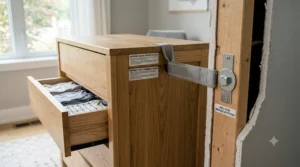
Here’s where I want to share something the spec sheet won’t tell you: the dresser is statistically one of the most dangerous pieces of furniture in a child’s room, yet it receives far less scrutiny than the crib. According to data from KidCo’s Canadian safety resources, Health Canada has found that more than 70% of tip-over injuries affecting children occur in the 1–3 age group — right when toddlers start pulling open drawers to climb. The Storkcraft Horizon is designed with this reality in mind.
GREENGUARD Gold Certified, the Horizon 6-Drawer Dresser includes wall-anchor hardware in the box — meaning Storkcraft is actually prompting you to install anti-tip protection rather than leaving it as an afterthought. In my assessment, this is a meaningful difference. The six-drawer configuration provides ample storage for Canadian nursery realities: you need room for warm sleep sacks, layered onesies for winter, blankets, and summerweight clothing all at once, because Canadian seasons demand a full wardrobe spectrum.
A flat top surface and compatible changing topper (sold separately) allow this dresser to function as a changing station, consolidating two pieces of furniture into one. For smaller Canadian nurseries — particularly condo spaces in Vancouver or Toronto where square footage costs a premium — this dual-function design is legitimately valuable.
Pros:
✅ Wall-anchor hardware included — anti-tip safety built into the purchase
✅ GREENGUARD Gold Certified, low-emission finish
✅ Compatible with Storkcraft changing topper for dual functionality
Cons:
❌ Changing topper sold separately — adds to total cost in CAD
❌ Heavier than flat-pack alternatives, which may challenge solo assembly
Price range: Around $280–$380 CAD. Good value for a certified, Canadian-ready dresser with built-in safety provisions.
6. DaVinci Otto 6-Drawer Double Dresser — Best Premium Nursery Dresser
The DaVinci Otto is the dresser you choose when you want the nursery anchor piece to feel substantial and last beyond the nursery years. A double dresser at roughly 127 cm (50″) wide, the Otto provides enough surface area to serve as an excellent changing station while offering six drawers of storage — enough to keep newborn to 3T clothing organized without cramming.
GREENGUARD Gold Certified with sustainable wood construction, the Otto uses DaVinci’s signature water-based, non-toxic finish — the same approach that distinguishes their Charlie crib. The drawer glides are smooth and operate with a soft-close mechanism, which matters more than you’d think at 3 a.m. when you’re trying not to wake a sleeping baby while grabbing a fresh onesie.
For Canadian buyers, the Otto is available on Amazon.ca and typically qualifies for free Prime shipping to major centres. At the $380–$480 CAD range, it sits at the premium end of the dresser market — but when you calculate cost-per-year over a decade of use, the number becomes much more reasonable.
Pros:
✅ Wide double-dresser format maximizes storage in a single piece
✅ GREENGUARD Gold with water-based non-toxic finish
✅ Soft-close drawer glides for quiet nighttime access
Cons:
❌ Higher price point requires upfront investment
❌ Large footprint may not suit smaller nurseries
Price range: Around $380–$480 CAD. Best for families planning to keep the dresser in use well into toddler and school years.
7. Safety Innovations Heavy Duty Furniture Straps (Anti-Tip Kit) — Best Safety Upgrade for Any Nursery
This is not a glamorous product. There are no beautiful wood grains or nursery colour palette options. But I’d argue it’s the single most important safety purchase on this list — because every dresser, bookcase, and tall cabinet in your child’s space is a tip-over risk until it’s anchored to the wall. The Safety Innovations Heavy Duty Furniture Straps are rated to withstand up to approximately 180 kg (400 lbs) of resistance, which means they’ll hold even if your determined toddler decides to climb the entire dresser.
What most parents overlook is that new furniture comes with tip devices in the box — but a significant percentage of buyers never install them, or install them incorrectly. The assembly process here takes under 10 minutes per piece of furniture, requires basic tools, and can be done by one person. For families renting (extremely common in Vancouver and Toronto, where ownership rates are lower than the national average), the straps are also removable without significant wall damage when properly installed with the included hardware.
Available on Amazon.ca, typically Prime-eligible, and inexpensive enough to outfit an entire nursery for under $50 CAD. This is not optional safety equipment — treat it as standard.
Pros:
✅ Rated to approximately 180 kg (400 lbs) resistance — genuinely heavy-duty
✅ Quick installation with included hardware
✅ Inexpensive — no reason not to use on every tall piece of furniture in the home
Cons:
❌ Requires screwing into wall — may require landlord permission in rental situations
❌ Not a substitute for choosing well-designed furniture in the first place
Price range: Around $25–$45 CAD for a multi-pack. One of the highest-value safety investments per dollar in the entire nursery.
How to Choose Safe Baby Furniture in Canada: A Room-by-Room Framework
Knowing what to buy is only part of the picture. Understanding how to evaluate any piece of baby furniture — whether it’s on Amazon.ca or at a local shop in Calgary — gives you a decision-making framework that works beyond any single product list.
Step 1: Verify Compliance with Canadian Regulations First
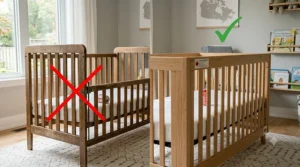
Canada’s regulatory environment for baby furniture is governed by the Canada Consumer Product Safety Act (CCPSA) and specific regulations underneath it. For cribs specifically, the Cribs, Cradles and Bassinets Regulations (SOR/2016-152) set mandatory requirements for slat spacing, mattress fit gaps, structural integrity, and labelling. Note that drop-side cribs are completely banned in Canada — it’s illegal to import, sell, or even donate them. If you’re purchasing secondhand, verify the crib model against Health Canada’s recall list.
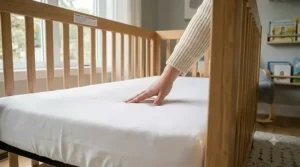
A critical Health Canada specification: the gap between a crib mattress and crib sides must be no larger than 3 centimetres, and mattress thickness cannot exceed 15 centimetres. These are not suggestions — they’re structural safety requirements designed to prevent entrapment and suffocation.
Step 2: Check for Third-Party Safety Certifications
The most meaningful certification for chemical safety is GREENGUARD Gold, which screens products for over 10,000 chemical emissions and VOCs. For structural safety, look for Baby Safety Alliance Verified status and compliance with ASTM standards (ASTM F1427 for bunk beds, ASTM F2057 for furniture stability). Health Canada recommends ASTM F2057 compliance for dresser stability even though it’s not yet mandatory under Canadian regulation — a gap that responsible manufacturers fill voluntarily.
For parents pursuing the most rigorous non-toxic standard, also look for: FSC certification (sustainably sourced wood), GOTS certification (organic materials where applicable), and water-based finish specifications.
Step 3: Assess Material Construction
The hierarchy of material safety for nursery furniture:
- Solid wood with water-based, non-toxic finish: best option
- Solid wood with oil-based, GREENGUARD Gold certified finish: excellent
- Engineered wood (MDF/plywood) with GREENGUARD Gold certified finish: acceptable
- Engineered wood without chemical certification: avoid for nursery use
What the spec sheet won’t tell you: MDF and particleboard use formaldehyde-based adhesives in manufacturing. Even products with adequate VOC certifications may off-gas more in warm, enclosed spaces — like a nursery in a well-insulated Canadian home during winter, when windows stay shut for months at a time.
Step 4: Evaluate Structural Design for Tip-Over Risk
Stand in front of any dresser and ask yourself: could my toddler pull open the bottom two drawers simultaneously and use them as ladder rungs? Because they will try. Evaluate whether the piece has: anti-tip hardware included, a low centre of gravity, wide base relative to height, and smooth-operating drawers with drawer stops that prevent complete pull-out.
Step 5: Plan Proper Assembly and Placement
Correct placement is a safety feature. Cribs should be positioned away from windows (blind cord strangulation risk — cords over 18 cm/7 inches are a hazard according to Health Canada guidelines), away from heaters, and not directly under wall-mounted shelving. Dressers must be anchored to wall studs, not just drywall — a strap anchored only in drywall will fail under the load of a tipping dresser. Use a stud finder before installation.
Step 6: Register Your Products and Check for Recalls
Register every piece of nursery furniture with the manufacturer. This ensures you receive direct notification of any recalls — and recalls in the nursery furniture category are not rare. Health Canada’s consumer product recall page is the authoritative Canadian source to check periodically.
Step 7: Don’t Forget the Mattress
The crib itself is only half the sleep safety equation. A GREENGUARD Gold certified mattress (or ideally, one with GOTS organic certification) is the next priority — because your baby’s face will be within centimetres of the mattress surface for thousands of hours. A firm, breathable mattress with no gaps to the crib sides (remember: maximum 3 cm gap per Health Canada) is non-negotiable.
Real Canadian Families, Real Nursery Scenarios: Matching Products to Your Situation
Understanding general principles is useful. Seeing them applied to situations that mirror your own makes the decision much more concrete. Here are three profiles of Canadian families and how I’d approach their nursery furniture choices.
Profile 1: Maya & James — First-Time Parents in a Downtown Toronto Condo
Maya and James are expecting their first baby in August. They live in a 750 sq. ft. condo in Liberty Village and have a dedicated 10-foot-by-10-foot nursery. Budget is $1,200–$1,500 CAD for the full nursery setup.
My recommendation: The Babyletto Hudson 3-in-1 Convertible Crib ($450–$600 CAD) pairs perfectly with the Storkcraft Horizon 6-Drawer Dresser ($280–$380 CAD), leaving room in the budget for a GREENGUARD Gold certified mattress and a set of Safety Innovations Anti-Tip Straps ($25–$45 CAD). The Horizon’s compatible changing topper eliminates the need for a standalone change table — critical when you’re working with limited square footage. The Hudson’s compact footprint and modern design suit a condo aesthetic while delivering the non-toxic credentials this safety-conscious couple prioritizes.
Canadian climate note: With no outdoor storage, Maya and James should plan to store off-season clothing in the Horizon dresser’s lower drawers — that six-drawer capacity earns its keep when you’re cycling through a full spectrum of Canadian seasons in a small space.
Profile 2: The Tremblay Family — Growing Family in Suburban Laval, Québec
The Tremblays have an 18-month-old and are expecting baby number two. They want furniture that’ll work for both children, in a 12-foot-by-14-foot nursery they’re transitioning from a toddler room. Budget is $1,500–$2,200 CAD.
My recommendation: The Graco Benton 5-in-1 Convertible Crib ($350–$480 CAD) is the right call here — because the 5-in-1 convertibility means this crib will serve the newborn for five or more years, eventually becoming a full-size bed frame when their older child graduates out of the toddler bed. The DaVinci Otto 6-Drawer Double Dresser ($380–$480 CAD) provides enough capacity to handle two children’s wardrobes in shared storage. Add a DaVinci Charlie 4-in-1 Crib ($300–$420 CAD) for the toddler who is transitioning, and both pieces share a visual language. Note: bilingual assembly instructions are legally required on products sold in Québec — all major brands on this list comply, but always verify French instructions are included.
Profile 3: Heather — Single Parent in Saskatoon, Saskatchewan
Heather is a single parent setting up a first nursery for a spring baby. Budget is tight at $600–$900 CAD total. She needs maximum safety and value, and lives in a house with high ceilings and minimal insulation — meaning significant temperature swings and dry winter air.
My recommendation: The Storkcraft Beckett 3-in-1 Convertible Crib ($280–$380 CAD) is the clear choice — Canadian brand, strong certifications, and accessible pricing. The Storkcraft Horizon 6-Drawer Dresser ($280–$380 CAD) is the natural companion, keeping the nursery within budget while sharing Storkcraft’s safety credentials. Install anti-tip straps immediately on the dresser. For Heather’s climate context: Saskatoon winters mean significant indoor heating and very low humidity, which accelerates VOC off-gassing from new furniture. I’d specifically suggest assembling all furniture 72+ hours before the baby’s arrival and ventilating the room well — open a window for 20–30 minutes per day during that initial period, even in cold weather.
Common Mistakes Canadians Make When Buying Baby Furniture (And How to Avoid Them)
Mistake 1: Trusting “Safe” Labels Without Verifying the Certifying Body
Not all certifications are equal. A label that says “non-toxic tested” or “low VOC” without specifying the standard or certifying body is marketing language, not safety verification. GREENGUARD Gold is issued by UL Environment — an independent, accredited body. Contrast this with self-declarations by manufacturers, which carry no third-party accountability. When shopping on Amazon.ca, filter for explicitly stated third-party certifications and cross-reference with the certifying body’s public database.
Mistake 2: Buying a Crib Second-Hand Without Checking for Recalls
Drop-side cribs are banned in Canada. Older cribs may have wider slat spacing, non-compliant hardware, or be subject to active recalls. A secondhand crib that looks perfect may have a structural issue that isn’t visible but has led to a recall. Always check Health Canada’s consumer recalls database before accepting or purchasing any used nursery furniture. This is not the place to save money if the alternative involves an unverified safety record.
Mistake 3: Ignoring the Canadian Winter Off-Gassing Factor
Most VOC testing is conducted at standard room temperature (approximately 23°C). In a Canadian winter, your nursery is sealed tight with heating running constantly — lower humidity and higher relative concentration of any off-gassing compounds. This doesn’t mean certified furniture becomes dangerous, but it does mean the ventilation window after assembly matters more in Canada than in milder climates. Give any new furniture at least 48–72 hours of ventilation in an unoccupied room before settling your baby in.
Mistake 4: Skipping Wall Anchoring on Dressers
I’ve mentioned this several times now, and I’ll mention it again: the anti-tip strap is the most skipped safety step in nursery setup. Statistics from Health Canada confirm that the 1–3 age group accounts for the majority of tip-over injuries. If you own a dresser taller than approximately 75 cm (30″) in any room your child can access, it needs to be anchored. Period. This includes guest room dressers when travelling — when you’re staying with family over the holidays, a child who knows how to climb furniture at home does not suddenly forget.
Mistake 5: Purchasing From Cross-Border Listings Without Verifying Canadian Compliance
Some products sold on Amazon.ca are shipped from US warehouses or third-party sellers and may comply with US CPSC standards but not Canadian CCPSA requirements. While there’s significant overlap, they are not identical. Look for listings that specifically state Canadian compliance, or purchase from known Canadian retailers. Products that display only US standard compliance (CPSC, ASTM) without Canadian regulatory confirmation carry more uncertainty for Canadian buyers.
Health Canada Furniture Standards and Canadian Certifications: What You Actually Need to Know
Canada’s regulatory framework for nursery furniture is multi-layered, and understanding it gives you a meaningful advantage when assessing products. Here is a practical summary:
Canada Consumer Product Safety Act (CCPSA): The overarching legislation that prohibits the sale of unsafe consumer products in Canada, including all baby furniture. This is the legal backbone that makes Health Canada’s specific product regulations enforceable.
Cribs, Cradles and Bassinets Regulations (SOR/2016-152): Canada’s specific mandatory standard for infant sleep products. Key requirements include: maximum 6 cm slat spacing, maximum 3 cm mattress-to-side gap, maximum 15 cm mattress thickness, no drop-side mechanisms, and specific labelling requirements including bilingual (English/French) instructions.
Surface Coating Materials Regulations (SOR/2016-193): Governs lead and other hazardous substances in paints and coatings applied to consumer products, including baby furniture. Any paint finish on nursery furniture must comply with these regulations — a non-negotiable for any product sold in Canada.
ASTM F2057 (Furniture Stability Standard): While not yet mandatory in Canada, Health Canada recommends compliance with this US standard for dresser stability. Responsible manufacturers building for the Canadian market voluntarily meet this specification.
GREENGUARD Gold: Not a Canadian standard, but currently the most credible third-party chemical emissions certification available for nursery furniture. Issued by UL Environment, it tests against more than 10,000 chemical compounds including formaldehyde, benzene, and hundreds of other VOCs. It’s the standard Health Canada points parents toward when guidance is silent on mandatory chemical testing.
CSA Group: Canada’s national standards organization. While CSA doesn’t currently publish a nursery furniture-specific standard equivalent to ASTM’s suite, their broader product safety frameworks underpin many Canadian regulatory requirements.
For comprehensive current guidance, the Health Canada baby product safety page is the authoritative Canadian source and is updated periodically.
Proper Assembly Guidelines: The Steps Most Parents Rush (And Shouldn’t)
Assembly is where even excellent furniture can become dangerous if done incorrectly. Here’s the framework I recommend for Canadian parents setting up nursery furniture:
Before you open the box:
- Read the full instruction manual before touching a single component. This sounds obvious and is almost universally ignored.
- Check the hardware bag immediately. Missing a single bolt from a crib structure is a structural safety issue, not a minor inconvenience. Contact the manufacturer before proceeding.
- Clear a large assembly space — at least 3 m × 3 m (10 ft × 10 ft) — so pieces can be laid flat without being forced into awkward angles during assembly.
During assembly:
- Never overtighten bolts on wood furniture. Stripped wood around a bolt hole compromises structural integrity and cannot be easily repaired.
- Assemble cribs with both rails fully engaged before tightening any hardware. Partial assembly while tightening creates misalignment that stresses joints over time.
- If any component doesn’t fit smoothly, stop and re-read the instructions. Forcing a component into the wrong position is how latent structural failures originate.
- Two-person assembly is strongly recommended for cribs. One person to hold components in alignment, one to tighten hardware.
After assembly:
- Perform the “wiggle test” on every joint. If any connection has noticeable play, the hardware needs to be re-tightened or the component re-examined.
- Test drawer stop mechanisms on dressers — drawers should not pull completely free of the dresser body without deliberate release of a safety mechanism.
- Install wall anchor hardware within 24 hours of completing dresser assembly — not “eventually.”
- Re-check all crib and dresser hardware after 30 days of use. Wood furniture settles, and bolts that were tight initially can loosen slightly. A 5-minute check at the one-month mark is good nursery maintenance practice.
Ventilation after assembly:
- Assemble all new furniture at least 48–72 hours before placing your baby in the room.
- Ventilate the room during this period, even in winter — 20 minutes of open window per day significantly accelerates off-gassing from new finishes and adhesives.
FAQ: How to Choose Safe Baby Furniture in Canada
❓ Does baby furniture sold on Amazon.ca automatically comply with Canadian safety regulations?
❓ What are the most important Health Canada furniture standards I need to know for a baby crib?
❓ Is GREENGUARD Gold certification recognized in Canada for nursery furniture?
❓ Do I need anti-tip furniture straps if the dresser came with wall anchor hardware?
❓ Can I safely buy second-hand baby furniture in Canada?
Conclusion: Making the Safe Choice Starts Before Your Baby Arrives
Setting up a nursery is one of the most meaningful preparations you’ll make as a new Canadian parent. But the decisions you make about furniture — which pieces to buy, how to verify their safety certifications, how to assemble them, and how to anchor them to your walls — have real consequences for the child sleeping, playing, and growing in that room.
The framework is actually simpler than it might appear from the outside: prioritize GREENGUARD Gold certified solid wood construction, verify Canadian regulatory compliance before purchase, assemble with care and patience, and anchor every tall piece to the wall. Those four principles will steer you right regardless of which specific products you ultimately choose.
The seven products on this list represent the best-available options on Amazon.ca for Canadian families in 2026 — ranging from the premium non-toxic credentials of the Babyletto Hudson to the budget-accessible safety of the Storkcraft Beckett, and the too-often-skipped but critical Safety Innovations anti-tip straps. None of them are perfect, but all of them start from a foundation of genuine safety commitment.
Your baby will spend more time in their crib in the first year than you’ll spend in your own bed. Make sure the space is worthy of that trust.
✨ Ready to Build Your Safe Nursery?
🔍 Check current pricing and availability on all recommended products directly on Amazon.ca. Every highlighted item in this guide has been selected for safety credentials, Canadian availability, and real-world value for Canadian families. Click through to find the right fit for your nursery — and don’t forget those anti-tip straps.
Recommended for You
- Best Nursery Furniture for Small Room in Canada 2026 (Top 7)
- 7 Best Nursery Furniture Sets Canada 2026 – Complete Packages
- 7 Best Grey Nursery Glider Modern Design Picks for Canada (2026)
Disclaimer: This article contains affiliate links. As an Amazon Associate, I earn from qualifying purchases. If you purchase products through these links, we may earn a small commission at no additional cost to you.
✨ Found this helpful? Share it with your friends! 💬🤗
