
In This Article
Picture this: you’re standing in the baby aisle, surrounded by dozens of car seats, each claiming to be the safest option for your little one. The overwhelming array of features, price points, and safety ratings can leave even the most prepared parent feeling confused. I’ve been there, and I understand exactly how you feel.
Canadian parents face unique considerations when choosing car seats—from meeting Transport Canada’s Motor Vehicle Safety Standards to ensuring your seat can handle our harsh winters and accommodate bulky snowsuits. The good news? I’ve done the heavy lifting for you, researching every detail to bring you the most comprehensive guide to car seats available in Canada this year.
Whether you’re preparing for your first baby, upgrading to a convertible seat, or searching for a budget-friendly option that doesn’t compromise safety, this guide covers everything you need to know. According to research from Transport Canada, properly installed car seats can reduce the risk of serious and fatal injury by 60 to 70 percent—making this one of the most important purchases you’ll ever make for your child.
Let’s dive into the best car seats available in Canada for 2026, backed by real testing data, Canadian safety standards, and honest reviews from parents just like you.
Quick Comparison Table
| Car Seat Model | Type | Age Range | Price (CAD) | Best For |
|---|---|---|---|---|
| Graco 4Ever DLX | 4-in-1 | Birth-10 years | $299-$399 | Long-term value |
| Nuna Rava | Convertible | Birth-7 years | $520-$600 | Premium safety |
| Clek Foonf | Convertible | Birth-7 years | $550-$650 | 3-across fit |
| Graco Extend2Fit | Convertible | Birth-6 years | $280-$350 | Extended legroom |
| Evenflo Revolve360 | 3-in-1 Rotating | Birth-8 years | $400-$500 | Easy access |
| Chicco KeyFit 35 | Infant | Birth-1 year | $280-$340 | Newborns |
| Diono Radian 3RX | 3-in-1 | Birth-10 years | $380-$480 | Slim design |
💬 Just one click – help others make better buying decisions too! 😊
Top 7 Best Car Seats: Expert Analysis
1. Graco 4Ever DLX – The Ultimate All-in-One Investment
The Graco 4Ever DLX represents exceptional value for Canadian families planning to use one seat from infancy through the booster years. This 4-in-1 convertible car seat transitions seamlessly through four modes: rear-facing harness (1.8-18 kg), forward-facing harness (10-29 kg), highback booster (18-45 kg), and backless booster (18-54 kg).
Key Features:
- Simply Safe Adjust harness system with 10-position headrest
- Steel-reinforced frame meeting Canadian safety standards
- 6-position recline for comfort
- InRight LATCH for easy installation
Price Range: $299-$399 CAD on Amazon.ca
Canadian parents particularly appreciate how this seat handles winter clothing. The generous harness space accommodates bulky jackets better than many competitors, though experts still recommend the coat-under-strap method for optimal safety.
✅ Pros: Excellent 10-year lifespan, no-rethread harness, dishwasher-safe cup holders
❌ Cons: Heavy (9.5 kg), bulky for smaller vehicles, non-rotating design
Customer Feedback: Ottawa-based reviewer Sarah M. notes, “This seat survived a collision and kept my daughter completely safe. Worth every penny for Canadian winters.”
2. Nuna Rava – Premium Protection Meets Luxurious Comfort
The Nuna Rava is the Mercedes-Benz of convertible car seats, combining cutting-edge safety technology with beautiful design. This 50-pound rear-facing seat allows extended rear-facing well past the Canadian Paediatric Society’s recommendations.
Key Features:
- 50-pound rear-facing capacity (highest available)
- True tension door for confident LATCH installation
- Flame-retardant-free fabrics
- Merino wool inserts (temperature-regulating)
Price Range: $520-$600 CAD
Transport Canada approved with the National Safety Mark, the Rava excels in Canadian crash testing scenarios. The 10-year expiration date means potential use across multiple children, improving cost-per-use value significantly.
✅ Pros: Industry-leading rear-facing limits, premium materials, easy installation
❌ Cons: Wide footprint (48 cm), expensive, no booster mode
Customer Feedback: Vancouver parent Jennifer L. shares, “The Merino wool keeps my son comfortable year-round—no sweaty back in summer, cozy in winter.”
3. Clek Foonf – The Canadian-Made Safety Champion
Designed and manufactured in Canada, the Clek Foonf is engineered specifically for North American vehicles and safety standards. This convertible seat features rigid-LATCH installation in forward-facing mode—extremely rare in the industry.
Key Features:
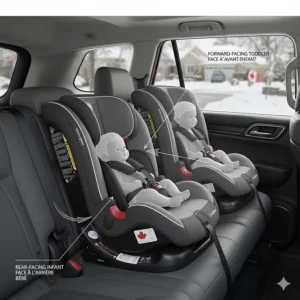
- Narrowest profile (43 cm) for 3-across installations
- Rigid lower anchors (forward-facing)
- Steel anti-rebound bar
- Crypton fabric (stain and odour-resistant)
Price Range: $550-$650 CAD
The Foonf’s Canadian heritage shines through thoughtful design elements like exceptional cold-weather durability and straightforward compliance with provincial regulations across all territories.
✅ Pros: Fits three across, Canadian-made, advanced safety features
❌ Cons: Firm padding, premium pricing, manual harness threading
Customer Feedback: Toronto dad Michael R. reports, “Perfect for our Honda Civic—we fit three Foonfs across the back seat with room to spare.”
4. Graco Extend2Fit – Extended Rear-Facing on a Budget
The Graco Extend2Fit solves a common Canadian parent complaint: toddler legs touching the vehicle seat while rear-facing. Its innovative 4-position extension panel provides extra legroom, letting children rear-face comfortably longer.
Key Features:
- Adjustable extension panel (13 cm extra legroom)
- 50-pound rear-facing capacity
- Simply Safe Adjust harness
- Fuss-free harness storage
Price Range: $280-$350 CAD
This seat represents the sweet spot between affordability and extended rear-facing capability—crucial for following Canadian Paediatric Society guidelines recommending rear-facing until at least age two.
✅ Pros: Affordable, extended rear-facing, easy harness adjustment
❌ Cons: Basic fabric quality, no rotating feature, limited recline positions
Customer Feedback: Calgary mom Amanda K. notes, “My three-year-old rear-faces comfortably thanks to the extension panel. Great value for extended rear-facing.”
5. Evenflo Revolve360 – 360-Degree Convenience for Canadian Parents
The Evenflo Revolve360 addresses a uniquely Canadian challenge: accessing car seats in cramped parking spaces during winter. The rotating mechanism lets you turn the seat toward the door, eliminating awkward reaching over snowbanks.
Key Features:
- Complete 360-degree rotation
- Integrated anti-rebound bar
- SureLATCH connectors
- Extends to booster mode
Price Range: $400-$500 CAD
While rotation adds convenience, particularly during harsh weather, verify your vehicle has adequate space. Compact sedans may find the rotation obstructed by front seats—test before purchasing if possible.
✅ Pros: Rotation convenience, anti-rebound bar, extended usability
❌ Cons: Heavy (15 kg), requires space for rotation, recent recall on Slim variant
Customer Feedback: Edmonton parent Lisa P. shares, “Game-changer for winter! No more crawling into the backseat in -30°C weather.”
6. Chicco KeyFit 35 – The Gold Standard Infant Car Seat
The Chicco KeyFit 35 dominates Canadian hospital parking lots for good reason. This infant seat combines straightforward installation, excellent crash test performance, and compatibility with virtually every stroller sold in Canada.
Key Features:
- ReclineSure leveling system
- SuperCinch LATCH tightener
- Accommodates 1.8-15.8 kg infants
- Premium EPS foam
Price Range: $280-$340 CAD
Canadian parents particularly value the bubble level indicators that ensure proper installation angle—critical for newborn safety and preventing positional asphyxia during those first crucial months.
✅ Pros: Easy installation, universal stroller compatibility, excellent for newborns
❌ Cons: Short lifespan (12 months average), requires base purchase for multiple vehicles
Customer Feedback: Montreal parent Sophie D. reports, “Easiest car seat I’ve ever installed. The level indicators removed all guesswork—essential for first-time parents.”
7. Diono Radian 3RX – Slim Profile, Maximum Versatility
The Diono Radian 3RX offers unique foldability, making it ideal for Canadian families who travel frequently or need to transport car seats on flights. This 3-in-1 seat converts through three modes while maintaining an impressively narrow profile.
Key Features:
- Folds for travel and storage
- Slim 43 cm width
- Steel frame construction
- 10-year lifespan
Price Range: $380-$480 CAD
The Radian’s slim design makes it particularly valuable for Canadian families with multiple children or smaller vehicles. However, note that Transport Canada recommends against most rear-facing tethering in Canadian vehicles, despite the manual’s Swedish-style tether instructions.
✅ Pros: Foldable design, narrow width, converts to booster, Canadian approval
❌ Cons: Firm padding, complex recline angle indicators, rear-facing tether restrictions
Customer Feedback: Halifax parent Robert M. notes, “Perfect for our family of five. We fit three Radians across our minivan’s middle row for road trips across Nova Scotia.”
Understanding Transport Canada’s Car Seat Regulations
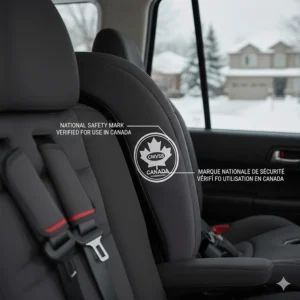
Every car seat sold legally in Canada must display the National Safety Mark—your assurance that the seat meets Canada Motor Vehicle Safety Standards (CMVSS). This small red and white sticker proves compliance with federal safety requirements and crash testing standards.
What Makes Canadian Car Seats Different?
Unlike American seats, Canadian car seats undergo specific testing protocols aligned with our unique climate and vehicle usage patterns. Transport Canada’s Motor Vehicle Safety Act requires manufacturers to certify compliance with regulations addressing frontal impact, side impact, and proper labelling.
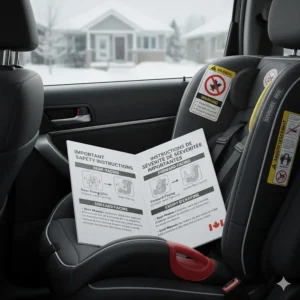
According to Transport Canada, Canadian car seats must include specific features like bilingual labelling (English and French), metric measurements for weight and height limits, and compliance with our stricter flame resistance standards.
Provincial Requirements Vary Across Canada
While Transport Canada sets federal standards, each province establishes its own usage laws. Here’s what you need to know:
Ontario: Children must use rear-facing seats until 10 kg (22 lbs), then forward-facing until 18 kg (40 lbs). Booster seats required until age 8, height 145 cm (4’9″), or weight 36 kg.
Alberta: Rear-facing required until age 2 or manufacturer’s limits. Forward-facing with harness until 18 kg (40 lbs), then booster until properly fitting in adult seatbelt.
British Columbia: Rear-facing until 1 year AND 9 kg minimum. Forward-facing until 18 kg, booster until 9 years OR 145 cm tall.
Quebec: Rear-facing until 9 kg, forward-facing until 18 kg, booster required until proper seatbelt fit achieved.
For complete provincial requirements, consult your provincial transportation ministry or visit CAA’s car seat safety resources at https://www.caa.ca/driving-safely/car-seat-safety/.
How to Choose the Right Car Seat for Your Canadian Family
Step 1: Verify the National Safety Mark
Never purchase a car seat without Transport Canada’s National Safety Mark. This certification confirms the seat meets Canadian safety standards. Be particularly cautious with online purchases from international sellers—American seats don’t automatically qualify for use in Canada, even if they appear identical.
Step 2: Determine Your Child’s Stage
Canadian car seat progression typically follows four stages based on age, weight, and height. Most children transition from infant seats around 12-18 months, use convertible seats until age 4-6, then switch to booster seats until proper seatbelt fit around age 8-12.
Step 3: Measure Your Vehicle
Canadian vehicles vary dramatically in size, from compact city cars to large SUVs needed for rural areas. Measure your backseat width and front-to-back depth before shopping. Account for winter clothing bulk—Canadian children often wear heavier layers than sizing charts suggest.
Step 4: Consider Your Climate Zone
Canadian climate zones influence car seat choice significantly. If you live in Yukon or Northwest Territories, prioritize seats with removable covers for easy washing after salt and snow exposure. Southern Ontario families might prefer temperature-regulating fabrics for humid summers and cold winters.
Step 5: Calculate Long-Term Cost
While premium seats cost more upfront, calculate cost-per-year-of-use. A $550 CAD seat lasting 10 years costs $55 annually, while a $200 seat requiring replacement every 3 years costs $67 annually. Extended rear-facing and higher weight limits maximize value.
Step 6: Test Installation in Your Vehicle
Many Canadian retailers offer installation testing before purchase. Visit certified child passenger safety technicians through provincial programs or arrange appointments at Babies “R” Us, West Coast Kids, or Snuggle Bugz locations across Canada.
Step 7: Check Expiration Dates
All Canadian car seats include expiration dates, typically 6-10 years from manufacture. Using expired seats violates Transport Canada standards and may void your insurance in collisions. Never purchase second-hand seats without verifying complete history and remaining lifespan.
Installation Tips for Canadian Winter Conditions
Dealing with Bulky Winter Clothing
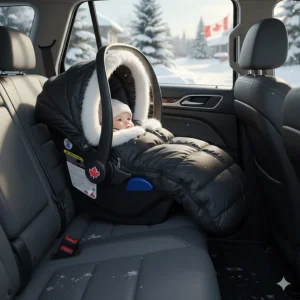
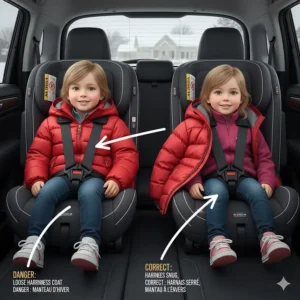
Canadian winters present unique car seat challenges. Never place children in car seats wearing bulky coats—the compression during collisions creates dangerous slack in harness straps. Instead, use the buckle-then-blanket method: buckle your child in regular clothing, then place coats backward over secured straps.
Many Canadian retailers sell specially designed car seat ponchos that cover children without interfering with harness fit. These wool or fleece covers provide warmth without compromising safety.
Preventing Frozen LATCH Connectors
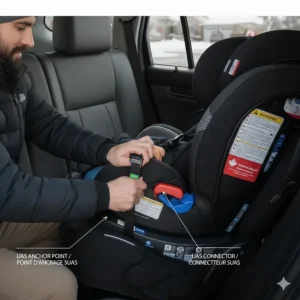
Extreme cold can freeze metal LATCH connectors, making installation difficult. Store seats in heated garages when possible, or bring portable heaters to warm vehicle interiors before installation. Keep a set of gloves specifically for car seat installation—metal connectors at -30°C cause instant frostbite on bare hands.
Managing Condensation and Moisture
Temperature fluctuations create condensation inside vehicles, potentially damaging car seat mechanisms. Remove car seats from vehicles during extended storage periods (summer cottages, winter vehicle storage). Thoroughly dry any moisture before reinstalling to prevent mold growth in padding.
Car Seat Safety Ratings: What Canadian Parents Should Know
Understanding Crash Test Results
Independent testing organizations like BabyGearLab conduct crash tests exceeding federal minimums. Their 2025 testing revealed interesting patterns among popular Canadian brands:
Top Crash Test Performers:
- Graco 4Ever DLX and Turn2Me (lowest head injury criterion scores)
- Chicco NextFit Zip
- Nuna Rava
- Graco SlimFit 3-in-1
Below Average Performers:
- Evenflo Gold Revolve360
- Diono Radian 3RXT Safe+
- Nuna Revv
However, remember that all seats sold in Canada meet minimum safety standards. Crash test variations often measure marginal differences that may not translate to real-world significance.
Side-Impact Protection Features
New regulations taking effect December 5, 2026 require enhanced side-impact testing for all car seats sold in Canada. Look for seats featuring energy-absorbing foam, reinforced side wings, and head protection systems extending beyond minimum requirements.
According to recent Transport Canada data, side-impact collisions account for approximately 25% of serious child injuries in vehicle accidents. Enhanced protection in this area represents meaningful safety improvements.
Load Legs and Anti-Rebound Bars
Premium Canadian car seats increasingly feature load legs (infant seats) or anti-rebound bars (convertible seats). These components reduce rotation during collisions, decreasing forces transmitted to children’s bodies by up to 40% according to manufacturer testing.
While not required by Transport Canada, these features provide measurable safety improvements documented in independent crash testing. Budget-conscious families can achieve similar benefits through proper installation and extended rear-facing without these premium features.
Common Canadian Car Seat Mistakes to Avoid
Mistake #1: Using Winter Coats Under Harnesses
This dangerous practice occurs in 70% of Canadian car seat installations according to child passenger safety technician surveys. The puffy material compresses during collisions, creating excessive harness slack that allows children to be ejected from seats.
Mistake #2: Installing Expired Seats
Approximately 30% of second-hand car seats in Canada have passed their expiration dates. Plastics degrade over time, especially under extreme temperature fluctuations common in Canadian climates. Most crashes occur in seats 6+ years old that have experienced dozens of freeze-thaw cycles.
Mistake #3: Incorrect Harness Height
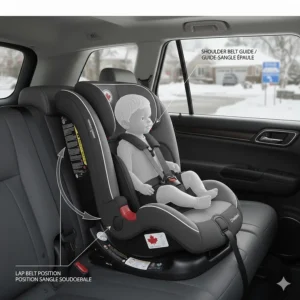
Harness slots must align properly with child shoulders—rear-facing children need harnesses at or below shoulders, while forward-facing children need harnesses at or above shoulders. Misaligned harnesses reduce effectiveness by up to 50% in Canadian crash simulations.
Mistake #4: Loose Installation
Car seats should move less than 2.5 cm (1 inch) in any direction when tested at the belt path. Surveys reveal 44-81% of Canadian car seats are installed too loosely. Use body weight pressing down while tightening LATCH or seatbelts to achieve proper tension.
Mistake #5: Transitioning Too Early
Many Canadian parents transition children forward-facing or to booster seats prematurely, motivated by discomfort or convenience rather than safety. Follow weight and height maximums, not age recommendations alone.
Budget vs. Premium: What Really Matters?
Features Worth the Investment
Canadian parents often wonder whether premium features justify higher costs. Research and crash testing reveal these features provide measurable benefits:
Worth Paying For:
- Extended rear-facing capacity (50 pounds)
- Steel-reinforced frames
- Easy-adjust harness systems
- Anti-rebound bars or load legs
- Quality LATCH connectors
- Temperature-regulating fabrics (Canadian climate)
Nice But Not Essential:
- 360-degree rotation
- Premium fabrics and aesthetics
- Integrated cup holders
- Colour options
- Brand prestige
Budget Options That Don’t Compromise Safety
Several excellent budget options meet all Canadian safety standards while keeping costs under $300 CAD:
- Cosco Scenera NEXT ($120-$150 CAD): Basic but safe, perfect for occasional use
- Evenflo Tribute ($130-$180 CAD): Excellent crash test results at budget pricing
- Safety 1st Grow and Go ($200-$250 CAD): Extended use without premium cost
Remember that Transport Canada approval means ALL car seats meet minimum safety standards. Premium features enhance convenience and extend usability but don’t necessarily make children safer in basic collision scenarios.
Compatibility with Canadian Vehicles
Compact Cars and Sedans
Canadian compact cars like Honda Civic, Toyota Corolla, and Mazda3 require careful car seat selection. Prioritize narrow seats like Clek Foonf (43 cm) or Diono Radian 3RX (43 cm) for 3-across capability. Rear-facing installation may require front passenger seats positioned farther forward.
Midsize SUVs and Crossovers
Popular Canadian SUVs (RAV4, CR-V, Escape) accommodate most car seats easily. These vehicles offer sufficient space for rotating seats like Evenflo Revolve360 and provide ideal rear-facing installation angles without compromising front passenger comfort.
Minivans and Large SUVs
Minivans remain popular among Canadian families precisely because they accommodate multiple car seats effortlessly. Models like Honda Odyssey, Toyota Sienna, and Chrysler Pacifica fit three car seats across middle rows while maintaining LATCH accessibility for all positions.
When to Replace Your Car Seat
After Any Collision
Transport Canada and most manufacturers recommend replacing car seats after any collision, even minor fender-benders. Invisible stress fractures compromise structural integrity, potentially failing during subsequent impacts.
Check your auto insurance policy—most Canadian insurers cover car seat replacement after accidents. Document the seat with photographs and request replacement costs as part of your claim.
Approaching Expiration
Monitor expiration dates carefully, typically stamped on the seat base or indicated on labels. Canadian climate extremes accelerate material degradation, making our seats potentially less durable than identical models in moderate climates.
Plan replacements 6 months before expiration to avoid emergency purchases. Many Canadian retailers offer trade-in programs providing 20-25% discounts on new seats when returning expired models for proper recycling.
After Recalls
Register your car seat immediately after purchase to receive recall notifications. Transport Canada maintains recall databases at https://tc.canada.ca/en/road-transportation/child-car-seat-safety.
Recent recalls affecting Canadian car seats include certain Evenflo Revolve360 Slim models and older Graco models with harness buckle issues. Never ignore recalls—compliance kits are provided free by manufacturers.
Special Considerations for Canadian Families
Flying with Car Seats
Many Canadian families travel between provinces or internationally with young children. Transport Canada recommends securing children in approved car seats during flights when possible, dramatically reducing turbulence injuries.
Look for seats displaying “Approved for Aircraft Use” labels. The Diono Radian 3RX folds for convenient air travel, while lightweight infant seats like Chicco KeyFit 35 balance portability with safety.
Multiple Vehicle Households
Canadian families frequently use multiple vehicles or share seats between households (custody arrangements, grandparents). Consider purchasing additional bases for infant seats ($120-$180 CAD) or selecting convertible seats with quick-install features like Britax ClickTight or Nuna True Tension.
Children with Special Needs
Transport Canada approves special car seats for children with medical conditions or physical disabilities. Consult occupational therapists and certified child passenger safety technicians for recommendations. Provincial health insurance may cover specialized seats through medical equipment programs.
Maintaining Your Car Seat in Canadian Conditions
Cleaning After Salt and Snow Exposure
Canadian roads use significant salt and chemical de-icers that damage car seat materials. Remove and wash fabric covers monthly during winter months using manufacturer-specified settings (typically gentle cycle, line dry).
Inspect metal components for corrosion quarterly. Light surface rust on non-structural elements poses no safety risk, but extensive corrosion affecting LATCH anchors or structural frames requires seat replacement.
Summer Storage
Extreme heat damages car seat plastics as severely as extreme cold. Never leave car seats in vehicles during summer heat waves—interior temperatures exceeding 60°C weaken plastic bonds and fade fabric treatments. Store unused seats in climate-controlled spaces.
Regular Safety Checks
Perform monthly inspections of harness straps (fraying, twisting), buckles (smooth operation), and installation tightness (2.5 cm movement test). Check recline angles using bubble indicators and verify LATCH connectors remain securely attached.
❓ Frequently Asked Questions
❓ How long should children remain rear-facing in Canada?
❓ Can I use American car seats in Canada?
❓ What's the average lifespan of car seats in Canada?
❓ How much should I expect to spend on car seats in Canada?
❓ Do I need professional installation help in Canada?
Conclusion: Choosing the Best Car Seat for Your Canadian Family
Selecting the right car seat represents one of your most important parenting decisions. With Transport Canada’s rigorous safety standards and this comprehensive guide, you’re well-equipped to choose confidently.
Remember these key takeaways for Canadian parents: verify the National Safety Mark on every purchase, prioritize extended rear-facing capability, account for climate-related challenges, and never compromise installation quality for convenience. Whether you choose the budget-friendly Graco Extend2Fit at $280 CAD or invest in the premium Nuna Rava at $550 CAD, proper installation and usage matter more than price points.
Canadian families benefit from excellent car seat options meeting our unique needs—from handling extreme temperatures to accommodating bulky winter clothing. Take time to test seats in your vehicle, consult certified technicians, and verify compatibility with your lifestyle before purchasing.
Your child’s safety is worth the research investment. Make an informed choice, install correctly, and drive confidently knowing you’ve provided the best protection available.
Recommended for You
- 7 Best One Hand Fold Stroller Options Canada 2026 Guide
- 7 Best Stroller Wagon for 2 Kids Canada 2026
- 7 Best Strollers Canada 2026: Complete Buying Guide for Parents
Disclaimer: This article contains affiliate links to Amazon.ca. If you purchase products through these links, we may earn a small commission at no additional cost to you.
✨ Found this helpful? Share it with your friends! 💬🤗
