
In This Article
You’re at the grocery store in Vancouver, juggling your toddler who wants “up…down…up…down” every thirty seconds. Your back is screaming, your arm has gone numb, and you’ve dropped your shopping list twice. Sound familiar? If you’re a parent in Canada, you’ve lived this scene. Traditional baby carriers take forever to strap on, and carrying your 25-pound toddler on your hip is wreaking havoc on your posture.
Enter the hip seat baby carrier—a game-changing solution that’s revolutionizing how Canadian families handle the constant “up and down” phase. Unlike structured carriers that require complex wrapping or those trendy wraps that need a YouTube tutorial every single time, hip seat carriers offer something brilliantly simple: a padded platform that sits on your waist, distributing your child’s weight across your hips instead of straining your arms and shoulders.
What makes these carriers particularly appealing for Canadian parents? Our climate demands versatility. Whether you’re navigating slushy sidewalks in Toronto during March, hiking forest trails in British Columbia during summer, or managing the festival season across the country, you need a carrier that works in layers, transitions quickly between indoor heating and outdoor cold, and doesn’t leave you overheated when you finally get inside that café.
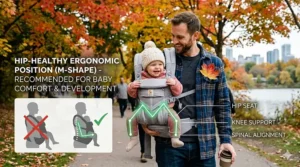
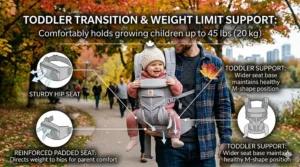
According to the International Hip Dysplasia Institute, proper positioning during babywearing supports healthy hip development—and hip seat carriers excel at maintaining the recommended M-position (knees higher than bottom, thighs supported). With one in 100 Canadian infants requiring treatment for hip dysplasia, choosing the right carrier isn’t just about convenience; it’s about your child’s long-term joint health.
In this comprehensive guide, we’ve researched and analyzed the top hip seat baby carriers available on Amazon.ca in 2026, focusing on real products with verified Canadian availability, honest customer reviews from Canadian buyers, and pricing in CAD. Whether you’re budget-conscious, seeking premium features, or need something specific like extra back support or quick-detach functionality, we’ve got you covered.
Quick Comparison Table: Top Hip Seat Carriers at a Glance
| Carrier | Best For | Weight Capacity | Price Range (CAD) | Key Feature | Rating |
|---|---|---|---|---|---|
| Tushbaby Original | Premium Quality | Up to 45 lbs | $145-$165 | Multiple storage pockets | 4.7/5 |
| Ergobaby Alta Hip Seat | Hands-free conversion | 12-45 lbs | $180-$220 | 2-in-1 design with back panel | 4.6/5 |
| Momcozy Hip Seat | C-section recovery | Up to 45 lbs | $75-$95 | 3D belly protector | 4.5/5 |
| Ergobaby Lift Hip Seat | Quick ups and downs | 17-45 lbs | $135-$155 | Large storage pockets | 4.6/5 |
| FRUITEAM 6-in-1 | Value for money | 7-45 lbs | $55-$75 | Adjustable positions | 4.3/5 |
| Bebamour Foldable | Portability | Up to 33 lbs | $65-$85 | Folds into compact pouch | 4.4/5 |
| HKAI Hip Carrier | Budget-friendly | Newborn to toddler | $45-$65 | Breathable mesh | 4.2/5 |
💬 Just one click – help others make better buying decisions too! 😊
Top 7 Hip Seat Baby Carriers: Expert Analysis
1. Tushbaby Original Hip Seat Baby Carrier
The Tushbaby Original has earned its reputation as the gold standard among Canadian parents, and for good reason. This safety-certified carrier features a unique no-foam design with a firm, structured seat that won’t collapse or lose shape over time—something cheaper alternatives struggle with.
Key Specifications:
- Weight capacity: 8-45 lbs (newborn to 3 years)
- Waist fit: 23-44 inches (extender available for up to 68 inches)
- Weight: Less than 1 pound
What Canadian Buyers Say: Toronto-based parents rave about receiving next-day shipping and appreciate how the lumbar support helps during long CN Tower visits or trips to Ontario Science Centre. Manitoba buyers specifically mention its effectiveness during prairie winter months when layering clothing is essential.
✅ Pros:
- Five storage pockets plus bottle holder eliminate need for diaper bag
- Memory foam seat provides cushioning for baby
- Machine washable for easy cleaning
- YKK zippers known for durability
❌ Cons:
- Higher price point may deter budget-conscious families
- Seat protrudes when not in use, which some find cumbersome
Price: $145-$165 CAD on Amazon.ca

2. Ergobaby Alta 2-in-1 Hip Seat and Carrier
For parents who want maximum versatility, the Ergobaby Alta Hip Seat offers the best of both worlds. Use it as a simple hip seat for quick pickups, or attach the back panel and shoulder straps to convert into a full hands-free carrier. The SoftFlex mesh construction provides exceptional breathability—crucial for Canadian summer heat waves.
Key Specifications:
- Weight capacity: 12-45 lbs (4-48 months)
- Waist fit: Up to 52 inches
- Four carrying positions: hip, front inward, front outward, back carry
What Canadian Buyers Say: Vancouver parents love the quiet buckle system (no Velcro ripping sounds) for maintaining sleeping babies. Quebec families appreciate that it works well over winter coats, and Alberta hikers praise its performance on mountain trails.
✅ Pros:
- Convertible design offers flexibility as baby grows
- Wide cushioned seat provides excellent hip support
- Reflective accents for safety during early winter evenings
- Side pocket for phone and essentials
❌ Cons:
- Not suitable for newborns under 4 months
- Higher price point compared to basic hip seats
Price: $180-$220 CAD on Amazon.ca
3. Momcozy Hip Seat Baby Carrier with 3D Belly Protector
The Momcozy Hip Seat stands out with its innovative 3D belly protector and EVA massage board—features specifically designed for postpartum recovery. Canadian mothers recovering from C-sections have particularly praised this design, as it reduces pressure on the abdominal area while still providing solid support.
Key Specifications:
- Weight capacity: Newborn to 36 months (up to 45 lbs)
- Available sizes: Medium (27-45 inch waist), Large (40-55 inch waist)
- Weight: 1.38 pounds
What Canadian Buyers Say: Reviews from Canadian mothers emphasize the carrier’s effectiveness during recovery periods. One Toronto buyer mentioned using it for both her 8-month-old and 4-year-old, while a Winnipeg parent appreciated the quick next-day delivery.
✅ Pros:
- C-section friendly design with belly protection
- Multiple carrying positions (inward, outward, side, feeding)
- Doubles as diaper bag with spacious storage
- Significantly lighter than competitors
❌ Cons:
- Sizing can be confusing; measure carefully before ordering
- Magic tape may wear over time with heavy use
Price: $75-$95 CAD on Amazon.ca and Best Buy Canada
4. Ergobaby Lift Hip Seat Baby Carrier
The Ergobaby Lift is Ergobaby’s answer to parents who want simplicity without sacrificing quality. This hip-seat-only design (no back panel attachment) focuses on doing one thing exceptionally well: making quick ups and downs effortless. It’s perfect for toddlers in that exploratory phase who want to walk fifty steps, get picked up, walk another twenty, and repeat.
Key Specifications:
- Weight capacity: 17-45 lbs (6-48 months)
- Waist fit: 22-55 inches
- Four positions: recline (feeding), inward, outward, hip carry
What Canadian Buyers Say: Parents across Canada appreciate the ErgoPromise Lifetime Guarantee. Halifax families mention its usefulness during boardwalk strolls, while Calgary parents love how it works seamlessly during Stampede visits with constantly changing toddler moods.
✅ Pros:
- No learning curve required—immediately intuitive
- Large side pocket and front mesh pocket
- Concaved, cushioned seat with anti-slip grip
- Quiet buckle for gentle sleeping baby removal
❌ Cons:
- Not hands-free (requires one arm for safety)
- Not suitable for very young babies (6 months minimum)
Price: $135-$155 CAD on Amazon.ca
5. FRUITEAM 6-in-1 Baby Carrier with Hip Seat
For Canadian families watching their budget without compromising on functionality, the FRUITEAM 6-in-1 offers remarkable value. This carrier provides six different carrying positions, growing with your baby from newborn through toddler years. While it may not have the premium materials of higher-end options, it delivers solid performance at a fraction of the cost.
Key Specifications:
- Weight capacity: 7-45 lbs (approximately 0-48 months)
- Waist fit: 25-40 inches (adjustable)
- Six carrying positions including breastfeeding support
What Canadian Buyers Say: Mixed reviews reflect the price point. Some Canadian parents report excellent quality and comfort, while others note inconsistencies in stitching. Edmonton buyers appreciate the value, though some Montreal parents wish for more robust construction.
✅ Pros:
- Budget-friendly without being cheaply made
- Multiple carrying positions for versatility
- Ergonomic M-position supports healthy hip development
- Five pockets provide adequate storage
❌ Cons:
- Quality control can be inconsistent
- May lack durability compared to premium brands
- Some units shipped without thigh straps despite product photos
Price: $55-$75 CAD on Amazon.ca
6. Bebamour Foldable Hip Seat Baby Carrier
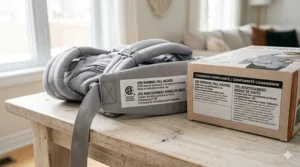
The Bebamour Foldable brings a unique feature to the table: collapsibility. The aluminum tube support system folds flat, allowing you to tuck this carrier into its included storage pouch—perfect for Canadian families who travel frequently or need to maximize stroller basket space. This makes it particularly appealing for multi-modal commutes common in cities like Montreal and Toronto.
Key Specifications:
- Weight capacity: Up to 33 lbs (0-36 months)
- Waist fit: Up to 46.4 inches (118 cm)
- Three carrying styles: horizontal, facing inward, facing forward
What Canadian Buyers Say: Commuting parents in major Canadian cities praise the foldability feature. British Columbia families who frequently transition between car, stroller, and carrying appreciate how easily it packs away.
✅ Pros:
- Folds completely flat for storage
- Two zipper pockets (front for bottles/diapers, side for phone)
- Adjustable padded waist strap reduces pressure
- Comes with storage pouch
❌ Cons:
- Lower weight capacity than competitors (33 lbs vs 45 lbs)
- Fewer carrying positions than multi-function carriers
Price: $65-$85 CAD on Amazon.ca
7. HKAI Baby Hip Carrier
For first-time parents testing the hip seat waters or grandparents who need an occasional carrier, the HKAI Hip Carrier provides entry-level pricing without completely sacrificing quality. The breathable mesh construction makes it particularly suitable for summer use, and the non-slip hip seat surface adds an extra safety element.
Key Specifications:
- Weight capacity: Newborn to toddler
- Adjustable waistband with breathable mesh
- Multiple carrying positions
What Canadian Buyers Say: Reviews are limited but generally positive for the price point. Canadian buyers appreciate it as a backup carrier or for short-term use when visiting relatives.
✅ Pros:
- Most affordable option for budget-conscious families
- Breathable mesh ideal for summer weather
- Non-slip surface on seat
- Lightweight design
❌ Cons:
- Limited brand recognition and customer reviews
- May lack advanced features of premium carriers
- Durability concerns for heavy daily use
Price: $45-$65 CAD on Amazon.ca
Understanding Hip Seat Carriers: More Than Just Convenience
What is a Hip Seat Baby Carrier?
A hip seat baby carrier consists of a wide, padded waistband with a small, firm seat attached to one side. Think of it as a supportive shelf that sits above your hip, creating a stable platform for your baby to sit on while you provide additional security with one arm. The design draws inspiration from how parents naturally carry children on their hip, but with crucial ergonomic improvements.
The International Hip Dysplasia Institute recognizes that proper positioning during babywearing can support healthy hip development. Hip seat carriers excel at maintaining what experts call the M-position or spread-squat position, where the baby’s knees are slightly higher than their bottom, thighs are spread and supported, and hips are flexed. This natural clinging position promotes optimal hip joint development during the critical first year when joints and ligaments are still forming.
Unlike traditional structured carriers that strap the baby securely to your front or back, hip seats offer something different: flexibility. Your toddler can hop on and off (with your assistance) in seconds, perfect for that developmental stage where they want independence but still need comfort. No complicated buckles, no wrestling with straps, no searching for instruction manuals online at 2 AM.
Why Choose a Hip Seat Over Traditional Carriers?
Traditional soft-structured carriers like the Ergobaby Omni or wrap-style carriers like the Solly Baby Wrap have their place—they’re fantastic for extended babywearing sessions, long hikes, or when you genuinely need both hands completely free. However, they come with limitations that hip seats address.
First, there’s the setup time. Traditional carriers require threading straps, adjusting buckles, and ensuring everything is properly positioned. For quick pickups during shopping trips or when your toddler decides the ground is suddenly lava, this feels like forever. Hip seats buckle on like a belt, ready in seconds.
Second, there’s the temperature factor. Structured carriers place fabric against both parent and baby, creating a heat trap that makes Canadian summers uncomfortable. Hip seats minimize contact, allowing air circulation while still providing support. This matters whether you’re experiencing a humid Ontario summer or exploring the Okanagan Valley during peak season.
Third, there’s developmental appropriateness. Toddlers crave independence and exploration. They want to walk, explore, touch, investigate—but they also tire quickly and need reassurance. Traditional carriers lock them in place; hip seats let them transition between carried and walking with minimal disruption to the flow of your day.
The International Hip Dysplasia Institute emphasizes that short-term carrying (up to 2 hours) in any position that maintains the M-position is unlikely to cause hip problems. Hip seats naturally support this position while offering the flexibility that modern parenting demands.
How to Choose the Perfect Hip Seat Carrier for Your Canadian Family
Weight Capacity and Age Suitability
Not all hip seats work for all ages. Some models, like the Momcozy and Tushbaby, claim newborn suitability (with proper support), while others like the Ergobaby Lift require babies to be at least 6 months with good head control. Consider where your child is now and where they’ll be in six months. A carrier that works from 6 months to 45 pounds offers better value than one limited to 33 pounds, especially given how quickly Canadian children seem to grow during those nutrition-packed early years.
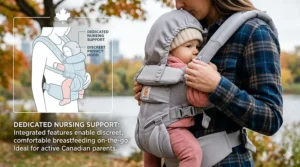
Canadian safety standards align with international guidelines: babies should have strong head and neck control before using hip seats independently. For younger infants, look for carriers that offer recline or cradle positions for feeding support, but always keep one hand supporting the baby.
Waist Size and Adjustability
This matters more than you might think, especially in Canadian households where multiple caregivers might use the same carrier. A petite mother with a 28-inch waist and a father with a 42-inch waist need a carrier with serious adjustability. Check the specified range carefully, and don’t forget about seasonal variations—a carrier that fits perfectly over a t-shirt in July might feel tight over a fleece in November.
Many premium carriers offer waistband extenders as accessories. Tushbaby’s extender adds 24 inches, making it suitable for bodies of all shapes and sizes. This inclusivity matters for Canadian families who value products that work for everyone.
Storage and Practicality
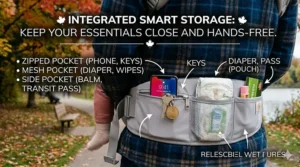
Canadian winters demand layers, which means you’re not always carrying a purse or diaper bag. Look for carriers with multiple pockets. The Tushbaby’s five pockets can hold diapers, wipes, phone, wallet, keys, and snacks—essentially functioning as a diaper bag alternative. FRUITEAM offers five pockets as well, while simpler designs like the HKAI might only have one or two.
Consider what you typically carry. If you’re the type to pack for every possibility, prioritize storage. If you minimalist-parent with just phone, keys, and emergency diaper, storage becomes less critical.
Material and Breathability
Canada’s climate varies wildly. Vancouver parents deal with rain and mild temperatures. Winnipeg families face extreme cold and wind chill. Toronto experiences humid summers that make any fabric contact unbearable.
Mesh materials like SoftFlex (Ergobaby Alta) provide superior breathability for summer but may feel less substantial. Padded, quilted designs offer more structure and warmth but can be stifling in July. Consider your primary season of use. If you’re purchasing in spring with summer adventures planned, prioritize ventilation. Winter buyers can opt for heavier construction, knowing layers will provide warmth anyway.

Ergonomic Design and Back Support
The whole point of a hip seat is reducing strain. Look for wide, padded waistbands that distribute weight across your core rather than concentrating pressure in one spot. The Momcozy’s EVA massage board and 3D belly protector exemplify thoughtful ergonomic design, particularly valuable for post-partum bodies still recovering.
Lumbar support matters too. The Tushbaby includes padded lumbar support, helping maintain proper spinal alignment when carrying. For parents with existing back issues—common after pregnancy and childbirth—this feature transforms from nice-to-have to essential.
Price vs. Value
Hip seats range from $45 to over $220 CAD. Before you assume expensive equals better, consider actual value. A $165 Tushbaby that lasts through two children and maintains resale value might cost less per use than a $55 carrier that falls apart after six months.
That said, budget-friendly options like FRUITEAM and HKAI serve legitimate purposes. If you need a backup carrier for grandparents’ house, or you’re uncertain whether you’ll actually use a hip seat regularly, starting with a lower investment makes sense. You can always upgrade if it becomes a daily essential.
Hip Dysplasia and Safe Baby Carrying: What Canadian Parents Need to Know
Understanding Hip Dysplasia in Canadian Context
Developmental dysplasia of the hip (DDH) affects approximately one in 100 Canadian infants who require treatment, though one in ten babies are born with some degree of hip instability that typically resolves naturally. The condition is more common in firstborn girls, babies born breech, and those with family history of hip problems—factors that make awareness crucial for Canadian families.
According to research cited by the International Hip Dysplasia Institute, cultures with strong babywearing traditions show lower rates of hip dysplasia. The key lies in positioning: babies carried in the spread-squat or M-position (thighs spread around the caregiver’s torso, knees bent and higher than bottom) experience forces that support healthy hip socket development.
Dr. Pablo Castañeda, pediatric orthopedic surgeon and Director of the International Hip Dysplasia Institute, emphasizes a crucial point that should ease parental anxiety: there’s no evidence that any type of baby carrier causes or worsens hip dysplasia, provided basic positioning guidelines are followed. The concern arises with positions that force babies’ legs straight down and together for extended periods—something hip seat carriers naturally avoid.
The M-Position: Nature’s Design
Hip seats excel at maintaining the M-position because they’re designed around it. When your baby sits on the platform, their legs naturally spread to each side of your body, knees bent, creating the ideal posture. The seat supports the thighs rather than leaving legs dangling, distributing weight properly and maintaining the knee-higher-than-bottom positioning that pediatric orthopedists recommend.
This contrasts with narrow-based carriers where a baby’s legs dangle straight down, or with carrying methods where legs are held together. While short-term carrying in less-than-ideal positions is unlikely to cause problems, the beauty of hip seats is that their default position is the healthy one—you’re doing it right without even trying.
Inward vs. Outward Facing: The Canadian Debate
The IHDI recommends inward-facing carrying during the first six months when hip development is most rapid. During this period, inward positioning allows babies to grasp the caregiver’s torso with inner thigh muscles, generating beneficial forces for hip development. After six months, when development has slowed, the guidance becomes more flexible, though many experts still recommend primarily inward-carrying until age one.
Most hip seat carriers offer both options. The Ergobaby Alta and Momcozy support all four positions (inward, outward, hip, back). Consider your baby’s age and developmental stage when choosing positions. Young infants benefit most from inward positions, while older babies and toddlers can safely enjoy outward-facing adventures—perfect for those curious Canadian toddlers who want to observe everything from geese in the park to streetcars rumbling past.
Canadian Health Resources
Health Canada doesn’t specifically regulate baby carriers as medical devices, but Canadian parents can access excellent resources through provincial health authorities. British Columbia’s HealthLink BC, Ontario’s Motherisk program, and similar services across provinces offer guidance on safe babywearing practices.
When in doubt, bring your hip seat to your baby’s next well-child visit. Pediatricians familiar with developmental milestones can assess whether your specific baby is ready for particular carrying positions. This personalized guidance beats general online advice, especially if your baby has any risk factors for hip dysplasia.
Benefits vs. Traditional Baby Carriers
| Feature | Hip Seat Carriers | Traditional Structured Carriers | Wrap-Style Carriers |
|---|---|---|---|
| Setup Time | 10-30 seconds | 2-5 minutes | 5-10 minutes (or 20 min for beginners) |
| Quick Pickups | Excellent – seconds on/off | Poor – full unbuckling required | Poor – complete rewrapping needed |
| Hands-Free Capability | Partial (one arm) or full with back panel | Full hands-free | Full hands-free |
| Temperature | Cool – minimal contact | Warm – full body contact | Warmest – multiple fabric layers |
| Weight Distribution | Hips and lower back | Shoulders, hips, back | Shoulders and back |
| Storage | Excellent (multiple pockets) | Limited (small pockets) | None (separate bag needed) |
| Toddler Independence | Excellent – easy on/off | Poor – feels restrictive | Poor – complete unwrapping |
| Newborn Suitability | Limited (some models with support) | Excellent (with infant insert) | Excellent (proper wrapping technique) |
| Price Range (CAD) | $45-$220 | $150-$300 | $80-$150 |
| Learning Curve | Very easy | Moderate | Steep (especially ring slings) |
This comparison makes clear that hip seats occupy a specific niche. They’re not replacing your structured carrier for long hikes or your wrap for newborn snuggles. They’re solving a different problem: the up-down-up-down toddler phase that makes shopping trips exhausting and park visits feel like CrossFit sessions.
Price Range and Value Analysis
Budget Tier ($45-$75 CAD)
Best Options: HKAI, FRUITEAM
These carriers provide basic hip seat functionality without premium features. Expect adequate padding, simple designs, and potentially less durable materials. Perfect for grandparents who need occasional use, or for parents testing whether hip seats work for their family before investing more.
Canadian Value Consideration: At this price point, even if the carrier lasts only 6-8 months, the cost-per-use makes it worthwhile compared to dealing with arm and back strain or purchasing multiple cheaper alternatives that break quickly.
Mid-Range ($75-$155 CAD)
Best Options: Momcozy, Ergobaby Lift, Bebamour Foldable
This sweet spot offers significantly better quality construction, thoughtful features (like the Momcozy’s 3D belly protector), and brand reliability. You’re paying for durability that extends through multiple children, materials that withstand Canadian weather, and designs backed by customer service and warranties.
Canadian Value Consideration: The ErgoPromise Lifetime Guarantee on Ergobaby products adds substantial value. Even at $135-$155, knowing you’re covered for the product’s lifetime—potentially through multiple children—justifies the investment for many Canadian families.
Premium Tier ($155-$220 CAD)
Best Options: Tushbaby Original, Ergobaby Alta 2-in-1
Premium carriers justify their cost through superior materials (YKK zippers, memory foam seats, reinforced stitching), extensive storage solutions, and innovative features like the Alta’s convertible design. These are heirloom-quality products that maintain resale value on Canadian buy-and-sell platforms.
Canadian Value Consideration: Premium carriers often have strong resale markets. A well-maintained Tushbaby can resell for $80-$100 CAD on Facebook Marketplace or Kijiji after years of use. Factor this into your total cost of ownership—a $165 carrier that sells for $90 later actually cost you $75, comparable to mid-range options.
✨ Don’t Miss These Exclusive Deals!
🔍 Take your parenting experience to the next level with these carefully selected products available in Canada. Click on any highlighted item to check current pricing and availability on Amazon.ca. These carriers will help you create authentic bonding moments your family will treasure!
Frequently Asked Questions
❓ What is the best age to start using a hip seat baby carrier in Canada?
❓ Are hip seat carriers safe for babies with hip dysplasia?
❓ How much do hip seat baby carriers cost in Canada?
❓ Can I use a hip seat carrier in Canadian winter with bulky clothing?
❓ Which hip seat carrier has the best storage for Canadian parents?
Conclusion: Finding Your Perfect Hip Seat Match
After analyzing dozens of hip seat baby carriers available to Canadian families in 2026, one truth becomes clear: there’s no single “best” carrier—only the best carrier for your specific situation. The premium Tushbaby Original earns its reputation for good reason, offering unmatched durability and storage that makes it worthwhile for parents using it daily over multiple years. Its strong Canadian resale market further justifies the investment.
For families seeking hands-free capability, the Ergobaby Alta 2-in-1 delivers exceptional versatility. The ability to convert from quick hip seat to full carrier as situations demand makes it ideal for unpredictable Canadian outings where weather, terrain, and toddler moods shift rapidly. The ErgoPromise Lifetime Guarantee provides peace of mind that few brands match.
Budget-conscious families and those new to hip seats will find the Momcozy Hip Seat strikes an impressive balance between affordability and features. Its C-section-friendly design addresses a real need in the postpartum community, while multiple carrying positions ensure it grows with your family’s needs.
Remember that choosing a hip seat carrier connects to broader parenting goals. You’re not just buying a product—you’re investing in your physical wellbeing, your child’s comfort, and those countless small moments where quick, easy carrying makes the difference between a pleasant outing and a frustrating experience.
Canadian parents have unique considerations: our extreme weather variations, our often car-dependent suburban living combined with walkable urban centres, our multicultural approach to childcare where carriers might move between multiple family members of varying sizes. The right hip seat accommodates all these factors while supporting your child’s healthy hip development according to guidelines from the International Hip Dysplasia Institute.
Whatever carrier you choose, know that you’re joining a growing community of Canadian parents who’ve discovered that babywearing doesn’t have to be complicated, uncomfortable, or time-consuming. Hip seats represent a return to simplicity—carrying your child close while maintaining the flexibility modern life demands. Your back, your arms, and your increasingly independent toddler will thank you.
Recommended for You
- 7 Best Baby Carrier 6-12 Months Canada 2026
- How to Tie Baby Wrap: 7 Safe Techniques for Canadian Parents 2026
- 7 Best Ring Sling Carriers in Canada 2026 – Top Picks
Disclaimer: This article contains affiliate links to Amazon.ca. If you purchase products through these links, we may earn a small commission at no additional cost to you.
✨ Found this helpful? Share it with your friends! 💬🤗
