
In This Article
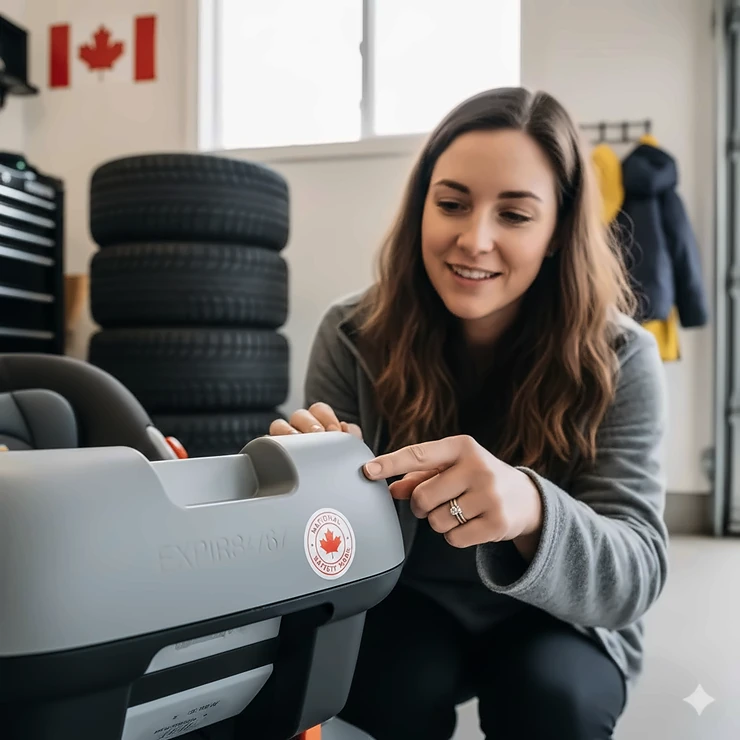
Here’s something that might surprise you: that car seat you’ve been using for your toddler could be putting them at risk, even if it looks perfectly fine. I learned this the hard way when a friend’s perfectly maintained car seat failed during a minor accident—turns out, it had expired three years earlier.
In Canada, car seat expiration isn’t just a manufacturer’s marketing ploy. Transport Canada recognizes that expired car seats don’t meet current safety standards, making them legally questionable and genuinely dangerous. With over 250,000 car seats ending up in Ontario landfills alone each year, many Canadian families struggle to understand when to replace car seat Canada guidelines and proper disposal methods.
This comprehensive guide breaks down everything you need to know about car seat expiration dates Canada rules, from brand-specific lifespans to recycling programs across the country. Whether you’re a new parent or have multiple children, understanding these regulations could save your child’s life.
Quick Comparison Table: Canadian Car Seat Regulations Overview
| Aspect | Details | Source |
|---|---|---|
| Expiration Range | 6-10 years from manufacture | Transport Canada |
| Legal Requirement | Must meet CMVSS standards | Federal Law |
| National Safety Mark | Required on all seats | Transport Canada |
| Selling Pre-2012 Seats | Illegal under CCPSA | Health Canada |
| Provincial Variations | Minor differences by province | Provincial Law |
💬 Just one click – help others make better buying decisions too!😊
Top 7 Car Seats in Canada: Expert Analysis 2026
1. Graco 4Ever All-in-One Convertible Car Seat
The Graco 4Ever is Canada’s best-selling all-in-one car seat for good reason. This powerhouse transitions through four modes: rear-facing infant (1.8-18 kg), forward-facing toddler (10-29 kg), highback booster (18-45 kg), and backless booster (18-54 kg).
Key Specifications:
- Expiration: 10 years from manufacture date
- Weight range: 1.8-54 kg (4-120 lbs)
- ProtectPlus Engineered™ crash protection
- Simply Safe Adjust™ harness system
Price Range: $299-$399 CAD on Amazon.ca
Canadian Customer Feedback: Parents across Canada rave about its value proposition. One Toronto mother noted, “This seat lasted through all three of my kids and saved us hundreds compared to buying separate seats.” Many reviewers appreciate how the seat fits three-across in vehicles like Honda Accords and Toyota Camrys.
✅ Pros:
- Exceptional 10-year lifespan
- Grows with child through all stages
- Steel-reinforced frame for durability
❌ Cons:
- Heavy (10+ kg) for frequent transfers
- Takes up significant rear-to-front space when reclined
2. Graco Extend2Fit Convertible Car Seat
The Graco Extend2Fit features an innovative 4-position extension panel providing up to 12.7 cm of extra legroom, allowing Canadian children to ride rear-facing longer—critical for safety.
Key Specifications:
- Expiration: 10 years (steel-reinforced model)
- Rear-facing: 1.8-22.5 kg (4-50 lbs)
- Forward-facing: 10-30 kg (22-65 lbs)
- InRight LATCH system
Price Range: $249-$329 CAD
Canadian Customer Feedback: Vancouver parents particularly appreciate the extended rear-facing capability during BC’s rainy winters. Several reviews mention children comfortably riding rear-facing until age 4, exceeding Canadian recommendations.
✅ Pros:
- Extended rear-facing for Canadian safety standards
- Easy no-rethread harness adjustment
- Dual integrated cup holders
❌ Cons:
- Bulkier footprint than compact models
- Fabric can show stains quickly
3. Chicco KeyFit 35 Infant Car Seat
The Chicco KeyFit 35 dominates Canada’s infant car seat market with its legendary ease of installation and superior safety ratings.
Key Specifications:
- Expiration: 6 years from manufacture
- Weight: 1.8-16 kg (4-35 lbs)
- Height: Up to 81 cm (32″)
- ReclineSure™ leveling system
Price Range: $329-$379 CAD (with base)
Canadian Customer Feedback: Montreal parents consistently mention the “one-click installation” as a game-changer during Quebec winters. The ClearTex model (free of flame retardants) is particularly popular among health-conscious Canadian families.
✅ Pros:
- Easiest installation in its class
- Premium push-on LATCH connectors
- Fits preemies (with insert)
❌ Cons:
- Shorter 6-year lifespan
- Slightly heavier carrier (about 4.5 kg)
4. Safety 1st EverSlim 4-in-1 Convertible Car Seat
The Safety 1st EverSlim answers a uniquely Canadian problem: fitting three car seats across in smaller vehicles during harsh winters when car pooling is essential.
Key Specifications:
- Expiration: 6-7 years (varies by component)
- Width: Only 43 cm (17″)
- Weight range: 2.2-45 kg (5-100 lbs)
- Magnetic chest clip
Price Range: $199-$269 CAD
Canadian Customer Feedback: Calgary families love the slim profile for fitting siblings side-by-side. One reviewer noted, “Perfect for our Subaru Outback—finally fits three kids across!” The magnetic chest clip is praised for preventing toddler escapes.
✅ Pros:
- Industry-leading narrow width
- Budget-friendly price point
- Unique magnetic anti-escape clip
❌ Cons:
- Lower harness height (16.5″) limits taller children
- Takes significant space when reclined
5. Evenflo Revolve360 Extend Rotating Car Seat
The Evenflo Revolve360 Extend brings premium rotating technology to Canadian families, with 360-degree swivel making winter loading significantly easier.
Key Specifications:
- Expiration: 10 years from manufacture
- Rear-facing: 1.8-22 kg
- Forward-facing: 10-29 kg
- SensorSafe™ technology
Price Range: $399-$499 CAD
Canadian Customer Feedback: Edmonton parents particularly value the rotating feature during -30°C winters. Reviews highlight how the rotation prevents back strain when bundling children in winter gear before securing them.
✅ Pros:
- 360° rotation simplifies access
- SensorSafe alerts for unbuckled clip
- Extended 10-year lifespan
❌ Cons:
- Premium pricing
- Bulkier width may limit 3-across fit
6. Chicco MyFit Harness + Booster Car Seat
The Chicco MyFit offers DuoGuard™ side-impact protection with a reinforced steel frame—crucial for Canadian highway safety.
Key Specifications:
- Expiration: 8 years from manufacture
- Weight range: 11-45 kg (25-100 lbs)
- 9-position headrest
- 4-position recline
Price Range: $249-$299 CAD
Canadian Customer Feedback: Ontario parents praise the extended harness weight limit, allowing children to stay in 5-point harness mode longer. The deep recline feature receives special mention for long Canadian road trips.
✅ Pros:
- Extended harness range
- Premium padding for comfort
- SuperCinch® LATCH tightener
❌ Cons:
- Only forward-facing (not convertible)
- Heavier than basic boosters
7. Graco TurboBooster 2.0 Highback Booster
The Graco TurboBooster 2.0 represents exceptional value for Canadian families needing a reliable, long-lasting booster seat.
Key Specifications:
- Expiration: 10 years from manufacture
- Weight range: 18-45 kg (40-100 lbs)
- Height: Up to 145 cm (57″)
- Hideaway cup holders
Price Range: $79-$129 CAD
Canadian Customer Feedback: Budget-conscious Canadian families appreciate the decade-long lifespan at an entry-level price. Saskatchewan reviewers note it’s “perfect for the cottage car or grandparents’ vehicle.”
✅ Pros:
- Outstanding value (10-year life)
- Lightweight for transfers
- Machine-washable cover
❌ Cons:
- Less padding than premium models
- No 5-point harness system
✨ Don’t Miss These Exclusive Deals!
🔍 Take your child’s safety to the next level with these carefully selected products available in Canada. Click on any highlighted item to check current pricing and availability on Amazon.ca. These seats will help you create authentic peace of mind your family deserves!
Understanding Car Seat Expiration Dates Canada Rules
Transport Canada doesn’t legally mandate expiration dates, but they strongly recommend following manufacturer guidelines. Here’s what makes this critical: although not required by regulation, virtually all car seats sold in Canada include expiration dates because manufacturers understand the real safety risks.
According to Transport Canada’s official guidelines, child car seats and booster seats should never be used beyond their expiry or useful life date. Beyond this point, seats may have missing parts, faded labels, unknown histories, and diminished crash performance.
The Canada Consumer Product Safety Act adds another layer: if your car seat was manufactured before January 1, 2012, it’s actually illegal to advertise, sell, or give it away. These older seats don’t meet current Health Canada requirements and could put children at serious risk.
Provincial regulations build on federal standards. Ontario’s Highway Traffic Act, for instance, mandates appropriate car seats for children under 8 years old, with fines of $240 and 2 demerit points for violations. Saskatchewan goes further—using an expired car seat can result in a $175 ticket. British Columbia’s ICBC even reimburses recycling fees for car seats involved in accidents.
Car Seat Lifespan by Brand Canada: Complete Breakdown
Different manufacturers set varying expiration periods based on materials, construction, and testing protocols. Here’s what Canadian parents need to know about major brands:
Graco Car Seat Lifespan
Graco defines “useful life” clearly: 10 years for belt-positioning boosters and steel-reinforced models (like the 4Ever and Extend2Fit), and 7 years for plastic-reinforced models. Infant seats like the SnugRide series typically expire after 6-7 years.
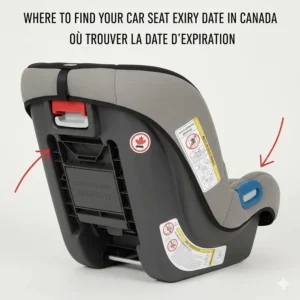
The date of manufacture appears on a label on the seat’s bottom or back. You’ll need to add the lifespan to this DOM (Date of Manufacture) to calculate your expiration date—Graco doesn’t print the actual expiration date directly.
Chicco Car Seat Lifespan
Chicco provides more straightforward labeling with expiration dates printed on both the seat and base. Most Chicco infant seats expire after 6 years, while convertible and all-in-one models like the MyFit last 8 years. The KeyFit series—Canada’s bestseller—has a 6-year window.
Britax Car Seat Lifespan
Britax varies by model and manufacture date. Post-2010 models follow this pattern: infant seats (6 years), standard convertibles (7 years), ClickTight convertibles (10 years), and Harness-2-Booster seats (9 years). The white sticker near the top of the seat shows the manufacture date.
Safety 1st Car Seat Lifespan
Safety 1st seats generally expire 6-7 years after manufacture, though booster components may last up to 10 years. Check your specific model’s manual, as the EverSlim has different expiration timelines for harness versus booster modes.
Evenflo Car Seat Lifespan
Most Evenflo seats expire 6 years from the DOM, with the Symphony series extending to 8 years. The Revolve360 line offers 10-year lifespans, making them among the longest-lasting in Canada.
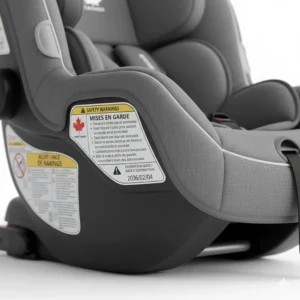
Why Do Car Seats Expire Canada: Science Behind the Date
Transport Canada identifies several critical factors driving expiration dates. Understanding these helps Canadian parents make informed decisions about when to replace car seat Canada timelines.
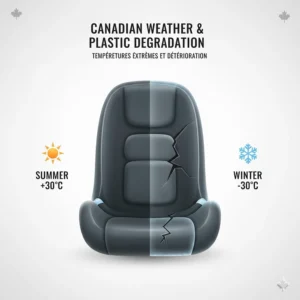
Material Degradation: Canada’s extreme temperature swings—from -40°C Prairie winters to +35°C Ontario summers—accelerate plastic degradation. UV exposure through car windows weakens structural integrity, while freeze-thaw cycles create microscopic cracks invisible to the naked eye.
Safety Technology Evolution: The car seats from 2016 lack side-impact protection standards introduced in 2020. New Canadian testing protocols mean older seats, even if undamaged, don’t provide modern protection levels. Manufacturers can’t retrofit old technology into existing seats.
Wear and Tear Accumulation: Consider this: buckling and unbuckling a car seat twice daily for five years means over 3,600 cycles. Harness adjustments, LATCH installations, and daily use stress components beyond visible detection.
Label Deterioration: Safety instructions fade, making proper installation nearly impossible. Missing weight limits or installation diagrams create dangerous guesswork situations.
Recall Limitations: Second-hand buyers rarely receive recall notices. Transport Canada estimates thousands of recalled seats remain in use because current owners don’t know about safety issues.
How to Find Expiration Date Car Seat: Step-by-Step Guide
Locating your car seat’s expiration requires knowing where manufacturers hide this critical information. Here’s your complete Canadian guide.
Method 1: Check the Seat Bottom Flip your car seat over completely. Most manufacturers mold the date directly into the plastic shell. Look for phrases like “Do Not Use After” or “Expires” followed by a date. Graco, Chicco, and Evenflo typically place it here.
Method 2: Examine All Labels White or silver stickers contain manufacture dates and sometimes expiration dates. Check these locations:
- Underneath the seat padding (remove fabric cover)
- Behind your child’s head near the harness
- On the back of the seat shell
- On any removable base (for infant seats)
Method 3: Calculate from Manufacture Date If only the DOM (Date of Manufacture) appears, add the useful life:
- Graco steel-reinforced: DOM + 10 years
- Chicco KeyFit: DOM + 6 years
- Britax ClickTight: DOM + 10 years
- Safety 1st standard: DOM + 6-7 years
Method 4: Consult Your Manual The instruction manual lists expiration timelines. If you’ve lost it, visit the manufacturer’s Canadian website. Most provide downloadable PDFs by model number.
Method 5: Contact Manufacturers When all else fails, contact Canadian customer service with your model number and serial number:
- Graco Canada: 1-800-667-8184
- Chicco Canada: 1-877-424-4226
- Safety 1st Canada: 1-800-667-8184
- Evenflo Canada: Available through website chat
Comparison Table: Major Car Seat Brands Expiration in Canada
| Brand | Infant Seats | Convertible | Booster | All-in-One |
|---|---|---|---|---|
| Graco | 6-7 years | 10 years (steel) / 7 years (plastic) | 10 years | 10 years |
| Chicco | 6 years | 6-8 years | 6-8 years | 8 years |
| Britax | 6 years | 7-10 years | 6-10 years | 9-10 years |
| Safety 1st | 6 years | 6-7 years | 10 years | 6-7 years (harness) |
| Evenflo | 6 years | 6-8 years | 6 years | 10 years (Revolve360) |
When to Replace Car Seat Canada: Beyond Expiration Dates
Expiration dates aren’t the only trigger for replacement. Canadian safety experts identify several situations requiring immediate car seat retirement.
After Any Motor Vehicle Collision
Transport Canada and most manufacturers recommend replacing car seats after any crash, even minor fender-benders. Internal damage isn’t always visible—harness anchors can shift, plastic shells can develop stress fractures, and LATCH systems may weaken.
Some insurance companies in Canada cover replacement costs under comprehensive coverage. ICBC in British Columbia specifically reimburses car seat recycling fees with a receipt when seats are involved in accidents.
Exception: Graco and some manufacturers allow continued use after “minor crashes” meeting specific criteria (vehicle driveable, no door damage, no injuries, airbags didn’t deploy). Always verify with your specific manufacturer.
Visible Damage or Missing Parts
Cracks in the plastic shell, frayed harness straps, broken buckles, or missing LATCH connectors all necessitate immediate replacement. Canadian winters can cause stress cracks from rapid temperature changes—inspect thoroughly each spring.
Unknown History
That free car seat from Facebook Marketplace seems like a deal until you realize you can’t verify if it’s been in a crash, stored in a damp basement, or has all original parts. Transport Canada strongly advises against using seats with unknown histories.
Recall Status
Check Transport Canada’s recall database regularly. If your seat is recalled and the manufacturer won’t provide a remedy, replace it immediately. Canadian law prohibits using recalled products even if you weren’t notified.
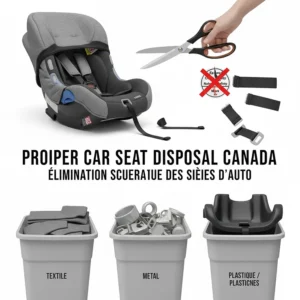
Expired Car Seat Disposal Canada: Responsible Options
Simply throwing an expired car seat in the garbage creates environmental problems and safety risks. Here’s how responsible Canadian families handle disposal.
Car Seat Recycling Programs Canada
Several organizations across Canada accept expired car seats for proper recycling:
Clek Recycling Program (National): Canada’s only car seat manufacturer with a take-back program. Purchase a $25 CAD return shipping label through their website, ship your Clek seat in any box, and receive a 10% discount code for your next purchase. They recycle 95% of materials at Canadian facilities.
ATMO Recycling (Ontario): Formerly Green Propeller Recycling, this not-for-profit partners with The Co-operators insurance offices across Ontario. Register online at atmo.ca, pay $15 CAD (waived for Co-operators clients), and drop off at participating locations. They manually deconstruct seats and employ workers facing employment barriers.
BCAA Child Car Seat Recycling (British Columbia): BC municipalities and private recycling centres accept seats for fees ranging from $5-$20 CAD:
- Burnaby: Reclaim Plastics ($20, appointment only)
- Vancouver: PMD Recycling Solutions ($20, monthly mobile collections)
- Victoria: PMD Recycling Solutions ($20, bi-monthly events)
- Columbia Shuswap Regional District: $5 per seat
Target Canada Trade-In Events: While not permanent, Target occasionally hosts car seat trade-in events offering 20% discount coupons. Follow their Canadian social media for announcements.
DIY Destruction for Garbage Disposal
If recycling isn’t accessible, render the seat unusable before disposal:
- Remove all fabric covers and padding (can often be donated separately)
- Cut all harness straps with heavy scissors
- Write “EXPIRED – DO NOT USE” in permanent marker across the plastic shell
- Use a saw to cut the plastic shell in multiple places
- Separate metal components for scrap metal recycling
- Contact your municipality—some accept dismantled seats in household garbage
York Region, Ontario specifically requests placing car seats in household garbage after removal of straps and covers. Saskatchewan accepts dismantled seats at landfills for $5 per seat.
💡 Smart Parent Tip
Set a calendar reminder for your car seat’s expiration date when you first purchase it. Many Canadian parents use their phone’s calendar to set an alert 6 months before expiration, giving time to research replacement options during sales events like Black Friday or Amazon Prime Day.
Canadian Car Seat Safety Standards You Need to Know
Understanding what makes a car seat legal in Canada helps parents make informed purchases, especially when considering cross-border shopping or hand-me-downs.
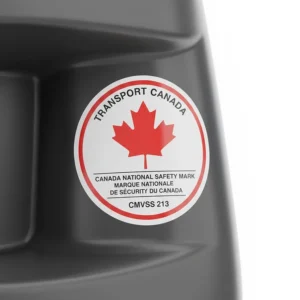
The National Safety Mark
Every car seat legally sold in Canada must display Transport Canada’s National Safety Mark—a circular sticker or molded symbol indicating compliance with Canada Motor Vehicle Safety Standards (CMVSS). Car seats from the US, Europe, or elsewhere lacking this mark are illegal to use in Canada, regardless of their quality.
CMVSS Requirements
The CMVSS outlines stringent crash testing protocols Canadian car seats must pass. Key requirements include:
- Dynamic crash testing at specified speeds
- Frontal, side, and rear impact protection
- Flammability standards
- Harness strength requirements
- LATCH system specifications
These standards update regularly—another reason why expired seats may not meet current regulations.
Provincial Variations
While federal standards apply nationwide, provinces add specific requirements:
Ontario: Children under 8 years old, under 80 lbs, or under 145 cm tall must use appropriate car seats. Violations bring $240 fines and 2 demerit points.
Quebec: Children under 9 years or 145 cm must use car seats. Quebec offers free car seat inspection clinics province-wide.
British Columbia: ICBC covers car seat replacement in accidents and funds community education programs.
Alberta: Children under 6 years or 40 lbs must use car seats, with booster requirements extending to age 9.
Storage and Maintenance: Extending Your Car Seat’s Life
Proper care helps car seats reach their full expiration date while maintaining safety. Canadian climate presents unique challenges.
Winter Storage Tips
If storing a car seat through winter months (cottage car, spare vehicle), keep it indoors. Unheated garages subject seats to -40°C temperatures that cause plastic brittleness. Store in a heated basement or spare room, covered to prevent dust accumulation.
Summer Heat Protection
Canadian summers bring UV exposure that degrades plastic. Use sunshades in parked vehicles, or remove seat covers when parking outdoors for extended periods. Dark-coloured vehicles in Ontario and Prairie provinces can reach 70°C inside—well above safe limits.
Cleaning Best Practices
Use only manufacturer-approved cleaning methods. Most Canadian car seat covers are machine washable in cold water, but harness straps should never be submerged—spot clean only with mild soap. Harsh chemicals can degrade webbing strength.
Regular Inspection Schedule
Every three months, check:
- Harness straps for fraying or twisting
- LATCH connectors for wear
- Plastic shell for cracks (especially after winter)
- All labels remain legible
- Buckles click securely
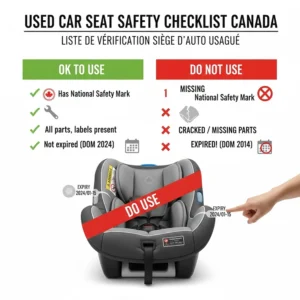
Buying Second-Hand Car Seats in Canada: When It’s Safe
Transport Canada doesn’t prohibit purchasing used car seats, but provides strict guidelines for safe second-hand purchases.
The Three Golden Rules
1. Know the Complete History: Only accept seats from trusted sources (family, close friends) where you can verify the seat’s never been in a crash, has all original parts, and comes with the original manual.
2. Verify It’s Not Expired: Check expiration dates thoroughly. Many well-meaning relatives offer “barely used” seats that are actually past their safe life.
3. Confirm It’s Not Recalled: Visit Transport Canada’s recall database and enter the model number. Some recalls render seats completely unusable.
Red Flags to Avoid
Never purchase used seats that:
- Lack the original manual (manufactures provide free downloads)
- Are missing any parts (replacement parts may not be available)
- Show any cracks, even hairline fractures
- Come from unknown sellers at garage sales or online marketplaces
- Were manufactured before 2012 (legally prohibited)
Where to Buy Safely
If purchasing second-hand, stick to:
- Direct from trusted family/friends
- Community groups where you can verify history
- Consignment stores that verify expiration dates
Facebook Marketplace and Kijiji pose risks—sellers may not disclose accident history or expiration dates honestly.
Car Seat Registration: Why It Matters in Canada
Registering your car seat with the manufacturer takes five minutes but provides crucial safety benefits Canadian families shouldn’t skip.
How Recalls Work
When Transport Canada identifies a safety defect, manufacturers must notify registered owners directly. Unregistered seats rely on public announcements—easily missed by busy parents.
Between 2020-2025, over 30 car seat models were recalled in Canada for issues ranging from harness adjustments to structural failures. Registered owners received direct mail and email notifications; unregistered owners might never have known.
Registration Methods
Most manufacturers offer three options:
- Online: Visit the manufacturer’s Canadian website, enter your information and model details
- Mail: Complete the card attached to your car seat and mail it (postage pre-paid)
- Phone: Call Canadian customer service numbers
Keep your registration confirmation—it proves ownership if replacement is needed for recalls.
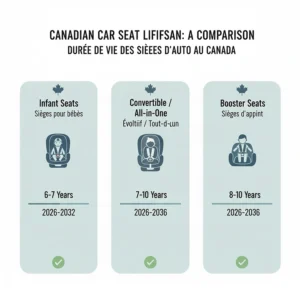
FAQ: Car Seat Expiration Dates Canada Rules
❓ Are there car seat trade-in programs in Canada like in the US?
❓ Can I use an American car seat in Canada if it's not expired?
❓ What happens if my car seat expires while my child still needs it?
❓ How much does car seat recycling cost in Canada?
❓ Do insurance companies cover expired car seat replacement in Canada?
Conclusion: Keeping Canadian Families Safe on the Road
Car seat expiration dates aren’t arbitrary—they’re science-based safety measures protecting Canada’s most precious cargo. With expiration windows ranging from 6-10 years depending on brand and model, understanding when to replace car seat Canada guidelines prevents tragic outcomes.
Remember these key takeaways: Check your seat’s expiration date today, register your seat with the manufacturer for recall notifications, never use seats involved in crashes (even minor ones), and utilize Canadian recycling programs rather than garbage disposal.
The investment in a quality, unexpired car seat pales compared to the alternative. Whether you choose the value-packed Graco 4Ever ($299-$399 CAD) for its decade-long lifespan, the trusted Chicco KeyFit 35 ($329-$379 CAD) for its installation ease, or the budget-friendly Graco TurboBooster 2.0 ($79-$129 CAD) for older children, prioritize that National Safety Mark and expiration date.
Canadian winters, summer heat, and vast driving distances make proper car seat selection crucial. Take five minutes today to locate your seat’s expiration date, mark your calendar, and plan for replacement before that date arrives. Your child’s safety depends on it.
Recommended for You
- How to Choose a Car Seat in Canada: 7 Best Picks for 2026
- Extended Rear Facing Car Seats: 7 Best Canada 2026 Guide
- 7 Best Booster Seats in Canada 2026: Safety Tested & Expert Reviewed
Disclaimer: This article contains affiliate links to Amazon.ca. If you purchase products through these links, we may earn a small commission at no additional cost to you.
✨ Found this helpful? Share it with your friends! 💬🤗
