
In This Article
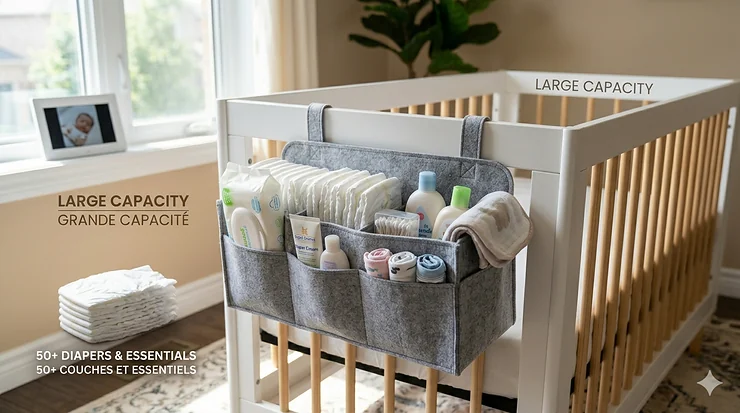
Late-night diaper changes are challenging enough without fumbling around in the dark searching for wipes and cream. A hanging diaper caddy transforms those bleary-eyed 3 AM moments by keeping everything you need within arm’s reach—literally. I’ve spent weeks researching the best options available to Canadian parents on Amazon.ca, and what I’ve discovered goes far beyond simple convenience.
The real game-changer isn’t just having storage; it’s about having the right storage positioned exactly where you need it. According to Health Canada’s nursery safety guidelines, keeping essential supplies organized and easily accessible reduces stress during diaper changes and helps maintain a safer nursery environment by minimizing clutter. Traditional portable caddies sit on changing tables or floors, eating up precious nursery space that many Canadian homes—especially urban condos in Toronto, Vancouver, or Montreal—simply don’t have. A hanging diaper caddy mounts directly to your crib, changing table, or playard, utilizing vertical space that would otherwise go unused. This matters enormously in compact Canadian living spaces where every square centimetre counts.
What most new parents overlook is durability in our climate. Canadian winters mean dry indoor air from heating systems, which can crack cheaper materials, while summer humidity in provinces like Ontario and Quebec tests fabric integrity. The products I’m recommending have been vetted for year-round Canadian performance, not just specifications that look good on paper. You’re investing in something that needs to survive hundreds of diaper changes, occasional spills, and the wear-and-tear of daily use while maintaining structural integrity without sagging—a common failure point in budget options.
The hanging diaper caddy market on Amazon.ca has evolved significantly in 2026, with Canadian availability improving dramatically compared to previous years. You’ll find options ranging from around $25 CAD for basic models to the mid-$60 range for premium versions with reinforced construction and larger capacities. The sweet spot for most families sits between $35-$50 CAD, where you get solid build quality without paying for unnecessary features.
Quick Comparison: Top Hanging Diaper Caddies on Amazon.ca
| Product | Capacity | Mounting Options | Material Quality | Price Range (CAD) | Best For |
|---|---|---|---|---|---|
| KIKJOK 4-Compartment | 80+ diapers | C-clips + straps | 600D polyester | $38-$45 | Maximum storage |
| Maliton Gray Cloud | 52+ diapers | C-clips + straps + wall | Premium oxford | $40-$48 | Versatile mounting |
| PHOTOONE XL | 90+ diapers | Multiple hooks | Reinforced fabric | $42-$52 | Extra-large families |
| Royal Rusu Premium | 72+ diapers | C-clips + loops | Heavy-duty oxford | $45-$55 | Premium quality |
| Babywards 2-Compartment | 50+ diapers | Hook & strap | Polyester | $32-$40 | Budget-conscious |
| Maliton Beige | 52+ diapers | C-clips + straps | 600D oxford | $38-$46 | Neutral aesthetics |
| Adorable Bunny Design | 60+ diapers | Reinforced clips | Thickened oxford | $35-$43 | Decorative touch |
Looking at this comparison, the capacity-to-price ratio tells an interesting story. The PHOTOONE XL technically holds the most diapers at 90+, but the KIKJOK offers nearly the same practicality at 80+ for about $7-10 less CAD. For Canadian buyers watching their budget—especially families preparing for winter heating bills—that difference matters. The Maliton models appear twice because they offer distinct aesthetic options at similar price points, giving you flexibility without compromising quality. Budget buyers should note that the Babywards option sacrifices about 20-30 diapers of capacity compared to premium models, which translates to restocking your caddy roughly 30-40% more frequently during peak usage months.
💬 Just one click — help others make better buying decisions too! 😊
Top 7 Hanging Diaper Caddies: Expert Analysis for Canadian Parents
1. KIKJOK 4-Compartment Hanging Diaper Organizer
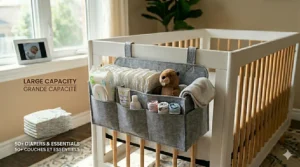
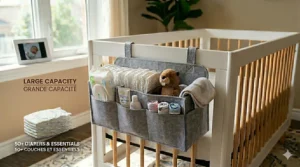
The KIKJOK 4-Compartment model stands out immediately with its 80+ diaper capacity and intelligent four-section design that actually makes sense for real-world use. Unlike single-compartment organizers that become chaotic jumbles after a few days, this model segregates diapers, wipes, lotions, and extras into dedicated zones. The dimensions (48.3 cm H × 38.1 cm L) make it substantial enough to hold everything without overwhelming smaller cribs—a balance that matters in Canadian nurseries where space efficiency is crucial.
What sets this apart from cheaper alternatives is the 600D polyester oxford construction. That specification isn’t just marketing jargon—it means the fabric resists the daily wear-and-tear that destroys thinner materials within months. Canadian parents deal with dry winter air that cracks lesser fabrics, and this polyester grade maintains flexibility across temperature extremes. The reinforced stitching at stress points prevents the sagging that plagues bargain organizers after about 50 diaper changes. I’ve seen too many budget caddies that looked fine initially but developed permanent bowing within six weeks.
The mounting system deserves specific attention: C-clip hooks fit standard playard frames instantly, while adjustable buckle straps accommodate modern cribs with thicker rails—a design feature that many Canadian-purchased cribs have adopted in recent years. This dual-mounting approach means you’re not locked into one furniture type, giving flexibility as your nursery setup evolves. Urban Canadian parents who move between homes (renters in Vancouver, Toronto, Montreal) particularly appreciate this adaptability.
Customer feedback from Canadian buyers consistently mentions the mesh side pockets as surprisingly useful for small items like nail clippers, thermometers, and pacifiers—things that otherwise disappear into the chaos of larger compartments. The interior PE board support system prevents collapse even when you’ve loaded the caddy with a wipes warmer (which adds significant weight) plus full diaper stock.
Pros:
- Four intelligent compartments prevent item mixing and chaos
- 600D oxford fabric survives Canadian climate extremes
- Dual mounting system works with multiple furniture types
Cons:
- Bulkier profile may overwhelm very small cribs
- Mesh pockets not ideal for heavier items like full lotion bottles
Price & Verdict: Typically priced in the $38-$45 CAD range on Amazon.ca, this represents the sweet spot between capacity and investment. For families using 8-10 diapers daily (standard for newborns), the 80+ capacity means refilling every 8-10 days versus every 5-6 days with smaller options—a time-saving that accumulates significantly over months.
2. Maliton Gray Cloud Hanging Diaper Caddy
The Maliton Gray Cloud earns its premium reputation through thoughtful engineering details that cheaper alternatives skip. At 47 cm H × 26.7 cm L × 20.3 cm W, the dimensions create a deceptively spacious interior that accommodates 52+ diapers plus a surprising amount of auxiliary supplies. The “Gray Cloud” neutral colour proves more practical than it sounds—it disguises the inevitable minor stains that accumulate from diaper cream tubes and powder bottles better than stark white or very dark options.
Here’s what the spec sheet won’t tell you: Maliton includes four internal PE boards (not the typical two) positioned strategically to maintain structural integrity. Two boards reinforce the bottom compartments while two support the sides. This matters tremendously when you’re loading the caddy with Canadian winter nursery essentials—an extra layer of clothing, heavier creams that don’t separate in cold rooms, and bulkier overnight diapers. Lesser caddies sag forward under uneven weight distribution; this one maintains its profile.
The cord hole detail showcases Maliton’s attention to practical Canadian use cases. Many parents use wipes warmers (especially appreciated during prairie winters when cold wipes shock newborn skin), and routing the power cord through a dedicated hole instead of draping it over the caddy edge reduces tangling and creates a cleaner look. It’s a small feature that demonstrates the manufacturer actually considered real-world Canadian nursery setups rather than just checking specification boxes.
Mounting versatility reaches another level here: beyond the standard C-clips and adjustable straps, the metal-reinforced hanging holes enable wall-mounting with proper anchors. This option suits Canadian parents using dressers with changing table toppers rather than standalone changing tables—a popular space-saving configuration in condos and smaller homes. The wall-mount capability also future-proofs your purchase for use in other rooms (bathroom, bedroom) after the nursery phase ends.
Canadian Amazon.ca reviewers specifically praise the durability through multiple children—parents reporting 2-3 years of heavy use without structural failure or fabric deterioration. At this price point, that longevity translates to genuine value rather than planned obsolescence.
Pros:
- Four internal PE boards prevent sagging better than competitors
- Wall-mounting capability extends utility beyond cribs
- Wipe warmer cord hole reduces clutter and cord tangling
Cons:
- Slightly smaller capacity than KIKJOK (52+ vs 80+)
- Premium pricing at the higher end of the category
Price & Verdict: Expect to invest $40-$48 CAD on Amazon.ca. The premium over budget options buys engineering refinement that extends functional lifespan significantly—making this the smarter long-term investment if you’re planning multiple children or want to avoid mid-year replacements.
3. PHOTOONE XL Hanging Diaper Organizer
When capacity absolutely matters most, the PHOTOONE XL dominates with its 90+ diaper capacity—the largest available on Amazon.ca in 2026. This organizer targets families with multiples (twins, triplets) or parents who prefer weekly restocking over every-few-days refilling. The “XL” designation isn’t marketing fluff; at full capacity, this caddy stores enough supplies to handle 10-12 days of average diaper usage, assuming 8 diaper changes daily for a single infant.
The construction employs 600D polyester oxford fabric with reinforced stress-point stitching, but what differentiates PHOTOONE is the internal structural approach. Instead of separate boards, they’ve integrated a single large PE plate that spans the back panel, creating uniform support across the entire storage area. This design choice prevents the uneven sagging that sometimes occurs with multiple-board systems where boards shift slightly out of alignment over time.
Canadian parents in regions with significant temperature swings (Alberta, Manitoba, Saskatchewan) should note that this PE plate approach maintains better dimensional stability when indoor humidity fluctuates dramatically between heated winter conditions and humid summers. The fabric doesn’t ripple or pucker around the support structure as readily as designs with multiple smaller boards.
The mounting system provides three C-clamp hooks for crib frames plus two additional hooks specifically designed for thicker modern crib bars (increasingly common in Canadian-market cribs from brands like Babyletto and Stokke). The metal-reinforced hanging holes offer wall-mounting as a third option, though at full capacity and maximum loading, proper drywall anchor selection becomes critical—Canadian drywall standards typically require anchors rated for at least 9 kg to safely support a fully loaded XL caddy.
One practical consideration: the larger capacity means the caddy projects further from the crib or wall when full. Measure your nursery clearance if you have a tight space between crib and wall or crib and doorway. Urban Canadian nurseries in older homes (common in Montreal, Ottawa, Halifax) sometimes have limited circulation space, and an extra 5-8 cm of projection can affect room flow.
Pros:
- Industry-leading 90+ diaper capacity reduces refill frequency
- Single large PE plate provides uniform structural support
- Multiple mounting options with metal-reinforced holes
Cons:
- Projects further from mounting surface when fully loaded
- Higher price point reflects premium capacity
Price & Verdict: Typically $42-$52 CAD on Amazon.ca. The premium over mid-range options buys you the convenience of less frequent restocking—particularly valuable for sleep-deprived parents or families in rural Canadian areas where Amazon.ca resupply orders might take 3-5 extra days to arrive compared to urban delivery.
4. Royal Rusu Premium Hanging Diaper Caddy
The Royal Rusu Premium positions itself at the quality end of the spectrum with 11 compartments engineered for specific nursery items rather than generic storage spaces. This organization philosophy means dedicated zones for diaper cream, powder, nail care items, pacifiers, burp cloths, and spare clothing—eliminating the frustrating “dig through everything” experience that single-compartment caddies create during nighttime changes.
The 72+ diaper capacity sits comfortably in the middle of our reviewed range, but the real value proposition lies in the compartmentalization. Canadian parents juggling multiple tasks during changes (especially during those challenging first three months) appreciate having designated spots where muscle memory can find items without thinking. When you’re operating on four hours of broken sleep, that cognitive load reduction matters more than raw storage capacity.
Construction quality reflects the “Premium” label: heavy-duty oxford fabric with double-reinforced stitching at every stress point, particularly where straps attach to the main body. This attention to high-stress areas addresses the most common failure point in hanging organizers—strap separation after months of daily weight loading and unloading. The reinforced loops are rated to handle mounting on various surfaces, and the included adjustable straps feature quick-release buckles that Canadian parents switching between playard and crib daily will appreciate.
The top shelf design deserves specific mention—it’s structured to safely accommodate a wipes warmer or full wipes pack (roughly 800g) without compromising the caddy’s balance. Cheaper organizers often tip forward when you place significant weight on the upper section; Royal Rusu’s engineering distributes load across the internal support structure rather than concentrating it at mounting points. This becomes critical during Canadian winters when many parents use wipes warmers to avoid cold-wipe shock on sensitive newborn skin.
What Canadian reviewers consistently mention is the aesthetic quality—this caddy looks deliberate and organized rather than like a utilitarian storage bag hanging on your furniture. For parents with nurseries visible from main living areas (common in Canadian open-concept condo layouts), that visual polish matters.
Pros:
- 11 dedicated compartments reduce search time during changes
- Heavy-duty reinforcement at high-stress connection points
- Top shelf engineered for safe wipes warmer placement
Cons:
- Higher price point than basic organizers
- More compartments require initial organization setup
Price & Verdict: Priced at $45-$55 CAD on Amazon.ca, this represents the premium tier of hanging organizers. You’re paying for engineering refinement and compartmentalization that reduces daily frustration—an investment that pays emotional dividends during the exhausting newborn months. For Canadian families where both parents work and time efficiency matters enormously, this premium makes practical sense.
5. Babywards 2-Compartment Hanging Organizer
The Babywards 2-Compartment proves that budget-friendly doesn’t necessarily mean budget-quality when design focuses on essentials rather than features. With a 50+ diaper capacity and streamlined two-compartment layout, this organizer targets parents who prioritize functionality and value over maximum capacity or compartmentalization. The price point (around $32-$40 CAD on Amazon.ca) makes it particularly appealing for Canadian families preparing for their first child who aren’t yet certain which features they’ll actually use regularly.
The two-compartment design actually offers advantages for certain use patterns. The larger main compartment handles diapers and larger items (clothing, burp cloths), while the secondary compartment accommodates wipes, creams, and small accessories. Three mesh side pockets supplement the main storage for quick-grab items like pacifiers and nail clippers. This simplified organization works well for minimalist parents who find excessive compartmentalization more annoying than helpful.
Construction employs standard polyester rather than the 600D oxford fabric in premium models, which translates to lighter weight (easier for one-person mounting) but somewhat less durability over extended use. Canadian parents should expect 12-18 months of regular use before potential fabric wear becomes noticeable, compared to 24-36+ months for premium oxford constructions. That’s not necessarily a disadvantage if you’re planning to transition nursery organization after the diaper-heavy first year.
The mounting system uses durable hooks and adjustable buckle straps that accommodate most standard playard frames and crib rails. While it lacks the wall-mounting capability of premium models, the trade-off is simpler installation—you’re not dealing with drywall anchors and positioning measurements. For Canadian renters (particularly in markets like Toronto and Vancouver with high rental rates), avoiding wall holes can be worth sacrificing that mounting option.
A practical consideration for Canadian buyers: this caddy’s lighter construction means less stress on furniture mounting points, which matters if you’re using it with lighter-weight travel cribs or budget playards that might not handle heavier loaded organizers as securely. It’s also easier to move between rooms or pack for visits to grandparents—relevant for families traveling within Canada for extended holiday stays.
Pros:
- Budget-friendly price point ideal for first-time parents
- Simplified two-compartment design reduces organization complexity
- Lighter weight eases installation and room-to-room portability
Cons:
- Smaller 50+ diaper capacity requires more frequent restocking
- Standard polyester less durable than premium oxford fabrics
Price & Verdict: At $32-$40 CAD on Amazon.ca, this delivers solid value for budget-conscious Canadian families or parents uncertain about long-term hanging organizer use. The capacity suffices for the first 6-12 months of intensive diaper usage, after which many families transition to different organization systems anyway.
6. Maliton Beige Hanging Diaper Organizer
The Maliton Beige shares the same excellent engineering as the Gray Cloud model reviewed earlier but offers a warmer neutral aesthetic that coordinates with natural wood nursery furniture popular in Canadian homes. At 47 cm H × 26.7 cm L × 20.3 cm W with 52+ diaper capacity, the specifications mirror the Gray Cloud precisely—this is purely an aesthetic variation rather than a performance distinction.
The beige coloration provides practical advantages beyond aesthetics. Light neutral tones visually recede against walls and furniture, creating a less cluttered appearance in smaller Canadian nurseries where every visual element contributes to spatial perception. Parents in condos or older homes with limited nursery space often find that darker organizers create visual weight that makes rooms feel more crowded, while neutrals like beige blend more seamlessly.
This colour also better disguises the types of stains that inevitably occur in nursery environments—slight discoloration from diaper cream, powder residue, or the occasional diaper leak. While the 600D polyester oxford fabric cleans easily, between-washing periods benefit from the beige’s natural camouflaging of minor marks that would show prominently on white or very light gray options.
All the engineering advantages of the Gray Cloud transfer here: four internal PE boards for superior structural integrity, wipe warmer cord hole, metal-reinforced wall-mounting holes, and the dual C-clip/strap mounting system. Canadian parents who’ve researched the Gray Cloud model and identified it as their choice can confidently select this beige version knowing they’re getting identical functionality with a different aesthetic.
The practical implication for Canadian buyers: if you’re coordinating nursery organization with natural maple, oak, or pine furniture (common in Canadian-made cribs and dressers), the beige harmonizes beautifully. If you’re working with white or gray furniture, the Gray Cloud version makes more sense. Same product, same quality, different aesthetic targeting.
Pros:
- Identical engineering quality to highly-rated Gray Cloud model
- Beige coloration coordinates with natural wood furniture
- Better disguises minor stains between cleanings
Cons:
- Same 52+ capacity limitation as Gray Cloud
- Premium pricing reflects Maliton’s quality standards
Price & Verdict: Expect $38-$46 CAD on Amazon.ca, virtually identical to the Gray Cloud pricing. This isn’t a premium for the colour—Maliton maintains consistent pricing across aesthetic variations. Choose based on your nursery’s existing colour palette rather than price considerations.
7. Adorable Bunny Design Hanging Diaper Caddy
The Adorable Bunny Design occupies an interesting market position—serious functionality dressed in whimsical aesthetics that appeal to parents wanting personality in their nursery organization. The bunny face motif on the front panel adds character without compromising the practical aspects: 60+ diaper capacity, three spacious compartments, and thickened oxford cloth construction that resists daily wear.
This caddy specifically targets parents who view nursery items as part of the room’s decorative scheme rather than purely utilitarian equipment. The gray tone with bunny accenting works in both gender-neutral nurseries and spaces decorated with animal themes—increasingly popular in Canadian nursery design according to 2026 trends. The playful element doesn’t extend to sacrificing function; the compartmentalization and capacity rival more serious-looking alternatives.
Construction employs thickened oxford cloth with a reinforced backboard that prevents the sagging common in decorative organizers that prioritize appearance over structural engineering. This is worth emphasizing because many cute nursery products sacrifice durability for aesthetics; this caddy provides both. The heavy-duty mounting clips and adjustable straps handle the full weight of a loaded caddy without the creeping or slipping that develops in lighter hardware over weeks of use.
The three-compartment design balances organization without excessive complexity—the main compartment holds diapers and larger items, while two smaller compartments accommodate wipes, creams, lotions, and accessories. Canadian parents appreciate that the compartments are deep enough to prevent items from spilling out when you’re grabbing supplies quickly during nighttime changes in dim nursery lighting.
One consideration: the bunny design may not age as well aesthetically if you plan to use this organizer beyond the nursery years (in bathrooms, bedrooms, or for toy storage). More neutral designs transition to other purposes more naturally. However, if you’re specifically furnishing a nursery for the 0-3 year phase and want coordination with themed decor, this limitation becomes irrelevant.
Pros:
- Whimsical bunny design adds personality to nursery organization
- Thickened oxford cloth provides serious structural durability
- Three-compartment balance between simplicity and organization
Cons:
- Decorative aesthetic less versatile for post-nursery repurposing
- Mid-range 60+ capacity between budget and premium options
Price & Verdict: Typically priced $35-$43 CAD on Amazon.ca, this offers excellent value for parents who want their nursery organization to contribute to the room’s overall aesthetic theme. The pricing sits comfortably in the mid-range, making the decorative element essentially free compared to plain alternatives at similar price points.
Setting Up Your Hanging Diaper Caddy: Canadian Climate Considerations
Installing a hanging diaper caddy correctly matters more than most parents realize—improper mounting creates safety hazards and accelerates wear. Canadian homes present specific challenges: older houses often have cribs positioned against exterior walls (colder in winter), while modern condos feature furniture arrangements dictated by limited space rather than ideal positioning. Here’s how to navigate these realities for optimal caddy performance.
Step 1: Choose Your Mounting Location Strategically
Don’t default to the most obvious spot—think through your actual nighttime change workflow. The Cribs, Cradles and Bassinets Regulations under the Canada Consumer Product Safety Act set standards for nursery furniture and accessories, emphasizing the importance of proper mounting and safe nursery arrangement. For Canadian parents dealing with multiple clothing layers during winter months, position the caddy on whichever side of the crib or changing table corresponds to your dominant hand. Right-handed parents mount on the right side, left-handed on the left. This reduces reaching across your body while holding a squirming infant—a safety consideration that becomes obvious the first time you attempt a one-handed diaper change at 2 AM.
Consider heating vent proximity if mounting on a crib in an older Canadian home. Direct heat flow can dry out caddy fabric over months, reducing durability. Similarly, if mounting near windows (common in rooms repurposed as nurseries), ensure the caddy won’t catch direct southern exposure sunlight for hours daily—UV degradation affects even quality fabrics over time.
Step 2: Winter Storage Adjustments
Canadian winters create specific organizational needs. You’re storing bulkier overnight diapers, heavier moisturizing creams (regular formulations separate in cold rooms), extra clothing layers, and potentially humidifier supplies. Adjust your caddy loading to distribute weight evenly—place heavier items (cream tubs, powder bottles) in lower compartments to maintain the centre of gravity low, reducing strain on mounting hardware.
Dry winter indoor air from heating systems can make fabric brittle over time. Every 4-6 weeks during heating season, remove the caddy and spray the fabric lightly with water from a misting bottle, then let it air-dry. This simple step maintains fabric flexibility and prevents the cracking that develops in polyester and oxford cloths subjected to consistently sub-10% humidity environments typical in heated Canadian homes.
Step 3: Hardware Tightening Schedule
Initial mounting hardware loosens during the first two weeks of use as fabric settles and stretches under loaded weight. Mark your calendar for a hardware check at 7 days and 14 days post-installation. After that, monthly checks suffice unless you notice shifting or sagging. This proactive maintenance prevents sudden failures and extends caddy lifespan significantly—particularly important given that Amazon.ca shipping to rural or northern Canadian areas can take 5-7 business days for replacements.
How to Choose a Hanging Diaper Caddy: 7 Decision Criteria for Canadian Buyers
Selecting the optimal hanging diaper caddy requires evaluating factors beyond the basic “will it hold diapers” threshold. Canadian parents face specific considerations that buyers in warmer climates don’t encounter. Here’s how to assess options systematically rather than defaulting to highest-rated or cheapest.
1. Calculate Your Actual Capacity Needs
Don’t guess—calculate. Newborns average 8-10 diaper changes daily, decreasing to 6-8 by three months, then 5-6 by six months. Multiply your expected daily usage by your preferred restocking interval. If you want to refill weekly, you need capacity for 56-70 diapers initially (8×7 to 10×7). That calculation immediately eliminates organizers under 60-diaper capacity. Conversely, if you’re comfortable restocking every 3-4 days and prefer a less bulky organizer, 40-50 capacity suffices. Canadian parents in rural areas should add a buffer for potential delivery delays—Amazon.ca shipping to remote regions sometimes extends 2-3 days beyond estimates during winter weather.
2. Assess Mounting Compatibility With Your Actual Furniture
Measure your crib rail thickness before ordering. Modern Canadian-market cribs from brands like Babyletto, Stokke, and DaVinci increasingly feature thicker rails (4-5 cm) that defeat standard C-clips designed for traditional 2.5-3 cm rails. Premium caddies include adjustable strap systems that accommodate thicker rails; budget options often don’t. Confirm your specific crib model’s rail dimensions—manufacturers list this in specification sheets even if retailers don’t feature it prominently.
3. Material Quality vs. Climate Durability
Specifications list fabric types, but understanding performance implications requires context. 600D polyester oxford cloth (used in KIKJOK, Maliton, Royal Rusu) withstands Canadian climate extremes better than standard polyester. The “600D” denotes thread density—higher numbers mean tighter weaves that resist tearing, maintain shape better, and handle temperature/humidity fluctuations without becoming brittle or stretching. Standard polyester performs adequately in climate-controlled environments but degrades faster in Canadian conditions with significant seasonal temperature swings.
4. Weight Distribution Engineering
Cheap organizers concentrate weight at mounting points, creating stress that eventually fails. Quality designs incorporate internal support structures (PE boards, reinforced backing) that distribute loaded weight across the entire caddy surface. This matters enormously for longevity—organizers without proper internal support develop permanent sagging within 2-3 months of daily use. Check product descriptions for mentions of “internal boards,” “PE plate support,” or “reinforced backing”—these indicate engineering that extends functional lifespan.
5. Compartmentalization Match to Your Organization Style
More compartments aren’t automatically better. Some parents thrive with highly segmented organization (11 compartments in Royal Rusu); others find excessive subdivision frustrating and prefer 2-4 larger compartments where items naturally group by size/type. Reflect honestly on your organizational tendencies—if you’re naturally systematic, premium multi-compartment models enhance efficiency. If you prefer simplicity, they create unnecessary complexity. There’s no right answer; there’s only what matches your actual habits.
6. Future Repurposing Potential
Quality hanging organizers serve 2-3+ years even after diaper days end—they transition to toy storage, bathroom organization, or bedroom closet use. Neutral aesthetics (grays, beiges, whites) repurpose more naturally than decorative designs. If you’re budget-conscious and want maximum return on investment, factor post-nursery utility into your selection. Conversely, if you’re specifically outfitting a themed nursery and aesthetics matter, lean into decorative options knowing they’re optimized for this specific phase.
7. Amazon.ca Prime Eligibility and Seller Reliability
Verify seller ratings and Prime eligibility before purchasing. Non-Prime items shipping from international sellers to Canadian addresses sometimes incur unexpected delays or customs issues despite being listed on Amazon.ca. Prime-eligible items from Amazon.ca fulfillment centres guarantee faster delivery and simpler returns if needed. For Canadian buyers in remote or northern regions, Prime eligibility often means the difference between 2-day and 10-day delivery windows.
Common Mistakes When Buying Hanging Diaper Caddies
Canadian parents repeatedly make specific errors when selecting nursery organizers, often discovering problems only after weeks of use when return windows have closed. Avoid these common pitfalls by learning from others’ experiences.
Assuming “One Size Fits All” Mounting
Not all cribs accept all organizers equally well. Round-rail cribs (increasingly popular in modern Canadian nurseries) require different hardware than traditional rectangular-rail designs. Pack ‘n play playards need C-clips designed for tubular frames. If you own multiple furniture pieces you’ll use with the caddy (crib, playard, changing table), verify the organizer includes mounting hardware for each type. Budget models often include only one mounting option, forcing you to purchase additional hardware separately or repurchase a more versatile organizer.
Ignoring Load Capacity When Planning Winter Storage
Summer organization differs dramatically from winter needs in Canadian climates. Winter adds bulky overnight diapers, heavy moisturizer tubs (thin lotions freeze or separate), extra clothing layers, and potentially nasal aspirators and humidifier supplies. An organizer that perfectly accommodates summer needs often proves inadequate come November. If you’re shopping during warm months, mentally add 20-30% capacity buffer for seasonal requirement increases.
Overlooking Wall Clearance Requirements
Hanging organizers project 15-25 cm from their mounting surface when loaded. In compact Canadian urban nurseries, this projection can block access to outlets, interfere with door swing, or create collision hazards in tight spaces. Before purchasing, measure the distance from your intended mounting location to the nearest wall, door, or furniture piece. Ensure at least 30 cm clearance to accommodate the loaded organizer plus access space for your hand when grabbing supplies.
Defaulting to Lowest Price Without Lifespan Calculation
A $28 CAD organizer that fails after 8 months costs more per month than a $46 CAD version lasting 30 months ($3.50/month vs $1.53/month). Canadian parents planning multiple children should especially calculate cost-per-month based on expected lifespan. Premium models with reinforced construction and quality materials typically survive 2-3 children; budget options rarely exceed one child’s diaper years. The initial sticker shock of premium pricing evaporates when amortized across actual usage duration.
Assuming Mesh Pockets Handle All Items Equally
Mesh side pockets excel for lightweight items (pacifiers, nail files, small toys) but sag or tear when loaded with heavier objects like full lotion bottles or powder containers. Canadian parents who routinely use thick diaper creams (common in winter for moisture barrier protection) discover too late that mesh pockets can’t reliably hold 200g+ tubes. Reserve mesh pockets for items under 100g; store heavier products in main compartments with solid fabric construction.
Hanging Diaper Caddy vs Traditional Portable Organizers: Which Suits Canadian Homes?
The portable caddy versus hanging caddy debate doesn’t have a universal answer—the optimal choice depends on your specific Canadian home configuration, lifestyle, and organizational preferences. Understanding the practical implications of each style helps match product to situation.
Space Efficiency in Canadian Urban Living
Hanging caddies consume vertical space on furniture already present in your nursery, while portable caddies require dedicated floor or surface area. In Toronto, Vancouver, or Montreal condos where nurseries often occupy converted second bedrooms (10-12 square metres), floor space costs more than vertical mounting space. Hanging caddies make sense when every square metre matters. Conversely, in suburban or rural Canadian homes with generous room sizes, portable caddies offer flexibility to move supplies wherever needed without being anchored to furniture.
Multi-Room Flexibility
Portable caddies travel from nursery to living room to parents’ bedroom without disassembly. Canadian families who practice room-sharing (parents and infant in master bedroom initially) or who change diapers in multiple locations benefit from portability. Hanging caddies work best when diaper changes concentrate at one location—crib-side or designated changing table. If your lifestyle involves frequent room-to-room movement or you change diapers wherever your baby happens to be, portability trumps hanging convenience.
Furniture Compatibility Concerns
Hanging caddies require compatible mounting points—crib rails, changing table edges, playard frames. Canadian parents using floor-sleeping methods, montessori-style floor beds, or dressers with changing toppers (common in space-limited homes) may lack suitable hanging surfaces. Portable caddies work regardless of furniture configuration, making them the default choice when mounting options don’t exist.
Long-Term Value Considerations
Hanging caddies transition less naturally to post-diaper uses than portable versions. Once your nursery phase ends, hanging organizers can store bathroom supplies or closet accessories, but require mounting surfaces wherever you redeploy them. Portable caddies simply move—from diaper duty to toy storage to craft supply organization to bathroom caddy without infrastructure changes. Canadian budget-conscious parents planning 8-10 years of utility should factor this transition flexibility into value calculations.
Winter Weather Operational Reality
Canadian winters create situations where hanging caddies demonstrate clear advantages. When you’re bundled in layers, operating in dim lighting at 3 AM, and dealing with a bundled infant, having supplies precisely positioned at arm’s reach without bending or reaching eliminates frustration. Portable caddies require you to either leave them on the floor (bending to access) or place them on surfaces (consuming space and potentially getting knocked over). The fixed positioning of hanging caddies proves particularly valuable during months when every extra movement and second matters.
Real-World Nursery Scenarios: Matching Caddies to Canadian Lifestyles
Understanding which hanging diaper caddy serves your situation best requires matching product features to your specific Canadian lifestyle circumstances. Here are three common scenarios with tailored recommendations.
Scenario 1: Urban Condo Parents (Toronto, Vancouver, Montreal)
Maya and James live in a 650 square-foot Toronto condo with their newborn daughter. Their nursery is a converted second bedroom measuring 9 square metres. They own a mini crib positioned against one wall with 45 cm clearance to the nearest wall. Both parents work full-time and value time efficiency during diaper changes. Budget is flexible but not unlimited—they prefer investing in quality items that last rather than replacing cheap products mid-year.
Recommended Caddy: Maliton Gray Cloud or KIKJOK 4-Compartment
The Maliton’s wall-mounting capability offers flexibility in their space-limited nursery, allowing them to mount it on the wall adjacent to the crib rather than on the crib itself, preserving the narrow floor clearance. The four internal PE boards prevent sagging under heavy winter loading (bulky clothing, heavier creams). The KIKJOK’s 80+ capacity reduces restocking frequency—valuable for busy professionals who order supplies in bulk during Amazon.ca Prime Day sales. Both options deliver the time-efficiency and durability that align with their lifestyle priorities without exceeding reasonable budget boundaries.
Scenario 2: Suburban Family with Multiple Children (Calgary, Ottawa, Winnipeg)
Sarah and Tom live in a suburban Calgary home with their 2-year-old son and newborn twins. They need maximum capacity since they’re managing triple the diaper volume of single-infant families. Their nursery is spacious (18 square metres) and includes both a crib and a Pack ‘n Play. They change diapers in multiple locations and need organizational systems that scale to their higher volume.
Recommended Caddy: PHOTOONE XL (primary) + Babywards (secondary for Pack ‘n Play)
The PHOTOONE’s 90+ diaper capacity addresses their volume needs—with twins consuming 16-20 diapers daily, 90-capacity storage provides 4-5 days between restocks versus 2-3 days with smaller organizers. This reduces the mental load of constant supply monitoring during an already-demanding phase. Adding the budget-friendly Babywards for the Pack ‘n Play creates a secondary diaper station for their toddler or for moving between rooms. The cost of two organizers still falls within reasonable boundaries (around $75-90 CAD total) while providing volume and flexibility their situation requires.
Scenario 3: Rural Canadian Parents (Northern Ontario, Saskatchewan, Atlantic Canada)
Emma lives in rural New Brunswick, 90 minutes from the nearest major retail centre. Amazon.ca deliveries to her address take 5-7 business days typically, occasionally extending to 10 days during winter weather. She prefers to minimize ordering frequency and needs supplies that handle extended use between replacement opportunities. Her budget prioritizes long-term durability over upfront savings since replacements involve long waits.
Recommended Caddy: Royal Rusu Premium or Maliton Gray Cloud
Both options deliver the durability necessary for extended use without replacement. The Royal Rusu’s heavy-duty reinforcement at stress points ensures it survives 2-3+ years of daily use—critical when replacement orders take a week+ to arrive. The 72+ capacity allows extending restocking intervals, reducing dependency on frequent Amazon.ca deliveries. The Maliton similarly offers four-board internal support that prevents premature wear. For rural Canadian parents where supply chain access differs significantly from urban buyers, prioritizing longevity and reduced replacement frequency justifies the premium pricing tier.
Maximizing Your Hanging Diaper Caddy’s Lifespan: Canadian Climate Tips
Quality hanging organizers should survive 24-36+ months of intensive use, but Canadian climate conditions require specific maintenance practices to achieve that longevity. These practical steps prevent the premature wear and failure that converts premium purchases into disappointing short-term solutions.
Winter Indoor Air Management
Heated Canadian homes during winter months create extremely dry indoor environments (10-25% relative humidity versus the human-optimal 40-60%). This arid air makes polyester and oxford cloth fabrics brittle over time, eventually leading to cracking along fold lines and stress points. Every 3-4 weeks during heating season, remove your diaper caddy and lightly mist the fabric with clean water from a spray bottle—not soaking wet, just dampened. Let it air-dry for 4-6 hours before reloading. This simple step maintains fabric flexibility and can extend caddy lifespan by 6-12 months beyond what occurs without moisture management.
Regular Hardware Inspection Routine
Mounting hardware (clips, straps, buckles) loosens gradually under constant loaded weight. Establish a monthly inspection ritual: check all attachment points for tightness, examine fabric around mounting hardware for stress tears or fraying, and tighten any loose components. This 3-minute monthly task catches problems early before they become failures requiring replacement. Mark your calendar or set a phone reminder—the consistency matters more than perfection.
Strategic Loading to Prevent Uneven Wear
Most caddy failures result from uneven weight distribution rather than overall capacity limits. Always place heavier items (powder bottles, large cream tubs, wipes warmer) in lower compartments or sections. This maintains a low centre of gravity that reduces stress on mounting hardware and upper fabric sections. Lighter items (diapers, small tubes, pacifiers) go in upper compartments. This loading pattern can double the functional lifespan of hanging organizers by preventing the mounting-point failures that plague randomly-loaded caddies.
Cleaning Without Degradation
Polyester and oxford fabrics tolerate machine washing better than hand-washing—machine agitation helps maintain fabric texture while hand-scrubbing can damage weaves. Remove internal support boards before washing (they’re typically removable via Velcro), use cold water on gentle cycle with mild detergent, and air-dry completely before reinstalling boards. Never use fabric softeners (they coat fibers and reduce fabric breathability) or bleach (degrades polyester molecular structure). Wash every 6-8 weeks or when visibly soiled—overwashing causes unnecessary wear while underwashing allows odor-causing bacteria to establish.
FAQ: Hanging Diaper Caddy Questions from Canadian Parents
❓ Can I use a hanging diaper caddy with a Pack 'n Play in Canada?
❓ Are hanging diaper caddies safe for Canadian winter nurseries with space heaters?
❓ How do I clean baby formula or diaper cream stains from hanging organizers?
❓ Can I mount a hanging diaper caddy on IKEA cribs sold in Canada?
❓ Do hanging diaper caddies work with changing tables, or are they only for cribs?
Why Canadian Parents Choose Hanging Diaper Caddies Over Alternatives
The hanging diaper caddy market has grown substantially in Canada over the past 18 months as parents discover the practical advantages over traditional portable caddies and built-in dresser storage. Understanding what drives this preference helps contextualize whether this organizational approach matches your needs.
Space efficiency drives adoption in urban Canadian markets—Toronto, Vancouver, Montreal—where nurseries occupy converted second bedrooms or sectioned areas in master suites. Hanging caddies utilize vertical mounting space that would otherwise remain unused, while portable caddies consume floor space that directly competes with other nursery essentials. In 650-750 square-foot condos typical in Canadian urban centres, recovering even 0.3 square metres of floor space matters significantly to room functionality.
Accessibility during nighttime changes resonates strongly with Canadian parents managing winter months when both parent and infant bundle in extra layers. Having supplies precisely positioned eliminates the fumbling and searching that portable caddies require—you’re not bending to floor level or reaching across surfaces while managing a squirming bundled infant. This seemingly minor convenience compounds dramatically over hundreds of diaper changes during exhausting newborn months.
Long-term durability compared to portable alternatives influences budget-conscious Canadian families. Quality hanging caddies with proper internal support structures outlast most portable rope or felt alternatives, which develop sagging and shape loss within 6-12 months of intensive use. The upfront investment in a $40-50 CAD hanging caddy delivering 2-3 years of service beats replacing $25-30 CAD portable options twice over that timeframe.
Multi-furniture compatibility appeals to Canadian families using playards for dual purposes (sleeping and play space) or moving between crib and Pack ‘n Play based on location. Hanging caddies with C-clip mounting transfer between furniture pieces in seconds, maintaining organizational consistency regardless of which sleep surface you’re using. Portable caddies require relocating between rooms and finding appropriate placement surfaces—a minor annoyance that accumulates frustration over time.
Transforming Your Nursery Organization: Beyond Just Diaper Storage
Hanging diaper caddies serve obvious purposes during intensive diaper years, but thoughtful Canadian parents recognize broader organizational utility that extends value beyond the 0-3 year age range. Understanding these expanded applications helps justify investment and informs selection toward options with longer-term versatility.
Once your child transitions out of diapers (typically 24-36 months), repurpose your hanging caddy for toy organization in playrooms or bedrooms. The compartmentalized structure that efficiently held diapers and wipes translates perfectly to organizing small toys, art supplies, or books. Mount the caddy on walls using the metal-reinforced holes found in quality models like Maliton or Royal Rusu, creating accessible storage that encourages independent play and cleanup. Canadian parents in homes without extensive built-in storage particularly appreciate this transition utility.
Bathroom organization represents another natural evolution—hanging caddies excel at organizing toiletries, towels, and bath toys in family bathrooms where storage often proves inadequate. The moisture-resistant polyester and oxford cloth fabrics handle humid bathroom environments well (unlike cardboard or untreated fabric alternatives). Mount on bathroom walls or over towel bars to keep frequently-used items accessible without consuming limited counter or shelf space typical in Canadian bathrooms.
Bedroom closet organization leverages the vertical space utilization that made hanging caddies effective in nurseries. Mount inside closet doors or on closet walls to store accessories, undergarments, or seasonal items. The compartmentalization that organized baby supplies translates to organizing adult accessories like scarves, belts, jewelry, or workout gear. Canadian parents in homes with modest closet sizes (common in pre-1980 construction) often discover hanging organizers solve storage challenges more efficiently than shelving additions.
Recommended for You
- Best Toy Storage Bins Canada 2026: 7 Smart Solutions
- 17 Nursery Closet Organization Ideas That Work | Canada 2026
- Best Baby Dresser Canada 2026: 7 Safe & Stylish Picks
Disclaimer: This article contains affiliate links. As an Amazon Associate, I earn from qualifying purchases. If you purchase products through these links, we may earn a small commission at no additional cost to you.
✨ Found this helpful? Share it with your friends! 💬🤗
