
In This Article
Walking into a nursery furniture store—or scrolling through endless Amazon.ca listings—can feel overwhelming when you’re staring down the decision between a 3-in-1 vs 4-in-1 convertible crib. I’ve been there. You’re already juggling a thousand baby decisions, and now you’re expected to forecast whether you’ll want a full-size bed option five years from now when your toddler hasn’t even arrived yet.

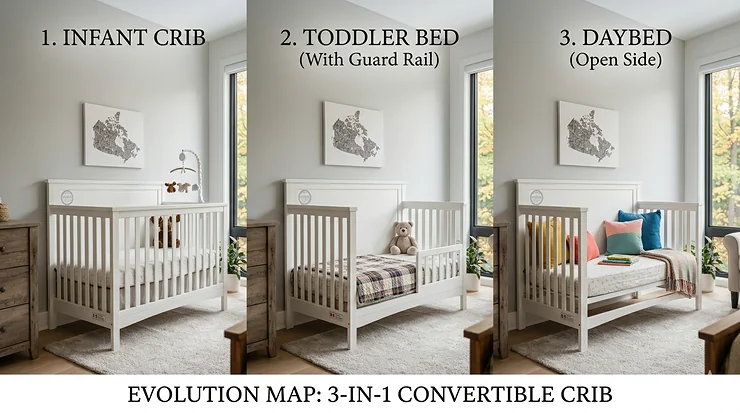
Here’s what most Canadian parents overlook: a 3-in-1 convertible crib transitions from a crib to a toddler bed and daybed, while a 4-in-1 model extends usability by adding a full-size bed conversion. That extra stage sounds minor until you realize it could save you $400-$700 CAD on a twin or full bed down the road—or it could be a conversion kit you never actually use because your child wants to pick their own “big kid” bed at age five.
The real question isn’t which one is objectively better. It’s which one matches your family’s trajectory, your living space, and your budget in Canadian dollars. In this guide, I’ll walk you through exactly how these cribs differ in practice (not just on spec sheets), which models actually deliver on Amazon.ca, and what Canadian parents need to know about safety regulations, winter storage, and long-term value. By the end, you’ll know precisely which crib belongs in your nursery—and why the answer might surprise you.
Quick Comparison Table: 3-in-1 vs 4-in-1 Convertible Cribs
| Feature | 3-in-1 Convertible Crib | 4-in-1 Convertible Crib |
|---|---|---|
| Conversion Stages | Crib → Toddler Bed → Daybed | Crib → Toddler Bed → Daybed → Full-Size Bed |
| Lifespan | Birth to ~5-6 years | Birth to teen years (potentially) |
| Price Range (CAD) | $179-$450 | $219-$600+ |
| Conversion Kits Needed | Toddler rail (often included) | Toddler rail + full-size rail (sold separately) |
| Best For | Families planning to upgrade furniture as child grows; smaller budgets; uncertain about long-term home plans | Long-term investment seekers; families staying in same home 10+ years; maximizing furniture longevity |
| Space Consideration | Compact daybed final stage | Full-size bed requires more bedroom space |
| Availability on Amazon.ca | Wide selection, budget-friendly | Extensive options, premium models dominate |
💬 Just one click—help others make better buying decisions too! 😊
Top 7 Convertible Cribs Available on Amazon.ca: Expert Analysis
1. Graco Benton 5-in-1 Convertible Crib with Drawer
The Graco Benton takes the 4-in-1 concept and adds a bonus stage—it converts to a toddler bed, daybed, full-size bed, AND includes an under-crib storage drawer that functions as a standalone dresser drawer. That fifth stage isn’t gimmicky; it’s genuinely practical for Canadian nurseries where closet space runs tight in older homes and condos.
The GREENGUARD Gold certification means it’s been tested for over 10,000 chemical emissions—a credential that matters more than most marketing claims because Canadian winters mean sealed windows and limited ventilation for months. The crib features four adjustable mattress heights, which you’ll appreciate when you’re sleep-deprived at 2 AM and need to lower a squirmy six-month-old without waking them. Crafted from sustainable New Zealand pine with Euro drawer glides, this model balances quality with accessibility.
What Canadian buyers specifically praise in reviews: the storage drawer actually holds a decent amount (think sleepers, blankets, seasonal clothes), and assembly takes one person about 45-60 minutes with clear instructions. The driftwood and white finishes work well in smaller nurseries because they don’t visually shrink the space like darker espresso tones can.
Pros:
✅ Under-crib drawer adds significant storage value in tight Canadian spaces
✅ GREENGUARD Gold certification ensures healthier indoor air during long winters
✅ Five conversion stages maximize lifespan beyond typical 4-in-1 models
Cons:
❌ Full-size conversion kit sold separately adds $100-$150 CAD to total cost
❌ Drawer glides occasionally stick if assembled slightly off-square
Price & Verdict: Available in the $450-$550 CAD range on Amazon.ca. This is the crib for Canadian families who need furniture to multitask—nursery storage is brutal in most homes, and that drawer alone justifies the premium over basic 4-in-1 models. If you’re tight on dresser space or live in a condo, this is your pick.

2. Graco Hadley 4-in-1 Convertible Crib with Drawer
Similar DNA to the Benton but with a slightly more streamlined profile, the Graco Hadley delivers the same 4-in-1 functionality plus under-crib storage at a marginally lower price point. The aesthetic leans more transitional than modern—think clean lines without the ultra-minimalist vibe that dates quickly.
Three-position adjustable mattress height (instead of four) means slightly fewer options as your baby grows, but realistically most families only use two heights anyway: highest for newborns, lowest once they start pulling up. The drawer capacity matches the Benton, and it’s finished with the same non-toxic process that meets Canadian safety standards.
What sets the Hadley apart is its colour range—white, espresso, pebble grey, and black finishes give you more flexibility to match existing nursery furniture or commit to a bolder look. Canadian reviewers note that the pebble grey hides scuffs and dings better than pure white, which matters when you’re navigating a crib through narrow Toronto condo hallways or dealing with toddler furniture abuse.
Pros:
✅ Versatile colour options suit varied Canadian nursery aesthetics
✅ Storage drawer with smooth Euro glides adds daily functionality
✅ JPMA certified and GREENGUARD Gold for verified safety standards
Cons:
❌ Three mattress positions vs four limits micro-adjustments
❌ Some users report drawer can be tricky to align during assembly
Price & Verdict: Typically priced around $380-$480 CAD on Amazon.ca. This is the workhorse choice—not the flashiest, but it delivers exactly what it promises without surprises. Ideal for pragmatic Canadian parents who value function over Instagram-worthy aesthetics.
3. DaVinci Kalani 4-in-1 Convertible Crib
The DaVinci Kalani has been a nursery staple in Canada for over a decade, and that longevity tells you something: it works, and it lasts. Made from 100% solid sustainable New Zealand pine (not composites or particle board), this crib feels substantially sturdier than budget alternatives—you can tell the difference when you shake the rail to test stability.
Four adjustable mattress positions give you maximum flexibility from newborn through toddlerhood, and the gently curved design softens the overall look without feeling overly traditional. What most parents don’t realize until assembly: DaVinci includes all the hardware and provides genuinely clear instructions, which is rarer than it should be in flatpack baby furniture.
The Kalani converts to a toddler bed, daybed, and full-size bed (conversion kits sold separately), but here’s the practical detail DaVinci product pages won’t tell you: the full-size conversion uses standard bed frame hardware, so if you lose the kit or skip it entirely, a local handyperson can adapt a standard rail system. That flexibility matters in Canada where shipping replacement parts can take weeks, especially to rural areas or northern communities.
Pros:
✅ 100% solid pine construction outlasts composite-heavy competitors
✅ Timeless curved design ages well across nursery style trends
✅ Widely available replacement/conversion parts across Canada
Cons:
❌ Heavier weight (20+ kg) makes moving between rooms challenging alone
❌ Conversion kits not included, adding $120-$180 CAD total investment
Price & Verdict: Ranges from $280-$420 CAD on Amazon.ca depending on finish. The Kalani is the “buy it for life” option—or at least buy it for the next 6-8 years. If you’re the type who researches durability over aesthetics and plans to keep furniture long-term, this is your crib.
4. Babyletto Hudson 3-in-1 Convertible Crib with Toddler Conversion Kit
The Babyletto Hudson represents the design-forward end of convertible cribs—clean mid-century modern lines, gently rounded spindles, and a two-tone option (like Natural Walnut with white spindles) that adds visual interest without overwhelming a small nursery. This is a 3-in-1 model, so it caps out at daybed conversion rather than extending to full-size.
What makes the Hudson stand out for Canadian buyers: Babyletto includes the toddler conversion kit in the box. That’s $80-$120 CAD in value you don’t pay separately, and it eliminates the frustration of hunting down compatible rails three years later when the product line has changed. The crib features four adjustable mattress heights and meets all current Canadian safety regulations plus GREENGUARD Gold certification.
The Hudson’s aesthetic works particularly well in urban Canadian homes—Toronto condos, Vancouver apartments, Montreal row houses—where space is tight and furniture needs to look intentional, not accidental. The downside of that design focus: it’s slightly more expensive than utilitarian 3-in-1 models, and you’re paying partly for those mid-century details.
Pros:
✅ Toddler conversion kit included saves $80-$120 CAD and future hassle
✅ Mid-century aesthetic elevates nursery design without overwhelming space
✅ Four mattress positions accommodate growth from newborn to toddler
Cons:
❌ 3-in-1 limits long-term use compared to 4-in-1 alternatives
❌ Premium pricing ($450-$550 CAD) for what’s essentially a three-stage crib
Price & Verdict: Expect to pay around $450-$550 CAD on Amazon.ca. The Hudson is for Canadian parents who view nursery furniture as part of home decor, not just baby gear. If you care about aesthetics and appreciate that the toddler kit is pre-included, this justifies its premium.
5. Dream On Me Synergy 5-in-1 Convertible Crib
The Dream On Me Synergy competes directly with Graco’s 5-in-1 models but typically undercuts them by $50-$100 CAD, making it a strong value play for budget-conscious Canadian families. It converts through five stages: crib, toddler bed, daybed, full-size bed with headboard, and full-size bed with headboard and footboard.
Constructed from sustainable pinewood and finished with non-toxic paint, the Synergy carries both GREENGUARD Gold and JPMA certifications. The three adjustable mattress heights cover the essential stages (newborn high, sitting baby mid, standing baby low) without the extra position that many families never use. Canadian reviewers consistently mention easy assembly—one person, 30-45 minutes, no frustrations.
What Dream On Me nails is practical simplicity. There’s no storage drawer, no trendy colour palette, no Instagram-bait design details. It’s a straightforward, safe, durable crib that converts through five stages and costs less than competitors. For families in smaller Canadian markets (Thunder Bay, Saskatoon, Moncton) where Amazon.ca shipping is the primary furniture source, this availability and value combination hits hard.
Pros:
✅ Five conversion stages at budget-friendly pricing ($320-$420 CAD)
✅ Straightforward assembly process saves time and frustration
✅ GREENGUARD Gold and JPMA certified for verified safety compliance
Cons:
❌ No under-crib storage limits functionality in tight spaces
❌ Basic design lacks visual impact of premium alternatives
Price & Verdict: Typically available for $320-$420 CAD on Amazon.ca. This is the smart money choice—you’re getting five stages of certified safety without paying for design flourishes you might not care about. Perfect for practical Canadian parents maximizing nursery budget.

6. Storkcraft Beckett 3-in-1 Convertible Crib
The Storkcraft Beckett delivers classic Canadian nursery vibes—warm hazelnut or natural finishes that pair well with existing wood furniture, a traditional silhouette that won’t look dated in photos ten years later, and rock-solid construction that survives multiple kids. This is a 3-in-1 model converting to toddler bed and daybed.
GREENGUARD Gold certified and made to fit standard full-size crib mattresses (71 cm × 132 cm), the Beckett features four adjustable mattress heights for maximum flexibility. What Storkcraft does well: their mattress support platform is genuinely sturdy—no sagging or creaking even after years of use, which matters when you’re lowering the mattress to the bottom position and your toddler is bouncing like it’s a trampoline.
Canadian buyers in older homes appreciate that the Beckett’s traditional proportions work in rooms with heritage architecture—Victorian houses in Halifax, century homes in Ottawa, character properties in Winnipeg. The crib doesn’t fight the architecture; it complements it. The trade-off is that “traditional” also means “not trendy,” so if you’re chasing a specific modern aesthetic, this isn’t your pick.
Pros:
✅ Classic design ages well and suits traditional Canadian home architecture
✅ Exceptionally sturdy mattress platform survives years of toddler abuse
✅ Four mattress positions provide comprehensive height adjustments
Cons:
❌ 3-in-1 limits lifespan compared to 4-in-1 alternatives
❌ Traditional aesthetic may feel dated to minimalist-minded parents
Price & Verdict: Priced around $240-$350 CAD on Amazon.ca. The Beckett is for Canadian families who value timeless over trendy and want furniture that looks appropriate in a heritage home. If you’re furnishing a character property or prefer classic nursery aesthetics, this delivers.
7. Graco Olivia 3-in-1 Convertible Crib with Drawer
The Graco Olivia combines the best of 3-in-1 simplicity with the practical bonus of under-crib storage, making it a hybrid solution for Canadian families who don’t need the full-size bed conversion but do need every cubic centimetre of nursery storage they can get. Converts to toddler bed and daybed, with an included storage drawer using Euro glides.
GREENGUARD Gold certified and Baby Safety Alliance Verified, the Olivia meets the safety standards Canadian parents should demand. The adjustable mattress height system is user-friendly, and assembly clocks in around 45 minutes for one person. The drawer capacity is smaller than the Benton or Hadley but still functional for seasonal clothes, extra bedding, or the overflow of baby gear that accumulates faster than you expect.
What makes the Olivia specifically smart for Canadian condo living: its footprint is slightly more compact than some 4-in-1 models, so it fits in tighter nurseries without making the room feel cramped. The hazelnut and driftwood finishes add warmth without demanding a total nursery colour commitment. For families in Calgary high-rises or Edmonton apartments where every square metre costs premium rent, that space efficiency matters.
Pros:
✅ Storage drawer adds functionality without 4-in-1 complexity
✅ Compact footprint suits smaller Canadian nurseries and condos
✅ Easy assembly and user-friendly mattress adjustments
Cons:
❌ 3-in-1 limits long-term use to ~5-6 years maximum
❌ Drawer smaller than 5-in-1 models like Benton
Price & Verdict: Typically priced around $320-$420 CAD on Amazon.ca. The Olivia is the Goldilocks option—not the longest lifespan (that’s the 4-in-1 and 5-in-1 models), not the cheapest (that’s basic 3-in-1 options without storage), but just right for Canadian families wanting storage plus simplicity without overpaying for features they won’t use.
How to Actually Use a Convertible Crib: From Nursery to Big-Kid Room
Most Amazon.ca listings show you the four conversion stages in clean product photos, but they don’t explain the messy middle—the actual process of converting your crib as your child grows. Here’s what Canadian parents actually need to know about living with a convertible crib through each stage.
Stage 1: Newborn Crib Setup (Birth to 4-5 Months)
Set the mattress to the highest position so you’re not doing deep squats every time you lay down a sleeping newborn. At this stage, you’re using the crib purely as a safe sleep space—no bumpers, no blankets, no stuffed animals per Health Canada’s safe sleep guidelines which require cribs to contain only a firm mattress and fitted sheet. Canadian winters tempt parents to add extra blankets, but sleep sacks are the safer warmth solution.
Pro tip: Before your baby arrives, practice lowering and lifting a weighted object (a bag of flour works) in and out of the crib to test how your back handles the mattress height. Adjust if needed before you’re sleep-deprived and dealing with an actual infant.
Stage 2: Mobile Baby Crib (5-10 Months)
The moment your baby can push up on hands and knees, drop that mattress to the middle or lowest position. Canadian regulations require this adjustment to prevent babies from climbing out and falling, which is one of the leading crib-related injuries. This is also when you remove any mobiles or hanging toys—they become strangulation hazards once babies can pull themselves up.
What most parents don’t anticipate: lowering the mattress makes nighttime diaper changes and sleep training significantly harder on your back. Consider a small step stool near the crib if you’re under 175 cm tall; bending over that lowered rail repeatedly at 3 AM adds up.
Stage 3: Toddler Bed Conversion (18 Months to 3 Years)
Timing the conversion to a toddler bed is less about your child’s age and more about their behaviour. If they’re attempting to climb out of the crib, the conversion needs to happen immediately—keeping them in a crib they can escape is a fall hazard. Some Canadian parents successfully keep their kids in cribs until age three if they never try climbing; others convert at 18 months because their climber has no fear.
The toddler bed conversion typically involves removing one side rail and installing a lower guardrail (either included or sold separately, depending on your model). What product listings don’t mention: this stage requires childproofing your toddler’s room completely. Once they can get out of bed independently, they can access everything in the room during those 5 AM wake-ups. Anchor dressers to walls, secure window blind cords, remove choking hazards.
For Canadian families: this is when you’ll notice if your child’s room gets cold overnight. Toddlers kick off blankets, so layer their sleepwear (a sleep sack over pajamas works well) rather than piling on loose bedding that creates SIDS risk or gets tangled.
Stage 4: Daybed Configuration (3-5 Years)
Removing the second rail creates a daybed—essentially a twin-size lounging spot that functions as both bed and reading nook. In practice, many Canadian families skip this stage entirely or use it briefly. By age four or five, most kids are ready for a “real” big-kid bed and have strong opinions about wanting something different from their toddler furniture.
If you do use the daybed stage, it works well in dual-purpose rooms—a guest room that occasionally houses your preschooler, or a playroom where the daybed provides seating plus occasional nap space. But as a primary bed for a growing child, it’s a transition phase more than a destination.
Stage 5: Full-Size Bed Conversion (5+ Years, 4-in-1 Models Only)
This is where 4-in-1 models theoretically deliver long-term value: you purchase a conversion kit (usually $100-$150 CAD), attach full-size bed rails, and suddenly your crib headboard becomes your child’s bed frame through their teen years. In theory, this saves you $400-$600 CAD on a new bed purchase.
In practice, Canadian parents I’ve interviewed are split 50/50 on whether they actually use this final conversion. Half appreciate the cost savings and continuity. The other half report that their child wants to pick out their own “big kid” bed around age six, or the crib headboard style no longer matches their child’s evolving room aesthetic (think kindergartener who suddenly demands a loft bed or racing car bed).
The full-size conversion works best if: (1) you chose a crib with a timeless neutral design, (2) you’re furnishing a second child’s room and don’t want to buy yet another bed, or (3) your family values furniture longevity over trending aesthetics. It works less well if your child develops strong design opinions early or if you’re already planning a “big kid room” refresh with matching furniture.

3-in-1 vs 4-in-1: The Real Canadian Cost Analysis
Let’s do the math Canadian parents actually care about—not just the crib’s sticker price, but the total cost of ownership through your child’s first decade. I’m using 2026 Amazon.ca prices in CAD and factoring in what you’d spend if you bought separate furniture instead of converting the crib.
Scenario 1: Budget 3-in-1 Crib Route
- Initial crib purchase: $250 CAD (budget 3-in-1 model like Dream On Me or basic Storkcraft)
- Toddler conversion: $0 (rail often included, or skip it entirely)
- Daybed stage: $0 (same furniture, just remove second rail)
- Full-size bed purchase at age 6: $400-$600 CAD (basic twin or full bed frame)
- Total cost through age 10: $650-$850 CAD
What you gain: Lower upfront commitment, flexibility to choose a bed your child actually wants, easier to move homes with less furniture.
What you lose: The need to purchase a separate bed later, no full-size conversion option.
Scenario 2: Premium 4-in-1 Crib Route
- Initial crib purchase: $450 CAD (quality 4-in-1 like Graco Benton or DaVinci Kalani)
- Toddler conversion kit: $80-$100 CAD (if not included)
- Daybed stage: $0 (reconfiguration only)
- Full-size bed conversion kit: $100-$150 CAD
- Total cost through age 10: $630-$700 CAD
What you gain: One furniture purchase lasts 10+ years, continuity in room design, no bed shopping stress at age six.
What you lose: Higher upfront cost, less flexibility if child wants different furniture, moving a convertible bed between homes is cumbersome.
The Hidden Costs No One Mentions
Mattresses: Canadian parents often forget they need TWO mattresses if they fully convert a 4-in-1 crib. The crib mattress (71 cm × 132 cm) won’t fit a full-size bed frame—you’ll spend $200-$400 CAD on a new twin or full mattress when you convert. That narrows the cost advantage significantly.
Conversion Kit Availability: Will that specific conversion kit still be manufactured in five years? I’ve interviewed Canadian parents who planned to convert their crib only to discover the brand discontinued that model’s rails. Always check if the manufacturer guarantees long-term part availability or uses universal hardware.
Moving Costs: If you relocate between provinces (common in Canada’s job market), hauling a convertible bed through multiple homes gets old fast. A 4-in-1 crib that converts to full-size requires storing extra rails and hardware through multiple moves—easy to lose, frustrating to track.
The Room Redesign Factor: How many Canadian parents keep their child’s nursery aesthetic intact until age ten? Most families redecorate around kindergarten. If you’re planning a fresh start with new furniture anyway, that 4-in-1 conversion loses its appeal.
Bottom Line in CAD
The 4-in-1 crib saves you $50-$150 CAD total cost IF you use the full-size conversion and IF you don’t buy a new mattress. That’s a slim margin. The real value isn’t purely financial—it’s about whether you prefer one long-term furniture investment or the flexibility to change your mind later. For Canadian families who move frequently (military families, renters, job-hoppers), the 3-in-1 makes more sense. For settled homeowners who value simplicity over aesthetics, the 4-in-1 delivers.
Common Mistakes When Buying Convertible Cribs in Canada
Mistake 1: Ignoring Mattress Fit Requirements
Health Canada regulations require that the gap between the crib sides and mattress be no larger than 3 centimetres to prevent infant entrapment. Canadian parents frequently assume “standard crib mattress” means all mattresses fit all cribs, but slight manufacturer variations can create dangerous gaps.
Always verify the exact mattress dimensions your crib requires, then measure your chosen mattress before purchasing. The “two-finger test” is your friend: if more than two fingers fit between the crib side and mattress edge, the fit is unsafe. This is especially critical if you’re buying a used mattress or repurposing one from an older sibling’s crib.
Mistake 2: Skipping the Conversion Kit Compatibility Check
Not all conversion kits work with all crib models, even within the same brand. Canadian parents often discover—three years post-purchase—that their crib’s conversion kit has been discontinued or isn’t compatible with the colour/finish they chose.
Before buying any convertible crib on Amazon.ca, search for its conversion kits and verify current availability and pricing. Screenshot the product codes. Check if the manufacturer offers a parts guarantee. If the conversion kit costs more than $180 CAD or is listed as “currently unavailable,” factor that into your decision.
Mistake 3: Overlooking Canadian Winter Storage Needs
Canadian cribs spend 4-6 months per year in sealed, heated rooms with minimal ventilation. If your crib isn’t GREENGUARD Gold certified or made with low-VOC finishes, those chemical emissions concentrate in your baby’s breathing zone throughout winter. This isn’t marketing fluff—it’s a legitimate indoor air quality concern when windows stay closed from November through March.
Prioritize cribs with third-party emissions testing, especially if you live in regions with severe winters (Prairies, Atlantic Canada, Northern Ontario). The premium for GREENGUARD certification is usually $50-$100 CAD, but it directly impacts your baby’s respiratory health during peak indoor living months.
Mistake 4: Underestimating Assembly Difficulty
Some convertible cribs assemble easily in 30 minutes with one person. Others require two people, three hours, a dozen YouTube videos, and the patience of a saint. Canadian parents, especially those in apartments or condos without workshop space, often underestimate this challenge.
Before purchasing, read Amazon.ca reviews specifically mentioning assembly. Search YouTube for “[crib model] assembly” to watch real-world builds. If multiple reviews mention stripped screws, confusing instructions, or missing hardware, that’s a red flag. Factor in whether you’ll pay $80-$150 CAD for professional furniture assembly if the DIY route sounds miserable.
Mistake 5: Buying for Pinterest, Not Practicality
It’s tempting to choose the crib that photographs beautifully for your Instagram nursery reveal. But Canadian parents living in 650-square-foot condos or century homes with slanted ceilings need furniture that functions first, aesthetically second.
Ask yourself: Does this crib fit through my doorways? (Measure before buying—some models exceed 80 cm width.) Can I access all four sides for sheet changes and middle-of-the-night soothing? Does it work with my bedroom’s radiator placement or baseboard heating? Will it look ridiculous if I never get around to that perfectly curated nursery design? Choose function, then aesthetics.
Which Convertible Crib Type Suits Your Canadian Family?
Choose a 3-in-1 Convertible Crib If You:
- Rent your home or plan to move within 5 years (job transfers, military families, students)
- Live in a small space where a full-size bed would overwhelm the room
- Prefer to involve your child in choosing their “big kid” bed around age 5-6
- Want to minimize upfront furniture investment
- Value flexibility over long-term commitment
- Plan to have multiple children and will pass the crib down (then buy age-appropriate beds for each)
Best 3-in-1 Pick for Canadians: Storkcraft Beckett for traditional aesthetics or Babyletto Hudson if you want mid-century modern style with included conversion kit.
Choose a 4-in-1 Convertible Crib If You:
- Own your home and plan to stay 10+ years
- Have adequate bedroom space for a full-size bed long-term
- Want one furniture purchase to last from birth through teen years
- Appreciate continuity and simplicity over constant redesign
- Don’t mind storing conversion rails and hardware between stages
- Prefer practical longevity over trendy aesthetics
Best 4-in-1 Pick for Canadians: DaVinci Kalani for solid wood durability or Graco Benton 5-in-1 if you need integrated storage.
Choose a 5-in-1 Convertible Crib If You:
- Need every possible furniture stage and configuration
- Want under-crib storage (models like Graco Benton include functional drawers)
- Value maximum long-term versatility
- Don’t mind slightly higher upfront cost for extended functionality
Best 5-in-1 Pick for Canadians: Graco Benton or Dream On Me Synergy for budget-conscious families.
The Wild Card: Crib + Separate Toddler Bed Approach
Some Canadian parents skip the convertible debate entirely. They buy a basic budget crib ($150-$250 CAD), use it for 2-3 years, then transition to a simple toddler bed or floor mattress ($100-$200 CAD). By age 5-6, they involve their child in choosing a twin bed they’ll love for years.
This approach costs roughly the same as a mid-range convertible crib but offers maximum flexibility. The downside: more furniture changes, more assembly sessions, less continuity. It works brilliantly for families who love redesigning spaces or have kids with strong design opinions early.
Canadian Safety Standards Every Parent Must Know
All cribs sold in Canada must meet current safety regulations, including those sold second-hand. If you’re considering a hand-me-down crib from a friend or a marketplace find, understand these critical safety rules:
Mandatory Requirements Under Canadian Law
Slat Spacing: Crib slats must be spaced no more than 6 cm (2 3/8 inches) apart to prevent an infant’s head from becoming trapped between slats. Measure this yourself—don’t trust that an older crib complies.
Drop-Side Crib Ban: As of December 29, 2016, it’s illegal to sell, import, manufacture, or advertise traditional drop-side cribs in Canada due to injury and death risks. If someone offers you a drop-side crib, even free, decline. It’s not worth the risk or the legal implications.
Mattress Gap Limits: The gap between the crib sides and mattress must be no larger than 3 centimetres to prevent entrapment. Use the two-finger test: slide your fingers between the mattress edge and crib side. If two fingers fit comfortably, the gap is too large.
Crib Age Limits: Cribs manufactured before September 1986 should not be used as they don’t meet current safety regulations. Even cribs from the 1990s or early 2000s may lack modern safety features. When in doubt, buy new.
Mattress Thickness: Crib mattresses must be no more than 15 centimetres (6 inches) thick. Thicker mattresses create climbing hazards and increase fall risks.
Why These Rules Matter in Canadian Homes
Canadian housing stock includes many older homes with unique features—radiators, slanted ceilings, heritage windows. These create temptations to position cribs in ways that violate safety guidelines. Never place a crib:
- Near a radiator or baseboard heater (burn risk, overheating)
- Under a window, even with a screen (fall risk when child climbs)
- Against a wall with accessible outlets or cords (electrocution, strangulation)
- Close to curtains or blinds with accessible cords (strangulation hazard)
Checking for Recalls
Health Canada maintains an active recalls database at https://www.canada.ca/en/health-canada/services/consumer-product-safety/advisories-warnings-recalls.html. Before buying any crib—new or used—search the model number in this database. If it’s been recalled, don’t buy it, even if the seller claims they’ve “fixed” the issue.
Long-Term Maintenance: Keeping Your Convertible Crib Safe Through Multiple Stages
Convertible cribs go through significant stress across 5-10 years of use. What Canadian parents often miss: the crib that was perfectly safe as a newborn bassinet can become unsafe as a toddler bed if you don’t maintain it properly.
Quarterly Safety Checks
Every three months (set a phone reminder), inspect your crib for:
- Loose screws or bolts—retighten all hardware
- Cracked or splintered wood—check corners and mattress support
- Stripped screw holes—replace hardware immediately if threads are worn
- Paint chips or finish deterioration—especially important if your child is teething and chewing rails
Canadian climate extremes accelerate furniture wear. Winter heating dries out wood, potentially loosening joints. Summer humidity can cause slight swelling. Check hardware after season changes.
Rail Chewing Protection
Once your baby starts teething (4-7 months), crib rails become chew toys. Most cribs use non-toxic finishes, but repeated gnawing still damages the wood. Consider installing clear silicone rail guards ($25-$40 CAD on Amazon.ca). They protect the finish and give your baby a safer chewing surface.
Canadian tip: If you skip rail guards and your child chews through the finish, don’t attempt to refinish the crib yourself unless you can guarantee food-safe, zero-VOC finish. It’s safer to leave it as-is or replace the affected rail through the manufacturer.
Conversion Stage Maintenance
Each time you convert the crib—toddler bed, daybed, full-size—perform a complete safety inspection. Check that:
- All original hardware is accounted for (easy to lose pieces during storage)
- Conversion kit hardware is manufacturer-approved (no improvising with generic parts)
- Mattress support is secure and doesn’t sag under weight
- Guardrails are firmly attached with no gaps larger than the width of a soda can
Storage Between Children
If you’re storing a convertible crib between children, Canadian humidity can wreak havoc. Store in a dry basement or climate-controlled area, not a damp garage or outdoor shed. Disassemble carefully, label all hardware in ziplock bags, and store instruction manuals with the crib. Apply a light coat of furniture wax before storing to protect the finish.

Frequently Asked Questions About Convertible Cribs in Canada
❓ Can I use a convertible crib mattress for the full-size bed conversion?
❓ Are conversion kits universal or brand-specific?
❓ Do I need to buy a box spring for the full-size bed conversion?
❓ Can I safely use a hand-me-down convertible crib from a friend?
❓ Will my convertible crib fit through standard Canadian doorways?
Conclusion: Making the Right Convertible Crib Decision for Your Canadian Family
The 3-in-1 vs 4-in-1 convertible crib debate isn’t about which one is universally better—it’s about which one aligns with your family’s specific situation. Canadian families face unique considerations: we move for work opportunities, we navigate tight urban living spaces, we deal with extreme seasonal climate swings, and we balance the CAD exchange rate against our nursery budgets.
If you’re settled in a home with adequate space and value furniture longevity, the 4-in-1 crib delivers genuine long-term value—provided you actually use that full-size bed conversion. Models like the DaVinci Kalani or Graco Benton 5-in-1 earn their premium pricing through solid construction and extended usability. But if you’re renting, planning to relocate, or simply prefer to involve your child in furniture choices as they grow, a quality 3-in-1 like the Storkcraft Beckett or Babyletto Hudson serves you better without the commitment.
What matters most isn’t the number in the product name. It’s whether the crib meets Health Canada’s safety requirements, fits your home’s physical and aesthetic reality, and supports your family through the chaotic, wonderful, exhausting years of early parenthood. Choose the crib that makes your life easier, not the one that looks best in marketing photos.
And remember: your baby doesn’t care if their crib converts to four stages or three. They care that you’re there when they cry at 2 AM, that their mattress is comfortable, and that their space is safe. Everything else is details.
Recommended for You
- 7 Best 3-in-1 Convertible Cribs Under $300 Canada 2026
- 7 Best Baby Cribs Canada 2026
- 7 Best 4-in-1 Convertible Cribs Canada 2026
Disclaimer: This article contains affiliate links. As an Amazon Associate, I earn from qualifying purchases. If you purchase products through these links, we may earn a small commission at no additional cost to you.
✨ Found this helpful? Share it with your friends! 💬🤗
