
In This Article
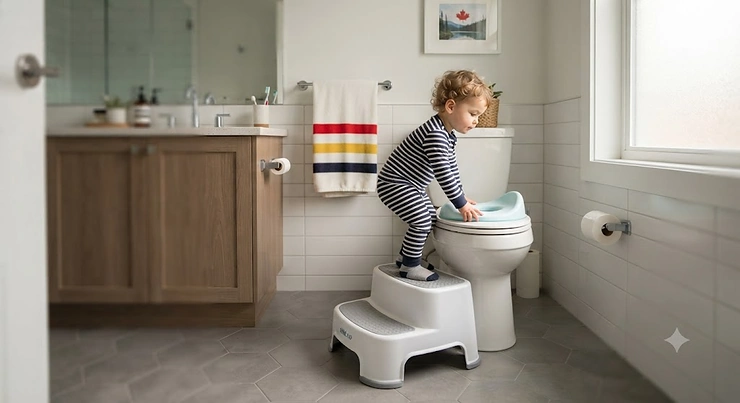
Picture it. A 27-month-old perched on an adult toilet, legs dangling like a tiny commuter on a bar stool, knuckles white on the seat rim. Nothing is happening. Nothing will happen, because a child who feels like they might fall in can’t relax enough to go.
Now slide a step stool for potty training under those feet. Knees come up, the body tilts forward, the grip loosens. Suddenly the whole exercise looks less like a hostage situation and more like, well, using the bathroom.
That is the quiet genius of a good stool. It costs less than a family pizza night, yet it solves three problems at once: getting up there, staying steady, and pushing effectively once seated. The Canadian Paediatric Society’s toilet learning guidance explicitly pairs a toilet seat adapter with a footstool for exactly this reason, and notes most kids begin toilet learning somewhere between 2 and 4 years old.
So what is a step stool for potty training? It’s a low, stable platform — usually 13-35 cm tall — that lets a toddler climb onto a full-size toilet independently and rest their feet flat while seated, creating the knees-up posture that makes bowel movements easier and helps kids feel secure rather than suspended.
The trouble is that Amazon.ca is stuffed with near-identical plastic stools, and the differences that matter — grip under wet socks, true stool weight capacity, whether the thing skates across tile — rarely make the listing photos. This guide cuts through that. I’ve compared seven real products on published specs, cross-checked them against aggregated review themes, and filtered it all through Canadian safety guidance. You’ll get the numbers, sure. More usefully, you’ll get what those numbers mean at 7 a.m. when your kid announces, urgently, that it’s time.
Quick Comparison Table: Top Step Stools at a Glance
| Product | Type | Approx. Height | Published Capacity | Price Range (CAD) | Best For |
|---|---|---|---|---|---|
| Dreambaby Step Stool | Single step, contoured | ~14-16 cm | 80 kg (176 lb) | Around C$15-C$25 | Dreambaby Step Stool: tight budgets, toilet-hugging fit |
| BabyBjörn Step Stool | Single step | 15 cm | Not published | Around C$25-C$35 | BabyBjörn Step Stool: best grip on wet feet |
| Squatty Potty Kids Toilet Stool | Base + locking riser | Adjustable | 113 kg (250 lb) | Around C$35-C$50 | Squatty Potty Kids Toilet Stool: posture-focused parents |
| Dreambaby 2-Up Step Stool | Two step | Taller two-level | 80 kg (176 lb)* | Around C$25-C$35 | Dreambaby 2-Up Step Stool: toilet + sink combo |
| Utopia Home Folding Step Stool | Folding, single | ~23 cm | 136 kg (300 lb) | Around C$20-C$30 | Utopia Home Folding Step Stool: small bathrooms, travel |
| GrowthPic Potty Seat with Step Stool Ladder | Seat + ladder | Adjustable footrest | 68 kg (150 lb) | Around C$55-C$85 | GrowthPic Potty Seat with Step Stool Ladder: nervous climbers |
| Bowdanie Wooden Toddler Step Stool | Two-step wood | ~33 cm | 136 kg (300 lb) | Around C$50-C$80 | Bowdanie Wooden Toddler Step Stool: long-term family use |
*Some Dreambaby listings quote 90 kg (200 lb); check the box on the version you receive. Prices are approximate at the time of research and may vary — check current price.
Reading across the table, the budget single-step models — the Dreambaby Step Stool and BabyBjörn Step Stool — cover the core job of foot support for the least money, while the Squatty Potty Kids Toilet Stool is the only option built specifically around toilet posture with adjustable height. If your bathroom doubles as the tooth-brushing station, the extra reach of the Dreambaby 2-Up Step Stool or Bowdanie Wooden Toddler Step Stool earns its keep. And the GrowthPic Potty Seat with Step Stool Ladder is a different animal entirely: more money, more bulk, but the most security for a child who is genuinely scared of the big toilet.
💬 Just one click — help others make better buying decisions too!😊
Top 7 Step Stools for Potty Training: Expert Analysis
1. Dreambaby Step Stool — best budget pick that hugs the toilet
The Dreambaby Step Stool earns its spot through one smart design choice: a contoured front edge that curves around the base of the toilet, so the stool tucks in closer than a flat rectangle ever could.
On the spec sheet, it measures roughly 25 x 37 x 16 cm, weighs about half a kilogram, and carries a published 80 kg (176 lb) limit. In practice, the light weight means your toddler can drag it from toilet to sink without help, and the contour puts their feet directly under their knees instead of 10 cm too far forward. The top is covered in raised rubber grip dots, and there are rubber pads underneath to keep it from sliding on tile.
My honest analytical take: this is the stool I’d point most first-time parents toward, because it does the essential job without pretending to be more. It’s low, though. At well under 20 cm, it helps with foot support on a standard-height toilet but won’t get most two-year-olds to a vanity sink.
Aggregated review sentiment on major retailers is strongly positive and backed by an unusually large review base; the most common complaint is exactly that height limitation, with some parents buying a second, taller stool for the sink.
Pros:
- ✅ Contoured shape sits snugly against the toilet base
- ✅ Light enough for toddlers to move themselves
- ✅ Rubber grip dots on top plus non-slip feet
Cons:
- ❌ Too short for most bathroom sinks
- ❌ Thin plastic feels less premium than pricier options
Usually found around C$15-C$25 (check current price), it’s the best value-per-dollar entry point on this list.
2. BabyBjörn Step Stool — best grip for wet, fidgety feet
The BabyBjörn Step Stool is what happens when a Swedish design team obsesses over one problem: small, damp feet slipping off plastic.
Per BabyBjörn, the stool is 35 x 24 x 15 cm, weighs 550 g, and is made from recyclable, BPA-free, PVC-free polypropylene. The step surface is non-slip rubber rather than moulded dots, and rubber edging runs around the base. What that means on your bathroom floor: the whole top is grippy, not just scattered patches, which matters when a kid climbs down straight from the bath with wet soles.
Based on the spec comparison, this one trades height for stability. At 15 cm, it’s firmly a foot-support stool rather than a reach stool. BabyBjörn doesn’t publish a maximum load, and it declines to give an age recommendation, noting children develop at different rates — an honest answer, but one that leaves stool weight capacity an open question if an adult plans to borrow it.
Reviewers consistently praise the grip and the stool’s rock-solid feel; the recurring gripe is price relative to simpler plastic stools.
Pros:
- ✅ Full rubber step surface grips even wet feet
- ✅ BPA-free, PVC-free, recyclable material
- ✅ Comes with a two-year manufacturer guarantee
Cons:
- ❌ No published maximum weight capacity
- ❌ Low height limits sink access
Expect roughly C$25-C$35 at the time of research; you’re paying a small premium for noticeably better traction.
3. Squatty Potty Kids Toilet Stool — best for posture and constipation-prone kids
The Squatty Potty Kids Toilet Stool takes the brand’s adult “squat” concept and shrinks it into a puppy- or bear-cub-shaped stool with a locking riser.
It’s rated for 250 lb (about 113 kg), and the version with the riser lets you add height as your child’s legs change — or subtract it when they finally hit a growth spurt. Two non-skid stepping surfaces help with the climb, and the cartoon “ears” double as carry handles. The real-world meaning of that adjustability is simple: you get the right knee angle for a 2-year-old and a 5-year-old from the same product.
This is my pick for families dealing with withholding or hard stools, because foot position genuinely affects how easily a child can push. That said, it’s bulkier than a flat stool, so measure the gap in front of your toilet first.
Aggregated review sentiment highlights that kids are drawn to the animal designs (a real advantage when motivation is the battle), with some reviewers noting the footprint is larger than expected in compact bathrooms.
Pros:
- ✅ Locking riser adjusts height as child grows
- ✅ High 113 kg (250 lb) rated capacity
- ✅ Playful design helps reluctant potty users
Cons:
- ❌ Larger footprint than single-step stools
- ❌ Priced above basic plastic alternatives
Typically around C$35-C$50 (check current price) — worth it if posture is your main problem.
4. Dreambaby 2-Up Step Stool — best two-level stool for toilet and sink
The Dreambaby 2-Up Step Stool solves the most common complaint about its single-step sibling: it’s actually tall enough for the sink.
The two-step design gives a lower tread for climbing and a higher platform for reach, both with non-slip surfaces. Dreambaby lists capacity at 80 kg (176 lb), though some product copy quotes 90 kg (200 lb), so treat the lower figure as your working number. In everyday terms, the lower step handles the toilet climb while the top step gets little hands under the tap for the post-potty wash — which makes the whole routine a single, unbroken sequence.
Here’s what to weigh: two-step stools are brilliant for toilet training independence, but the top step is higher off the ground, which raises the stakes on supervision in the early weeks. For kids under two, I’d lean toward single-step models first.
Reviewers generally report it feels sturdy and stays put, with the main trade-off being a larger footprint that doesn’t fold. Dreambaby also offers free spare parts for three years when purchased directly from the brand.
Pros:
- ✅ Reaches both toilet and most vanity sinks
- ✅ Non-slip treads on both levels
- ✅ Spare parts support from the manufacturer
Cons:
- ❌ Doesn’t fold for storage
- ❌ Higher top step needs closer supervision
Around C$25-C$35 at the time of research; strong value if you want one stool doing two jobs.
5. Utopia Home Folding Step Stool — best space-saver for small bathrooms
The Utopia Home Folding Step Stool is the stool for condo bathrooms where every centimetre of floor is already spoken for.
It stands roughly 23 cm (9 in) tall, folds nearly flat, and carries a published 300 lb (136 kg) capacity — the highest of any plastic model here. A pop-up handle makes it easy to carry, and grippy dots cover the step. What that combination means: a parent can stand on it to reach a high shelf, then fold it behind the door before anyone trips over it at night.
Honestly, folding stools always introduce one extra variable: the hinge. This one locks open with firm pressure, but you should teach your child to only climb it once it’s fully clicked open, and check it periodically. It’s also the natural choice for grandparents’ houses or cottage weekends, since it slides into a tote bag.
Aggregated review sentiment is positive on portability and strength; some reviewers find the step surface smaller than fixed stools, which matters for wobbly early climbers.
Pros:
- ✅ Folds flat for storage or travel
- ✅ Highest plastic capacity at 136 kg (300 lb)
- ✅ Usable by adults as well as kids
Cons:
- ❌ Hinge adds a failure point to monitor
- ❌ Smaller step surface than fixed stools
Usually around C$20-C$30 (prices may vary), it’s an excellent secondary or travel stool.
6. GrowthPic Potty Seat with Step Stool Ladder — best for nervous or very young climbers
The GrowthPic Potty Seat with Step Stool Ladder isn’t really a stool at all; it’s a staircase with a built-in toddler seat and handrails.
It measures about 66 x 40 cm, supports up to 150 lb (68 kg), and includes side rails, an adjustable footrest, an anti-slip base, and a seat reducer that fits standard and elongated toilets. Real-world translation: your child climbs, turns, sits, and stays surrounded by something to hold at every stage, which is precisely what a frightened child needs.
Based on the design, this is the strongest choice for children under about 30 months or any child whose hesitation is clearly fear-based. The trade-off is bulk. It occupies the toilet full time, so adults must lift or swing it aside, and that friction can annoy households with one bathroom.
Parent reviews and editorial roundups repeatedly mention kids’ confidence improving with the rails; common complaints involve assembly time and the space it eats up.
Pros:
- ✅ Handrails provide security while climbing and sitting
- ✅ Integrated seat reducer and adjustable footrest
- ✅ Fits both round and elongated toilets
Cons:
- ❌ Bulky; must be moved for adult use
- ❌ Requires assembly out of the box
Generally around C$55-C$85 at the time of research — pricier, but it replaces both a seat insert and a stool.
7. Bowdanie Wooden Toddler Step Stool — best long-life wooden option
The Bowdanie Wooden Toddler Step Stool is for parents who want something that looks like furniture and will still be in use when their kid is nine.
It’s a two-step wooden design standing about 33 cm tall, with a published 300 lb (136 kg) capacity and optional carpet-style liners on the steps. The height gets most preschoolers comfortably to a standard vanity, while the wood mass makes it far less likely to shift when a child steps onto one edge.
My analytical view: wood’s weight is both its superpower and its weakness. It’s stable, but a toddler can’t easily reposition it alone, so it’s best parked in one spot — ideally at the sink — with a lighter plastic stool doing duty at the toilet. Wooden surfaces also need those liners (or grip tape) in a wet bathroom; bare lacquered wood and damp feet don’t mix.
Reviewers consistently describe it as sturdy and attractive; the recurring caveats are weight and the need to keep the treads covered for grip.
Pros:
- ✅ Very stable, 136 kg (300 lb) capacity
- ✅ Tall enough for most bathroom sinks
- ✅ Durable wood lasts years beyond potty training
Cons:
- ❌ Too heavy for toddlers to move alone
- ❌ Needs liners for grip when wet
Found around C$50-C$80 (check current price) — the best long-term cost per year on this list.
Top 7 Head-to-Head: Specs That Matter
| Product | Height Level | Grip Type | Capacity | Moves Easily? | Best For |
|---|---|---|---|---|---|
| Dreambaby Step Stool | Low | Rubber dots + feet | 80 kg | Yes | Dreambaby Step Stool: toilet foot support |
| BabyBjörn Step Stool | Low | Full rubber top | Not listed | Yes | BabyBjörn Step Stool: wet-feet grip |
| Squatty Potty Kids Toilet Stool | Adjustable | Non-skid steps | 113 kg | Moderately | Squatty Potty Kids Toilet Stool: posture |
| Dreambaby 2-Up Step Stool | Medium-tall | Non-slip treads | 80 kg | Moderately | Dreambaby 2-Up Step Stool: toilet + sink |
| Utopia Home Folding Step Stool | Medium | Grip dots | 136 kg | Yes, folds | Utopia Home Folding Step Stool: tiny spaces |
| GrowthPic Potty Seat with Step Stool Ladder | Toilet-height | Anti-slip base | 68 kg | No | GrowthPic Potty Seat with Step Stool Ladder: fearful kids |
| Bowdanie Wooden Toddler Step Stool | Tall | Liners | 136 kg | No | Bowdanie Wooden Toddler Step Stool: long-term sink use |
The pattern jumps out: the more a stool weighs and the taller it stands, the less your toddler can move it — and the more stable it becomes. That’s why the smartest setup in many homes is a pairing, like the Dreambaby Step Stool at the toilet and the Bowdanie Wooden Toddler Step Stool at the sink. If you’re only buying one, the Squatty Potty Kids Toilet Stool offers the widest range of adjustment for the money.
✨ Don’t Miss These Top Picks!
Take your potty training routine to the next level with these carefully selected stools. Click on any highlighted product to check current pricing and availability on Amazon.ca. The right stool can turn a nightly standoff into a proud “I did it myself!” moment your whole family will celebrate.
Setting Up Your Step Stool for Potty Training: A Practical Usage Guide
Buying the stool is the easy part. Setting it up well is where most families quietly lose a week.
Day 1: Position and test
Place the stool so your child’s feet land flat with knees slightly above hips once they’re seated on the insert. On a standard Canadian toilet, that usually means the stool front edge sits 5-10 cm from the bowl base. Then do the “wobble test”: press hard on each corner. If anything rocks, flip the stool and check for debris or a warped pad.
Week 1: Practise the climb, not the pee
Let your child practise getting on and off while fully clothed. It sounds silly. It isn’t. A kid who has rehearsed the sequence — step, turn, bum back, sit — doesn’t panic when the real urge hits.
Maintenance schedule
- Daily: Wipe the top; urine splashes make grip surfaces slick.
- Weekly: Wash with warm soapy water, including the rubber feet — soap film and dust reduce traction.
- Monthly: Inspect hinges (folding models), riser locks (Squatty Potty Kids Toilet Stool), and liners (Bowdanie Wooden Toddler Step Stool).
Common mistakes in the first 30 days
- Placing the stool on a bath mat. Mats slide; stools on mats slide faster.
- Using a tall two-step stool before the child has mastered a low one.
- Removing the stool too early once they “get it.” Foot support still helps bowel movements.
- Leaving the stool as the only route to the sink, forcing risky reaching over the toilet.
A small optimization trick: put a strip of coloured tape on the floor marking the stool’s “home.” Kids love returning things to a designated spot, and you’ll stop finding it in the hallway.
Real-World Scenarios: Matching Families to the Right Stool
Specs are abstract. Families aren’t. Here are three common profiles and the reasoning behind each match.
Scenario 1: The Toronto condo, one tiny bathroom, a 2.5-year-old
Budget: under C$30. Space: roughly 40 cm between toilet and tub. Frequency: 6-8 trips a day.
The Utopia Home Folding Step Stool fits here because it disappears when adults need the floor, and its 136 kg capacity means a parent can stand on it too. Pair it with the Dreambaby Step Stool if the budget stretches — contoured for the toilet, while the folding stool handles the sink.
Scenario 2: The Calgary family, two kids, one constipation-prone
Budget: flexible. Space: a standard family bathroom. Frequency: constant, plus a younger sibling coming up.
The Squatty Potty Kids Toilet Stool is the clear pick. Its adjustable riser tunes knee angle for a child who struggles to push, and the high capacity means it’ll serve the younger sibling next. The playful design doesn’t hurt either when you’re negotiating with a strong-willed four-year-old.
Scenario 3: The nervous 22-month-old in Halifax
Budget: around C$60-C$80. Space: ample. Frequency: just starting.
The GrowthPic Potty Seat with Step Stool Ladder earns the spend. A child this young and this hesitant needs rails, not just a platform. Once confidence builds — often within a few months — you can transition to the BabyBjörn Step Stool and a separate seat insert.
The lesson running through all three? Choose for the child you have, not the child in the product photo.
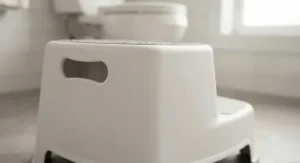
Problem → Solution: Fixing Common Step Stool Headaches
Even a good step stool for potty training can create new wrinkles. Here are the most frequent ones and what actually fixes them.
Problem 1: The stool slides on tile. Solution: Clean the rubber feet — soap residue is the usual culprit. If it still moves, choose a model with full-perimeter rubber edging like the BabyBjörn Step Stool, or add a small non-slip pad cut to size underneath (never a loose mat).
Problem 2: My child refuses to climb onto the “big toilet.” Solution: Fear is common, and pushing tends to backfire. Step back to a potty chair or try a railed ladder like the GrowthPic Potty Seat with Step Stool Ladder. Let them sit clothed first. Praise the climb itself.
Problem 3: Straining and long sits on the toilet. Solution: Check foot position. Dangling or tiptoeing feet make pushing harder. Raise the platform with the riser on the Squatty Potty Kids Toilet Stool until knees sit above hips.
Problem 4: The stool is perfect for the toilet but useless at the sink. Solution: Add a second, taller stool rather than making the child climb onto the vanity. The Dreambaby 2-Up Step Stool or Bowdanie Wooden Toddler Step Stool closes that gap.
Problem 5: A sibling or adult keeps using it. Solution: Check stool weight capacity before anyone heavier steps on. If adults will share it, the 136 kg-rated Utopia Home Folding Step Stool is designed for that.
How to Choose a Step Stool for Potty Training
Choosing well comes down to six decisions. Work through them in order and the right stool usually picks itself.
- Measure the toilet height and the floor gap. Most standard toilets sit around 38-43 cm; “comfort height” models run taller. A taller bowl means you’ll want a taller or adjustable stool.
- Decide on the job: foot support, reach, or both. Low single steps (around 15 cm) handle foot support; two-step or 30 cm+ models reach sinks.
- Prioritize grip over looks. Look for full rubber tops or dense grip dots, plus rubber feet underneath. Wet feet are the norm, not the exception.
- Check the published stool weight capacity. A missing figure isn’t necessarily a red flag, but a clear rating helps if siblings or adults share.
- Consider who moves it. Light plastic stools support independence; heavy wooden ones stay put.
- Think about storage. In small bathrooms, folding designs win; in family bathrooms, a fixed stool is more stable.
- Match it to your child’s temperament. Anxious kids benefit from rails; confident climbers just need a platform.
Canada’s AboutKidsHealth resource from SickKids makes the underlying point plainly: whichever setup you choose, your child needs good support for their feet. Every one of the seven criteria above is really a way of delivering that support safely.
Stool Weight Capacity: What the Numbers Actually Mean
Here’s something the listings never explain. A toddler weighs perhaps 12-17 kg. So why does it matter whether a stool is rated for 68 kg or 136 kg?
Three reasons.
First, dynamic load. A child who jumps down, or stomps up in a mood, puts far more force through the stool than their body weight at rest. A higher stool weight capacity means more margin for those moments.
Second, sharing. Older siblings borrow stools. Parents stand on them to reach the top cupboard. A stool rated at 136 kg (300 lb), like the Utopia Home Folding Step Stool or Bowdanie Wooden Toddler Step Stool, handles that; a 68 kg ladder like the GrowthPic Potty Seat with Step Stool Ladder is strictly for kids.
Third, ageing plastic. Polypropylene can become more brittle over years of cleaning and temperature swings — think of a stool stored in a cold garage over a prairie winter. Starting with a generous rating builds in a buffer.
What to be careful about: capacity figures vary between listings of the same product (Dreambaby quotes both 80 kg and 90 kg on the 2-Up), and some brands, like BabyBjörn, don’t publish one at all. When in doubt, use the lowest number you see and don’t let adults stand on a stool without a stated rating.
The practical rule? For a toddler-only stool, anything rated 50 kg or above is plenty. For a shared family stool, look for 100 kg or more.
Non-Slip Bathroom Stools: Why Grip Design Matters Most
If you only compare one feature, compare grip. Bathrooms are the slipperiest room in any home, and non-slip bathroom stools are only as good as their two contact points: the top surface and the feet.
The top surface
There are three common approaches. Moulded grip dots (the Dreambaby Step Stool uses them) provide texture across most of the surface. Full rubber tops, like the BabyBjörn Step Stool, cover the whole tread, so there’s no smooth patch for a heel to land on. Carpet-style liners, as on the Bowdanie Wooden Toddler Step Stool, add comfort and grip but need drying and regular washing.
The feet
Rubber feet or edging are non-negotiable on tile. A stool with bare plastic legs is essentially a sled. Full-perimeter rubber tends to outperform four small pads, because weight is spread and there’s no single pivot point.
What to test at home
Wet your hand and press down at an angle on the top surface. If your palm slides, a damp foot will too. Then push the stool sideways on dry tile; it should resist rather than glide.
The best non-slip bathroom stools earn their name only when they’re kept clean. Soap scum, talcum powder, and hair all quietly erase traction. A 30-second weekly wipe restores most of it.
Step Stools for Toilet Access vs Potty Chairs
This is the big fork in the road, and there’s no single right answer.
Potty chairs sit on the floor. The Canadian Paediatric Society notes children may feel more stable on a potty chair because their feet touch the ground. That’s a real advantage for very young or anxious kids.
Step stools for toilet access, paired with a seat insert, take a different path. They skip the transition entirely: your child learns on the toilet they’ll use for life. No emptying bowls. No second transition months later. And they work everywhere, from daycare to Grandma’s.
| Approach | Stability | Cleanup | Transition Needed? | Portability | Best For |
|---|---|---|---|---|---|
| Step stool + seat insert (e.g., Squatty Potty Kids Toilet Stool) | High with good stool | Flush and done | No | Good | Confident kids 2.5+ |
| Railed ladder seat (GrowthPic Potty Seat with Step Stool Ladder) | Very high | Flush and done | No | Poor | Nervous toddlers |
| Floor potty chair | Very high | Empty and wash bowl | Yes | Good | Kids under ~2, early starters |
| No stool, adult toilet only | Low | Flush | No | N/A | Not recommended for toddlers |
The table makes the trade-off visible: floor potties win on stability but cost you a messy bowl and a second transition, while step stools for toilet access win on long-term simplicity. Many families use both — a potty chair for the first few weeks, then a stool like the Dreambaby Step Stool once the child is comfortable. The one clear loser is skipping foot support entirely.
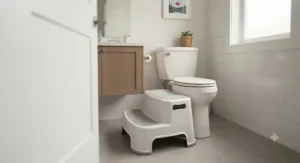
Toilet Training Independence: How the Right Stool Builds Confidence
Toddlers crave control. Almost everything in their day is decided for them — what to wear, when to leave the park, which cup is “the blue cup.” The bathroom is one of the first places they can own a routine start to finish.
A stool makes that possible. When your child can climb up, sit, wipe (with help), flush, climb down, and reach the sink alone, you’re not just training a bladder. You’re building toilet training independence, which is what actually makes the habit stick.
How to design for independence
- Choose a stool your child can move themselves, like the Dreambaby Step Stool or Utopia Home Folding Step Stool.
- Keep soap, a low towel hook, and the stool in a consistent spot.
- Use a picture chart of the steps at child eye level.
Resist the urge to hover
It’s tempting to lift your child onto the toilet “to save time.” Doing so tells them the job isn’t theirs. Let them climb, even when it takes 40 seconds.
Supervision still matters — independence means doing it themselves, not doing it unattended at age two. But the goal is steady withdrawal. Over weeks, move from standing beside them, to standing at the door, to calling from the hallway.
Kids who manage the whole sequence tend to report “I need to go” earlier, because they know they can handle it. That confidence is the real payoff of toilet training independence.
Bathroom Safety for Toddlers: A Canadian Guide
Falls are the leading cause of injury hospitalization for Canadian children. According to Parachute, Canada’s national injury prevention charity, nearly 4,500 children aged 0-14 are hospitalized for falls in a single year, and for toddlers most of those happen at home.
Bathrooms concentrate the risk: hard surfaces, water, and porcelain edges. Good bathroom safety for toddlers starts with the stool but doesn’t end there.
Stool-specific rules
- Place stools only on dry, bare floors — never on bath mats or rugs.
- Keep the stool flush against the toilet or cabinet so there’s no gap to step into.
- Teach “two feet, then turn” before sitting.
- Retire stools with cracks, wobbling, or missing rubber feet.
Room-wide precautions
- Set your water heater so tap water isn’t scalding; kids at the sink reach for taps unpredictably.
- Store medications and cleaners up high and locked, especially now that your child can climb.
- Use a toilet lock if the child is not yet toilet trained but can reach the bowl.
Check for recalls
Children’s step stools and learning towers are occasionally recalled for fall hazards. Before buying second-hand, search Health Canada’s Recalls and Safety Alerts database for the brand and model. It takes one minute and it’s free.
The mindset shift for bathroom safety for toddlers is this: once you hand your child a stool, you’ve handed them altitude. Everything within 30 cm higher reach is now in play, so re-scan the room from their new eye level.
Common Mistakes When Buying Step Stools
Most stool regrets trace back to the same few decisions.
Buying for looks alone. Cute animal shapes are fine — the Squatty Potty Kids Toilet Stool proves design can help motivation — but a novelty stool without rubber feet is a hazard dressed as a toy.
Ignoring toilet height. Comfort-height toilets are increasingly common in newer Canadian homes. A 15 cm stool may leave a toddler’s feet hanging on these bowls, defeating the purpose.
Going too tall too soon. A 33 cm stool gives reach but adds fall height. For toddlers under two, start low.
Assuming all sturdy toddler step stools are equal. Sturdiness is about base width, material, and grip, not just bulk. A wide, low plastic stool can be more stable than a narrow tall wooden one. The most sturdy toddler step stools share a footprint wider than their height and rubber at every contact point.
Skipping the capacity check. If adults will ever stand on it, confirm stool weight capacity rather than guessing.
Buying one stool for two jobs when you need two. Toilet support and sink reach call for different heights. Trying to force one stool to do both often means it does neither well.
Forgetting cleaning. Deep crevices and fabric liners trap urine. Choose smooth, wipeable surfaces unless you’re committed to washing liners.
Sturdy Toddler Step Stools: What Real Stability Looks Like
“Sturdy” is the most overused word on stool listings. So what does it actually mean?
Base-to-height ratio
The wider the footprint relative to height, the harder it is to tip. The BabyBjörn Step Stool is 35 cm wide and only 15 cm tall — difficult to tip even if a child stands on one edge. Taller stools need proportionally wider bases.
Material and flex
Thick polypropylene with internal ribbing barely flexes; thin moulded plastic can bow slightly under a stomp, which feels unsettling to a nervous kid. Wood like the Bowdanie Wooden Toddler Step Stool doesn’t flex at all, but adds weight.
Contact points
Four small feet can rock on uneven tile grout. Full-perimeter rubber sits flat almost everywhere.
Locking mechanisms
On adjustable or folding sturdy toddler step stools, the lock is the weak link. The Squatty Potty Kids Toilet Stool riser and the Utopia Home Folding Step Stool hinge both need a firm click before use.
The practical takeaway: the best sturdy toddler step stools feel boringly solid. If you press a corner and feel any shift, your child will feel it more.
Long-Term Cost & Value Analysis
A stool is cheap. But cost per year of use tells a more interesting story.
| Product | Approx. Price (CAD) | Likely Years of Use | Rough Cost per Year | Best For |
|---|---|---|---|---|
| Dreambaby Step Stool | C$15-C$25 | 2-3 | Under C$10 | Dreambaby Step Stool: lowest upfront cost |
| Squatty Potty Kids Toilet Stool | C$35-C$50 | 3-5 (adjustable) | ~C$10 | Squatty Potty Kids Toilet Stool: multiple kids |
| GrowthPic Potty Seat with Step Stool Ladder | C$55-C$85 | 1-2 | C$30-C$55 | GrowthPic Potty Seat with Step Stool Ladder: short-term confidence |
| Bowdanie Wooden Toddler Step Stool | C$50-C$80 | 6-10+ | Under C$10 | Bowdanie Wooden Toddler Step Stool: long-term household use |
Price ranges are approximate at the time of research; check current price.
The analysis reveals a surprise: the priciest stool per year is the railed GrowthPic Potty Seat with Step Stool Ladder, because most children outgrow the need for rails quickly. Meanwhile, the Bowdanie Wooden Toddler Step Stool looks expensive but often ends up cheapest over time since it stays useful for sink and kitchen tasks for years. For value with siblings, the adjustable Squatty Potty Kids Toilet Stool sits neatly in the middle.
FAQ
❓ What age should a child start using a step stool for the toilet?
❓ How tall should a toddler toilet step stool be?
❓ Can adults use a kids' step stool?
❓ Is a potty ladder better than a regular step stool?
❓ How do I clean a plastic potty step stool?
Conclusion: Small Stool, Big Leap
A step stool for potty training isn’t glamorous. It won’t sing, light up, or reward your child with stickers. But it quietly handles the physics of potty training — getting up, staying steady, and pushing comfortably — so your child can focus on the part only they can do.
If you want the short version: the Dreambaby Step Stool is the best low-cost starting point, the BabyBjörn Step Stool wins on grip, and the Squatty Potty Kids Toilet Stool is the smartest single purchase for posture and siblings. Need sink reach too? Add the Dreambaby 2-Up Step Stool or invest in the long-lasting Bowdanie Wooden Toddler Step Stool. Short on space, grab the Utopia Home Folding Step Stool. And if fear is the roadblock, the GrowthPic Potty Seat with Step Stool Ladder buys confidence with rails.
Whichever you pick, prioritize grip, match height to your toilet, check stool weight capacity, and set the stool up where your child can manage the whole routine alone. That’s where the magic happens — not in the product, but in the moment your kid climbs down, washes up, and looks at you like they’ve just summited Everest.
🚀 Ready to Make Potty Time Easier? 👉
Click any highlighted stool above to check current pricing and availability on Amazon.ca, and give your little one the boost they need — literally — to master the potty with confidence.
Recommended for You
- Step Stools Under $25 CAD: 7 Brilliant Toddler Picks For 2026
- 7 Best Training Pants For Girls In Canada 2026
- Training Pants For Nighttime: 7 Top Picks That Stop Leaks (2026)
Disclaimer: This article contains affiliate links. As an Amazon Associate, I earn from qualifying purchases. If you purchase products through these links, we may earn a small commission at no additional cost to you.
✨ Found this helpful? Share it with your friends! 💬🤗
