
In This Article
Let me guess—you’re three weeks into parenthood, changing your eighth diaper of the day, and your lower back is screaming. Sound familiar? Here’s what most Canadian parents don’t realize until it’s too late: that “standard” changing table you grabbed from Amazon.ca might be the reason you’re wincing every time you bend over your little one.

The changing table height guide isn’t just another boring nursery detail—it’s the difference between enjoying those early bonding moments and dreading every diaper change. I’ve seen too many parents in Toronto condos and Vancouver townhomes hunched over tables that force them into positions their physiotherapists would cringe at. The average Canadian parent changes 2,500-3,000 diapers in the first year alone. That’s 2,500 opportunities to strain your back if your table height is wrong.
What most people miss is that optimal changing surface height isn’t one-size-fits-all. A 5’4″ parent needs a completely different setup than someone who’s 6’2″. The standard 36-inch (91 cm) changing tables you’ll find at big-box stores were designed for average heights, but “average” doesn’t help when you’re the one hunched over in pain. This is especially critical in Canada, where we’re already dealing with winter stiffness and the physical demands of bundling babies into snowsuits.
Here’s the breakthrough insight from ergonomic research: your ideal comfortable changing position occurs when the changing surface sits approximately 10-15 cm (4-6 inches) below your elbow height. This positioning allows your arms to rest naturally while supporting your baby, without forcing your shoulders up or your spine into flexion. For most Canadians, this translates to a changing surface between 86-106 cm (34-42 inches) depending on your height, and this is precisely why adjustable height changing tables have become game-changers for back-pain-free diaper changing.
Quick Comparison: Top Changing Table Heights at a Glance
| Model | Height Range | Best For | Price Range (CAD) | Adjustability |
|---|---|---|---|---|
| Maydolly Adjustable | 100-106 cm (39.5″-42″) | Tall parents (5’8″-6’2″) | $150-$200 | 4 levels |
| Graco Teddi | 112 cm (44″) fixed | Average height (5’7″-5’10”) | $180-$230 | None (fixed) |
| VEVOR Foldable | 95-105 cm adjustable | Multi-user families | $130-$180 | 3 levels |
| SUNHOO Portable | 92-98 cm adjustable | Compact spaces | $120-$160 | 3 levels |
| Dream On Me Emily | 96 cm (38″) fixed | Budget-conscious | $100-$140 | None (fixed) |
Looking at this comparison, the adjustable models like the Maydolly and VEVOR deliver the most versatility for Canadian households where multiple caregivers of different heights share diaper duty. The fixed-height Graco Teddi works brilliantly if everyone in your household falls within that 5’7″-5’10” sweet spot, but becomes problematic when Grandma (5’3″) or your tall partner (6’1″) takes over. The budget options sacrifice adjustability but still provide safe changing surfaces—just make sure you measure your elbow height first, because returning a 40-pound changing table through Amazon.ca’s system is nobody’s idea of fun.
💬 Just one click — help others make better buying decisions too! 😊
Top 7 Changing Tables for Canadian Parents: Expert Analysis
1. Maydolly Adjustable Height Changing Table
The Maydolly Adjustable Height Changing Table stands out as the most thoughtfully designed solution for preventing caregiver back strain in multi-generational Canadian households. This portable unit features 4-level height adjustment ranging from 100-106 cm (39.5″-42″), specifically engineered to accommodate parents between 147-183 cm tall (4’8″-6’0″).
What makes this model exceptional is its understanding of real-world Canadian family dynamics. The 4-level system means your petite mother-in-law visiting from Mississauga can lock it at the lowest setting, while your 6-foot partner can raise it to the maximum without either of you compromising spinal alignment. The waterproof 300D Oxford cloth surface withstands the reality of Canadian living—muddy spring boots tracked through the house, winter static cling, humid summer nights. The rust-proof steel frame matters more in Canada than many realize; our freeze-thaw cycles and road salt can corrode lesser materials when you’re wheeling this between rooms.
Canadian parents on Amazon.ca consistently praise the lockable silent wheels, which glide smoothly over both hardwood (common in newer builds) and the plush carpeting found in many Toronto and Vancouver condos. The 4-sided protective fabric panels provide genuine security, not just regulatory compliance. The maximum load capacity of 11 kg (24.25 lbs) covers you through approximately 12-15 months, depending on your baby’s growth curve.
Pros:
✅ Four-position height adjustment eliminates caregiver back strain across height ranges
✅ Folds flat for storage in compact Canadian apartments and condos
✅ Waterproof surface handles Canadian climate humidity and spills
Cons:
❌ Weight limit of 11 kg means you’ll outgrow it faster than fixed models
❌ Fabric storage baskets can sag when overloaded with heavy wipes containers
Price range: around $160-$200 CAD. Best value for families with multiple caregivers of varying heights.

2. Graco Teddi Changing Table
The Graco Teddi Changing Table represents the gold standard for fixed-height nursery furniture in Canada, and for good reason—it’s GREENGUARD Gold Certified, which means it’s been screened for over 10,000 chemicals and VOCs that Canadian parents rightfully worry about, especially during our long winters when homes are sealed tight.
At 112 cm (44 inches) total height with the changing pad, the Teddi hits the ergonomic sweet spot for parents in the 173-178 cm range (5’8″-5’10”). This isn’t arbitrary—Graco’s engineering accounts for the roughly 10-15 cm elbow-to-surface distance that prevents forward spinal flexion during diaper changes. The extra-deep changing surface (wider than many portable models) provides genuine security when your 6-month-old starts the rolling phase that terrifies every new parent.
What Canadian buyers should understand about the Teddi is its longevity value. While portable models tap out at 11 kg, this solid New Zealand pinewood construction handles babies up to 13.6 kg (30 lbs), extending your investment through the entire diapering phase and beyond. The two open storage shelves become toy storage or book displays once diaper days end—important in Canadian cities where square footage costs $800-$1200 per square foot.
The water-resistant changing pad included with the Teddi is notably thicker than aftermarket pads, and the safety strap system uses a secure buckle rather than velcro (which loses grip over time). Available on Amazon.ca with reliable shipping across Canada, though remote northern communities should verify delivery timelines.
Pros:
✅ GREENGUARD Gold Certified for Canadian indoor air quality standards
✅ Solid wood construction outlasts portable alternatives by years
✅ Deeper changing surface reduces roll-off anxiety as babies become mobile
Cons:
❌ Fixed height doesn’t accommodate shorter parents (under 5’7″) without back strain
❌ Heavier construction (approximately 18 kg) makes moving between rooms impractical
Price range: $180-$230 CAD depending on finish (white, driftwood, or black). Check current pricing on Amazon.ca as seasonal promotions occasionally drop this into the $160 range.
3. VEVOR Baby Changing Table with Adjustable Height
The VEVOR Baby Changing Table tackles the ergonomic problem from a different angle—its 3-level height adjustment system (95-105 cm) focuses on the most common height range where Canadian parents actually fall, rather than trying to accommodate every possible body type.
This strategic approach to the changing table height guide makes the VEVOR particularly smart for Canadian families where both parents are within 10 cm of each other in height. The middle setting at 100 cm works perfectly for someone around 168-173 cm (5’6″-5’8″), while the highest 105 cm position suits taller parents up to about 180 cm. What you gain from this narrower range is exceptional stability—the lockable wheels and foldable design don’t compromise structural rigidity the way some ultra-adjustable models do.
The side basket storage deserves specific mention for Canadian nurseries. Unlike hanging organizers that sag in humidity or freeze in unheated mudrooms, VEVOR’s integrated baskets maintain their shape through our climate extremes. The dark gray finish (also available in lighter colours on Amazon.ca) hides the inevitable diaper cream smudges and spit-up stains that accumulate no matter how careful you are.
Canadian parents specifically note that the waterproof surface genuinely repels moisture rather than just resisting it—important when you’re dealing with diaper blowouts or condensation from bringing a bundled baby in from -20°C temperatures. The multi-functional design extends beyond changing; parents in smaller Toronto and Vancouver units use the lower shelf for nursery storage and the hanging rod for air-drying cloth diapers or hand-wash baby clothes.
Pros:
✅ Three height positions cover the most common Canadian parent height ranges efficiently
✅ Dark finish disguises daily wear better than white alternatives
✅ Genuine waterproof (not just water-resistant) surface for Canadian climate demands
Cons:
❌ Narrower adjustment range excludes very short (under 5’4″) or very tall (over 6’0″) parents
❌ Assembly requires two people despite “easy setup” claims in the listing
Around $140-$180 CAD on Amazon.ca. Best for families where both parents are average height.
4. SUNHOO Portable Changing Station with 3-Height Adjustment
The SUNHOO Portable Changing Station solves a specifically Canadian problem: how do you fit essential baby furniture into the 550-square-foot condos that dominate Toronto, Vancouver, and Montreal real estate markets?
This unit’s collapsible design folds to roughly the thickness of a folded ironing board, sliding into closets or behind bedroom doors. The three height adjustments (92-98 cm) target the lower end of the ergonomic spectrum, making this ideal for shorter parents or those who prefer a slightly lower surface to maintain better visual contact with squirmy babies. At 98 cm maximum height, this works beautifully for parents up to about 173 cm (5’8″), but taller Canadian parents should look elsewhere to avoid the chronic forward bend that triggers lumbar strain.
The built-in height measuring scale printed on the surface is a clever touch that Canadian parents appreciate—tracking baby’s growth during those frequent well-baby check-ups Health Canada recommends. The moveable wheels earn their keep in Canadian apartments where the nursery, bathroom, and living room might all be changing stations depending on time of day and which parent is on duty.
What the marketing materials don’t emphasize but Canadian reviewers notice: the 5.56 kg total weight makes this genuinely portable in ways heavier models aren’t. You can wheel this between floors in a townhouse, take it to grandparents’ houses for extended visits, or move it to different rooms as your routine evolves. The parcel dimensions (83 × 49.6 × 10.2 cm) mean it ships efficiently across Canada, even to locations where oversized freight charges can double the cost of larger changing tables.
Pros:
✅ Folds compact enough for Canadian condo/apartment storage constraints
✅ Lower height range prevents back strain for shorter parents (under 5’7″)
✅ Lightweight 5.56 kg makes moving between rooms or houses feasible
Cons:
❌ Maximum 98 cm height forces taller parents into uncomfortable bending
❌ Lighter construction feels less stable when babies start grabbing and pulling
Price range: $120-$160 CAD. Outstanding value for space-constrained urban Canadian living.
5. Dream On Me Emily Changing Table
The Dream On Me Emily Changing Table represents old-school nursery furniture values—solid construction, simple design, no complicated mechanisms to break. At a fixed height of approximately 96 cm (38 inches), this New Zealand pinewood table targets the middle of the ergonomic range, working adequately for parents between 165-175 cm (5’5″-5’9″).
What makes the Emily relevant in the changing table height guide conversation is its demonstration that fixed-height tables can work perfectly fine if you measure correctly before buying. The two-shelf open storage design provides accessible space for diapers, wipes, and creams without the fussy drawers that jam or the fabric baskets that collapse. The 1-inch changing pad included is thinner than premium options, so most Canadian parents replace it immediately with something more cushioned from Amazon.ca or Buy Buy Baby.
The Emily’s greatest strength is its price-to-durability ratio. While adjustable models in the $160-$200 CAD range use fabric, plastic, and lightweight metals, this solid wood construction will outlast them by years. Canadian parents pass these down to siblings, friends, or resell them for 60-70% of original price on Facebook Marketplace—try doing that with a portable changing station after 18 months of use.
Canadian shipping reality: this arrives requiring assembly (plan 45-60 minutes with two people), and the pinewood can show minor dings from cross-Canada freight transport. Inspect carefully upon delivery and photograph any damage for Amazon.ca’s return process.
Pros:
✅ Solid pinewood construction survives multiple children and resells well
✅ Simple two-shelf design has no mechanisms to break or fabrics to tear
✅ Budget-friendly pricing under $140 CAD makes this accessible for first-time parents
Cons:
❌ Fixed 96 cm height doesn’t accommodate very short or tall parents comfortably
❌ Thin included changing pad requires immediate replacement for proper cushioning
Around $100-$140 CAD. Best budget choice if your height falls in the 5’5″-5’9″ range.

6. Delta Children Infant Changing Table with Pad
The Delta Children Infant Changing Table brings mainstream retail sensibility to the changing table height guide discussion—it’s the table you’ll find at every Babies”R”Us and Walmart across Canada, and there’s comfort in that ubiquity for parents who want something proven rather than experimental.
At approximately 102 cm (40 inches) with the pad, this fixed-height table works for the 170-178 cm (5’7″-5’10”) range that represents a large chunk of Canadian adults. Delta’s design philosophy prioritizes stability over adjustability, using a wider base and lower centre of gravity that resists tipping when curious toddlers start pulling themselves up on furniture. This matters in Canadian homes where older siblings might grab the table while playing, or where pets might bump into it.
The included changing pad meets basic safety requirements but lacks the contoured edges and memory foam found in premium options. Most Canadian parents upgrade to a Graco or Skip Hop contoured pad within weeks. The open-shelf storage works fine until you accumulate the staggering quantity of baby supplies Canadian parents tend to hoard (we blame Costco runs), at which point you’ll need supplementary storage bins.
What Canadian buyers should know: Delta manufactures specifically for the North American market, meaning their safety certifications align with Canadian standards, and their customer service operates in compatible time zones. Warranty claims and replacement parts ship from warehouses in Ontario and BC, not overseas—valuable when you discover a loose bolt at 2 AM during a diaper emergency.
Pros:
✅ Widely available across Canadian retailers for easy local pickup
✅ Stable wide-base design resists tipping from curious toddlers or pets
✅ North American manufacturing means compatible safety standards and time-zone-friendly service
Cons:
❌ Basic included changing pad requires upgrade for proper support
❌ Generic grey finish shows every dust particle and mark
Price range: $130-$170 CAD. Solid mid-range option available for quick local pickup.
7. Yetom Baby Changing Table Dresser with 6 Drawers
The Yetom Baby Changing Table Dresser represents the premium end of the changing table height guide spectrum—not because it’s necessarily better at the core function of supporting diaper changes, but because it solves the problem Canadian parents face around month 18: what do you do with a piece of furniture that becomes obsolete?
This combination unit features a removable changing table topper sitting at approximately 100 cm, with a 6-drawer dresser underneath that converts to standalone bedroom storage when diapering days end. For Canadian parents paying $2,000-$3,000+ per month in rent or mortgages pushing $600,000-$900,000 in major cities, furniture that serves only one 18-month purpose feels wasteful. The Yetom addresses this by essentially giving you a changing table now and a dresser forever.
The waterproof diaper changing station surface handles the reality of Canadian baby care—winter static that makes disposable diapers cling to everything, summer humidity that makes diaper cream tubes sweat, spring mud tracked into the nursery. The mobile design with wheels seems contradictory for such a heavy unit (approximately 35 kg loaded), but Canadian parents use this feature differently than portable tables: you position it once in the nursery, then wheel it around for deep cleaning or when moving houses.
The rustic brown finish specifically targets the aesthetic of Canadian millennial parents who favour warm, natural tones over the stark white nursery furniture that dominated previous generations. This matters for resale value—tastefully neutral furniture sells faster on Facebook Marketplace or Kijiji when you’re done with it.
Pros:
✅ Converts to permanent bedroom dresser, solving the “obsolete furniture” problem
✅ 6 drawer storage exceeds typical changing table capacity significantly
✅ Rustic brown finish aligns with current Canadian interior design trends
Cons:
❌ Heavy 35+ kg weight makes assembly and positioning require multiple people
❌ Higher price point (approaching $300 CAD) requires long-term furniture thinking
Around $250-$300 CAD. Best for parents who want furniture that outlasts the diaper phase.
How to Measure Your Ideal Changing Table Height: The Canadian Way
Here’s what Health Canada won’t tell you in their change table safety guidelines: the perfect height isn’t about meeting safety standards—it’s about protecting your body from the cumulative strain of 3,000 diaper changes.
Stand naturally in socks or the indoor shoes you typically wear around the house (this matters because that extra 2 cm from slippers changes your ergonomics). Bend your arm to 90 degrees at the elbow, as if you’re about to shake someone’s hand. Measure from the floor to the bottom of your elbow—let’s say this is 105 cm for our example.
Now subtract 10-15 cm. That range (90-95 cm in our example) represents your optimal changing surface height. Why? Because when you’re standing at a changing table, your arms naturally extend downward as you support your baby’s head, secure their legs, or reach for wipes. If the surface is at elbow height, you’re forced to lift your shoulders and upper trapezius muscles, creating tension. If it’s too low, you flex forward at the spine, straining the lumbar region.
For the average Canadian woman (approximately 162 cm tall), this calculation typically yields an optimal changing surface around 88-93 cm. For the average Canadian man (approximately 175 cm), you’re looking at 95-100 cm. This 7-12 cm difference is precisely why adjustable height changing tables have become essential for households where parents vary significantly in height.
Canadian-specific consideration: if you’re wearing heavy wool socks or slippers during winter months (as most of us do from November through March), measure in those. That extra 1-2 cm of cushioning lowers your standing height slightly, which affects the ergonomic calculation.
The Science Behind Back-Pain-Free Diaper Changing
According to ergonomic research cited by the Canadian Centre for Occupational Health and Safety, maintaining neutral spinal posture during repetitive tasks—like the 8-12 daily diaper changes typical in the first months—prevents the cumulative microtrauma that eventually manifests as chronic lower back pain.
The problem with “standard” changing table heights (typically 36 inches or 91 cm) is that they’re optimized for average heights, but biomechanics research shows that “average” accommodates less than 40% of the population comfortably. When your changing surface forces you to work above or below that 10-15 cm below elbow zone, you’re recruiting stabilizer muscles that weren’t designed for sustained activation.
Think about your changing routine: you’re not just placing a baby down and walking away. You’re leaning forward to grab wipes, twisting to reach the diaper pail, maintaining constant hand contact for safety, and often supporting a squirming, kicking baby who’s discovered they can resist diaper changes. All of this happens while your spine manages the complex task of keeping you upright and balanced. Put that changing surface at the wrong height, and you’re adding unnecessary load to an already complex movement pattern.
Canadian winters compound this biomechanical stress. When you’re bundling a baby into snowsuits, dealing with static from heated indoor air, or changing diapers while still wearing slippers that alter your standing height, every centimetre of table height mismatch amplifies. The forward flexion required to reach a too-low changing surface becomes even more problematic when you’re already moving carefully to avoid slipping on tile floors or when your own back is tight from shovelling snow.
Research from the National Resource Center for Health and Safety in Child Care and Early Education found that commercial changing tables at 28-32 inches (71-81 cm) plus a 6-inch (15 cm) barrier reduce back strain in professional caregivers—people who change dozens of diapers daily. If that height matters for professionals, imagine how critical it is for sleep-deprived parents doing middle-of-the-night changes.
Common Mistakes When Choosing Changing Table Height in Canada
Mistake #1: Buying Based on Looks Rather Than Measurements
Every week on r/BabyBumpsCanada, someone posts a gorgeous nursery photo with a pristine white changing table…and then three months later asks for physiotherapy recommendations for back pain. The changing table that looks perfect in an Instagram nursery flat-lay might be completely wrong for your body.
Canadian parents often choose changing tables during the nesting phase, focusing on aesthetics—does it match the crib? Does the finish work with our hardwood? Will it fit our Scandinavian-minimalist nursery theme? Then they get home from the hospital, start the actual work of diapering, and realize they’re hunching over or standing on tiptoe 12 times per day.
Mistake #2: Assuming “Standard” Height Works for Everyone
The 36-inch (91 cm) changing table marketed as “standard” was designed for average heights, which in Canada means it’s optimized for someone approximately 170-175 cm tall. If you’re a 157 cm parent (average for many Canadian women of Asian descent) or a 188 cm parent, that “standard” table creates problems.
What makes this particularly problematic in Canadian households is our multicultural reality. Grandparents from different ethnic backgrounds might have significantly different heights than parents, but everyone shares diaper duty during visits. The “standard” table that works fine for your 175 cm partner becomes an ergonomic nightmare for your 160 cm mother-in-law who visits from Hong Kong for three months.
Mistake #3: Ignoring the Seasonal Footwear Factor
This is uniquely Canadian: your ergonomic needs change with the seasons. In summer, you might be barefoot or wearing thin slippers while changing diapers. Come November, you’re in thick wool socks or padded house shoes that add 1-2 cm to your standing height. That seemingly minor difference shifts your elbow-to-floor measurement enough to affect comfort over hundreds of diaper changes.
Smart Canadian parents account for this by choosing adjustable changing tables where they can lower the surface 2-3 cm during winter months when they’re wearing thicker footwear. Fixed-height tables force you into suboptimal positions for half the year.
Mistake #4: Not Testing While Wearing What You’ll Actually Wear
When you visit a store to test changing table heights, you’re probably wearing street shoes and regular clothes. But at home during actual diaper changes, Canadian parents are typically in loungewear, often with a nursing baby in a wrap, sometimes holding a bottle, usually sleep-deprived and moving carefully.
Test the changing table while simulating real conditions: lean forward as if grabbing wipes from a lower shelf, twist as if reaching for diaper cream, maintain hand placement as if securing a squirming baby. If your shoulders tense, your lower back flexes forward, or you feel off-balance, that height isn’t right regardless of what the product description promises.
Mistake #5: Forgetting About Winter Baby Bundling
Changing a baby in July means wrestling with a onesie and a diaper. Changing a baby in January in Winnipeg means peeling off snowsuit, fleece sleeper, onesie, diaper, then reassembling the entire outfit. That process takes 3-4 times longer and involves more complex movements, sustained bending, and often requires you to work at awkward angles.
A changing surface height that feels comfortable during quick summer changes can become torturous when you’re spending 8-10 minutes bundling a squirmy baby into winter gear. Canadian parents underestimate this until they hit their first winter with a newborn.
Adjustable vs. Fixed Height Changing Tables: The Canadian Verdict
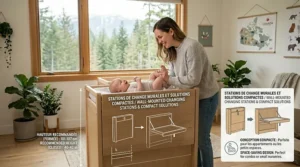
Let’s address the adjustable height changing table question honestly: adjustable models cost $30-$80 more than fixed-height equivalents on Amazon.ca, add mechanical complexity that can fail, and require more assembly steps. So when does the investment make sense?
Adjustable tables are essential if:
- Parents differ by more than 8 cm in height (this creates a 5+ cm difference in optimal changing surface height)
- Extended family or caregivers regularly help with diaper changes
- You’re renting and might move between Canadian cities with different home layouts
- Either parent has existing back problems or mobility limitations
- You prefer working barefoot in summer vs. in thick socks during winter
Fixed-height tables work perfectly fine if:
- Both parents fall within 5 cm of the same height
- You’ve measured carefully and confirmed the specific table height matches your elbow-to-floor calculation
- You’re buying premium solid wood furniture (like the Graco Teddi) intended to last through multiple children
- You have a dedicated nursery space where the table will remain permanently
The Canadian market reality is that adjustable changing tables (Maydolly, VEVOR, SUNHOO) dominate Amazon.ca’s bestseller lists, while fixed-height premium models (Graco, Dream On Me) sell through traditional retail and specialty baby stores. This split reflects different buyer priorities: online shoppers prioritize flexibility and value, while in-store buyers value the ability to physically test and confirm fit before purchase.
One often-overlooked advantage of adjustable tables in Canada: they work brilliantly in homes with multiple floors. Set it at your height for the main-floor nursery, then adjust it up 5 cm when you move it to the basement playroom where your taller partner tends to handle evening diaper changes. This flexibility is particularly valuable in Canadian townhouses and split-level homes where different caregivers “own” different floors.
Setting Up Your Changing Station: Expert Tips for Canadian Homes
Strategic Placement for Canadian Climate
Position your changing table away from exterior walls during winter months. That seemingly perfect spot next to the window? In a Canadian February, that area can be 3-5°C colder than the room’s core, making diaper changes uncomfortable for your baby and requiring you to work faster (which increases injury risk when you’re rushing).
Baseboard heaters create another placement challenge in Canadian homes. You need clearance for safety, but that clearance often puts the changing table in awkward room positions that force you to work at odd angles. The solution many Canadian parents discover: removable changing pads on dressers positioned in the room’s warmest zone, typically an interior wall away from windows and vents.
Storage Configuration for One-Handed Access
Health Canada’s change table safety guidelines emphasize keeping one hand on your baby at all times—which means your other hand needs to reach diapers, wipes, creams, and clothes without looking, stretching, or shifting your weight dangerously.
Set up your storage following the “hot zone” principle borrowed from commercial kitchen design: items you use every change (diapers, wipes) go in the primary reach zone (the shelf or basket directly beside where your baby’s bottom rests). Items used frequently but not universally (diaper cream, petroleum jelly) go in the secondary zone (lower shelf, opposite side). Rarely-used items (thermometer, extra clothes, burp cloths) can occupy tertiary storage farther away.
Canadian parents dealing with static from dry winter air should keep a small spray bottle of water in the primary zone—a quick mist on your hands prevents diapers from clinging to you when you’re trying to work one-handed.
Lighting for Safe Night Changes
This is where Canadian parents with basement or below-grade nurseries face unique challenges. Northern homes often lack natural light in nurseries during our long winter months (sunset at 4:30 PM from December through February), making proper artificial lighting essential.
The optimal changing station lighting setup: a warm LED strip light mounted on the wall directly above the changing surface (not overhead, which creates shadows right where you’re working). This provides shadow-free task lighting without the harsh brightness that fully wakes a baby during 2 AM changes. Canadian tire and IKEA both sell battery-powered options that avoid the electrical code complications of hard-wiring new fixtures in rental units.

FAQ: Changing Table Height Guide for Canadian Parents
❓ What is the standard changing table height in Canada?
❓ Can I use a regular dresser as a changing table in Canada?
❓ How do I prevent back pain when using a changing table?
❓ Are adjustable changing tables worth the extra cost in Canada?
❓ What changing table height works for short parents in Canada?
Conclusion: Find Your Perfect Height and Protect Your Back
After 3,000 diaper changes—the average for a Canadian baby’s first year—that 5 cm difference between a properly sized changing table and a “standard” one translates to hours of cumulative spinal stress. This isn’t about being precious or over-researching baby gear. It’s about acknowledging that you’ll spend hundreds of hours at this piece of furniture, often sleep-deprived, frequently while juggling multiple tasks, and always while supporting a squirming human who has no interest in making your job easier.
The changing table height guide comes down to one measurement: find your elbow-to-floor distance, subtract 10-15 cm, and buy (or adjust) a changing table to match that number. For most Canadian parents, adjustable models like the Maydolly or VEVOR provide the flexibility to accommodate multiple caregivers and seasonal footwear changes. If you’ve measured carefully and fall in that 170-175 cm sweet spot, the Graco Teddi‘s fixed height delivers premium quality at a fair price.
Your back will thank you. Your physiotherapy budget will thank you. And when you’re on diaper change number 2,847 on a Tuesday in February, standing comfortably while your properly-sized changing table supports your work, you’ll remember this article and feel vindicated for doing the research upfront.
Check current pricing on Amazon.ca for all models mentioned—Canadian prices fluctuate with exchange rates and seasonal promotions, so the ranges listed here reflect typical pricing as of 2026 but aren’t exact quotes.
Real Canadian Families: Height Solutions That Actually Work
The Vancouver Condo Family (Mixed Heights)
Sarah (162 cm) and Marcus (185 cm) live in a 650-square-foot Yaletown condo with their 4-month-old. Their initial changing table—a beautiful fixed-height Ikea piece at 91 cm—created instant problems. Marcus could work comfortably, but Sarah developed shoulder tension within two weeks from constantly reaching upward.
Their solution: the Maydolly Adjustable set at 88 cm for Sarah’s morning shifts and 103 cm for Marcus’s evening routine. Total adjustment time: 15 seconds. The space-saving foldable design also solved their storage crisis—it tucks behind their bedroom door when they need floor space for tummy time.
Key Takeaway: Height difference exceeding 20 cm between partners makes adjustable models non-negotiable, not optional.
The Toronto Multi-Generational Household
Priya and Arjun in Scarborough share their townhouse with Priya’s parents, who provide daily childcare while both parents work. The challenge: Priya (168 cm), her mother (155 cm), and Arjun (178 cm) all needed to change their baby comfortably.
They chose the VEVOR 3-level adjustable and assigned each caregiver a dedicated height setting. Priya’s mother uses the lowest (95 cm), Priya uses middle (100 cm), and Arjun uses highest (105 cm). The lockable height mechanism prevents accidental adjustments during use—critical when multiple people are operating the same table.
Key Takeaway: Multi-generational households benefit from models with easily identifiable height markers or memory settings.
The Rural Alberta Solution (Budget-Conscious)
Emily in rural Medicine Hat needed changing table functionality on a tight budget with limited access to returns (nearest city 3 hours away). After measuring her 170 cm height, she calculated her optimal surface at 93-95 cm.
Rather than risk ordering online, she bought a basic dresser from the local furniture store and added a changing pad topper. Total cost: $180 CAD vs. $250+ for dedicated changing tables shipped to her area. The dresser continues serving as bedroom storage long after diaper days end.
Key Takeaway: DIY dresser conversions work beautifully when you measure carefully and prioritize longevity over specialized features.
Ergonomic Changing Table Setup: Beyond Just Height
Foot Positioning for Stability
Stand with one foot slightly forward when changing diapers—this creates a more stable base and allows you to shift weight between legs during longer changes (like those winter snowsuit wrestling matches). The forward foot should be on the same side as your dominant hand for optimal balance.
Canadian parents often discover this too late: those cute fuzzy socks everyone wears during winter months? Terrible for changing table stability on hardwood or tile. Keep a pair of grip socks (the kind used for yoga) near your changing station for secure footing.
Arm Position and Reach Zones
Your changing table height is only half the equation—the other half is where you position supplies. Ergonomic research shows that horizontal reach matters as much as vertical reach. Items you grab repeatedly (wipes, diapers) should sit in the “primary reach zone”—the 30 cm radius around where your non-baby-holding hand naturally rests.
Canadian changing tables with side-mounted baskets (like the VEVOR and Maydolly) are ergonomically superior to models with under-table shelving that force you to bend or twist to reach supplies. Every avoided twist is one less opportunity for back strain.
Winter-Specific Considerations
From November through March, Canadian parents bundle babies in extra layers—sleepers, sleep sacks, sometimes even hats indoors if your heating isn’t keeping up. These extra layers mean more time at the changing table per session, which amplifies any ergonomic problems with table height.
During winter months, consider lowering adjustable tables by 2-3 cm. The slightly lower position gives you better leverage when wrestling bulky fleece sleepers over baby’s head while maintaining one hand on baby for safety. Come April, raise it back to your summer height when you’re dealing with lighter onesies.
The True Cost of Wrong Changing Table Height
Direct Healthcare Costs
Canadian physiotherapy isn’t fully covered under provincial health plans. Private physiotherapy in Toronto, Vancouver, or Calgary runs $80-$120 CAD per session. If your too-high or too-low changing table creates back strain requiring six physiotherapy sessions, you’ve spent $480-$720 CAD—far more than the $30-$80 price difference between a poorly-fitted fixed table and a properly-adjusted one.
Massage therapy for parental back pain runs $90-$140 per hour in major Canadian cities. Many parents discover they need monthly sessions to manage changing-table-induced muscle tension. Over an 18-month diapering period, that’s $1,620-$2,520 CAD in ongoing treatment costs.
Opportunity Costs and Quality of Life
Back pain from poor changing table ergonomics doesn’t confine itself to diaper changes. That lumbar strain manifests when you’re picking up baby from the crib, carrying the car seat through Canadian winter parking lots, or simply trying to sleep after a long day.
Canadian parents dealing with back problems report reduced capacity to enjoy outdoor activities with their babies—walks through parks, hikes on easy trails, even simple playground visits become uncomfortable. This quality-of-life impact is impossible to price, but it’s real and it’s preventable.
Long-Term Physical Impact
Occupational health research shows that repetitive strain injuries from poor ergonomics have cumulative effects. The forward spinal flexion you adopt when reaching down to a too-low changing table doesn’t just cause acute pain—it gradually alters your posture, tightens hip flexors, and weakens core stabilizers.
Twenty years from now, that chronic lower back pain limiting your golf game or hiking ability might trace directly back to 18 months of poorly-positioned diaper changes. The changing table height guide isn’t just about baby furniture—it’s about protecting your long-term physical health.
Safety Standards and Regulations: What Canadian Parents Must Know
Health Canada provides basic safety guidelines for change tables but doesn’t mandate specific height requirements for residential furniture. The guidelines focus on safety straps, guardrails (minimum 5 cm height), and weight limits (typically 13.6 kg or 30 lbs).
However, commercial changing tables in Canadian daycares and public facilities often follow different standards. Many provinces reference the National Resource Center guidelines suggesting changing surfaces at 71-81 cm (28-32 inches) for caregiver comfort. The discrepancy between commercial (optimized for worker safety) and residential (no specific height standards) reveals a gap in consumer protection.
Canadian parents should verify that changing tables purchased on Amazon.ca meet or exceed ASTM F2388 standards, which govern structural integrity, stability, and safety features. Products manufactured or sold in Canada should comply with the Canada Consumer Product Safety Act, though enforcement for imported furniture varies.
Provincial differences matter too. Quebec requires bilingual labelling on baby products, but this doesn’t affect safety performance. British Columbia and Ontario have stronger consumer protection laws that make returns and warranty claims easier to process than in some other provinces.
Maintaining Your Changing Table: Canadian Climate Considerations
Winter Humidity and Wood Furniture
Fixed-height wooden changing tables (like the Graco Teddi or Dream On Me Emily) contract slightly during Canadian winters when indoor humidity plummets to 20-30%. This seasonal movement can loosen joints and screws over time.
Check and retighten all visible screws and bolts monthly during heating season. Apply furniture wax to wooden surfaces biannually to prevent moisture loss that leads to cracking. If you notice creaking or wobbling that wasn’t present initially, the wood may have dried and shrunk—simple retightening usually resolves this.
Metal Frame Care in Salt Season
Portable changing tables with metal frames (Maydolly, VEVOR, SUNHOO) can develop rust spots if you’re wheeling them across floors tracked with road salt from winter boots. Wipe down metal components weekly with a barely-damp cloth, then dry immediately. Check wheel mechanisms monthly and apply a tiny amount of silicone lubricant if they start catching.
Canadian winter air is harsh on metal—that beautiful chrome finish can pit and corrode faster than you’d expect in our climate. An extra 30 seconds of maintenance weekly prevents needing to replace corroded wheels or frames before baby outgrows the table.
Fabric Component Cleaning
The fabric storage baskets and changing pads on portable units need more frequent cleaning in Canadian climates. Winter static makes fabric attract every dust particle and pet hair in your home. Summer humidity can promote mildew in fabric that doesn’t fully dry between uses.
Machine-wash removable fabric components monthly minimum, weekly if you notice odours or visible staining. Use hot water (the fabric can handle it better than you’d expect) and skip fabric softener, which reduces the waterproof coating on changing surfaces. Line-dry in a well-ventilated area—Canadian winter indoor air provides plenty of drying power without needing high heat that degrades fabrics.
Recommended for You
- 7 Best Portable Changing Pads for Travel Canada 2026
- 7 Best Waterproof Changing Pads Canada 2026
- 7 Best Changing Tables with Storage Canada 2026
Disclaimer: This article contains affiliate links. As an Amazon Associate, I earn from qualifying purchases. If you purchase products through these links, we may earn a small commission at no additional cost to you.
✨ Found this helpful? Share it with your friends! 💬🤗
