
In This Article
When you’re preparing for a new baby, the nursery closet quickly becomes ground zero for chaos. Between receiving adorable onesies in six different sizes, storing bulky winter gear for those harsh Canadian winters, and keeping track of countless tiny socks that seem to disappear into another dimension, maintaining an organized nursery closet can feel overwhelming. What most Canadian parents don’t realize is that a well-organized closet isn’t just about aesthetics—it’s about sanity during those sleep-deprived early months when you’re fumbling for a clean sleeper at 3 AM.
The challenge is uniquely Canadian. Unlike our American counterparts who might store a few light jackets, Canadian nurseries need space for snowsuits, fleece layers, and season-specific clothing that takes up considerably more room. Add to that the reality that babies grow at lightning speed through their first year, and you’re constantly rotating sizes while managing hand-me-downs and gifts. A strategic approach to closet organization isn’t optional—it’s essential survival equipment for the modern Canadian parent.
In this comprehensive guide, I’ll walk you through proven nursery closet organization ideas that actually work in real Canadian homes, complete with product recommendations available on Amazon.ca, expert commentary on what makes each solution effective, and practical tips you won’t find on standard product listings. Whether you’re working with a spacious walk-in or a compact reach-in closet, these strategies will help you create a functional system that grows with your child.
Quick Comparison Table: Top Organization Systems
| Product Type | Best For | Price Range (CAD) | Space Efficiency | Canadian Winter-Ready |
|---|---|---|---|---|
| Closet Dividers | Size sorting | $15-$30 | High | Yes |
| Hanging Shelves | Vertical storage | $25-$45 | Very High | Yes |
| Drawer Organizers | Small items | $20-$35 | Medium | N/A |
| Over-Door Organizers | Accessories | $30-$50 | High | Yes |
| Modular Cube Systems | Complete solutions | $80-$200 | Very High | Yes |
| Double Hanging Rods | Maximizing space | $20-$40 | Very High | Yes |
| Storage Bins | Seasonal rotation | $15-$40 | Medium | Yes |
Looking at this comparison, hanging shelves and double rods offer the best value for Canadian parents dealing with seasonal clothing rotation. The modular cube systems command a premium price but deliver unmatched flexibility—particularly valuable if you’re planning multiple children or need to adapt the space as your baby grows. What the table doesn’t show is that combining 2-3 of these solutions typically creates the most effective system, with most Canadian nurseries benefiting from closet dividers plus either hanging shelves or a second rod.
💬 Just one click — help others make better buying decisions too! 😊
Top 7 Nursery Closet Organization Products: Expert Analysis
1. 3 Sprouts Baby Closet Dividers — The Size-Sorting Essential
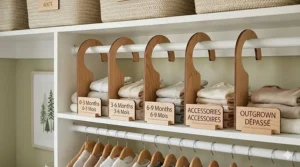
When most parents think about organizing baby clothes, they envision colour-coding or categorizing by type. What they should be thinking about is size—because nothing is more frustrating than discovering your baby outgrew those adorable 3-6 month outfits before wearing them even once. The 3 Sprouts closet dividers solve this with their 8-piece set covering newborn through 24 months, with double-sided printing so you can see sizes from either angle when rifling through the closet in dim nursery lighting.
These dividers fit standard closet rods up to 3.5 cm (1.38 inches) in diameter, which covers virtually every Canadian closet configuration including wire shelving systems. The double-sided feature isn’t just convenient—it’s transformative during those early weeks when you’re operating on minimal sleep and can barely remember your own name, let alone which side of the closet holds which size. Canadian reviewers consistently praise their durability through multiple children, noting they withstand the constant sliding and repositioning that comes with frequent wardrobe changes.
What sets these apart from cheaper alternatives is the quality of the printing and materials. While you can find similar products in the $10-$15 CAD range, those tend to crack, fade, or bend after a few months of use. The 3 Sprouts version maintains its integrity even when you’re aggressively shoving hangers past them during a clothing emergency. For Canadian parents managing seasonal transitions—moving summer clothes to storage bins while bringing out fleece sleepers and snowsuits—having durable dividers that last through multiple rotations justifies the slightly higher investment.
Customer Feedback: Parents love the neutral colour options that work with any nursery theme, and appreciate that the sizing markers are accurate to typical Canadian baby clothing standards. Some wish the set extended to 3T for toddler planning.
Pros:
- Double-sided visibility saves time during nighttime changes
- Durable construction survives years of use
- Universal fit works with all standard Canadian closet systems
Cons:
- Stops at 24 months (doesn’t extend to toddler sizes)
- Premium pricing compared to basic cardboard alternatives
Price Range: Around $20-$28 CAD, representing solid value given the multi-year lifespan and daily usability for Canadian families managing seasonal clothing rotation.
2. YOUDENOVA 6-Shelf Hanging Closet Organizer — Vertical Space Maximizer
The secret weapon in small nursery closets is vertical storage, and the YOUDENOVA hanging organizer exploits this principle brilliantly. With six fabric shelves suspended from a single closet rod position, it transforms wasted vertical space into highly functional storage for folded clothes, diapers, blankets, and accessories. Each shelf measures approximately 30 cm wide—perfectly sized for baby items without overwhelming a compact closet.
What Canadian parents specifically appreciate is how this system handles bulky winter items. Unlike rigid shelving that locks you into fixed heights, the fabric construction allows you to compress summer clothes tightly when storing them, then expand sections for puffy snowsuits and fleece layers during winter months. The grey fabric is deliberately neutral, disguising the inevitable stains and discolouration that come from storing diapering supplies or dealing with leaky bottles.
The 11 kg (25 lb) weight capacity is conservative—most users report successfully loading significantly more without sagging, though I’d recommend distributing heavier items toward the bottom shelves for stability. Installation requires zero tools, hooks, or wall damage, making this perfect for rental properties or homes where you can’t modify the closet structure. For Toronto condo dwellers or Vancouver apartment parents working with minimal closet space, this organizer delivers storage capacity that would otherwise require a separate dresser.
Customer Feedback: Canadian buyers note it ships quickly from Amazon.ca and arrives without the musty smell that sometimes plagues fabric storage products. The mesh side pockets are praised for holding small accessories like headbands and pacifier clips.
Pros:
- Maximizes vertical space without permanent installation
- Flexible fabric accommodates seasonal clothing variations
- Neutral colour hides stains and wear
Cons:
- Fabric may sag slightly with very heavy items over time
- Requires closet rod space (reduces hanging room)
Price Range: Typically $25-$35 CAD on Amazon.ca, offering exceptional value per cubic metre of storage created—particularly for Canadian parents juggling seasonal wardrobes.
3. Simple Houseware Closet Underwear Organizer — Small Item Salvation
The tragedy of baby socks is real. These tiny essentials have an almost supernatural ability to vanish, separate from their partners, or migrate to mysterious corners of the nursery. The Simple Houseware drawer organizer addresses this with 24 individual cells designed for socks, accessories, and other miniature clothing items that would otherwise create drawer chaos.
While marketed as an underwear organizer, Canadian parents have adopted this for a different purpose entirely: organizing those impossibly small baby items by category and size. Use one section for 0-3 month socks, another for 3-6 months, allocate cells for mittens, hats, and bibs, and suddenly you have a system that actually works. The rigid dividers maintain their shape even when drawers are opened roughly (which, let’s be honest, happens frequently when you’re rushing to dress a squirming baby).
The 33 cm × 33 cm × 10 cm dimensions fit standard dresser drawers, though Canadian buyers with European-sized furniture should measure first. The beige fabric blend cleans easily with a damp cloth, essential given that baby accessories tend to attract mysterious stains. What impressed me most is how this transforms the frustrating morning routine of “find matching socks” into a three-second task—a small efficiency that compounds into significant time savings over months.
Customer Feedback: Parents report this works exceptionally well for organizing cloth diapers, burp cloths, and reusable wipes in addition to clothing accessories. Some use it in the closet itself rather than a drawer, setting it on a shelf.
Pros:
- Eliminates small item chaos with defined compartments
- Rigid structure prevents collapse under weight
- Multipurpose across various baby accessories
Cons:
- Fixed cell size doesn’t accommodate all items
- Requires drawer or shelf space (not hanging)
Price Range: Generally $18-$25 CAD, a minor investment that delivers major sanity preservation for Canadian parents tired of the sock-matching nightmare.
4. mDesign Fabric Hanging Closet Organizer with Drawers — The Hybrid Solution
This ingenious product combines hanging shelves with integrated fabric drawers, creating a self-contained storage system that doesn’t require any closet modification. The four shelves paired with three removable drawers give you options: visible storage for frequently accessed items on the shelves, concealed storage in the drawers for backup supplies or items you’re rotating out as baby grows.
The fabric drawers slide out completely, which is brilliant for Canadian parents who rotate seasonal clothing. When winter ends, pull out the entire drawer containing fleece sleepers and wool socks, replace it with a drawer of summer rompers and sun hats, then store the winter drawer in a basement or storage room. This beats individually moving items and keeps complete seasonal wardrobes together. The drawers also prevent items from falling off shelves when you’re quickly grabbing something—a common frustration with standard hanging organizers.
At 30 cm wide and 100 cm long when hanging, this fits standard closets without monopolizing all your rod space. The neutral grey-and-white colour scheme integrates with any nursery aesthetic, while the mesh construction allows air circulation—particularly important in humid Canadian summers or damp coastal climates where mildew can become an issue with sealed storage.
Customer Feedback: Multiple Canadian reviewers mention using this for cloth diaper storage, with drawers holding clean diapers and shelves organizing diaper covers and inserts. The removable drawers make laundry day significantly easier.
Pros:
- Combination of open and concealed storage maximizes flexibility
- Removable drawers facilitate seasonal clothing rotation
- Breathable fabric prevents moisture accumulation
Cons:
- More expensive than basic hanging organizers
- Drawers may eventually show wear at high-traffic areas
Price Range: Around $35-$48 CAD on Amazon.ca, justified by the dual functionality and Canadian-climate-friendly fabric construction that prevents mustiness.
5. SONGMICS Adjustable Double Rod Closet — Space Doubling Innovation
Baby clothes are short. This obvious fact creates a massive opportunity: most nursery closets waste roughly 60-90 cm of vertical space below hanging onesies and sleepers. The SONGMICS double rod system captures this wasted space by adding a second hanging level below the first, instantly doubling your hanging capacity without expanding the closet footprint.
The adjustable height mechanism (ranging from 81-142 cm) accommodates different closet configurations and grows with your child. Start with the bottom rod low enough for newborn clothes, then raise it as toddler outfits get longer. This adjustability is particularly valuable for Canadian parents who inherit or purchase different closet organizers—the system adapts to whatever setup you already have rather than requiring a complete overhaul.
The chrome finish resists rust and moisture, critical for Canadian nurseries where humidifiers run frequently during winter months or in naturally humid regions like coastal British Columbia. Installation requires only basic assembly—no drilling, no permanent fixtures—making it rental-friendly and easily relocatable if you move. Weight capacity of 23 kg per rod far exceeds what baby clothes will ever demand, giving you confidence to pack it full during peak season transitions.
Customer Feedback: Canadian buyers appreciate that the rods are strong enough to handle the weight of winter coats and snowsuits when baby gets older. Several mention using the top rod for current-size clothes and the bottom for next-size-up items they’re accumulating.
Pros:
- Doubles hanging capacity using existing vertical space
- Adjustable height adapts as baby grows
- Rust-resistant finish suits Canadian climate variations
Cons:
- Requires floor space (not suitable for very shallow closets)
- Assembly required (though straightforward)
Price Range: Typically $40-$55 CAD, representing excellent value given it eliminates the need for additional dresser drawer space while keeping clothes visible and wrinkle-free.
6. IRIS OHYAMA Modular Cube Storage System — Ultimate Customization
For parents who want a complete nursery closet transformation, the IRIS modular cube system delivers maximum flexibility. Each cube measures 35 cm × 35 cm × 35 cm, and you can configure anywhere from 6 to 20 cubes depending on your space and needs. Use some cubes with fabric bins for concealed storage, leave others open for books or displayed items, add hanging rods to designated cubes for clothes—it’s completely customizable.
The genius for Canadian parents is seasonal adaptability. During summer, configure the system to prioritize drawer-style cubes for rolled rompers and light layers. When winter hits, reconfigure to include hanging cubes for snowsuits and jacket storage. The modular nature means you’re never locked into one arrangement, and as your baby grows into a toddler who needs toy storage instead of diaper organization, you simply reconfigure again.
The white finish has a clean, modern aesthetic that appeals to contemporary nursery design while remaining neutral enough to work with any colour scheme. The plastic construction is waterproof and wipeable—essential when dealing with diaper cream spills or leaked bottles. Weight capacity per cube reaches 20 kg, though realistically baby items rarely approach this limit. The wall anchoring kit included is non-negotiable for Canadian safety standards; use it to secure the structure as required by Health Canada nursery safety guidelines.
Customer Feedback: Parents rave about using this not just in the closet but also as a room divider or against a wall in shared nursery situations. The Canadian buyers particularly appreciate the stability once properly anchored, noting it survives curious toddlers attempting to climb.
Pros:
- Completely customizable configuration adapts to changing needs
- Waterproof construction handles nursery messes
- Grows with child from newborn through early childhood
Cons:
- Higher initial investment than single-purpose organizers
- Requires assembly time and wall anchoring
Price Range: Systems range from $80-$200 CAD depending on cube count and accessories, representing a significant investment but one that serves multiple years and purposes across your child’s development.
7. StorageWorks Hanging Closet Organizer with Side Pockets — Maximum Capacity Design
The StorageWorks organizer takes hanging storage to the next level with five main shelves plus four side pockets, creating storage zones for different categories of items. The main shelves hold larger items like folded sleepers, blankets, or stacks of burp cloths, while the side pockets are perfectly sized for accessories, pacifiers, hair accessories, or small toys that would otherwise get lost.
The clear window panels on each shelf let you see contents without unpacking everything—incredibly useful when you’re trying to remember where you stored those 6-9 month summer outfits while preparing for next season. Canadian parents with multiple children especially appreciate this visibility, as it helps identify which child’s hand-me-downs are stored where. The breathable fabric prevents that musty smell that can develop in sealed storage containers, particularly important in humid Canadian summers or homes without climate control in closets.
At 30 cm wide and 122 cm long, this organizer provides substantial storage without completely dominating your closet rod. The reinforced hanging straps distribute weight evenly, preventing the sagging and drooping that plagues cheaper alternatives after a few months of use. The neutral grey colour and clean design work equally well in traditional or modern nurseries.
Customer Feedback: Canadian reviewers note this arrives quickly from Amazon.ca fulfillment centres and often mention using it for cloth diaper organization, with main shelves for clean diapers and side pockets for diaper covers and wet bags. The clear windows get particular praise.
Pros:
- Side pockets create dedicated zones for small accessories
- Clear panels provide visibility without unpacking
- Breathable design prevents moisture and odour accumulation
Cons:
- The 5-shelf height may not fit extremely short closets
- Clear panels can make clutter visible (requires tidier organization)
Price Range: Around $32-$42 CAD on Amazon.ca, offering excellent value for the sheer storage volume created, particularly for Canadian families managing extensive seasonal wardrobes that require smart categorization.
Setting Up Your Closet Organization System: A Canadian Parent’s Guide
Once you’ve selected your organization products, implementation strategy matters just as much as product choice. I’ve worked with dozens of Canadian families setting up nurseries, and the difference between a system that works long-term versus one that collapses into chaos within weeks often comes down to the setup process.
Start by completely emptying your closet and sorting everything into categories: current size, next size up, seasonal storage, and items to donate or return. Canadian parents accumulate significant clothing volume through generous relatives and baby showers—this is your chance to ruthlessly eliminate duplicates and items that don’t suit your climate. If you live in Winnipeg, you probably don’t need five lightweight cotton rompers, but you absolutely need quality fleece sleepers and warm layering pieces.
Install your hanging systems first—double rods, hanging organizers, or modular cubes that require wall anchoring. Follow Health Canada safety guidelines and anchor everything into wall studs, not just drywall. This might seem excessive for a closet organizer, but as your baby becomes a mobile toddler, they will attempt to climb or pull on everything within reach. Proper anchoring prevents tip-over incidents that send parents to emergency rooms every year across Canada.
Next, implement your clothing rotation system using size dividers. Hang current-size clothes in the most accessible section, usually the middle of the rod at eye level. Next-size-up items go to one side, items baby has outgrown but you’re saving for a potential sibling or to donate go to the other side. This spatial organization creates a visual inventory system that prevents you from forgetting about clothes and discovering them too late. During seasonal transitions, move winter items to less accessible upper shelves or storage bins, bringing spring/summer clothes to prime positions. The effort invested in this twice-yearly rotation pays dividends in daily efficiency throughout the following months.
Maximizing Small Nursery Closets: Space-Saving Strategies for Canadian Apartments
Urban Canadian parents—particularly those in Toronto condos, Vancouver apartments, or Montreal walk-ups—face unique space constraints. The typical nursery closet in these settings measures 90-120 cm wide and 60 cm deep, which seems laughably inadequate when confronted with the volume of baby gear modern parenting requires. However, with strategic planning, even compact closets can handle surprising storage loads.
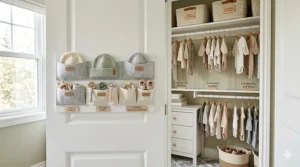
The key principle is thinking three-dimensionally. Use every vertical centimetre from floor to ceiling. Install a high shelf above the closet rod for items you access infrequently—next-season clothes, special occasion outfits, or backup supplies of diapers purchased during sales. Use the floor space for rolling storage carts or stackable bins containing bulky items like extra blankets or out-of-season clothing. The back of the closet door becomes prime real estate with over-door organizers for accessories, bibs, or small toys.
Consider the “capsule wardrobe” approach for your baby’s clothes. Instead of keeping every adorable outfit friends and family gifted, curate a focused collection of versatile pieces that mix and match. For Canadian climates, this means prioritizing layering pieces that work across temperature fluctuations rather than single-purpose outfits. Six quality sleepers, four pairs of pants, six onesies, and appropriate outerwear will carry you further than twice as many items that don’t coordinate or serve multiple functions.
Lighting matters more than most parents realize. Compact closets are often poorly lit, making it difficult to distinguish between navy and black onesies or find specific items quickly. Battery-operated LED strip lights or motion-sensing closet lights (available on Amazon.ca for $15-$30 CAD) transform usability. When you’re fumbling for clothes during a 4 AM diaper blowout, adequate lighting prevents grabbing the wrong size or missing items entirely. The small investment delivers immediate returns in reduced frustration and time savings.
Seasonal Clothing Rotation: The Canadian Necessity
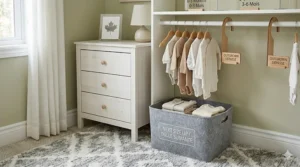
Unlike parents in temperate climates who can keep most clothes accessible year-round, Canadian parents must actively manage seasonal transitions. A baby born in October will need completely different wardrobe compositions by January (winter gear), April (spring layers), and July (summer lightweights). Without a rotation system, your closet becomes an archaeological dig where buried summer rompers lie forgotten under mountains of fleece.
Implement a twice-yearly deep rotation: once in spring (late March or early April depending on your region), and once in fall (late September or early October). During each rotation, remove the previous season’s clothes entirely from the closet. Box them by size, clearly label with both size and season, and store in a basement, under-bed storage, or other out-of-closet location. This creates space for incoming seasonal items while maintaining a cleaner, more navigable closet.
Use clear plastic bins for stored seasonal clothes rather than opaque containers or cardboard boxes. The visibility prevents the “out of sight, out of mind” syndrome where you forget what you stored and accidentally purchase duplicates. Clear bins also let you quickly verify during the rotation that clothes remain in good condition without mould or moisture damage—a legitimate concern in damp Canadian basements or storage rooms. Label bins with both the size range and the season for easy retrieval next year or for potential hand-me-downs to younger siblings.
Don’t forget about outerwear rotation. Canadian babies need legitimate winter gear—snowsuits, winter boots, fleece buntings—that consume significant closet real estate. During summer months, these items can move to basement storage or even off-site if you’re extremely space-constrained. Come October, before the first serious cold snap hits, retrieve winter gear and store summer items. This proactive approach ensures you’re never caught in November desperately searching for a snowsuit while your baby shivers in inadequate layers.
Common Nursery Closet Organization Mistakes (And How to Avoid Them)
After helping numerous Canadian families organize nurseries, I’ve identified recurring mistakes that undermine even well-intentioned organization systems. The first and most common error is over-organizing before the baby arrives. Many expectant parents create elaborate systems for categorizing onesies by colour, folding methods inspired by Japanese minimalism experts, or complex labelling schemes that require maintenance. Then the baby arrives, sleep deprivation hits, and these high-maintenance systems collapse immediately.
Instead, build systems around realistic post-baby capabilities. You won’t have time or energy for complex folding patterns—simple rolling or basic stacks work fine. You won’t consistently maintain colour-coded arrangements—size-based organization using dividers requires minimal ongoing effort. Design for your worst day, not your best day. A system that functions when you’re operating on three hours of sleep with spit-up on your shoulder is one that will actually last.
Another critical mistake is ignoring Canadian climate realities in your storage choices. Fabric organizers that work beautifully in Arizona’s dry heat can develop mildew in Vancouver’s damp coastal air or Toronto’s humid summers without proper air circulation. Choose breathable fabrics, avoid placing storage directly against exterior walls where condensation forms, and consider using moisture-absorbing packets in bins storing off-season clothes. The extra attention to humidity management prevents discovering ruined clothes when you retrieve storage bins.
Many parents also fail to plan for rapid growth. Babies don’t progress gradually through sizes—they often skip sizes entirely or spend only two weeks in a particular size range. Build flexibility into your system by leaving empty space for unexpected size changes and incoming gifts. If your closet is packed completely full from day one, you’ll have nowhere to put the inevitable shower gifts, hand-me-downs, and impulse purchases that accumulate. Maintain at least 20-30% unused capacity in your organization system to accommodate this reality without complete reorganization.
How Canadian Safety Standards Affect Closet Organization
Health Canada provides specific guidelines for nursery safety that directly impact how you should organize closets. According to official guidance on setting up safe nurseries, any furniture or storage system in baby’s room must be anchored to prevent tip-over incidents. This includes modular cube systems, freestanding closet organizers, or heavy storage pieces you might place in or near the closet.
The anchoring requirement isn’t optional or excessive caution—it’s based on data showing furniture tip-over incidents cause serious injuries to Canadian children annually. Use the wall anchors provided with products or purchase heavy-duty anchors rated for your wall type. Drywall anchors differ from anchors designed for studs or masonry; using incorrect anchors defeats the purpose. If you’re uncertain about proper installation, many Canadian cities offer baby-proofing services through local safety companies who will professionally anchor furniture according to Health Canada standards.
Storage choices should also consider choking hazards. Small organizing accessories like tiny bins, removable buttons, or decorative elements on closet organizers can become hazardous if they detach and baby gains access. Choose organizers with securely attached components, and position any small-piece storage solutions on high shelves outside baby’s reach. As your child becomes mobile and eventually figures out how to open closet doors, reassess what’s stored at lower levels and move anything potentially dangerous higher.
Keep cords and ties from hanging organizers away from the crib or changing area. Window covering cords are a well-known strangulation hazard, but hanging organizer straps can pose similar risks if they’re accessible from the crib. Ensure there’s adequate distance between the closet and crib, and secure any long straps or ties so they can’t be pulled into the crib area.
Organizing Different Types of Baby Items
Clothing Categories That Need Dedicated Spaces
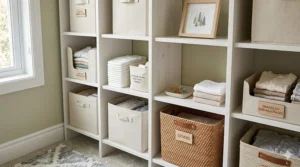
Beyond basic size sorting, effective nursery closet organization requires thinking about clothing function and access frequency. Daily-wear items like sleepers, onesies, and pants deserve prime real estate at eye level where you can grab them quickly during routine changes. Special occasion outfits—holiday dresses, formal baby clothes, or seasonal costumes—can live on higher shelves or in less accessible areas since they’re used infrequently.
Create a dedicated zone for sleep-specific clothing separate from daywear. Sleep sacks, nighttime diapers, and specialized sleepwear should be grouped together for easy access during bedtime routines. This separation helps maintain consistency in sleep associations and ensures you’re not hunting through mixed clothing piles when trying to establish bedtime as a calm, routine process.
Outerwear needs completely different storage consideration than interior clothing. Winter bunting suits, snowsuits, and heavy coats don’t fold well and consume significant space. Use hanging storage or large bins exclusively for outerwear, and don’t try to squeeze them into regular dresser drawers where they’ll become wrinkled and difficult to extract. For Canadian babies, proper outerwear storage is essential—inadequate organization often means forgetting about perfectly good winter gear and purchasing duplicates unnecessarily.
Accessories and Small Items
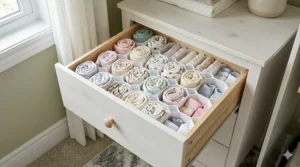
The accessories category expands exponentially beyond most new parents’ expectations. Hats, mittens, socks, bibs, burp cloths, headbands, hair accessories, and pacifiers quickly accumulate and become the single largest source of closet chaos if not properly contained. Drawer organizers with compartmentalized sections work brilliantly for these items, creating defined homes that prevent the jumbled mess that makes finding anything impossible.
Consider seasonal subdivision even within accessories. Winter hats and mittens should be stored separately from summer sun hats. This prevents hunting through irrelevant items and creates cleaner visual organization. Use small clear bins or drawer dividers to maintain these category separations, and label them clearly so any caregiver (partner, grandparent, babysitter) can locate items without instruction.
Bibs deserve special mention—most parents underestimate how many they’ll accumulate and use. Dedicated bib storage, whether through hanging organizers with pockets or drawer sections, prevents the common scenario where you own fifteen bibs but can never find a clean one when needed. Positioning bib storage near the changing area or designated feeding spot optimizes accessibility for this frequently needed item.
Baby Closet Organization on a Budget
Professional-grade nursery organization can cost hundreds of dollars, but Canadian parents working within tight budgets can create highly functional systems for under $100 CAD. The key is prioritizing items that deliver maximum organizational impact per dollar spent and creatively repurposing common household items.
Closet dividers represent the single best budget investment—typically $15-$25 CAD on Amazon.ca, they immediately create order from chaos by establishing clear size categories. This one purchase transforms closet usability more than almost any other single item. If you can only afford one organization product, make it quality closet dividers.
For hanging storage, consider DIY alternatives before purchasing commercial organizers. Plastic shoe organizers (around $10-$15 CAD) can be hung from closet rods and used for baby accessories, small toys, or folded clothing items. Fabric hanging sweater organizers designed for adult closets work perfectly for baby clothes at a fraction of nursery-specific product pricing. Check discount retailers like Dollarama or Dollar Tree for basic storage bins that function identically to premium versions at a fraction of the cost.
Cardboard boxes can serve as drawer dividers or shelf organizers without any financial investment. Cut shoe boxes or cereal boxes to appropriate heights and sizes, and use them to compartmentalize drawers or create sections on closet shelves. While they lack the aesthetic appeal of purchased organizers, they function equivalently for families prioritizing budget over appearance. You can even cover them in contact paper or decorative tape if the plain cardboard bothers you.
The Canadian buy-and-sell market offers tremendous value for nursery organization items. Check Facebook Marketplace, Kijiji, or local community groups for gently used closet organizers, storage cubes, and hanging systems. Many parents sell organization items after their baby outgrows the nursery, often at 50-75% discounts from retail. The organizational functionality remains identical whether purchased new or used, making secondhand shopping an economically smart choice.
Long-Term Planning: Organization That Grows with Your Child
The most effective nursery closet organization systems anticipate future needs beyond the infant stage. A well-designed closet should function effectively from birth through toddlerhood and potentially into early childhood with minimal modification. This forward-thinking approach prevents the frustration and expense of complete reorganization every six months as your child’s needs evolve.
Choose adjustable systems wherever possible. Double hanging rods with height adjustment, modular cube storage that can be reconfigured, and flexible hanging organizers that accommodate different item sizes all provide longevity that fixed systems cannot match. While these adjustable options may cost slightly more initially, they eliminate the need for replacement purchases as your child grows—a better economic proposition over the 3-5 year lifespan of active nursery use.
Consider how storage needs shift from infancy to toddlerhood. Infants need extensive clothing storage but minimal toy organization. By age two, the balance flips—toddlers need significant toy storage while clothing needs remain relatively modest. Design your closet system with this transition in mind, perhaps allocating lower cube sections or bins for items that can later convert to toy storage while keeping upper sections for clothing that will remain constant.
Plan for multiple children if that’s in your future. Organization systems that clearly separate sizes and seasons make hand-me-down management infinitely easier when a second baby arrives. Proper labelling and storage of outgrown clothes in clearly marked bins by size and season means you can simply retrieve the appropriate box when baby number two reaches that size, rather than sorting through mixed storage trying to remember what you saved.
❓ FAQ: Nursery Closet Organization in Canada
❓ How do I organize baby clothes by size in a small Canadian closet?
❓ What's the best way to store baby clothes during Canadian seasonal transitions?
❓ Are expensive closet organization systems worth it for Canadian nurseries?
❓ How can I prevent mildew in nursery closet organizers during humid Canadian summers?
❓ What closet organization items should I prioritize if I'm on a tight budget in Canada?
Conclusion: Creating Your Perfect Nursery Closet System
Organizing a nursery closet isn’t about achieving Instagram-worthy perfection—it’s about creating a functional system that supports you during the demanding early months of parenthood. The best organization approach combines practical storage solutions with realistic maintenance expectations, acknowledging that life with a newborn is beautifully chaotic no matter how organized your closet might be.
For Canadian parents, effective closet organization must account for seasonal clothing transitions, bulky winter gear, and the climate realities that differentiate our nursery needs from those in temperate regions. By investing in adaptable storage solutions like hanging organizers, size dividers, and modular systems, you create a closet that evolves alongside your child while maintaining order through constant change.
Remember that organization is iterative, not permanent. Your first system probably won’t be perfect, and that’s completely normal. Adjust as you discover what works for your specific family, your particular closet layout, and your baby’s unique patterns. The goal isn’t perfection—it’s creating a space that reduces stress, saves time, and helps you find what you need when you need it, even during those exhausted, sleep-deprived moments that define early parenthood.
Start with the basics, implement systems gradually, and give yourself grace when organization slips during particularly demanding periods. A temporarily messy closet doesn’t make you a bad parent—it makes you a normal human navigating one of life’s most challenging and rewarding transitions.
Recommended for You
- Best Baby Dresser Canada 2026: 7 Safe & Stylish Picks
- 7 Best Changing Table Heights 2026: Ergonomic Guide Canada
- 7 Best Portable Changing Pads for Travel Canada 2026
Disclaimer: This article contains affiliate links. As an Amazon Associate, I earn from qualifying purchases. If you purchase products through these links, we may earn a small commission at no additional cost to you.
✨ Found this helpful? Share it with your friends! 💬🤗
