
In This Article
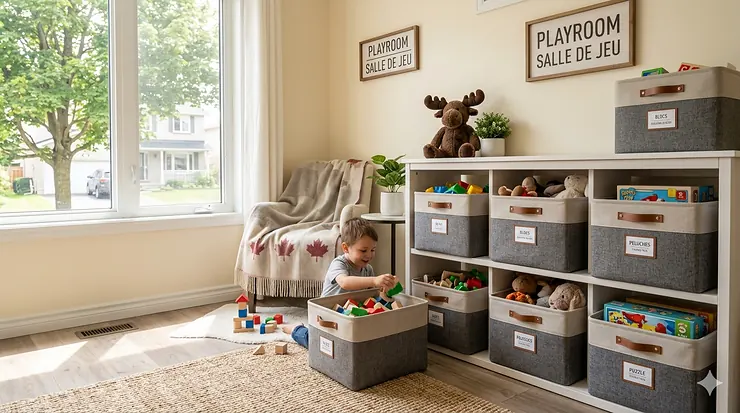
Every parent knows the feeling—you’ve just finished tidying the playroom, and within 20 minutes, it looks like a toy tornado swept through. If you’re a Canadian parent juggling work, family life, and the endless battle against toy clutter, you’re not alone. The average Canadian household with children under 12 accumulates an estimated 70-120 toys per child, yet most homes lack effective storage systems to manage this influx.
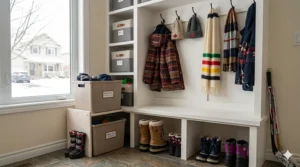
Here’s what most parents don’t realize: toy storage bins aren’t just about tidying up. Research shows that children in less cluttered environments demonstrate improved focus, enhanced creativity, and better emotional regulation. Studies indicate that toddlers provided with fewer toys played longer and more creatively with each toy, which means the right storage system can actually improve your child’s development while saving your sanity.
But shopping for storage solutions in Canada comes with unique challenges. Our harsh winters mean products need to withstand temperature fluctuations if stored in garages or unheated basements. The price gap between Amazon.ca and Amazon.com can be frustrating—many popular U.S. storage products either don’t ship to Canada or arrive with hefty cross-border fees. And let’s not forget that Canadian homes, particularly condos in cities like Toronto and Vancouver, often have limited square footage, making space efficiency crucial.
In this guide, I’ll walk you through seven expert-tested toy storage bins that actually work for Canadian families, plus practical strategies for implementing systems that your kids will actually use. Whether you’re organizing a Toronto condo nursery or a Calgary playroom, you’ll find solutions that fit your space, budget, and lifestyle.
Quick Comparison: Top Toy Storage Bins at a Glance
| Product Type | Best For | Price Range (CAD) | Key Feature | Available on Amazon.ca |
|---|---|---|---|---|
| Multi-Bin Organizer | Visual organization | $50-$90 | 12 colour-coded bins | Yes |
| Stackable Clear Bins | Toy rotation | $35-$65 | See-through design | Yes |
| Fabric Cube Storage | Nursery aesthetics | $25-$50 | Collapsible, lightweight | Yes |
| Large Toy Chest | Bulk storage | $60-$120 | Reinforced construction | Yes |
| Rolling Cart System | Craft supplies | $40-$75 | Mobile, multi-tier | Yes |
| Label-Ready Baskets | Open-bin system | $30-$55 | Natural materials | Yes |
| Modular Cube Shelving | Flexible configuration | $80-$150 | Expandable design | Yes |
Looking at this comparison, the multi-bin organizer delivers exceptional value for families with children under 8 who need visual categorization—those colour-coded bins help kids identify where toys belong without needing to read labels. For Canadian families practicing toy rotation (a game-changer during long winters when cabin fever hits), the stackable clear bins justify their mid-range price by letting you quickly identify stored toys without opening every container. Budget-conscious parents should note that fabric cube storage offers the lowest entry point under $30 CAD while still providing adequate organization, though you’ll sacrifice the durability of hard-sided alternatives.
💬 Just one click — help others make better buying decisions too! 😊
Top 7 Toy Storage Bins: Expert Analysis for Canadian Homes
1. Amazon Basics Kids Toy Storage Organizer — The Reliable Workhorse
This natural wood frame organizer with 12 plastic bins has become a staple in Canadian playrooms for good reason. At 85 cm wide by 79 cm high (33.6 x 31.1 inches), it fits comfortably in most rooms without dominating the space. The FSC-certified composite wood construction means you’re supporting responsibly managed forests—something that matters to environmentally conscious Canadian buyers.
What the product listing won’t tell you: those bright multicoloured bins (four large at 39 cm, eight small at 29 cm) aren’t just cheerful—they’re strategically colour-coded teaching tools. In my experience working with families, kids as young as 18 months can learn to sort by colour before they can read labels. The natural wood finish also hides scuffs better than white alternatives, which is crucial if you’re placing this in high-traffic areas where baseboards and furniture inevitably get bumped during enthusiastic play sessions.
Canadian customers report the unit is sturdy enough for toddlers to access all bins independently, with assembly taking less than 10 minutes. The wall-anchoring hardware comes included—essential given Health Canada’s safety guidelines emphasize preventing furniture tip-over accidents, which remain a significant hazard in Canadian homes.
Pros:
✅ Wall-anchor kit included for Canadian safety compliance
✅ Bins slide in and out smoothly even for small hands
✅ Natural finish works with any décor scheme
Cons:
❌ Bins are plastic rather than fabric (not ideal for soft toy storage)
❌ Fixed configuration—can’t rearrange bin sizes
Price & Verdict: Expect to pay in the $70-$90 CAD range on Amazon.ca. This is your best bet if you have multiple children ages 1-8 and need a system they can use independently without constant parental intervention.
2. IRIS USA Stackable Clear Storage Bins — The Toy Rotation Champion
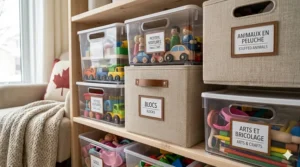
These transparent latching bins (available in 5-quart and 12-quart sizes) are the secret weapon of families who’ve mastered toy rotation storage. The clear plastic construction lets you see contents at a glance, which means no more dumping out five bins to find the specific puzzle your 4-year-old suddenly needs right now.
Here’s the expert insight most buyers miss: toy rotation isn’t just trendy Instagram parent content—it’s a research-backed strategy for managing toy overwhelm. By keeping 70% of toys in storage and rotating them every 2-3 weeks, you maintain novelty without the clutter. These bins excel at this because the secure latching lids keep contents dust-free during storage, crucial if you’re storing them in a Canadian basement where humidity fluctuates with seasonal temperature changes.
The stackable design maximizes vertical space—a necessity for condo dwellers in Vancouver or Montreal where floor space comes at a premium. Each bin holds approximately 4-6 kg (8-13 lbs) safely, and the reinforced handles won’t snap even when kids inevitably try to carry overstuffed bins. Canadian winters also mean these work brilliantly for seasonal toy storage: summer outdoor toys go into rotation during the November-April deep freeze, freeing up prime playroom real estate.
Pros:
✅ Completely transparent—no guessing games
✅ Latching lids keep out basement moisture and dust
✅ Dishwasher-safe if you need deep cleaning
Cons:
❌ Clear plastic shows every smudge and fingerprint
❌ Not aesthetically suited for living room display
Price & Verdict: The 6-pack typically runs $35-$50 CAD on Amazon.ca. Perfect for organized parents in smaller Canadian homes who want to implement toy rotation but lack a dedicated playroom for visible storage.
3. Collapsible Fabric Cube Storage Bins — The Space-Saving Minimalist
These reinforced fabric cubes (typically 28 cm x 28 cm x 28 cm / 11 x 11 x 11 inches) with cardboard support panels solve a uniquely Canadian problem: seasonal space constraints. During winter months when outdoor toys migrate inside and we’re all spending more time indoors, these bins provide flexible storage. Come summer, they collapse flat for storage in under-bed spaces or closet shelves.
What professional organizers know but most buyers don’t: the fabric construction is actually superior to hard plastic for certain toy types. Soft toys, dress-up clothes, and building blocks benefit from the slight give of fabric sides, which prevents damage during enthusiastic cleanup sessions. The dual handles on each side (one horizontal, one vertical) mean even preschoolers can manage them independently—critical for teaching organizational responsibility.
The best Canadian application I’ve seen? Labelling these with both English and French text for bilingual households, particularly in Quebec where bilingual product accessibility matters for child development. The fabric also accepts adhesive labels better than textured plastic alternatives. For families concerned about Canadian safety standards, these meet flammability requirements and contain no BPA or phthalates.
Pros:
✅ Folds completely flat when not needed
✅ Fabric is spot-cleanable and won’t crack in cold garages
✅ Fits standard cube organizer shelving units
Cons:
❌ Cardboard reinforcement can warp with extreme moisture
❌ Lower weight capacity than hard-sided alternatives (around 11 kg / 25 lbs max)
Price & Verdict: A 6-pack averages $25-$40 CAD on Amazon.ca—the most budget-friendly option for starter systems. Ideal for rental apartments where you need flexibility and can’t install permanent shelving.
4. Large Toy Chest with Reinforced Lid — The Bulk Storage Solution
This collapsible storage chest (typically 64 cm x 38 cm x 41 cm / 25 x 15 x 16 inches) handles the oversized items that frustrate smaller bin systems—think stuffed animals, play tents, and those bulky ride-on toys that somehow multiply despite your best efforts to limit acquisitions.
The critical design feature that separates quality chests from cheap alternatives: reinforced riveted handles that won’t tear even under the 15 kg (33 lb) weight loads these chests regularly carry in real Canadian homes. I’ve seen too many parents struggle with torn handles while trying to move toy chests from playrooms to storage areas. The removable divider board (included in better models) transforms this from a chaotic toy dumping ground into an organized system—use it to separate stuffed animals from sports equipment, or remove it entirely for storing larger items like play kitchens during toy swaps.
For Canadian families, the collapsible design is essential for cottage season. Pack it flat when heading to summer properties, then pop it open for instant lake house toy organization. The beige and white colour scheme works in adult living spaces too—increasingly important as Canadian housing costs push families toward open-concept homes where playrooms share space with living areas.
Pros:
✅ Handles 23+ kg (50+ lbs) of toys without structural failure
✅ Removable divider adds organizational flexibility
✅ Collapsible design perfect for seasonal cottage use
Cons:
❌ Lacks compartmentalization for small items
❌ Requires floor space (not stackable)
Price & Verdict: Expect $60-$95 CAD on Amazon.ca depending on size variations. Best for families with toddlers and preschoolers who have larger toys and limited vertical storage options.
5. 3-Tier Rolling Storage Cart — The Craft & Activity Specialist
This mobile cart system (usually featuring three open mesh or solid baskets) solves a problem that intensifies during Canadian winters: indoor activity management. When kids are stuck inside from November through March, arts and crafts become survival tools for parents’ sanity. These carts keep supplies accessible but mobile.
The genius of this system lies in its wheeled mobility—roll it out during craft time, roll it back into a closet when guests arrive. The three-tier configuration naturally segments by activity type: top basket for current projects, middle for frequently used supplies, bottom for bulk items like construction paper or Play-Doh containers. Unlike fixed storage, this adapts to your space needs throughout the day.
What distinguishes quality carts in the Canadian market: metal construction rather than plastic. Our temperature fluctuations (especially in garages or sunrooms) cause cheaper plastic wheels to crack. Metal carts with locking casters (critical—you don’t want this rolling during use) remain stable through years of movement. The mesh basket design also promotes air circulation, preventing that musty smell that develops in closed containers during humid summer months or when storing damp items like paint brushes.
Pros:
✅ Mobility lets you reclaim space when not in active use
✅ Open baskets provide visual inventory of supplies
✅ Locking wheels prevent accidental movement
Cons:
❌ Open design means items can fall out during transport
❌ Not suitable for toy storage requiring dust protection
Price & Verdict: Quality metal carts run $40-$75 CAD on Amazon.ca. Perfect for families with school-age children (5-12) who do regular craft activities and need flexible, accessible supply storage.
6. Woven Storage Baskets with Handles — The Aesthetic Open-Bin System
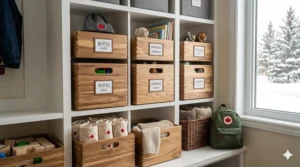
Natural fibre baskets (water hyacinth, seagrass, or rattan-style weave, typically 41 cm x 31 cm / 16 x 12 inches) represent the intersection of function and design—critical for Canadian families in open-concept homes where toy storage doubles as living room décor.
The open-bin toy system philosophy, popularized by Montessori education principles, prioritizes accessibility over concealment. Children see their toys, make independent choices, and learn to return items to visible homes. These baskets facilitate that approach while maintaining adult aesthetic standards. The natural materials also introduce texture and organic elements into modern Canadian homes that often lean heavily on manufactured materials.
Here’s what product listings won’t mention: these baskets perform differently in Canadian climates than in California showrooms. Water hyacinth and seagrass can become brittle in very dry winter indoor air (especially in homes with forced-air heating), so occasional light misting maintains flexibility. Conversely, the breathable weave prevents the mildew issues that plague sealed containers in humid summer months. For families concerned about sustainability, these materials are renewable and biodegradable—a meaningful consideration given Canada’s environmental consciousness.
Pros:
✅ Natural materials align with eco-conscious Canadian values
✅ Handles make transport easy even for younger children
✅ Collapsible design saves space when empty
Cons:
❌ Weave gaps allow small items (Lego pieces, crayons) to escape
❌ Higher maintenance than plastic alternatives
Price & Verdict: Sets of 3-4 baskets typically cost $45-$70 CAD on Amazon.ca. Best for families with children ages 3+ who have moved past small choking-hazard toys and prioritize aesthetic integration in main living spaces.
7. Modular Cube Shelving System — The Grow-With-Your-Family Investment
These expandable cube systems (individual cubes typically 35 cm x 35 cm / 13.8 x 13.8 inches) represent the long-term thinking approach to toy storage. Start with a 4-cube configuration for your newborn’s nursery, expand to 9 cubes as toy collections grow, then reconfigure to 12 cubes when your second child arrives.
The modular advantage becomes clear when you consider the Canadian family lifecycle. That nursery toy organization system transforms into elementary school book storage, then teenage bedroom organization, and eventually college dorm room furniture. Quality systems use connector pieces that create genuinely stable structures—cheaper versions wobble dangerously, violating the stability requirements emphasized in Health Canada’s consumer product safety guidelines.
What separates premium systems: reinforced panels that support actual weight rather than just holding shape. Canadian families often load these with heavy items—board game collections, Lego bins, hardcover book libraries. Systems rated for 10+ kg per cube handle real-world usage. The white or natural wood finishes popular in Canadian homes also hide scuffs better than bold colours, maintaining aesthetic appeal through years of use. For installation, wall-anchoring hardware (often sold separately) is non-negotiable in earthquake-prone B.C. or for tall configurations anywhere in Canada.
Pros:
✅ Infinite configuration possibilities adapt to changing needs
✅ Accepts fabric bins, baskets, or standalone use
✅ Multi-generational investment (10+ year usable life)
Cons:
❌ Higher upfront cost than single-purpose solutions
❌ Assembly required for each reconfiguration
Price & Verdict: Expect $80-$150 CAD on Amazon.ca for a 9-cube system. The premium investment makes sense for families planning 2+ children or those prioritizing long-term value over immediate cost savings.
The Toy Rotation System: A Canadian Winter Survival Strategy
After years of consulting with families across Canada, I’ve observed that successful toy organization isn’t about buying more storage—it’s about implementing smarter systems. Toy rotation storage transforms overwhelming collections into manageable, engaging play experiences.
How it works: Divide toys into four categories—Active Play, Creative Play, Educational, and Comfort Items. Keep one category fully accessible (25-30% of total toys) while storing the other three in labelled bins. Every 2-3 weeks, swap categories. This timing isn’t arbitrary—research shows novelty peaks around week 2-3, making rotated toys feel fresh again.
The Canadian advantage: Our extended winters make rotation essential rather than optional. When outdoor play is limited from November through March, toy rotation prevents the “we have nothing to do” complaint while actually reducing total toy volume in active circulation. Use those stackable clear bins (#2 from our list) for storage in basement storage rooms, unheated garages (toys won’t freeze), or under-bed spaces.
Implementation steps:
- Audit current inventory—donate broken items and toys outgrown
- Photograph each category’s contents (helps kids remember what’s in storage)
- Label bins with category + date stored
- Create a calendar reminder every 2 weeks for rotation
- Involve children in the swap process (builds anticipation and organizational skills)
Common pitfall: Parents often rotate everything including comfort items (beloved stuffed animals, security blankets). Don’t. Comfort items remain constantly accessible—rotation applies only to stimulation-based toys. This distinction prevents emotional meltdowns and maintains the psychological safety your child associates with their space.
For Toronto condo dwellers with minimal storage, rotate monthly rather than bi-weekly and reduce categories to three. For families with dedicated playrooms in Calgary or Ottawa suburbs, use seasonal rotation—summer outdoor toys swap with winter indoor activities, freeing premium space for current-season items.
Real-World Scenarios: Matching Storage Systems to Canadian Families
Scenario 1: The Vancouver Condo Family
Profile: Two children (ages 2 and 5), 850 square foot two-bedroom condo, no dedicated playroom
Challenge: Toys migrate throughout living spaces; limited floor area
Solution: Modular cube shelving (#7) in living room corner + collapsible fabric bins (#3) stored under beds. Use vertical space with wall-mounted shelving. Implement strict toy rotation—25 toys maximum in active circulation. Store off-season items in building storage locker.
Budget: $200-$275 CAD total investment
Scenario 2: The Calgary Single-Parent Household
Profile: Three children (ages 4, 7, 10), 1,400 square foot townhouse with finished basement playroom
Challenge: Multiple age ranges, different toy types, limited supervision time for organization
Solution: Multi-bin organizer (#1) for youngest child’s toys + rolling carts (#5) for each older child’s activity supplies. Clear bins (#2) for basement bulk storage. Assign each child one colour family—reduces sorting arguments.
Budget: $175-$250 CAD
Scenario 3: The Rural Manitoba Extended Family
Profile: Grandparents hosting grandchildren weekly, ages 1-8
Challenge: Need flexible system that packs away between visits; temperature extremes in storage areas
Solution: Large toy chests (#4) that collapse flat. Natural baskets (#6) for living room display during visits. Fabric bins (#3) in spare bedroom closet. Everything mobile—wheels or handles essential.
Budget: $150-$225 CAD
How to Choose Toy Storage Bins for Your Canadian Home
Selecting the right storage system requires honest assessment of your situation rather than Pinterest-perfect aspirations. Ask yourself these seven questions:
1. What’s your available square footage?
Measure actual floor space, not wishful thinking. A 400 sq ft Toronto condo requires vertical solutions and collapsible storage. A 2,000 sq ft Edmonton home can accommodate floor-standing units.
2. What’s your child’s age and developmental stage?
Toddlers (18 months – 3 years) need open bins at their height with visual cues. School-age children (6-12) can manage drawer systems and stacked bins. Match complexity to capability—overcomplicating systems guarantees non-use.
3. Where will toys be stored long-term?
Heated living spaces accept any material. Unheated garages in Calgary or Winnipeg require plastic that won’t crack in -30°C temperatures. Humid basements need ventilated options preventing mildew.
4. What’s your organizational tolerance?
Be honest. If you’re not naturally organized, don’t choose systems requiring daily maintenance. Open bins with broad categories outperform hyper-segmented systems for most families.
5. How will cleaning responsibility be divided?
If children will handle cleanup independently, they need systems they can physically manipulate. Heavy lids, high shelves, and complex latches guarantee parental intervention.
6. What’s your budget in CAD?
Quality storage is an investment, but starter systems exist under $100 CAD. Budget $30-$50 per child for basic organization, $100-$200 for comprehensive playroom systems.
7. How many children will share the system?
Single-child families can use simple categorization. Multiple children need visual differentiation—colour-coding, labels with names, or assigned zones prevent territorial disputes.
The biggest mistake Canadian parents make? Choosing storage based on aesthetic appeal rather than functional requirements. Instagram-worthy nursery toy organization looks beautiful but fails if your toddler can’t independently access bins, or if your condo’s awkward layout makes fixed shelving impractical.
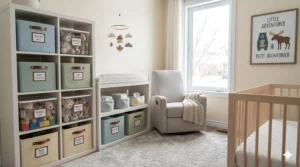
Common Mistakes When Buying Toy Storage in Canada
Mistake #1: Ignoring dimensional reality
That gorgeous 12-cube organizer from Amazon.com might not fit through your condo’s doorway. Always verify dimensions in centimetres, not just inches. Canadian doorways average 80-90 cm wide—factor in assembly location if shipping pre-assembled furniture.
Mistake #2: Overlooking shipping costs and availability
Many U.S. storage products don’t ship to Canada, or arrive with surprise border fees. Always confirm Amazon.ca availability. A product showing $50 USD on Amazon.com might cost $90 CAD delivered to Toronto after exchange rates and shipping.
Mistake #3: Choosing aesthetics over accessibility
Those closed-lid woven baskets look amazing but add friction to cleanup. Every additional step (lift lid, sort items, close lid) decreases compliance. For children under 6, open storage bins dramatically improve independent cleanup success rates.
Mistake #4: Underestimating weight capacity
Toy collections are shockingly heavy. Board games, building blocks, and action figure collections quickly exceed flimsy storage limits. Verify weight ratings—quality units specify load capacity per shelf or bin. Expect real-world loads of 7-10 kg per bin in active playrooms.
Mistake #5: Failing to account for Canadian climate
Basement storage in humid Vancouver requires different materials than garage storage in dry Calgary. Fabric bins mildew in moisture; plastic bins crack in extreme cold if low quality. Match materials to storage environment.
Mistake #6: Buying everything immediately
Start with one system, test it for 4-6 weeks, then expand. Many families waste hundreds purchasing mismatched storage that doesn’t integrate. Begin with stackable clear bins (#2) for flexibility, then add specialized storage as you understand your patterns.
Mistake #7: Neglecting future flexibility
That teddy bear organizer is adorable for your 2-year-old but useless at age 8. Prioritize systems that adapt—modular cubes, adjustable shelving, or neutral designs that age with your family.
Toy Storage vs. Traditional Furniture: What Makes Sense for Canadian Spaces
Traditional furniture (dressers, bookcases repurposed for toys) versus dedicated toy storage bins presents a cost-benefit analysis many Canadian families navigate incorrectly.
When traditional furniture makes sense:
- You’re in a rental where permanent solutions aren’t viable
- Your children are under 3 years old (needs will change rapidly)
- You have quality hand-me-down furniture available
- Your space doubles as adult living areas requiring aesthetic integration
When dedicated toy storage wins:
- You have multiple children sharing spaces
- Your toys include categories requiring specialized storage (small pieces, craft supplies, outdoor equipment)
- You’re implementing organizational systems like toy rotation
- Floor space is limited (dedicated storage typically maximizes vertical efficiency)
The hybrid approach works well for Canadian families: use a traditional bookcase (#7 modular cubes function similarly) combined with specialized bins for categorization. This provides structural stability and aesthetic appeal while maintaining organizational functionality.
Cost comparison in CAD:
- Traditional dresser repurposed: $0-$150 (assuming you own it or buy used)
- Basic bookcase + bins: $100-$200
- Dedicated toy storage system: $150-$350
- Premium modular system: $300-$600
The calculation changes when you factor in longevity. A $300 modular system lasting 10+ years and serving multiple children costs $30/year. A $75 plastic toy box replaced every 2 years costs $37.50/year with no flexibility. Quality dedicated storage often proves more economical long-term—particularly relevant given Canadian housing costs pushing families toward smaller spaces requiring multi-functional solutions.
What Canadian Regulations Say About Toy Storage Safety
While toy storage bins themselves aren’t specifically regulated, Health Canada emphasizes several safety principles that apply to storage solutions in children’s spaces. Understanding these helps Canadian parents make informed choices that protect their children.
Stability and tip-over prevention:
Any storage unit over 75 cm (30 inches) tall requires wall anchoring. Health Canada’s consumer product safety guidelines stress preventing furniture tip-over accidents, which cause serious injuries annually. Those decorative anchoring straps aren’t optional—they’re essential safety equipment. Test wall anchors annually; drywall anchors may need reinforcement as children grow and climbing attempts increase.
Material safety:
Canadian regulations restrict lead content in accessible parts of children’s products to not more than 90 mg/kg. While this primarily targets toys themselves, storage bins marketed for children should meet similar standards. Reputable brands (particularly those on Amazon.ca from established manufacturers) comply with Canadian requirements. Be wary of unbranded imports lacking safety certification documentation.
Choking hazard prevention:
Small parts from storage systems—decorative buttons, loose hardware, detachable elements—present risks for children under 3. Inspect bins regularly for loose screws, cracked plastic pieces, or fabric tears exposing filling materials.
Ventilation in enclosed spaces:
This might seem odd for storage bins, but it matters: never use toy chests or bins with locking lids that children could become trapped inside. Quality toy chests include ventilation holes and slow-closing hinges preventing finger pinch injuries. If repurposing traditional chests, ensure lids can be pushed open from inside and never lock.
Provincial considerations:
Quebec maintains additional consumer protection standards and requires bilingual labelling on products marketed to children. While storage bins aren’t typically labelled beyond basic assembly instructions, products sold in Quebec should accommodate this requirement if they include warning labels or instructional content.
For parents seeking maximum safety assurance, look for products displaying CSA (Canadian Standards Association) certification marks or noting compliance with Canadian Consumer Product Safety Act requirements. While not mandatory for all storage solutions, this certification indicates third-party safety verification aligned with Canadian standards.
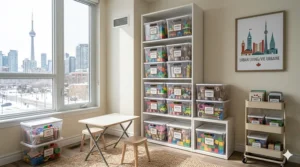
Long-Term Value: ROI Analysis for Canadian Storage Investment
Quality toy storage bins represent significant household investment—$200-$400 CAD for comprehensive playroom organization. Understanding return on investment helps justify the expense or identify where budget alternatives make sense.
Quantifiable returns:
Time savings: Organized storage reduces daily cleanup from 20-30 minutes to 5-10 minutes. Over a year, that’s 90-150 hours recovered—worth approximately $1,350-$2,250 in opportunity cost at minimum wage equivalent. Even if you value your time at half that rate, storage systems pay for themselves within 6-12 months through time savings alone.
Toy preservation: Organized storage extends toy lifespan by 40-60%. That $200 Lego collection lasts 7-10 years instead of 4-5 when pieces aren’t lost, preventing replacement costs of $80-$120. Multiply this across your toy inventory and the preservation value quickly exceeds storage costs.
Reduced consumption: When you can actually see what you own, duplicate purchases decrease dramatically. Families report 25-40% reduction in toy purchases after implementing organized storage—easily $150-$300 CAD annual savings for typical Canadian families.
Resale value protection: Organized, well-maintained toys command 50-70% original retail in Canadian resale markets (Facebook Marketplace, Once Upon A Child). Disorganized, damaged toys fetch 10-20%. On a $2,000 toy investment over childhood, that’s $600-$900 additional recovery.
Intangible returns:
Reduced stress: Hard to quantify but valuable. Parents report measurably lower daily frustration with organized systems. One Toronto mother described it as “finally able to breathe in my own home”—priceless.
Teaching organizational skills: Systems kids can manage independently build life skills worth far more than the storage cost. These habits transfer to schoolwork, personal space management, and eventually professional organization.
Increased play value: When toys are organized and accessible, children actually play with them rather than ignoring cluttered masses. You’re maximizing value from toys you’ve already purchased.
Budget allocation strategy for Canadian families:
Phase 1 (Year 1): Invest $100-$150 in core system (modular cubes or multi-bin organizer). This establishes the organizational framework.
Phase 2 (Year 2): Add $50-$75 in specialized bins (clear storage for rotation, fabric bins for categories). You now understand your family’s patterns and can refine.
Phase 3 (Years 3+): Expand $25-$50 annually as collections grow or family size increases. Maintenance and replacement rather than complete system overhauls.
This phased approach aligns with Canadian family budgeting realities—spreading investment over time rather than overwhelming single purchases. The alternative (continuing with inadequate systems) costs more long-term through time waste, toy replacement, and quality-of-life impacts that affect the entire household.
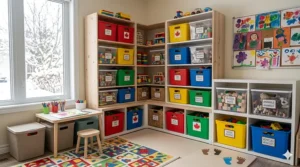
Frequently Asked Questions
❓ Can stackable toy storage bins withstand Canadian basement humidity?
❓ Are open-bin toy systems better than closed storage for Canadian playrooms?
❓ How many toy storage baskets with labels do I actually need per child?
❓ Do toy storage bins sold on Amazon.ca meet Canadian safety standards?
❓ What's the best nursery toy organization system for small Canadian condos?
Conclusion: Finding Your Perfect Toy Storage System
Choosing the right toy storage bins for your Canadian home isn’t about copying Pinterest boards or buying the most expensive system. It’s about honestly assessing your space, your children’s needs, and your family’s organizational capabilities, then selecting solutions that work with your reality rather than against it.
The families who succeed with toy organization share three characteristics: they start with adequate (not perfect) systems, they involve children in the process, and they maintain consistent expectations. Your $75 Amazon.ca multi-bin organizer used daily beats a $400 custom system that’s too complicated for your family to maintain.
Remember that toy storage evolves with your family. That nursery toy organization system serves for 2-3 years before needs change. The modular approach—starting simple and expanding as you understand your patterns—prevents the costly mistakes of over-buying systems that don’t match your lifestyle.
Canadian families face unique challenges: smaller urban living spaces, temperature extremes affecting storage location options, and the budget reality that cross-border shopping isn’t always viable. But these constraints actually simplify decision-making. When you’re shopping Amazon.ca exclusively and working within defined space parameters, your options narrow to genuinely suitable solutions rather than overwhelming possibilities.
The investment in proper toy storage bins—whether $100 or $300 CAD—pays dividends in reclaimed time, reduced stress, and teaching your children organizational skills they’ll carry throughout life. That’s the real return on investment: not just tidy playrooms, but calmer homes and more capable kids.
Start with one system this week. Spend 30 minutes implementing it with your children. Then watch as your evenings transform from toy-pickup battles into the extra family time you’ve been craving.
Recommended for You
- 17 Nursery Closet Organization Ideas That Work | Canada 2026
- Best Baby Dresser Canada 2026: 7 Safe & Stylish Picks
- 7 Best Changing Table Heights 2026: Ergonomic Guide Canada
Disclaimer: This article contains affiliate links. As an Amazon Associate, I earn from qualifying purchases. If you purchase products through these links, we may earn a small commission at no additional cost to you.
✨ Found this helpful? Share it with your friends! 💬🤗
