In This Article
It’s 2 a.m. The baby has just finished a feed. You’re running on about three hours of sleep and a cold cup of tea, and somehow you still need to wash that bottle. You grab the nearest scrubby thing in the sink — and honestly? That’s where things can go quietly wrong.

A baby bottle brush isn’t just a cleaning tool. It’s your first line of defence against invisible threats that your exhausted eyes can’t see. A good baby bottle brush reaches every curve, shoulder, and thread of your bottle — areas where leftover breast milk or formula create the perfect breeding ground for harmful bacteria like E. coli, Salmonella, and Cronobacter. Health Canada reminds parents and caregivers to sterilize bottles, nipples, and other feeding equipment regularly, especially in the early months when your baby’s immune system is still developing.
In this guide, I’ve done the deep research — scouring Amazon.ca bestseller lists, combing through Canadian parent reviews, and comparing specifications across dozens of options — so you don’t have to do it at 2 a.m. You’ll find seven real products available on Amazon.ca right now, honest expert commentary, and a practical cleaning routine that actually fits into a busy Canadian family’s life. Whether you’re stocking up before your baby arrives or replacing a brush that’s finally given up the ghost, this guide has you covered.
All prices in this article are in Canadian dollars (CAD) and reflect general price ranges only — check Amazon.ca for current pricing, as prices change frequently.
Quick Comparison Table: Best Baby Bottle Brushes in Canada 2026
| Product | Type | Best For | Price Range (CAD) | Dishwasher Safe? |
|---|---|---|---|---|
| Dr. Brown’s Soft Touch No Scratch Brush | Silicone-tip nylon | Everyday newborn use | $10–$15 | Yes (top rack) |
| Dr. Brown’s Reusable Sponge Brush (2-Pack) | Sponge + bristle | Budget buyers, twins | $12–$18 | Yes |
| Momcozy 7-in-1 Bottle Cleaning Kit | Silicone set | Complete all-in-one kit | $30–$45 | Yes |
| Playtex Baby Deluxe Bottle & Nipple Brushes | Sponge + straw brush | Traditional cleaning fans | $12–$20 | Yes |
| OXO Tot Bottle & Straw Cleaning Set | Multi-tool silicone | Minimalist, multi-function | $20–$30 | Yes |
| haakaa Silicone Cleaning Brush Kit | Silicone 3-pc set | Breastfeeding moms, pump parts | $18–$28 | Yes |
| Boon Cacti Bottle Cleaning Brush Set | Nylon 4-pc set | Style-conscious parents | $22–$32 | Yes |
The table above makes one thing crystal clear: the Canadian market is rich with quality options across every budget tier. What separates an $12 CAD brush from a $40 CAD kit isn’t just build quality — it’s the ecosystem of tools included. If you’re exclusively bottle-feeding or pumping, investing in a complete set pays dividends in time and hygiene. If you’re supplementing breastfeeding with occasional bottles, a single high-quality brush does the job perfectly well.
💬 Just one click — help others make better buying decisions too! 😊
✨ Don’t Miss These Exclusive Deals!
🔍 Take your baby’s hygiene to the next level with these carefully selected products. Click on any highlighted item to check current pricing and availability on Amazon.ca. These tools will help you keep your baby’s feeding items spotlessly clean and safe!
Top 7 Baby Bottle Brushes in Canada: Expert Analysis
1. Dr. Brown’s Soft Touch No Scratch Baby Bottle Cleaning Brush
Dr. Brown’s has been a staple in Canadian nurseries for decades, and this brush earns its reputation on the merits — not just the name recognition. The Soft Touch features a sponge tip surrounded by nylon bristles, a design that lets it scrub thoroughly without scratching the interior of polycarbonate-free or glass bottles. It comes with a suction-cup stand and a storage clip — two details that matter far more than they sound when your counter is cluttered with pump parts, drying racks, and miscellaneous baby gear.
What most Canadian parents overlook about this brush is how well it handles Dr. Brown’s own anti-colic bottles, which have internal vent systems that trap milk residue in hard-to-see places. The slim neck of the brush fits through the narrow openings where gunk loves to hide. It’s BPA-free, top-rack dishwasher safe, and available in both blue and pink at Amazon.ca in the $10–$15 CAD range.
In my assessment, this is the go-to for Canadian parents who want a reliable, no-nonsense option that doesn’t require a learning curve. It works on narrow-neck and standard bottles, rinses clean quickly, and the suction cup stand keeps it off your counter and out of standing water — a real hygiene win.
✅ Reliable, established brand widely available on Amazon.ca
✅ Suction stand keeps brush upright and hygienic
✅ Sponge + nylon combo handles mild-to-moderate buildup
❌ Sponge tip needs replacing every 2–4 weeks
❌ Not ideal for very wide-neck bottles like some Tommee Tippee styles
Value verdict: Solid everyday performer in the budget-to-mid range. Great first brush for new Canadian parents.

2. Dr. Brown’s Reusable Sponge Baby Bottle Cleaning Brush with Suction Cup Stand (2-Pack)
If you’re feeding twins, or you simply want a backup brush at the kitchen sink and one by the utility sink in the laundry room, this 2-pack is one of the smartest purchases you can make. The sponge-tip design is classic Dr. Brown’s — soft enough to be gentle on silicone nipples, firm enough to lift dried formula from bottle shoulders. Each brush comes with its own suction cup stand, so both can live on your counter without tipping over or trapping water underneath.
The 2-pack format also solves a real Canadian problem: supply. If you’re running low between deliveries from Amazon.ca (Prime members, you know this dilemma well), having two brushes means you always have a clean one in rotation while the other is drying. The pink colourway is the most popular on Amazon.ca’s Canadian listings.
These are designed for reuse, but the sponge does absorb milk proteins over time. Even with daily rinsing, plan to swap them out monthly. At the $12–$18 CAD price range for two, that’s a very affordable rotation.
✅ Two-for-one value — perfect for multiples or heavy bottle use
✅ Individual suction stands for both brushes
✅ Gentle on silicone and polycarbonate-free bottle interiors
❌ Sponge absorbs milk residue and needs frequent replacement
❌ Short handle may not reach the bottom of very tall 11 oz bottles
Value verdict: Best budget pick for high-volume bottle washers. The 2-pack format makes it one of the most cost-effective baby bottle brush options on Amazon.ca.
3. Momcozy 7-in-1 Bottle Cleaning Kit
Momcozy has quietly become one of the most popular breastfeeding and feeding brands among Canadian parents, and this 7-in-1 kit explains exactly why. The set includes a silicone bottle brush, nipple brush, straw brush, soap dispenser, and a drying rack — essentially everything you need to build a complete bottle-cleaning station on your countertop, sourced from a single Amazon.ca order.
The silicone bottle brush is the star of this kit. Unlike sponge-tip brushes, the flexible silicone bristles don’t trap milk residue in microscopic pores — meaning the brush itself stays cleaner for longer between sanitizing runs. The integrated soap dispenser is one of those features that sounds gimmicky until you’ve used it. At 3 a.m., being able to press the handle and dispense the right amount of soap without fumbling for a bottle of dish soap is genuinely appreciated.
For Canadian families with limited counter space — think Toronto condos or Vancouver apartments — this all-in-one set is a dream. Everything stores neatly on the drying rack, and the compact footprint rivals what a standalone brush + rack + soap dispenser would take up separately.
In the $30–$45 CAD range, this is a mid-range investment that replaces $50–$70 CAD worth of individual pieces. Amazon.ca Prime members typically receive this within 2 days in major Canadian centres.
✅ Complete cleaning ecosystem in one purchase
✅ Silicone bristles resist bacterial buildup better than sponge
✅ Soap dispenser handle reduces fumbling during night feeds
❌ Higher upfront cost compared to single brushes
❌ Drying rack is not suitable for large bottle collections (6+ bottles at once)
Value verdict: Best all-in-one kit for Canadian parents who want to invest once and not piece together a cleaning setup over several orders.
4. Playtex Baby Deluxe Bottle & Nipple Brushes (3-Piece Set)
Playtex is one of those brands that Canadian grandparents recognize instantly — it’s been in the feeding game for generations, and for good reason. This 3-piece set includes a large bottle brush with a sponge tip, a nipple brush, and a straw brush, all BPA-free and dishwasher safe. The suction base on the main brush is particularly strong — it adheres to tile, laminate, and countertop surfaces without slipping, which matters when you’re washing one-handed while holding a wiggly baby on your hip.
The sponge tip delivers a satisfyingly thorough clean on classic Playtex Nurser bottles, and it’s wide enough to handle standard-neck bottles from most major brands. The included straw brush is a bonus that’s easy to underestimate — once you start using sippy cups and transition bottles, this tiny accessory earns its place every single day.
What I appreciate about the Playtex set is its familiarity. There’s no learning curve. Every piece does exactly what it looks like it does, which is actually a virtue when you’re a sleep-deprived parent. Available on Amazon.ca in the $12–$20 CAD range, it’s excellent value for a multi-piece kit.
✅ Strong suction base keeps brush upright and stable
✅ Straw brush included — useful from newborn stage through toddlerhood
✅ Trusted brand with decades of Canadian market presence
❌ Sponge tip won’t reach tight anti-colic vent systems as effectively as dedicated tools
❌ Straw brush is relatively short for tall sports-style bottle straws
Value verdict: A solid traditional choice. Best for parents who want a familiar, no-surprises cleaning set at an accessible price point.
5. OXO Tot Water Bottle & Straw Cup Cleaning Set
OXO has a cult following among Canadian parents who value thoughtful design, and the Tot cleaning set demonstrates exactly why. This multi-tool set includes a bottle brush with a rotating base (which collects drips and prevents countertop puddles), a detail brush for nipples and valves, and a straw brush — all in OXO’s signature slate grey colourway that looks at home in a modern kitchen.
The rotating base is genuinely clever. Most brush stands are static, meaning water drips straight onto your counter. OXO’s design channels drips into the base and lets you pour them out. It’s a small detail that eliminates a persistent annoyance. The silicone elements are top-rack dishwasher safe, and the brush head itself is firm enough to scrub stubborn residue without being abrasive.
For minimalist Canadian parents — particularly those in urban condos with limited storage — the OXO Tot set is ideal. It occupies a compact footprint, looks clean and modern, and covers the three cleaning tasks you’ll need 95% of the time: bottles, nipples, and straws. Available on Amazon.ca in the $20–$30 CAD range, it sits confidently in the mid-tier without feeling like a compromise.
✅ Rotating drip-catching base keeps counters dry
✅ Sleek design works well in modern Canadian kitchens
✅ Covers bottle, nipple, and straw cleaning in one compact set
❌ Bottle brush head is on the smaller side — may not fully clean very wide-neck bottles
❌ No soap dispenser or full drying rack included
Value verdict: Best for design-conscious, minimalist Canadian parents. The rotating drip base alone is worth the price of admission.
6. haakaa Silicone Cleaning Brush Kit (3-Piece)
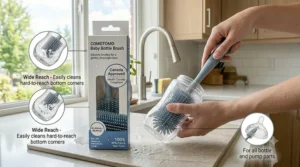
haakaa is a New Zealand brand with massive popularity among Canadian breastfeeding parents — you’ll spot their silicone pumps and cleaning tools on nearly every Canadian mommy blog, and for good reason. This 3-piece silicone cleaning brush kit includes a double-ended bottle brush (one wide end for bottle interiors, one angled tip for tight corners), plus two narrow tube brushes sized for straws and pacifiers.
The food-grade silicone construction is the standout feature here. Unlike nylon or sponge, food-grade silicone is non-porous — it doesn’t absorb milk fats or harbour bacterial colonies between washings. You can sterilize these brushes by boiling them directly alongside your bottles, which means they’re always as clean as the bottles they’re washing. The stainless steel handles provide a sturdy, rust-resistant grip that won’t corrode from repeated hot-water exposure — a practical consideration for Canadian kitchens that run hot water to deal with thick dairy residue in cold months.
This set is especially well-suited for parents using haakaa pumps and storage bags, as the angled detail brush was clearly designed with the brand’s own pump architecture in mind. Available on Amazon.ca in the $18–$28 CAD range in the signature pea green colourway.
✅ Food-grade, non-porous silicone won’t harbour bacteria between uses
✅ Boilable alongside bottles for synchronized sterilization
✅ Stainless steel handle resists rust and corrosion
❌ Silicone bristles require slightly more scrubbing effort on dried-on formula
❌ Narrower bottle brush head isn’t ideal for very wide-neck bottles (e.g., Comotomo)
Value verdict: Best choice for breastfeeding families and haakaa users. The ability to boil the brush with your bottles is an underrated hygiene advantage.
7. Boon Cacti Bottle Cleaning Brush Set (4-Piece)
Let’s be honest — the Boon Cacti set is the one that makes people smile when they see it on a countertop. Styled as a miniature cactus garden, the four-piece set includes a large bottle brush, a straw brush, a nipple brush, and a detail brush, all stored in a ceramic-look “planter” vase. It’s whimsical without being impractical, and the nylon bristles genuinely deliver a thorough clean.
Beyond the aesthetics, Boon has engineered genuine function into this set. The vase base drains collected water through slots in the sides, keeping the brushes from sitting in a soggy puddle — a common hygiene issue with traditional stands. The bristles are stiff enough to tackle dried formula on bottle shoulders and threads, and the detail brush fits into anti-colic vent channels on bottles like Dr. Brown’s and Philips Avent. All four pieces are top-rack dishwasher safe.
Where Boon really wins is in the Canadian gift registry market. This is one of the most popular items on Canadian baby registries at major retailers, and it’s easy to see why — it looks beautiful in photos and is genuinely useful. In the $22–$32 CAD range on Amazon.ca, it’s priced fairly for a complete four-tool kit.
✅ Complete 4-brush set covers every cleaning scenario
✅ Draining vase keeps brushes sanitary between uses
✅ A crowd favourite on Canadian baby registries for good reason
❌ Nylon bristles eventually splay and need replacing (every 4–6 weeks)
❌ The “fun” aesthetic means it’s less convincing to partners who prefer minimal kitchen decor 😄
Value verdict: Best for style-conscious Canadian parents who refuse to sacrifice function for form — because with Boon Cacti, you genuinely get both.
How to Properly Clean Baby Bottles: A Step-by-Step Guide for Canadian Parents
Knowing which baby bottle brush to buy is half the battle. Knowing how to clean properly is the other half — and it’s where a surprising number of parents quietly cut corners.
Here’s a routine that takes under five minutes and actually works:
Step 1 — Rinse immediately after each feed. Don’t let bottles sit in the sink. Research shows that bacteria begin multiplying within two hours at room temperature, and dried formula creates a protein film that’s dramatically harder to remove. A quick cold rinse right after feeding takes 10 seconds and saves you significant scrubbing later.
Step 2 — Disassemble completely. Remove the nipple, collar ring, anti-colic valve (if applicable), and any vent components. Each part needs to be washed individually — milk loves to hide in collar threads and valve channels.
Step 3 — Use hot, soapy water and your baby bottle brush. Fill your wash basin with hot water and a few drops of fragrance-free dish soap. Scrub the interior of the bottle with your main brush using circular motions, paying attention to the shoulder area just below the bottle neck where milk film accumulates. Use your nipple brush to clean the nipple inside and out, and your straw/detail brush for vent channels.
Step 4 — Rinse thoroughly. Rinse all components under running hot water until no soap residue remains. Soap residue can affect the taste of milk and potentially irritate your baby’s digestive system.
Step 5 — Air-dry completely before assembling. Place all parts on a clean drying rack or fresh tea towel. Never towel-dry — dish towels transfer bacteria far more readily than we’d like to admit. Bottles assembled while still damp trap moisture inside, which is precisely the environment bacteria thrive in.
Step 6 — Sanitize daily for newborns and at-risk babies. Health Canada recommends sterilizing bottles and feeding equipment regularly, particularly for newborns and infants with compromised immune systems. You can boil, steam, or use a dishwasher with a sanitize cycle for this step. Your baby bottle brush should also be included in this routine — a dirty brush used on clean bottles defeats the entire purpose.
Canadian winter tip 🇨🇦: In Canadian winters, many families run their dishwashers on sanitize cycles more frequently as the indoor heat dries bottles faster — but watch for static cling on silicone nipples in very dry air (common in prairie homes with forced-air heating). A light rinse before use is always wise.
Silicone vs. Sponge Bottle Brush: Which One Should You Choose?
This is the question every Canadian parent eventually asks, and the answer is genuinely nuanced. Both have earned their place in the market, and the right choice depends almost entirely on your cleaning habits.
Silicone bottle brushes are non-porous, meaning they don’t absorb milk residue or harbour bacterial colonies the way sponge materials do. A silicone brush that air-dries overnight between uses is genuinely clean. They’re also boilable and often dishwasher safe at high temperatures, which makes them easy to sterilize alongside your bottles. The trade-off: silicone bristles are more flexible, which means they require a bit more elbow grease on dried, stubborn formula. If you’re great at rinsing bottles immediately after every feed, silicone is your ideal match.
Sponge bottle brushes deliver superior scrubbing power on dried milk and formula because the sponge compresses into corners and curves in ways that silicone can’t. The downside is well-documented: sponge materials are porous, and they trap milk proteins in microscopic channels. The CDC recommends replacing sponge-type feeding tools roughly every two weeks to maintain hygiene standards — that’s a recurring cost and a recurring to-do list item. In a busy Canadian household, it’s easy to lose track.
The verdict for most Canadian families: A silicone primary brush paired with a stiff nylon or sponge detail brush for occasional stubborn residue is the optimal combination. This is exactly the setup that all-in-one kits like the Momcozy 7-in-1 and haakaa Silicone Kit provide, which is a big part of why they’re so popular.
| Feature | Silicone | Sponge/Nylon |
|---|---|---|
| Bacterial resistance | ✅ Non-porous, excellent | ❌ Porous, harbours bacteria |
| Scrubbing power | ⚠️ Good on fresh residue | ✅ Excellent on dried formula |
| Longevity | ✅ 6–12 months | ❌ 2–6 weeks |
| Dishwasher safe | ✅ Yes, high-heat safe | ✅ Usually (top rack) |
| Cost over time | ✅ Lower | ❌ Higher (frequent replacement) |
| Best For | Rinse-promptly households | Occasional heavy buildup |
Silicone wins on hygiene. Nylon wins on scrubbing power. Sponge loses on both over time. That’s not an opinion — it’s the consensus of cleaning science research on non-porous versus porous surfaces.

Bacteria in Baby Bottles: What Every Canadian Parent Should Know
This section might be the most important in the entire article, so I’m going to be direct with you.
Dirty baby bottles aren’t just unpleasant — they’re a genuine health risk. Infants have immune systems that are still developing and cannot fight off bacterial contamination the way adults can. Dangerous bacteria like E. coli, Salmonella, and Cronobacter thrive in leftover breast milk or formula residue and can cause severe gastrointestinal illness and, in the case of Cronobacter, potentially fatal infections in newborns. This is not fear-mongering — it’s why health authorities across Canada and internationally maintain strict guidelines on bottle hygiene.
Research from NIH on bacterial contamination in feeding bottles has shown that bacterial biofilms form on bottle interiors and cannot be removed by gentle rinsing alone. These biofilm communities are particularly stubborn on plastic bottle surfaces, where formula residue creates ideal attachment points. The critical takeaway: rinsing is not washing, and washing is not sterilizing. Each step serves a distinct purpose.
Here’s what the science tells us about the three-step process:
- Rinsing removes loose milk immediately. It does not eliminate bacteria that have already begun colonizing surfaces.
- Washing with hot soapy water and a brush removes the milk film that bacteria feed on — this is where your baby bottle brush earns its keep. A good brush reaches the shoulders, base, and collar threads that a rinse can’t touch.
- Sterilizing (via boiling, steam, or a sanitize dishwasher cycle) eliminates the remaining pathogens that washing misses. Health Canada recommends this step especially for formula-fed babies, given that powdered infant formula can expose babies to Cronobacter spp. if not prepared and stored properly.
The practical upshot for Canadian parents: don’t skip the brush step. A dishwasher alone won’t remove visible milk film from bottle interiors — the physical scrubbing action of a baby bottle brush is non-negotiable for the cleaning phase.
Baby Bottle Cleaning Routine That Actually Works
The best cleaning routine is one you’ll actually stick to, especially in those chaotic first months. Here’s a rhythm that experienced Canadian parents swear by:
After every feed: Rinse immediately with cold water (cold prevents proteins from “cooking” onto the bottle surface — a Canadian winter kitchen tip, since we tend to run hot water instinctively).
Daily (after last feed of the day): Full hand-wash with baby bottle brush using warm, soapy water. Clean the brush itself under running hot water and stand it upright to dry.
Every 1–2 days (for newborns): Full sterilization. This can be a dishwasher sanitize cycle or a pot of boiling water — both are effective. If you’re boiling, submerge bottles and silicone brushes (where applicable) for at least 5 minutes.
Weekly: Inspect your brush. Sponge-tip brushes that smell sour, have visible discolouration, or are starting to tear should be replaced immediately. Silicone brushes should be boiled for 3–5 minutes weekly to reset hygiene levels.
Monthly: Deep-clean your drying rack and countertop brush stand. These surfaces accumulate dried water mineral deposits (especially hard in cities like Calgary and Winnipeg, which have hard tap water) and milk residue. White vinegar and a stiff brush work wonders.
✨ Don’t Miss These Cleaning Essentials!
🔍 Ready to upgrade your bottle-cleaning routine? Check out current pricing and availability for all the brushes reviewed above on Amazon.ca — most ship free with Amazon Prime, and many arrive within two days across major Canadian cities!
How to Choose the Right Baby Bottle Brush in Canada: 7 Criteria That Actually Matter
1. Bottle compatibility first, everything else second. Wide-neck bottles (Comotomo, Philips Avent Natural) need a wide-head brush. Narrow-neck bottles (Dr. Brown’s Natural Flow, standard glass bottles) need a slimmer-neck brush that can reach the base without wedging. Check your bottle type before ordering. What fits in a Tommee Tippee won’t reach the bottom of a Dr. Brown’s narrow.
2. Handle length for your bottle height. Standard baby bottles range from about 15 cm (6 in) for 150 mL bottles to about 22 cm (9 in) for 330 mL bottles. Your brush handle should extend roughly 5–7 cm (2–3 in) beyond the bottle height for comfortable grip. Long handles also protect your wrist from awkward angles during repetitive washing — relevant for parents with any existing wrist issues.
3. Material based on your cleaning style. As covered above: silicone if you rinse promptly; nylon or sponge if formula sometimes dries before you get to it.
4. Included accessories matter more than you think. A nipple brush and straw brush aren’t luxuries — they’re necessities. Nipples have tiny feeding holes and interior surfaces that your main brush cannot reach. Anti-colic vents (Dr. Brown’s, Philips Avent AirFree) trap residue in micro-channels that only detail brushes can address. If the set doesn’t include a nipple brush, add one separately.
5. Drying setup counts. A brush that stores in standing water is a hygiene liability. Look for a suction stand, draining vase, or integrated rack that holds the brush upright with airflow around the bristles.
6. Amazon.ca availability and Prime eligibility. Remote and northern communities in Canada can face longer shipping windows. Prime-eligible products from Amazon.ca fulfilment centres typically arrive within 2–5 business days across most of Canada, though Nunavut, Northwest Territories, and remote BC/Quebec communities may see longer timelines. If you’re in a remote area, order before you run out — a backup brush is worth the small investment.
7. Value over time, not just sticker price. A $10 CAD sponge brush replaced monthly costs $120 CAD per year. A $25 CAD silicone set lasting 12 months costs $25 CAD per year. Do the math once, then buy accordingly.

Dishwasher Safe Baby Bottles & Tools: What Works and What Doesn’t
Many Canadian parents wonder whether a dishwasher alone can replace the baby bottle brush — and the answer is a firm “no,” but a nuanced one. Here’s what your dishwasher actually does and doesn’t do:
✅ Dishwashers ARE effective for: Sanitizing pre-rinsed components on a hot cycle (60°C/140°F or higher), removing loose milk residue from wide surfaces, and sterilizing using a certified NSF/ANSI 184 sanitize cycle, which achieves 99.999% bacterial reduction.
❌ Dishwashers ARE NOT effective for: Removing dried milk film baked onto bottle shoulders, cleaning anti-colic vent tubes and valve channels, reaching the shoulder curve inside narrow-neck bottles where the spray arm’s water jet angle misses entirely.
The correct approach: wash first with your baby bottle brush, then run through the dishwasher for sterilization. This two-step process is what the CDC and Health Canada’s feeding guidelines are aligned around — physical cleaning followed by heat sterilization.
For Canadian parents with water-conserving dishwashers (common in newer Canadian condos and LEED-certified buildings), note that eco/water-saving cycles often don’t reach high enough temperatures for effective sanitization. Use the normal or heavy cycle with heated dry for baby items.
Dishwasher placement matters too: Small parts — nipples, valves, collar rings — should go in a closed-top mesh basket or dedicated baby bottle cage to prevent them from falling to the heating element at the bottom of the dishwasher. Several brands sell these basket accessories on Amazon.ca in the $8–$15 CAD range and they’re genuinely worth it.
Common Mistakes When Buying a Baby Bottle Brush (And How to Avoid Them)
Mistake #1: Buying based on looks alone. A brush that photographs beautifully but has a head that won’t fit your specific bottles is useless. Always check your bottle neck diameter before purchasing.
Mistake #2: Assuming one brush does everything. The bottle brush, the nipple brush, and the detail brush each perform tasks the others can’t. Canadian parents who try to scrub a tiny anti-colic vent with their main bottle brush often end up frustrated and under-cleaning — or worse, damaging the vent component.
Mistake #3: Neglecting the brush itself. This is the most common and most serious mistake. A dirty baby bottle brush creates a situation where you’re literally dragging bacterial contamination through every bottle you wash. Clean and inspect your brush after every use. Replace it on schedule.
Mistake #4: Ignoring handle ergonomics for the long haul. You will wash hundreds — possibly thousands — of bottles over the feeding period. A brush with poor grip or awkward balance contributes to the repetitive wrist strain that paediatric physiotherapists sometimes call “new parent wrist.” Look for a comfortable, balanced handle. This matters more at month four than it does at the store.
Mistake #5 (Canada-specific): Ordering from Amazon.com instead of Amazon.ca. Products listed on Amazon.com aren’t always available with Canadian shipping, and those that do ship to Canada often carry customs fees, longer delivery windows, and reduced warranty support. All seven products reviewed above are verified on Amazon.ca — stick to the Canadian storefront for faster shipping, clearer pricing in CAD, and hassle-free returns.

FAQ
❓ What is the best baby bottle brush in Canada in 2026?
❓ How often should I replace my baby bottle brush in Canada?
❓ Are silicone bottle brushes better than sponge brushes for cleaning baby bottles?
❓ Does Health Canada have guidelines on cleaning baby bottles?
❓ Can I get a baby bottle brush set with Prime shipping to all of Canada?
Conclusion: The Right Baby Bottle Brush Makes Every Feed a Little Safer
Parenting in Canada is already full of decisions — from navigating Health Canada’s feeding guidelines to figuring out whether your dishwasher reaches a high enough temperature to count as sanitization. The baby bottle brush is one of the simpler decisions, but it’s also one of the ones with the most direct impact on your baby’s daily health.
The bottom line from this guide: invest in a silicone or combination-material brush set that includes a nipple brush and straw tool. Keep your brush clean, replace it on schedule, and don’t rely on a dishwasher to do the job that only a brush can do. Whether you choose the value-forward Dr. Brown’s Soft Touch, the comprehensive Momcozy 7-in-1 Kit, the hygienic haakaa Silicone Set, or the delightfully designed Boon Cacti Set — all seven options reviewed here are verified available on Amazon.ca and represent genuinely excellent choices for Canadian families in 2026.
Your baby’s feeding items are cleaned dozens of times a week. Getting this routine right is one of the highest-return investments of time you’ll make in early parenthood.
✨ Ready to Upgrade Your Bottle-Cleaning Setup?
🔍 All products reviewed are available on Amazon.ca — click any highlighted product name to check current pricing, Prime availability, and shipping estimates to your Canadian address. Your baby (and your sleep-deprived future self) will thank you!
Recommended for You 📖
- Best Bottle Drying Rack Canada 2026: 7 Top Picks for Tiny Kitchens
- Best Baby Bottle Sterilizer Canada 2026: 7 Expert Picks
- Best Bottle Warmer in Canada 2026: 7 Top Picks for Night Feeds
Disclaimer: This article contains affiliate links. As an Amazon Associate, I earn from qualifying purchases. If you purchase products through these links, we may earn a small commission at no additional cost to you.
✨ Found this helpful? Share it with your friends! 💬🤗
