

In This Article
Let’s be honest — when you’re juggling a newborn, sleep deprivation, and the sheer chaos of new parenthood, the last thing you want is a breast pump that fights back. The best breast pump for you isn’t the one with the most features or the heftiest price tag; it’s the one that fits your life, your body, and your feeding goals without making you feel like you’ve strapped on a medieval torture device.

As a feeding tool, a breast pump mimics a baby’s natural nursing rhythm to stimulate milk production and express milk for storage or bottle feeding. Health Canada and the Public Health Agency of Canada recommend exclusive breastfeeding for the first six months of life, sustained for up to two years or longer with appropriate complementary feeding — and a reliable pump is often what makes that possible when real life (read: returning to work, medical separations, or just needing sleep) gets in the way.
Canadian mums face a unique set of pumping challenges: long parental leave periods mean you may rely on a pump for months rather than weeks; returning to work in busy cities like Toronto, Vancouver, or Calgary means pumping on the go or in less-than-ideal environments; and our famously cold winters mean products stored or charged in unheated spaces can behave unexpectedly. This guide takes all of that into account.
Whether you’re a breastfeeding working mum heading back to the office after your Ontario mat leave, a new parent in rural Manitoba searching for something available on Amazon.ca with reliable shipping, or a mum in Vancouver just wanting a discreet wearable pump for coffee shop visits — we’ve done the research so you don’t have to. Below, you’ll find seven real, Amazon.ca-available pumps, a frank assessment of each, a full buying guide, flange sizing tips, and everything else you need to pump with confidence in 2026.
All prices in this guide are quoted in Canadian dollars (CAD) as approximate ranges — Amazon.ca prices fluctuate frequently, so always check current pricing directly.
Quick Comparison: Best Breast Pumps on Amazon.ca
| Product | Type | Suction (mmHg) | Modes/Levels | Best For | Price Range (CAD) |
|---|---|---|---|---|---|
| Momcozy M6 | Wearable | Up to 280 mmHg | 3 modes / 9 levels | Hands-free pumping mums | Mid-range |
| Momcozy V1 Pro | Wearable | 300 mmHg | 3 modes / 15 levels | Working mums needing hospital-grade | Mid-to-upper range |
| Spectra S1 Plus | Traditional electric | Up to 300 mmHg | Customizable cycles | Home-based pumpers, milk supply concerns | Mid-range |
| Medela Pump In Style Pro+ | Traditional electric | Clinically tested | 2-phase expression | Frequent pumpers, versatile users | Upper range |
| Medela Freestyle Hands-Free | Wearable | Multiple levels | 2 modes / 9 levels | Portability + brand trust | Upper range |
| eufy Heated Wearable E20 | Wearable | Hospital-grade | App-controlled | Tech-forward mums | Mid-to-upper range |
| Lansinoh Manual Breast Pump | Manual | Hand-controlled | N/A | Occasional pumpers, budget buyers | Budget |
What this table tells us: The wearable category has genuinely exploded in quality since 2023, and for Canadian mums heading back to work, the freedom to pump during a meeting or commute is transformative. However, traditional electric pumps like the Spectra S1 Plus still outperform wearables in raw efficiency — they empty breasts faster and are better for building or maintaining supply. Your decision should hinge on where you’ll be pumping most, not which pump sounds the fanciest.
💬 Just one click — help others make better buying decisions too! 😊
✨ Don’t Miss These Exclusive Deals!
🔍 Take your breastfeeding journey to the next level with these carefully selected products. Click on any highlighted item to check current pricing and availability on Amazon.ca. These tools will help you build a comfortable, sustainable pumping routine your whole family will benefit from!
Top 7 Breast Pumps on Amazon.ca: Expert Analysis
1. Momcozy M6 Wearable Breast Pump
The Momcozy M6 has quietly become one of the most beloved wearable pumps among Canadian mums, and once you understand what it actually does differently, it’s easy to see why. With DoubleFit flanges that contour to your breast shape, 3 pumping modes, and 9 suction levels, this pump lets you fine-tune your experience in a way that most wearables simply don’t offer. The 8 oz (240 mL) collection cups are notably large — crucial on days when you’re pumping for a full stash and don’t want to pause mid-session to transfer milk.
What sets the M6 apart for Canadian working mums is its near-silent operation. You can genuinely use this in a shared office, a coffee shop, or the front seat of your car during a lunch break without anyone noticing. The self-standing collection cups also make post-pump transfer significantly less stressful — no fumbling with wobbly bottles while sleep-deprived.
In my assessment, the M6 is the sweet spot for mums who spend a lot of time outside the home. It’s not hospital-grade in suction power, so if you’re dealing with supply concerns or a very young newborn, you may want to pair it with rental sessions on a hospital-grade pump (more on that below). But for established supply maintenance through a busy Canadian work week? It’s hard to beat.
Canadian reviewers consistently praise the discreet design and the quality of milk expression relative to price. The catch: it sits at the higher end of the wearable price range on Amazon.ca.
✅ Truly hands-free pumping in any environment
✅ Large 8 oz collection capacity with self-standing cups
✅ Near-silent operation — usable in public settings
❌ Not ideal for supply-building in early weeks
❌ Higher price point compared to other wearables
Price range: Mid-range in CAD — check Amazon.ca for current pricing. Solid value for the freedom it provides.
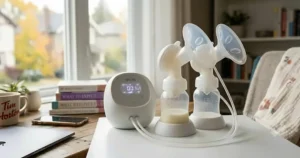
2. Momcozy V1 Pro Hospital-Grade Wearable Breast Pump
The Momcozy V1 Pro is the brand’s answer to a question many mums had: “Can I get hospital-grade suction in a pump I can wear in my bra?” The answer, impressively, is yes. With 300 mmHg of maximum suction, 3 fine-tuned rhythms, and 15 suction levels, the V1 Pro matches the suction power of traditional hospital-grade machines while fitting discreetly inside a nursing bra. That’s a meaningful achievement.
For Canadian working mums — particularly those returning to demanding jobs in industries like healthcare, education, or corporate offices where pumping breaks are limited — the V1 Pro offers something unique: hospital-quality expression without needing to haul a traditional pump through a Toronto subway or a Calgary office tower. The Type-C charging port is a practical touch that most mums will appreciate; you’re not hunting for a proprietary cable.
What most buyers overlook about this model is the rhythm customization. Unlike single-mode wearables that offer one suction pattern, the V1 Pro’s three distinct rhythms mean you can choose a pattern that mimics your baby’s natural nursing sequence — stimulation phase followed by expression phase — rather than one-size-fits-all pulsing. This makes a real difference in milk output efficiency.
Canadian users note excellent milk output comparable to sitting-down pumping sessions with traditional machines. Worth noting: while Canadian pricing typically runs slightly higher than US equivalents, you avoid cross-border shipping fees, customs delays, and warranty headaches.
✅ Genuine hospital-grade suction (300 mmHg) in a wearable design
✅ 15 suction levels + 3 rhythms for maximum customization
✅ Type-C charging — convenient for modern Canadian mums
❌ Higher price than standard Momcozy models
❌ Capacity monitoring required to prevent overflow
Price range: Mid-to-upper range in CAD — represents genuinely strong value for hospital-grade suction in a wearable format.
3. Spectra S1 Plus Electric Breast Pump
The Spectra S1 Plus is the gold standard for mums who are serious about milk supply and want clinical-level performance at home. Where it earns its reputation is in raw efficiency: it empties breasts thoroughly and consistently, which is exactly what matters when you’re trying to establish or protect your supply in those critical early weeks. The built-in rechargeable battery (what separates it from the S2, which is plug-only) means you’re not tethered to an outlet — a real advantage in Canadian homes where you might want to pump in different rooms.
The spec that matters most here isn’t suction strength alone — it’s the adjustable cycle speed (cycles per minute) combined with adjustable vacuum levels. This dual control mimics a real nursing baby more accurately than single-dial pumps, which is why lactation consultants across Canada frequently recommend the Spectra as a first pump for mums who are exclusively pumping or concerned about supply.
What this pump sacrifices for that performance is discretion. It’s considerably louder than wearable alternatives, and at roughly 1.3 kg (just under 3 lbs), it’s not something you’ll slip into your bra for a commute. It’s a home base pump — your serious workhorse for morning and evening sessions — ideally complemented by a wearable for on-the-go pumping.
Canadian lactation consultants and mum groups consistently cite the Spectra S1 as the top recommendation for supply building, particularly in the first 12 weeks. It doesn’t come with a travel bag (that’s sold separately), but it fits into most diaper bags without issue.
✅ Hospital-level efficiency for thorough milk expression
✅ Dual control of suction strength AND cycle speed
✅ Built-in rechargeable battery (unlike the S2 Plus)
❌ Louder than wearable alternatives — not discreet for office use
❌ Heavier and bulkier; designed for stationary use
Price range: Mid-range in CAD — excellent long-term value for mums prioritizing supply and efficiency over portability.
4. Medela Pump In Style Pro+ Traditional Breast Pump
Medela is arguably the most recognized breast pump brand in Canadian hospitals, and the Pump In Style Pro+ brings that clinical credibility into a portable, consumer-friendly package. With Medela’s 2-Phase Expression® technology — a stimulation phase followed by an expression phase — this pump is designed to maximize milk output by working with your body’s natural let-down response rather than just applying constant suction.
What sets this pump apart from competitors is its PersonalFit Plus breast shields, which are designed to accommodate a wider range of nipple sizes and reduce friction during pumping sessions. For Canadian mums who’ve struggled with discomfort on other pumps, this is often the fix. The included tote bag is a practical touch for mums commuting in cities like Ottawa or Montreal.
The Pump In Style Pro+ is the better choice if you work in an environment where you have a private space and access to an outlet, want brand reliability and widely-available Canadian replacement parts, and pump 4+ times per day. Where it lags is in the wearable department — this is a traditional plug-in-first pump, and while it has a battery pack option, it’s not the same seamless wireless experience as newer wearable models.
Canadian mums report it’s the easiest Medela model to find replacement parts for in-store at Canadian pharmacies and baby retailers, which is a meaningful practical advantage if you’re pumping long-term.
✅ Clinically proven 2-Phase Expression technology
✅ Widely available replacement parts across Canada
✅ PersonalFit Plus shields for comfort across nipple sizes
❌ Not a hands-free wearable design
❌ Heavier than wearable alternatives
Price range: Upper range in CAD — justifiable for mums who want proven clinical technology with strong Canadian parts availability.
5. Medela Freestyle Hands-Free Double Electric Breast Pump
The Medela Freestyle Hands-Free is Medela’s entry into the wearable pump space, combining the brand’s clinical credibility with cups you can wear inside a nursing bra. It features 2 pumping modes with 9 levels each, a rechargeable battery, and app connectivity through the MyMedela app — handy for tracking sessions and monitoring milk volume over time.
Where the Freestyle genuinely shines is in the trust factor. If you’ve used Medela equipment in the hospital, you already understand their suction pattern and it feels familiar. For mums who find the learning curve of a new brand intimidating in those exhausted early weeks, continuity matters. The Freestyle Hands-Free is also the most intuitive pump in this roundup for first-time pumpers.
What the spec sheet won’t tell you is that the Freestyle’s suction, while effective, is slightly softer than competitors like the Momcozy V1 Pro at equivalent settings. Multiple independent reviewers note it can take an extra 5–10 minutes per session compared to the Momcozy or Spectra to achieve equivalent milk output. That’s not dealbreaking for most mums, but if your pumping windows are tightly scheduled — a reality for many Canadian nurses, teachers, and office workers — efficiency matters.
The app connectivity is genuinely useful for mums tracking supply over time or sharing data with a lactation consultant.
✅ Trusted Medela brand with familiar clinical performance
✅ App connectivity for session tracking and data sharing
✅ Comfortable wearable cups with good real-world reviews
❌ Slightly lower suction efficiency than competitors at similar price points
❌ Proprietary charging port (not Type-C)
Price range: Upper range in CAD — best for Medela loyalists or mums who value app tracking and brand familiarity.
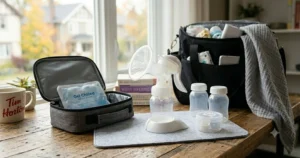
6. eufy Heated Wearable Breast Pump E20
The eufy E20 brings something genuinely novel to the Canadian market: integrated heat technology in a wearable pump. The HeatFlow™ system provides three levels of warmth directly at the breast — and this matters more than it might seem. Heat is one of the most evidence-backed tools for improving let-down response and milk flow, usually accomplished with warm compresses before pumping. The E20 eliminates that extra step by building the heat source directly into the cup.
For Canadian mums pumping in colder environments — a chilly home office, a Calgary winter where even indoor temperatures can feel brisk, or a workplace where you’re rushing between tasks — the integrated heat genuinely reduces prep time and improves comfort. App control via your smartphone means you can adjust settings without reaching inside your shirt, which is a small but meaningful quality-of-life upgrade.
The E20 delivers hospital-grade suction and operates ultra-quietly, making it viable for use during video calls or in shared spaces. What I’d caution about is battery management: the heat function draws additional power, so if you’re doing longer sessions (25+ minutes), you’ll want to be aware of battery life.
This is the pump for the tech-forward Canadian mum who wants maximum comfort innovation and doesn’t mind paying a premium for it.
✅ Integrated HeatFlow™ technology for improved let-down response
✅ App-controlled settings without reaching inside clothing
✅ Hospital-grade suction in an ultra-quiet, slim design
❌ Heat function reduces battery longevity in longer sessions
❌ Higher price point relative to standard wearables
Price range: Mid-to-upper range in CAD — worth every dollar for mums who struggle with let-down or pump in cold environments.
7. Lansinoh Manual Breast Pump
Don’t underestimate the manual pump — for the right mum, it’s the perfect tool. The Lansinoh Manual Breast Pump uses a comfortable ergonomic handle and Lansinoh’s HPA Lanolin-compatible flange design to make hand-expression more efficient than you’d expect. It comes with a 5 oz (150 mL) baby bottle and slow-flow nipple, making the transition from pump to bottle seamless.
Manual pumps have a specific and valuable role: they’re ideal for occasional pumping (once or twice per day), for travel where charging isn’t guaranteed, as a backup when your electric pump dies mid-session, and for mums in remote or northern Canadian communities where shipping times for replacement parts can stretch to weeks. At under $40–50 CAD, it’s also the only true budget option on this list.
What most buyers overlook about manual pumps: your hand strength and pumping stamina directly affect output. Lactation lab testing has shown the Lansinoh outperforms many electric competitors in efficiency per squeeze — but sustaining that efficiency over a 20-minute session is physically demanding. Treat it as a supplementary or situational tool rather than a daily workhorse, and it’s exceptional value.
✅ Ultra-affordable — ideal for budget-conscious Canadian mums
✅ Excellent for travel, backup use, and remote areas with limited charging
✅ Includes 5 oz bottle with slow-flow nipple
❌ Hand fatigue limits it as a primary, high-frequency pump
❌ Single-sided only — doubles pump session time
Price range: Budget in CAD — the best-value breast pump on Amazon.ca for occasional or supplementary use.
Breast Pump Buying Guide: What to Look for in a Breast Pump
Choosing a breast pump without a framework is like choosing a car by picking your favourite colour — you might get lucky, but the odds aren’t great. Here’s a structured approach designed specifically for Canadian buyers in 2026.
1. Suction Strength and Adjustability
Suction is measured in mmHg (millimetres of mercury). Hospital-grade pumps typically deliver 250–300 mmHg with fine-grained adjustability. What matters isn’t the maximum suction — pumping on maximum is rarely comfortable or effective — but the range of adjustability. Look for pumps with at least 9 suction levels. This lets you find the sweet spot where you’re extracting the most milk with the least discomfort.
2. Pumping Modes
The best electric pumps offer at minimum a stimulation (let-down) mode and an expression mode. Stimulation mode uses fast, light suction to trigger let-down; expression mode switches to slower, stronger suction to draw milk out. Pumps that only offer one mode are less effective at mimicking natural nursing.
3. Wearable vs. Traditional
Wearable pumps sit entirely inside your bra. Traditional pumps connect via tubing to flanges and sit on a surface. Wearables give you mobility; traditional pumps generally offer better efficiency. The right choice depends on where you’ll be pumping most: wearable if you’re largely on-the-go, traditional if you have dedicated pumping sessions at home or in a private office space.
4. Noise Level
For Canadian mums pumping at work, in shared living spaces, or in public, noise is a real consideration. Wearable pumps like the Momcozy M6 and eufy E20 operate significantly more quietly than traditional models like the Spectra S1 Plus. If discretion matters to your daily routine, factor this in.
5. Battery and Charging
In 2026, any pump you buy should have USB-C or at minimum a reliable rechargeable battery. Proprietary charging ports are a frustration — cables get lost, and in remote or northern Canada, replacement cables can take weeks to arrive. Prioritize Type-C where possible.
6. Parts Availability in Canada
This is the underrated Canadian consideration. Some pump brands have robust Canadian retail presence (Medela is the clearest example, with parts widely stocked at Shoppers Drug Mart, Babies R Us, and pharmacies coast to coast). Others require ordering online. If you’re in a smaller community, ask yourself: if a valve breaks at 2am, can I replace it tomorrow?
7. Price Range in CAD
Budget (under $80 CAD): Manual pumps, basic electric options Mid-range ($80–$250 CAD): Most quality wearable pumps, including Momcozy M6, Spectra S1 Plus Upper range ($250–$450+ CAD): Premium wearables, Medela Freestyle, eufy E20, Momcozy V1 Pro
Flange Sizing for Your Breast Pump: The Most Important Detail Nobody Talks About
Here’s a fact that surprises many first-time pumpers: the flange (also called a breast shield) that comes in the box with your pump may not fit you correctly — and using the wrong size is the single most common reason mums experience pain, poor milk output, and frustration with an otherwise excellent pump.
According to The Lactation Network, the flange tunnel diameter should fit around your nipple with approximately 1–3 mm of clearance. If your nipple is rubbing the sides of the tunnel, the flange is too small. If your areola is being pulled into the tunnel (leaving a swollen ring), the flange is too large.
How to measure: Using a ruler or measuring tape, measure the diameter of your nipple at the base in millimetres (mm) — not including the areola. Then add approximately 4 mm to find your starting flange size. So if your nipple diameter is 17 mm, begin with a 21 mm flange.
Important nuances for Canadian mums:
- Your two sides may differ. It’s completely normal to need different flange sizes on each breast. Many mums discover this only after weeks of lopsided output.
- Size changes over time. Nipple tissue stretches with prolonged breastfeeding. Reassess your flange fit at 3 months and 6 months.
- Silicone inserts are a game-changer. If you fall between standard sizes (e.g., between 21 mm and 24 mm), silicone flange inserts — available on Amazon.ca — let you reduce a standard flange size without buying an entirely new flange set.
- Consult an IBCLC. An International Board Certified Lactation Consultant can assess your fit visually and catch issues a self-measurement might miss. Many Canadian provinces offer IBCLC appointments covered under provincial health plans or public health units.
The bottom line: before concluding your pump “doesn’t work,” check the flange fit. In most cases, correct sizing resolves 80% of discomfort and output complaints.

Hospital-Grade Breast Pump Rental in Canada: When It Makes Sense
Buying a personal pump isn’t always the right first step — and in Canada, renting a hospital-grade pump is a practical, well-supported option that more mums should know about.
What is hospital-grade? Hospital-grade pumps (primarily the Medela Symphony) use stronger, more consistent motors designed for multi-user use and extended pumping sessions. They’re the pumps used in Canadian maternity wards and NICU units. The Medela Symphony, for example, uses 2-Phase Expression® technology in a continuous-duty motor that outperforms most personal pumps for supply establishment.
When to rent rather than buy:
- Premature baby or NICU stay: If your baby can’t nurse directly, a hospital-grade pump is the fastest way to establish and protect your supply in those critical first weeks. Many Canadian NICUs provide access on-site, but home rental extends that support.
- Supply concerns in the first 6 weeks: If you’re worried about milk production, a hospital-grade rental for 4–6 weeks while your supply establishes is a smart investment before committing to a personal pump purchase.
- Post-surgery or medical separation: Any situation that prevents direct nursing in early weeks benefits from hospital-grade suction.
- Trying before buying: Rental lets you understand your pumping needs before investing $200–$400+ CAD in a personal pump.
Where to rent in Canada:
Hospital-grade pump rentals are available at many Canadian pharmacies, including Pharmasave locations across BC and Alberta, independent pharmacies in Ottawa and the GTA, and medical supply stores nationwide. Rental rates typically run around $75–$80 CAD per month plus a security deposit, with accessory kits (flanges, tubing, bottles) sold separately for hygienic reasons.
Some extended health benefits plans in Canada include partial or full coverage for breast pump rentals — check with your insurer before paying out-of-pocket. Keep your receipts regardless, as many plans reimburse with documentation.
Breastfeeding Working Mum: How to Make Pumping at Work Actually Work
Returning to work after Canadian parental leave — often after 12 months or more — presents a unique pumping challenge. You’ve likely established a solid routine at home, and now you need to maintain supply through a work day in an environment that wasn’t designed with pumping in mind. Here’s what actually works.
Know your rights. In Canada, provincial employment standards generally require employers to provide reasonable accommodation for breastfeeding employees, including clean private space (not a bathroom) for pumping. Ontario’s Occupational Health and Safety Act and similar legislation across provinces support this. If your employer is resistant, contact your provincial Employment Standards office.
Plan your pumping schedule. Most working mums maintain supply by pumping at the times their baby would normally nurse — typically once mid-morning and once mid-afternoon for a baby past 6 months. Falling behind by more than 30–40 minutes consistently can signal your body to reduce production.
The wearable pump advantage. This is where pumps like the Momcozy M6, V1 Pro, or Medela Freestyle genuinely change the game. You can pump during a meeting, on public transit, or while walking between appointments — without retreating to a pumping room. For mums in fast-paced Toronto, Vancouver, or Calgary workplaces, this freedom is genuinely transformative.
Storage logistics for Canadian offices:
- Freshly expressed milk keeps safely at room temperature for up to 4 hours (Canada.ca guidelines) — sufficient for most work days
- Office refrigerators work well for longer storage; use a clearly labelled bag
- Invest in a quality insulated cooler bag with ice packs for commuting
Protecting supply through work weeks: Even with a great pump, supply naturally dips slightly when you return to work. Power-pump on weekends — three 10-minute sessions with 10-minute breaks over an hour — to signal your body to maintain production.
Comparison: Electric vs. Manual vs. Wearable Breast Pumps
| Category | Electric Traditional | Wearable | Manual |
|---|---|---|---|
| Suction Efficiency | ⭐⭐⭐⭐⭐ | ⭐⭐⭐⭐ | ⭐⭐⭐ |
| Discretion | ⭐⭐ | ⭐⭐⭐⭐⭐ | ⭐⭐⭐ |
| Portability | ⭐⭐⭐ | ⭐⭐⭐⭐⭐ | ⭐⭐⭐⭐⭐ |
| Ease of Cleaning | ⭐⭐⭐ | ⭐⭐⭐ | ⭐⭐⭐⭐⭐ |
| Price (CAD) | Mid–High | Mid–High | Budget |
| Best For | Home/supply building | Working mums, on-the-go | Backup/occasional use |
Reading the table: Electric traditional pumps remain the gold standard for efficiency and supply management, but they’ve conceded the lifestyle category entirely to wearables. For the average Canadian working mum in 2026, the ideal setup is a quality wearable for daytime use paired with a traditional electric (or hospital rental) for dedicated morning and evening sessions. Manual pumps serve best as reliable backups — every mum should own one, but few should rely on one as their primary tool.
✨ Don’t Miss These Exclusive Deals!
🔍 Ready to find your perfect pumping match? Click on any highlighted product above to check current pricing and availability on Amazon.ca. These carefully selected pumps are trusted by Canadian mums from Victoria to Halifax — your breastfeeding journey deserves the right tools!

Canadian Buyer Profiles: Which Pump Is Right for You?
Every Canadian mum’s pumping situation is different. Here are three realistic profiles with matched recommendations.
Profile 1: The Toronto Office Commuter Maya is a marketing manager in downtown Toronto returning to work when her baby is 11 months old. She commutes 40 minutes each way on the TTC and has one 30-minute private office window mid-day. Supply is well-established.
Best match: Momcozy M6 or Momcozy V1 Pro. The wearable design lets Maya pump during her commute and in any quiet space. The near-silent operation means no awkward subway moments, and the large collection cups handle a full session without overflow. She should bring the Lansinoh manual as a backup for days when the battery runs low unexpectedly.
Profile 2: The New Mum in Small-Town Saskatchewan Jess is a first-time mum in a small community two hours from the nearest city. Her baby was born four weeks early and had initial feeding difficulties. She’s worried about supply and needs something with serious suction.
Best match: Spectra S1 Plus, ideally paired with a hospital-grade rental for the first 4–6 weeks. The Spectra’s dual-control suction builds supply effectively, and it’s available with Prime shipping on Amazon.ca. For the rental, Jess should call her nearest pharmacy or midwife clinic — hospital-grade rental services operate across Saskatchewan, often with mail-in options.
Profile 3: The Vancouver Work-from-Home Creative Priya works from home as a freelance designer and pumps throughout the day while managing client calls and creative sessions. She wants maximum flexibility and doesn’t mind investing in a premium option.
Best match: eufy E20 with the Spectra S1 Plus as a home base pump. The eufy’s heat function and app control make it ideal for Priya’s varied schedule — she can pump during a video call with suction controlled from her phone. The Spectra handles her dedicated AM/PM sessions for thorough supply maintenance.
Common Mistakes When Buying a Breast Pump in Canada
1. Buying solely based on the cheapest Amazon.ca listing. The lowest-priced wearable pumps (under $60 CAD) often have limited parts availability, short motor lifespans, and poor customer support. A pump that breaks at 6 weeks and can’t be replaced easily is no bargain.
2. Ignoring flange sizing entirely. At least half of all negative breast pump reviews — “not enough milk,” “so painful,” “doesn’t work” — trace back to incorrect flange fit. This is fixable and free with a ruler and 5 minutes of attention.
3. Choosing wearable without assessing suction needs. Wearable pumps are magical for lifestyle, but if you’re in the first 6–8 weeks and building supply, a traditional electric or hospital rental is almost always the better first tool. Buy the wearable later, once your supply is established.
4. Not checking Canadian warranty coverage. Some pumps sold on Amazon.ca have warranties that exclude Canada or direct you to US service centres. Always verify Canadian warranty coverage before purchasing — Medela and Spectra both have Canadian warranty support, which is one reason they remain recommended brands.
5. Skipping the consultation. Many Canadian public health units, midwifery practices, and hospitals offer free or low-cost lactation consultant appointments. An IBCLC visit before or shortly after purchasing can save you hundreds of dollars in wrong-pump mistakes.

FAQ: Best Breast Pump Canada
❓ Is a breast pump covered by insurance in Canada?
❓ Where can I rent a hospital-grade breast pump in Canada?
❓ What flange size do I need for my breast pump?
❓ Are wearable breast pumps as effective as traditional electric pumps?
❓ Can I use the same breast pump for a second baby in Canada?
Conclusion: Your Best Breast Pump Is the One You’ll Actually Use
At the end of a long feed-pump-wash-repeat cycle, the “best” breast pump isn’t the one with the highest suction rating or the most Instagram-friendly design. It’s the one that fits your body, your schedule, and your life — and that you’ll actually reach for consistently.
For most Canadian mums in 2026, we’d suggest starting with a quality wearable like the Momcozy M6 or Momcozy V1 Pro for everyday mobility, pairing it with a traditional electric like the Spectra S1 Plus for morning and evening supply sessions at home. If you’re in the first few weeks with supply concerns, start with a hospital-grade rental before investing in a personal pump. And wherever you are in your journey, get the flange fit right before writing off any pump as broken.
Canada’s public health breastfeeding guidelines support breastfeeding for up to two years and beyond — and having the right equipment makes that goal achievable even through the realities of a Canadian work life, a long winter, and everything else parenthood throws at you.
You’ve got this. And now you’ve got the right information to choose the pump that will support you.
✨ Don’t Miss These Exclusive Deals!
🔍 Check current pricing and availability on Amazon.ca for all seven pumps reviewed here. Prices change frequently — click through to see today’s best deals and Prime shipping options for your province!
Recommended for You
- Best Baby Bottle Brush in Canada 2026: 7 Surprisingly Brilliant Picks
- Best Bottle Drying Rack Canada 2026: 7 Top Picks for Tiny Kitchens
- Best Baby Bottle Sterilizer Canada 2026: 7 Expert Picks
Disclaimer: This article contains affiliate links. As an Amazon Associate, I earn from qualifying purchases. If you purchase products through these links, we may earn a small commission at no additional cost to you.
✨ Found this helpful? Share it with your friends! 💬🤗
