
In This Article
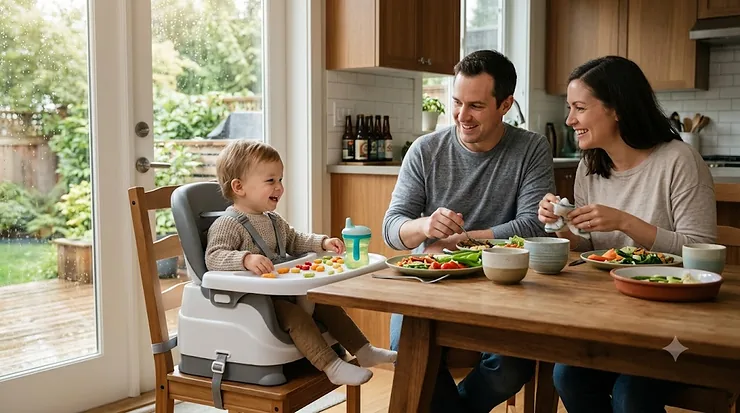
Somewhere between the newborn fog and the “I do it myself!” era, every Canadian parent hits the same fork in the road: the high chair is starting to look like a spaceship your toddler has outgrown, and a booster seat for eating suddenly seems like the obvious next step. But which one? Strapped-in cushions, hook-on trays, 3-in-1 convertibles — the options multiply faster than crumbs under a dining table.
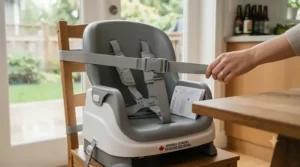
A booster seat for eating is a raised, strap-on seat that lifts a toddler to table height on a regular dining chair, letting them join family meals without the bulk of a full high chair. It typically includes a harness, non-slip attachment straps, and sometimes a removable tray, and it’s designed for kids roughly 15 months to 5 years old who can sit up independently.
The timing lines up with broader feeding guidance, too — Health Canada and the Canadian Paediatric Society jointly encourage self-feeding and early finger-food practice starting around six months, which is part of why table-height seating becomes so relevant as toddlers grow.
Here’s what most buying guides skip: the “best” booster depends entirely on your chairs, your kitchen table, your travel habits, and how independent your toddler already is. This guide walks through seven real, currently available options — from a C$30-ish travel cushion to a full 3-in-1 system — with honest analysis of who each one actually suits, not just a list of specs copied from a product page. We’ll also dig into the practical stuff: how to pick one, common buying mistakes, when to actually make the switch from a high chair, and how Canadian safety standards factor into your decision.
Quick Comparison Table
Before the deep dive, here’s a snapshot of how these seven products stack up on the things that matter most: portability, price, and who they’re built for.
| Product | Best For | Weight Limit | Price Range (CAD) |
|---|---|---|---|
| Ingenuity SmartClean Trio Elite | Long-term 3-in-1 versatility | 50 lbs | C$190-C$230 range |
| Chicco Bento 3-in-1 | All-around home + travel use | 50 lbs | C$70-C$90 range |
| OXO Tot Perch | Older toddlers, tight table fit | 70 lbs | C$75-C$95 range |
| Regalo My Chair 2-in-1 | Budget high chair/booster combo | 40 lbs | C$55-C$70 range |
| Nuby Easy Go Booster | Ultra-light travel booster | 35 lbs | C$30-C$40 range |
| Bumbo Multi Seat 3-in-1 | Younger toddlers, floor-to-table growth | 45 lbs | C$85-C$105 range |
| Bright Starts Pop ‘N Sit | Indoor/outdoor portable seating | 40 lbs | C$35-C$45 range |
A quick read of this table tells its own story: there’s no single “best” booster seat for eating, only the best one for your situation. If you’re chasing longevity and don’t mind the higher upfront cost, the Ingenuity SmartClean Trio Elite wins on paper because it spans three growth stages instead of one. But if your priority is a seat that lives in a diaper bag between grandma’s house and restaurant patios, the Nuby Easy Go Booster and Bright Starts Pop ‘N Sit punch well above their price point. Families sitting on the fence between “one more year of a high chair” and “just get a booster” should note that the mid-range options — Chicco Bento 3-in-1 and Bumbo Multi Seat 3-in-1 — hedge that bet nicely, since both transition through multiple use-cases as your toddler grows.
💬 Just one click — help others make better buying decisions too!😊
Top 7 Booster Seats for Eating: Expert Analysis
We looked at real, currently sold products spanning budget, mid-range, and premium tiers, plus a mix of strap-to-chair designs and 3-in-1 systems. Every product below includes genuine spec interpretation, an honest take on who it suits, and aggregated review sentiment — never invented quotes or fabricated testing.
1. Ingenuity SmartClean Trio Elite — three growth stages in one purchase
The headline feature here is flexibility: this is a full high chair, a chair-top booster, and a standalone toddler chair depending on how you configure it. That range is what justifies the premium price tag for families who’d rather buy once than twice.
Specs-wise, the 5-point harness with three shoulder-height positions matters because a 3-point harness (common on pure booster seats) doesn’t offer the same shoulder containment for younger toddlers still perfecting their balance. The dishwasher-safe EasyClean tray holds plates up to 19 inches wide, which sounds like trivia until you’re trying to fit a full family-style dinner plate on a tray built for baby purees — this one’s sized for an actual toddler meal, not just snacks. Wheels on the frame make it easy to reposition the whole unit around a kitchen, a small but genuinely useful detail nobody mentions until they’re wrestling a high chair across tile floors solo.
Based on the spec comparison with pure booster seats, this product earns its higher price through longevity: a family buying at six months can realistically use the same seat through the toddler-chair stage, whereas a basic booster only covers the “sits at the table” phase. It suits parents who want one purchase to last from first solids through preschool, and it’s a poor fit for anyone short on kitchen space, since the full high chair mode has real footprint. Reviewers consistently report that the wipeable, fabric-free design is a major upgrade over cloth-covered high chairs, with several noting it survives daily use without staining or odour buildup. A common complaint in user reviews is that the tray fit feels snug for bigger toddlers, with some parents flagging tight legroom once a child exceeds roughly 30 pounds.
Pros:
- ✅ Converts through three real growth stages, not just two
- ✅ Dishwasher-safe tray and wipe-clean EVA insert simplify cleanup
- ✅ Can seat two children at once in booster and toddler-chair modes
Cons:
- ❌ Bulkier footprint than a standalone booster seat
- ❌ Higher upfront cost than single-purpose alternatives
At around C$190-C$230 range depending on retailer promotions, this is the priciest pick on our list, but the value case holds up if you genuinely plan to use all three modes rather than jumping straight to a booster.
2. Chicco Bento 3-in-1 — best all-around booster for home and travel
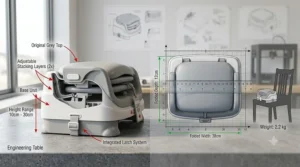
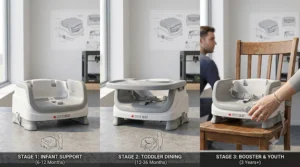
The standout feature is genuine dual-purpose design: it works as a strap-on table booster, an on-the-floor feeding seat, and a stripped-down toddler chair, all in a seat that folds flat and weighs about 5.5 pounds.
That sub-6-pound weight matters more than it sounds — it’s light enough to carry one-handed to a relative’s house without feeling like you’re hauling gym equipment, unlike bulkier convertible high chairs that top 15 pounds. The two height positions and 3-point harness cover the wobbly-sitter stage through a sturdier toddler phase, and the non-marking feet mean it won’t scuff hardwood or laminate dining chairs, a small detail that matters if you’re renting or simply house-proud.
What most buyers overlook about this model is that its floor-seat mode doubles as a portable dinner or snack station for picnics, camping, or living-room floor meals — useful for households that eat casually some nights and formally on others. It suits parents who want one seat that flexes between “fancy dinner at grandma’s” and “quick snack on the living room floor,” and it’s less ideal for families with unusually large or high dining chairs, since the strap system is built around standard chair dimensions. Reviewers consistently report that assembly is quick and the fold-flat design genuinely saves storage space compared to bulkier boosters. A common theme in user reviews is that the tray surface runs on the smaller side for bigger toddlers, with a few parents noting a snug fit for kids approaching the 30-35 pound range even though the seat’s listed capacity goes to 50 pounds.
Pros:
- ✅ Converts between booster, floor seat, and toddler chair
- ✅ Lightweight at roughly 5.5 pounds with a built-in carry handle
- ✅ Folds flat for compact storage or car-trunk travel
Cons:
- ❌ Tray surface feels tight for larger toddlers nearing weight capacity
- ❌ Straps require testing on unusual dining chair shapes before relying on them
In the C$70-C$90 range, this sits comfortably in the mid-tier and represents strong value for families who want genuine versatility without the premium 3-in-1 high chair price tag.
3. OXO Tot Perch — best fit for older toddlers who need a slimmer profile
The standout advantage is its arm-free, minimalist shape, which slides fully under a dining table — something bulkier booster designs with side arms simply can’t do.
The cushion is roughly 3 inches thick and rated for children as young as about 15 months (with straps) up to a documented 70-pound weight limit once the harness is removed for older kids around age three and up. That higher weight ceiling means this seat has real staying power for families with a preschooler who’s outgrown other boosters but still needs a boost at an adult-height table. Here’s what the spec sheet won’t tell you, but reviewers note: because the Perch has no side arms, some toddlers who are still building core control feel less “held in” than they would in a booster with a wraparound frame, so this model rewards kids who already sit confidently on their own.
This suits households with an older toddler or a preschooler who’s between sizes — too big for baby gear, too small to sit unaided at full table height — and it’s a weaker choice for a younger toddler who still needs more lateral support while eating. Reviewers consistently report that the fold-and-carry design travels well and that the wipeable urethane cushion cleans up easily after messy meals. A common complaint in user reviews is that the chair-attachment straps aren’t adjustable for length, so they can sit loosely on unusually slim or thick dining chair frames.
Pros:
- ✅ Slim, arm-free design fits flush under most dining tables
- ✅ Weight capacity up to 70 lbs extends useful life for years
- ✅ Removable straps let the seat “grow down” into a strapless big-kid booster
Cons:
- ❌ Chair-attachment straps aren’t adjustable in length
- ❌ Less side support than boostered with arms, which may suit only steadier sitters
At a price range of about C$75-C$95, this model earns its spot through longevity rather than bells and whistles — it’s the pick that keeps working long after your toddler has become a genuine kid at the table.
4. Regalo My Chair 2-in-1 — budget-friendly high chair and booster combo
The standout feature here is doing double duty as both an early high chair and a later booster seat, aimed at stretching one purchase across two stages without a premium price.
The oversized tray with a built-in cup holder means fewer spills mid-meal, since a wider tray gives more surface for plates, sippy cups, and the inevitable flying puree without everything sliding into a toddler’s lap. On paper, this means parents get a genuine two-stage product for a fraction of what a 3-in-1 convertible costs, though it’s worth noting the trade-off is fewer configuration options overall compared to true 3-in-1 systems like the Ingenuity or Bumbo picks above.
Based on the spec comparison with premium convertibles, this model is best suited to budget-conscious families who want one seat that transitions from early high chair use into a lightweight booster, rather than households chasing every possible configuration. It’s a less natural fit for parents who want a true floor-seat mode or a fully separate toddler chair down the line, since those extra stages simply aren’t part of this design. Reviewers consistently report that the fold-flat portability makes this a favourite for travel and visits to relatives, since it collapses smaller than most standard high chairs. A common theme in user reviews is that the recline options are more limited than dedicated infant high chairs, so very young babies may find it less accommodating in the earliest weeks of solids.
Pros:
- ✅ Doubles as both a high chair and a portable booster
- ✅ Oversized tray with cup holder reduces mid-meal spills
- ✅ Compact fold makes it genuinely travel-friendly
Cons:
- ❌ Fewer configuration modes than true 3-in-1 systems
- ❌ Limited recline makes it less ideal for the youngest babies
Priced around C$55-C$70 range, this is one of the strongest value plays on the list if you want two stages of use without paying premium 3-in-1 pricing.
5. Nuby Easy Go Booster — lightest, most travel-ready pick on this list
The standout advantage is sheer portability: this is one of the lightest true booster seats available, built to fold into a compact shape for a diaper bag or car trunk rather than to live permanently at one dining chair.
The 3-point harness and adjustable straps matter because they’re what make this seat usable across wildly different chair styles — a kitchen chair at home one day, a folding chair at a cottage the next. Because it’s built light and simple, expect a more basic cushion and narrower seat base than the pricier picks on this list, which is exactly the trade-off that keeps the price down.
What most buyers overlook about ultra-portable boosters like this one is that “light” often means “less structured,” so a seat this size suits toddlers who already sit confidently rather than a wobbly first-timer who needs more built-in support. It’s an excellent secondary or backup booster for restaurants, travel, and relatives’ houses, and a weaker primary seat for a family’s main daily dining chair if a toddler needs more cushioning for long meals. Reviewers consistently note the low weight and compact fold as the top selling points, with many buyers specifically choosing it as a grab-and-go option rather than a permanent fixture. A common complaint in user reviews is that the straps can feel less secure on chairs with unusually shaped backs, reinforcing the general rule that any strap-on booster should be tested on your actual chairs before regular use.
Pros:
- ✅ Genuinely lightweight and compact for travel
- ✅ Adjustable straps fit a wide range of chair shapes
- ✅ Simple design means fewer parts to lose or break
Cons:
- ❌ Thinner cushioning than pricier alternatives
- ❌ Best suited to steadier sitters rather than newer boosterusers
At roughly C$30-C$40 range, this is the cheapest true booster seat on our list and a smart secondary purchase even for families who already own a primary seat at home.
6. Bumbo Multi Seat 3-in-1 — best transitional pick for younger toddlers
The standout feature is its floor-seat-to-booster growth path, designed for children as young as roughly 6 months who can sit up unaided, all the way through the toddler booster stage.
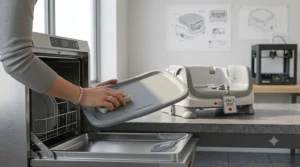
The removable foam pad and non-slip base pads matter in practice because they add real stability on smooth dining chairs — a common failure point for cheaper boosters that shift or tip on slick surfaces. A leg-opening width of about 3.25 inches with the foam pad attached is a small but meaningful detail for families with a smaller-framed toddler, since generic boosters sized for bigger kids can leave a smaller child sliding forward mid-meal.
Based on the spec comparison with strap-only boosters, this model suits families who want a genuine floor-to-table growth arc starting earlier than most competitors on this list, since the 6-month starting point is younger than several rivals here. It’s a less efficient buy for a family who’s skipping the floor-seat stage entirely and just wants a booster for a toddler who’s already walking and eating independently, since you’d be paying for a stage you won’t use. Reviewers consistently mention the tray’s built-in storage slot as a genuinely convenient touch for keeping the tray attached to the seat between uses instead of losing it in a drawer. A common theme in user reviews is that the booster mode’s straps require some trial and error to get snug on certain dining chair shapes, echoing a pattern seen across most strap-on designs.
Pros:
- ✅ Usable from around 6 months through the toddler booster stage
- ✅ Non-slip base pads improve stability on smooth chairs
- ✅ Removable tray includes built-in storage so it doesn’t go missing
Cons:
- ❌ Straps need adjusting carefully on some dining chair styles
- ❌ Less value if you’re skipping the earlier floor-seat stage
In the C$85-C$105 range, this sits toward the upper-mid tier, priced for the extra growth stage it covers rather than for premium materials alone.
7. Bright Starts Pop ‘N Sit Portable Booster — best budget pick for indoor and outdoor flexibility
The standout advantage is genuine indoor/outdoor versatility at a low price point, aimed at everything from kitchen dinners to backyard barbecues and camping trips.
Because this model is built with a simpler frame and washable fabric seat rather than a moulded cushion, it prioritizes light weight and quick cleanup over the plush comfort of pricier options — a sensible trade-off for a seat that’s meant to travel outside as often as it sits at a dining table. The adjustable straps allow use on a wide range of chair types, and the low price point makes it an easy add-on rather than a major investment decision.
Here’s what most buyers overlook about budget portable boosters like this one: their real value shows up on trips and outdoor meals, not as a primary daily seat, since the fabric construction won’t hold up quite as long under constant daily wipe-downs as a moulded plastic or foam seat would. It suits families who eat outdoors often, travel frequently, or want an inexpensive backup seat for grandparents’ houses, and it’s a weaker pick for a toddler’s sole, everyday dining seat if durability over years is the top priority. Reviewers consistently highlight the low price and easy portability as the main draws, particularly for camping and patio use. A common complaint in user reviews is that the fabric seat shows wear faster than moulded alternatives after repeated outdoor use and washing.
Pros:
- ✅ Genuinely usable indoors and outdoors, including camping
- ✅ Very budget-friendly entry point into booster seating
- ✅ Washable fabric simplifies quick cleanup
Cons:
- ❌ Fabric construction wears faster than moulded seats over time
- ❌ Less plush than foam-cushioned alternatives for long meals
At around C$35-C$45 range, this is a smart low-commitment buy for occasional use rather than a full-time replacement for a primary booster seat.
Practical Usage Guide: Setting Up Your Booster Seat for Success
Getting a new booster seat right on day one saves weeks of frustration. Start by testing the attachment straps on your actual dining chairs before your toddler’s first meal in it — chair backs vary enough in width and shape that a seat rated for “most dining chairs” can still sit loosely on an unusual design. Tighten the straps until the seat can’t rock forward, backward, or side to side when you push on it firmly; if it moves, don’t use it on that chair.
In the first 30 days, expect a short adjustment period where your toddler protests the harness or fusses about sitting higher than usual — this is normal and typically fades within a week or two of consistent use. A common mistake is loosening the harness “just for this meal” to stop a tantrum, which undermines the whole point of the strap system and teaches a toddler that protesting works. Instead, keep the harness snug but comfortable, and offer a distraction like a favourite bib or a small toy clipped to the tray during the settling-in period.
For maintenance, wipe foam or moulded cushions after every meal with a damp cloth and mild soap, and do a deeper strap-and-buckle check weekly — food debris in buckle mechanisms is a common cause of straps that stick or won’t release cleanly. If your model has a fabric seat cover, check the care label before machine washing, since some fabrics are wipe-clean only. One optimization trick many parents miss: rotate the seat’s height position (if adjustable) every few months as your toddler grows, rather than waiting until they’ve clearly outgrown the current setting.
Real-World Scenarios: Matching the Right Booster to Your Family
The apartment-dwelling family with one small dining table. If you’re short on storage and eat most meals at home, a fold-flat option like the Chicco Bento 3-in-1 or Regalo My Chair 2-in-1 makes sense — both collapse compactly and don’t demand a dedicated storage corner the way a full high chair frame does.
The frequent traveller or extended-family visitor. If you’re regularly packing a booster for grandma’s house, cottage weekends, or restaurant backups, the Nuby Easy Go Booster or Bright Starts Pop ‘N Sit are built for exactly this — both prioritize low weight and quick folding over plush comfort, which is the right trade-off for a seat that lives in a car trunk half the time.
The family wanting one seat from six months to preschool. If you’d rather make one bigger investment than buy twice, the Ingenuity SmartClean Trio Elite or Bumbo Multi Seat 3-in-1 cover the longest growth arc, starting earlier and stretching further than single-purpose boosters.
Booster seat vs high chair toddler: which does your toddler actually need?
This is one of the most common points of confusion, and the honest answer is that it depends on developmental readiness, not age alone. High chairs are generally built with more containment — deeper seats, taller backs, and often a 5-point harness — which suits infants and younger toddlers who are still building core strength and balance. Booster seats trade some of that containment for portability and a smaller footprint, which works well once a toddler can sit upright unassisted and has decent trunk control.
| Feature | High Chair | Booster Seat for Eating |
|---|---|---|
| Support level | Higher (deeper seat, taller back) | Moderate (varies by model) |
| Portability | Low (bulky, often not foldable) | High (many fold flat or travel) |
| Typical age range | 4-6 months to ~2-3 years | ~15 months to 4-5 years |
| Table integration | Separate unit, own tray | Attaches to existing dining chair |
| Best For | Ingenuity SmartClean Trio Elite (also converts to booster) | Chicco Bento 3-in-1, OXO Tot Perch |
Reading across this table, the real decision point isn’t “which is better” but “which matches my toddler’s current sitting ability and my space constraints.” A high chair remains the safer default for a toddler who still slouches or slides in a normal chair, while a booster seat for eating becomes the smarter pick once a child can hold themselves upright through a full meal. Parents furnishing a small apartment or planning frequent travel often lean booster earlier than the “average” timeline simply because portability matters more to their day-to-day life than maximum containment.
When to switch from high chair to booster
There’s no single magic age, but there are reliable readiness signs worth watching for. Look for a toddler who can sit fully upright without slumping for the length of a meal, has enough trunk stability to reach forward for food or a cup without toppling sideways, and has outgrown the high chair’s weight or height limit, whichever comes first.
Most toddlers hit this window somewhere between 15 and 24 months, though plenty of kids stay comfortably in a high chair well past age two if they’re smaller-framed or simply prefer the extra support — and that’s completely fine developmentally. What most parents overlook is that the switch doesn’t have to be all-or-nothing: many families keep a high chair for home use while introducing a portable booster seat for eating at restaurants or relatives’ houses first, letting the toddler get comfortable with the format in a lower-stakes setting before retiring the high chair entirely.
A practical checklist before switching for good: your toddler sits independently without side support for 20+ minutes, can use utensils or fingers to feed themselves reasonably well, and has shown interest in “sitting like everyone else” at the table. If any of those aren’t quite there yet, there’s no downside to waiting a few more months.
How to Choose a Booster Seat for Eating
- Check your dining chairs first. Measure the chair back width and seat depth before shopping — strap-on boosters aren’t universal, and a seat that “fits most chairs” can still sit loosely on unusual designs.
- Match support level to your toddler’s sitting ability. A younger or less steady sitter benefits from a booster with side arms and a deeper seat; a confident toddler can handle a slimmer, arm-free design.
- Decide how much portability you actually need. If the seat mostly stays at one table, prioritize comfort and stability over weight. If it’s traveling regularly, prioritize fold size and carry weight.
- Consider the weight and age ceiling. A higher weight limit (like the OXO Tot Perch’s 70 lbs) extends usable life well past the toddler years, which matters if you want fewer future purchases.
- Look at cleanup realistically. Moulded foam or plastic wipes clean faster than fabric, which matters enormously during the messiest early independence-eating months.
- Factor in tray needs. Some boosters include a removable tray for snacking away from a table; others rely entirely on the dining table surface, which suits kids already eating directly off plates.
- Set a realistic budget band. Spending more on a 3-in-1 system only pays off if you’ll genuinely use all the modes — a simpler, cheaper booster is often the smarter buy for a toddler who’s already past the high chair stage.
Common Mistakes When Buying a Booster Seat for Eating
The single most common mistake is buying based on looks or brand name without measuring your actual dining chairs first — a beautiful booster that won’t securely strap to your chairs is a wasted purchase. A close second is assuming a higher price always means a better fit; a C$200 3-in-1 system is genuinely wasted money for a family whose toddler is already past the high chair and floor-seat stages and just needs a simple booster.
Another frequent misstep is under-checking the harness system before the first use — testing straps once in the store or on the box photo isn’t the same as pushing firmly on the assembled seat at home to confirm it won’t rock or slide. Parents also commonly overlook weight limits entirely, buying a budget seat rated to 35 lbs for a toddler who’s already close to that mark, which shortens the seat’s useful life dramatically. Finally, many buyers skip reading aggregated review sentiment on strap adjustability, only to discover after purchase that their specific chair style — a slim café chair, a chunky farmhouse chair — doesn’t pair well with that model’s strap length. It’s also worth remembering that not every product on the market has actually been checked against recognized standards — a recent Health Canada compliance verification project on high chairs found several imported models failed testing and were recalled, which is a good reason to stick with well-established brands and register any seat you buy.
portable booster seat for travel: what actually matters
Not every “portable” booster is equally travel-friendly, and the difference usually comes down to three things: fold size, total weight, and how the straps handle unfamiliar chairs.
| Feature | Nuby Easy Go Booster | Bright Starts Pop ‘N Sit | Chicco Bento 3-in-1 |
|---|---|---|---|
| Approx. weight | Very light | Very light | ~5.5 lbs |
| Fold type | Compact fold | Compact fold, indoor/outdoor | Flat fold with handle |
| Best travel use | Restaurants, quick visits | Camping, patios, outdoor meals | Extended stays, multi-setting use |
| Best For | Nuby Easy Go Booster | Bright Starts Pop ‘N Sit | Chicco Bento 3-in-1 |
The pattern across these three is clear: the lighter and simpler the construction, the better suited it is to frequent, quick trips, while a slightly heavier option like the Chicco Bento 3-in-1 earns its extra half-pound by offering a floor-seat mode that pure travel boosters skip entirely. If your travel is mostly short restaurant outings, prioritize the lightest option; if you’re setting up for a longer stay away from home, the extra versatility of a multi-mode seat may be worth the marginal weight difference.
✨ Ready to pick your travel booster? Compare current availability before your next trip so you’re not scrambling the night before.
restaurant booster seat: bring your own or trust theirs?
Restaurant-supplied booster seats vary enormously in cleanliness and structural condition, which is the honest reason many parents choose to bring a portable option rather than rely on what’s provided. A seat that’s been through hundreds of toddlers without regular deep cleaning is a reasonable hygiene concern, and worn straps or cracked plastic on a restaurant loaner are safety concerns worth taking seriously.
Bringing your own portable booster seat for eating — something like the Nuby Easy Go Booster or Bright Starts Pop ‘N Sit — solves both problems at once: known cleanliness and a harness you’ve already tested. The trade-off is one more item to carry, which is exactly why lightweight, quick-fold models dominate this use case. For occasional outings, trusting the restaurant’s seat is usually fine, especially at newer or well-maintained establishments; for frequent dining out with a toddler still building sitting stability, owning a dedicated travel booster removes the guesswork entirely.
toddler mealtime independence: building skills at the table
A booster seat for eating does more than solve a height problem — it’s often the turning point where a toddler starts participating in family meals rather than being fed separately. Sitting at true table height changes the whole dynamic: a toddler can reach their own plate, watch how everyone else eats, and start mimicking utensil use naturally.
Problem: toddler refuses to stay seated through a meal. Solution: a snugger harness fit paired with a consistent “we sit until everyone’s done” routine tends to work better than repeatedly re-strapping a loose harness, which can feel like a game to a toddler testing boundaries.
Problem: constant spills and mess during self-feeding. Solution: a booster with a removable tray, like the Regalo My Chair 2-in-1 or Ingenuity SmartClean Trio Elite, contains most spills to a wipeable surface rather than the dining table itself, which reduces cleanup stress and lets a toddler practice self-feeding without constant correction.
Problem: toddler seems uninterested in feeding themselves. Solution: sitting at genuine table height — rather than in a separate, lower high chair — often reignites interest simply because the toddler can now see and copy what everyone else is doing with their utensils.
Problem: switching seats disrupts established mealtime routines. Solution: introduce the new booster gradually, perhaps for one meal a day at first, rather than retiring the old seat cold-turkey, giving your toddler time to adjust without a full routine upheaval.
Long-Term Cost & Maintenance
| Product | Approx. Price Range (CAD) | Expected Useful Life | Best For |
|---|---|---|---|
| Nuby Easy Go Booster | C$30-C$40 | 1-2 years | Budget/secondary seat |
| Regalo My Chair 2-in-1 | C$55-C$70 | 2-3 years | Budget two-stage use |
| OXO Tot Perch | C$75-C$95 | 3-4+ years | Long-term single seat |
| Ingenuity SmartClean Trio Elite | C$190-C$230 | 3-4+ years | Full growth arc, one purchase |
Looking at cost-per-year rather than sticker price reframes this table entirely: the OXO Tot Perch‘s higher weight ceiling means it can realistically serve a family for several years past the toddler stage, while a cheaper option like the Nuby Easy Go Booster may need replacing sooner as a toddler approaches its lower weight limit. The Ingenuity SmartClean Trio Elite looks expensive up front, but spread across three growth stages instead of one, its effective cost-per-stage often lands closer to the mid-range options than the raw price tag suggests.
Maintenance costs are minimal across the board — mostly time, not money. Budget a few minutes weekly for a strap-and-buckle inspection, since a stuck buckle or fraying strap is the most common reason a booster gets retired early, well before its weight limit is actually reached.
Safety, Regulations & Compliance in Canada
Booster seats for eating sold in Canada fall under the oversight of Health Canada’s Consumer Product Safety Program, which conducts compliance verification testing against recognized safety standards for children’s feeding and seating products. Testing on high chairs in a recent fiscal year led to several recalls after some imported models failed to meet applicable performance criteria, a reminder that even products already on store shelves aren’t automatically guaranteed safe.
Before buying, it’s worth checking the recalls and safety alerts database for the specific model you’re considering, since recalls on high chairs and boosters do happen — Canadian broadcasters have reported past recalls affecting thousands of high chairs sold nationwide due to fall and choking hazards from loosened hardware. Always register your booster seat with the manufacturer after purchase so you’re notified directly if a recall is issued later, and practically speaking, always supervise a toddler in any booster seat, check the harness before every use, and never leave a child unattended in a seat attached to a chair that isn’t stable on the floor beneath it.
Features That Actually Matter (And Those That Don’t)
Genuinely important: a harness that can’t be loosened by the toddler themselves, non-slip attachment straps tested on your actual chairs, and a weight limit with real headroom above your toddler’s current weight. Also worth prioritizing: how easily the seat wipes clean, since messy meals are the daily reality of toddler eating, not the exception.
Less important than marketing suggests: elaborate colour patterns or licensed characters, which add cost without adding function, and multiple recline positions on a pure booster seat, since boosters are meant for toddlers who already sit upright — reclining features matter far more on an infant high chair than on a booster. Cup holders and small storage pockets are nice-to-haves rather than essentials; they’re convenient but rarely the deciding factor between two otherwise similar seats.
Best Booster Seat That Straps to Chair: What to Look For
Since most booster seats for eating rely on straps rather than clamps or clips, strap quality genuinely deserves more attention than most shoppers give it. Look for straps that adjust in both length and angle, since a strap that’s only adjustable in one direction may work on a standard dining chair but sit loosely on a slimmer café-style chair or a chunkier farmhouse design. Non-marking rubber feet or grip pads on the underside of the seat add a second layer of stability beyond the straps alone, which matters most on smooth, hard flooring where a booster can shift even with tight straps.
Among our seven picks, the OXO Tot Perch and Bumbo Multi Seat 3-in-1 stand out for stability thanks to their wider base designs and grip pads, while ultra-light travel options like the Nuby Easy Go Booster trade a bit of that stability for portability — a reasonable trade-off for occasional use, but worth knowing going in.
✨ Don’t Miss These Exclusive Deals!
🔍 Take your family’s mealtimes to the next level with one of these carefully researched booster seats. Click on any highlighted product above to check current pricing and availability on amazon.ca. A little research now means calmer, mess-contained dinners for years to come!
Frequently Asked Questions
❓ What age is a booster seat for eating appropriate for?
❓ Can a booster seat replace a high chair completely?
❓ Are cheaper booster seats less safe than expensive ones?
❓ Do booster seats work on all dining chairs?
❓ How do I clean a booster seat after messy meals?
Conclusion
Choosing a booster seat for eating really comes down to matching the seat to your toddler’s current sitting ability, your dining chairs, and how often it needs to travel with you. Families chasing maximum longevity from six months onward will get the most out of a 3-in-1 system like the Ingenuity SmartClean Trio Elite or Bumbo Multi Seat 3-in-1, while households prioritizing portability and budget will likely find more value in lighter, simpler options like the Nuby Easy Go Booster or Bright Starts Pop ‘N Sit.
For most Canadian families landing somewhere in the middle — wanting solid everyday performance without premium pricing — the Chicco Bento 3-in-1 and OXO Tot Perch both represent genuinely strong value, each excelling in a slightly different scenario: the Bento for households that split time between home and travel, and the Perch for families with an older toddler who’s outgrowing smaller boosters. Whichever seat you land on, remember that strap testing on your own chairs, regular harness checks, and staying aware of any Health Canada recalls matter just as much as the product specs themselves.
Mealtime independence is a genuine milestone, not just a furniture upgrade — the right booster seat simply makes that transition smoother for everyone at the table.
Recommended for You
- Convertible High Chair 2026: 7 Picks That Actually Last
- 7 Best hook on high chair Picks for 2026
- Space Saving High Chair: 7 Best Picks for Tiny Kitchens (2026)
Disclaimer: This article contains affiliate links. As an Amazon Associate, I earn from qualifying purchases. If you purchase products through these links, we may earn a small commission at no additional cost to you.
✨ Found this helpful? Share it with your friends! 💬🤗
