In This Article
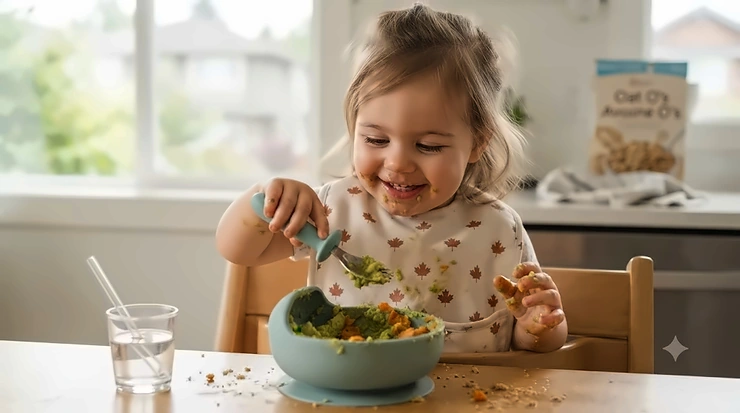
Somewhere around month six, your baby stops being a passive passenger at mealtime and starts grabbing the spoon out of your hand like it owes them money. That moment — equal parts adorable and chaotic — is exactly why finding the best baby utensils matters more than most parents expect going in. It’s not just cutlery. It’s the tool that either makes self-feeding click or turns every dinner into a standoff.
The trouble is that “best baby utensils” isn’t a single answer, because a soft tip baby spoon that’s perfect for a six-month-old’s first purée swipes is the wrong shape entirely for a toddler learning to stab a piece of banana. Add in choking safety, material questions (silicone? bamboo? stainless?), and the sheer number of brands shouting for attention on Amazon.ca, and it’s easy to end up with a drawer full of utensils your baby refuses to touch.
We dug into real specs, real aggregated review sentiment, and Canadian public-health feeding guidance to build this guide. According to Health Canada’s infant nutrition guidance, solid foods that are hard, small and round, or smooth and sticky should be avoided because they can cause choking — a baseline that shapes which utensils actually deserve a spot on your baby’s tray. Below, we break down seven real products across budget, mid-range, and premium tiers, plus the comparisons, milestones, and safety context that actually help you decide.
Quick Comparison Table
| Product | Best For | Material | Price Range (CAD) |
|---|---|---|---|
| NumNum Pre-Spoon GOOtensils | Very first self-feeding attempts | Silicone | C$18-C$24 |
| Olababy Feeding + Training Spoon Set | Parent-and-baby dual feeding | Silicone | C$20-C$26 |
| EZPZ Mini Utensils | Building spoon-and-fork coordination | Silicone | C$24-C$30 |
| Avanchy Bamboo & Silicone Infant Spoon | Eco-conscious, natural-material households | Bamboo + Silicone | C$28-C$36 |
| Munchkin Soft-Tip Infant Spoons (12-pack) | Budget bulk buyers | BPA-free plastic | C$10-C$15 |
| Grabease Self-Feeding Utensils | Ergonomic, no-wrong-way grip | Stainless steel + silicone | C$18-C$23 |
| Bumkins Silicone Dip & Chew Spoons | Choke-conscious first-time parents | Silicone | C$14-C$19 |
Looking at the spread above, there’s a clear pattern: silicone dominates the early self-feeding stage because it flexes with an uncoordinated grip, while stainless steel and bamboo show up once you’re prioritizing durability or sustainability over pure forgiveness. Budget doesn’t necessarily mean worse here — the Munchkin Soft-Tip Infant Spoons hold their own against sets nearly triple the price. The right pick really comes down to your baby’s stage and your own priorities, which is exactly what the rest of this guide unpacks.
💬 Just one click — help others make better buying decisions too!😊
Top 7 Baby Utensils: Expert Analysis
1. NumNum Pre-Spoon GOOtensils — flat design built for zero learning curve
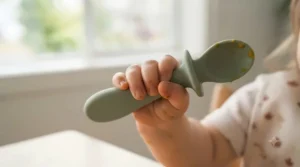
The standout here is the flat, paddle-like bowl that skips the “scooping” step entirely, letting babies press food onto the spoon instead of trying to angle a traditional bowl shape they haven’t figured out yet.
Each set includes a Stage 1 flat pre-spoon and a Stage 2 scoop, made from 100% food-grade silicone that’s free of BPA, PVC, and phthalates. On paper, that two-stage progression matters because it mirrors the actual mechanics of how babies learn to self-feed — pressing before scooping — rather than expecting a six-month-old to master an adult motion on day one.
Based on the spec comparison against similar pre-spoon designs, the short, stubby handle and wide, flat head are what set this apart from more traditional silicone spoons; it’s built around the baby’s motor skills rather than around what looks like a “real” spoon.
Reviewers consistently report that this is the first utensil that finally clicked for babies who’d rejected every other spoon — it’s also worth noting the line has amassed tens of thousands of reviews on Amazon, an unusually large sample for this category.
Pros:
- ✅ Two-stage design matches real self-feeding motor development
- ✅ Flat pre-spoon head removes the scooping learning curve
- ✅ Freezer- and dishwasher-safe for meal-prep convenience
Cons:
- ❌ Flat shape holds less food per bite than deeper bowls
- ❌ Less useful once baby has mastered a standard scoop
At around C$18-C$24 for the set, at the time of research this sits comfortably in the mid-range and earns its price as a genuine first-stage specialist rather than a general-purpose spoon — check current price before buying.
2. Olababy Feeding + Training Spoon Set — dual spoons for parent and baby in one pack
What stands out immediately is that this set solves the tug-of-war over “who holds the spoon” by giving parent and baby their own version, each shaped for the job they’re actually doing.
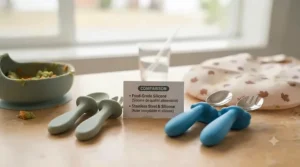
The parent spoon has a longer handle and slightly deeper bowl for accurate feeding, while the baby spoon is short, leaf-shaped, and tapered to be gentle on emerging gums. Both are made of soft, food-grade silicone that won’t clack against new teeth the way rigid plastic can.
What most buyers overlook about this model is that the tapered tip isn’t just about comfort — it’s shaped to hold a small, controlled amount of purée, which reduces overloading and gagging risk during those early weeks of solids.
Aggregated review sentiment consistently praises the set for being the rare “two spoons in one box” answer to co-feeding, with parents specifically noting it reduced mealtime friction during the awkward transition period when babies want independence they don’t quite have the coordination for yet.
Pros:
- ✅ Includes distinct spoons for parent-feeding and self-feeding
- ✅ Tapered, gentle tip suited to teething gums
- ✅ Doubles as a soothing teether between meals
Cons:
- ❌ Bowl is shallow, so it’s not ideal for thicker foods
- ❌ Colour options are limited compared with rival sets
In the C$20-C$26 range at the time of research, the value case is strong simply because you’re buying two purpose-built tools instead of one compromise design — solid pick for households doing combination feeding.
3. EZPZ Mini Utensils — spoon-and-fork set built for two-handed coordination
The hook here is the stubby, capped handle design, which is short enough that toddlers can’t flip the utensil around backwards mid-bite — a small detail with an outsized effect on independence.
Made from single-piece food-grade silicone with no crevices for food to hide in, the set pairs a shallow spoon with a blunt-tipped fork, both sized for hands that are still figuring out pincer grip. Here’s what to weigh: the one-piece construction means there’s no metal core and no separate parts to loosen over time, which matters more than it sounds once a utensil has been gnawed on daily for a year.
Reviewers frequently note that the fork tines are soft enough to be genuinely safe for face-first eating (because yes, that happens), while still rigid enough to actually spear soft foods like banana or avocado.
Pros:
- ✅ Fork and spoon combo builds two-utensil coordination early
- ✅ Single-piece silicone construction, nothing to loosen
- ✅ Blunt fork tines are safe for face-plant style eating
Cons:
- ❌ Bowl and tines are shallow for thicker or larger bites
- ❌ Pricier than single-utensil sets in this category
At C$24-C$30 for the pair at the time of research, it’s positioned as a mid-to-premium pick, and it earns that price mainly through the durability of the one-piece build rather than flashy extras.
4. Avanchy Bamboo & Silicone Infant Spoon — natural-material pick for eco-conscious households
The standout feature is the sustainably sourced bamboo handle paired with a silicone tip, giving this set a distinct look and feel compared with the sea of all-plastic and all-silicone competitors.
Bamboo is naturally antimicrobial and doesn’t retain odours the way some plastics can over repeated dishwasher cycles, and the silicone tip still delivers the same gentle-on-gums softness parents expect from a baby spoon. On paper, this combination means you’re trading a bit of flex (bamboo obviously doesn’t bend like all-silicone spoons) for a more durable, better-aging handle.
Based on the spec comparison with other natural-material spoons, the ergonomic curve of the bamboo handle is designed for small parent hands during the early parent-feeding stage, then hands off naturally to baby once grip strength develops.
Reviewers note the aesthetic appeal is a real draw for parents who prefer wood-toned nursery and feeding gear, though a recurring theme in feedback is that the bamboo requires hand-washing rather than dishwasher cycles to preserve the finish long-term.
Pros:
- ✅ Antimicrobial bamboo handle resists odour buildup
- ✅ Distinct, natural aesthetic beyond standard plastic/silicone
- ✅ Curved handle transitions well from parent-fed to self-fed
Cons:
- ❌ Hand-wash only, unlike most silicone competitors
- ❌ Premium price for what is still a basic two-piece spoon
At C$28-C$36 at the time of research, this is the priciest entry on our list, and it’s a deliberate choice for households already leaning toward natural materials elsewhere in their baby gear.
5. Munchkin Soft-Tip Infant Spoons (12-pack) — best-value bulk pick for daily wear and tear
The obvious hook is quantity: twelve spoons in one pack means you’re never scrambling for a clean utensil mid-feeding, and losing one in the diaper bag is a shrug, not a crisis.
Each spoon has a soft, flexible silicone tip on a rigid BPA-free plastic handle, a hybrid design that keeps costs down while still protecting new gums. What most buyers overlook about this model is that the rigid handle actually helps parents control angle and depth more precisely during early spoon-feeding, compared with all-silicone spoons that can feel floppy when loaded with purée.
Reviewers consistently flag this as the practical “starter pack” choice — not the most refined design on the list, but reliable enough that losing or damaging one spoon barely registers.
Pros:
- ✅ Twelve-pack means constant supply without repurchasing
- ✅ Rigid handle gives parents more feeding precision
- ✅ Genuinely budget-friendly for the number of pieces
Cons:
- ❌ Handle material feels less premium than silicone rivals
- ❌ Less ideal once baby is self-feeding independently
At just C$10-C$15 for the full pack at the time of research, this is the clear value leader on our list, and it earns that spot by solving a real logistics problem rather than by cutting corners on safety.
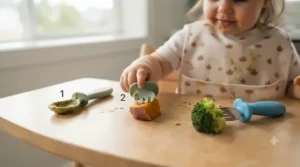
6. Grabease Self-Feeding Utensils — ergonomic, no-wrong-way-to-hold design
What stands out is the compact, rounded handle shape specifically engineered so there’s no “correct” grip to teach — baby can grab it from any angle and the spoon or fork still ends up pointed the right way.
The utensils pair a food-grade silicone handle with a stainless-steel bowl or tines, which is a meaningfully different construction from the all-silicone entries above. Here’s what to weigh: stainless steel doesn’t stain or absorb odours from foods like turmeric or tomato sauce the way silicone occasionally can, which matters more than people expect after a few months of colourful purées.
Based on the spec comparison, the short handle length is intentional — it’s calibrated to whatever grip strength babies typically have around six to nine months, rather than the longer handles found on adult-style toddler cutlery.
Reviewer sentiment repeatedly highlights that this is one of the few designs where babies “get it” almost immediately, with parents specifically crediting the ergonomic handle shape for cutting down the frustration phase.
Pros:
- ✅ No-wrong-way ergonomic grip speeds up self-feeding success
- ✅ Stainless-steel bowl resists staining from pigmented foods
- ✅ Short handle matched to typical 6-9 month grip strength
Cons:
- ❌ Metal bowl can feel cold on very first bites
- ❌ Not as forgiving for face-first eating as full silicone
In the C$18-C$23 range at the time of research, this is a strong mid-tier pick specifically for parents prioritizing grip ergonomics over maximum softness.
7. Bumkins Silicone Dip & Chew Spoons — choke-conscious design for the earliest self-feeders
The defining feature is a built-in depth guard on the handle that limits how far the spoon can go into baby’s mouth, addressing a specific worry that comes up constantly with brand-new self-feeders.
Made from one-piece food-grade silicone, the spoon has a shallow, dippable bowl designed more for dipping into thicker purées or yogurt than scooping loose food, which suits babies who are still working on hand-to-mouth accuracy. What most buyers overlook about this model is that the shallow bowl isn’t a design compromise — it’s intentional, since a deep bowl loaded with food is part of what makes early self-feeding attempts messier and, in some cases, riskier for an uncoordinated grip.
Reviewers consistently frame this as the pick for anxious first-time parents specifically because of the built-in guard, with aggregated sentiment describing real peace of mind during the earliest self-feeding sessions rather than claims of eliminating gagging entirely (which no utensil can honestly promise).
Pros:
- ✅ Built-in handle guard limits insertion depth
- ✅ Shallow dip-style bowl suits early, uncoordinated grip
- ✅ One-piece silicone with no small parts to loosen
Cons:
- ❌ Shallow bowl holds less food per attempt
- ❌ Less useful once baby graduates to scooping thicker meals
At C$14-C$19 at the time of research, it’s an accessible, safety-forward option that punches well above its price point for the specific first-self-feed use case.
Setting Up Baby’s First Self-Feeding Toolkit
Getting the utensils right is only half the job — how you introduce them matters just as much. Start with one utensil at a time rather than presenting a full set, so your baby isn’t overwhelmed choosing between a spoon and a fork before they’ve mastered either. In the first 30 days, expect more food on the floor than in the mouth; that’s not a sign anything’s wrong, it’s the actual mechanism by which grip and aim improve.
A simple maintenance routine keeps things sanitary without becoming a chore: rinse immediately after meals so purée doesn’t dry into silicone texture lines, then run through the dishwasher’s top rack weekly for a deeper clean (unless you’ve gone with a bamboo-handled set, which needs hand-washing to protect the finish). Common first-month mistakes include over-loading the spoon (leading to gagging, not choking, but still upsetting for new parents) and switching utensils too frequently, which resets the learning curve every time. One underused trick: pre-load two spoons before mealtime so you can hand off a fresh one the instant baby drops the first, keeping momentum without a mid-meal scramble.
✨ Ready to build your baby’s first feeding kit? Check current pricing on our top picks before your next grocery run.
Real-World Feeding Scenarios
The exhausted new parent, six months in: juggling a return to work with a baby just starting solids, this family needs speed and simplicity over novelty. The Munchkin Soft-Tip Infant Spoons 12-pack solves the real problem — never hunting for a clean spoon at 6 a.m. — while the rigid handle keeps purée control easy for a tired hand.
The safety-first first-timer: every parenting forum thread about choking has been read twice. For this household, the Bumkins Silicone Dip & Chew Spoons‘ built-in depth guard offers tangible reassurance during those nerve-wracking first self-feeding sessions, without resorting to gear that isn’t actually necessary.
The family already all-in on natural materials: wooden toys, organic cotton, the works. The Avanchy Bamboo & Silicone Infant Spoon fits the existing aesthetic and material philosophy of the nursery, and the antimicrobial bamboo genuinely suits a household already avoiding excess plastic elsewhere.
Baby Self-Feeding Milestones: What to Expect Month by Month
What is baby self-feeding readiness? It’s the point where an infant can sit upright unassisted, reach for food or utensils, and bring an object to their mouth with reasonable accuracy — typically emerging between six and nine months, though every baby’s timeline differs.
Around six months, most babies can grasp an object with their whole hand (a palmar grasp) and get it toward their mouth, though aim is rough. Health Canada notes that parents should let babies discover different textures and experiment with feeding themselves, offering foods they can eat using their hands, from the point solids are introduced. By nine months, the pincer grasp — thumb and forefinger together — typically emerges, unlocking smaller, more precise bites. Between nine and twelve months, spoon control improves enough that babies can scoop (messily) rather than just dip or press. The Canadian Paediatric Society’s feeding guidance similarly frames self-feeding as a gradual process that runs alongside these milestones rather than a switch that flips overnight.
It’s worth remembering that gagging during this window is a normal, protective reflex, not a sign of choking or that a utensil is unsafe — it’s the mechanism by which babies learn how much food their mouth can safely handle.
How to Choose the Best Baby Utensils
- Match the utensil to your baby’s current stage — a flat pre-spoon suits six-month-olds who can’t scoop yet, while a deeper-bowled spoon suits a baby already managing that motion.
- Prioritize a soft, tapered tip for the first few months — new gums and emerging teeth are sensitive, and a rigid edge can make mealtimes unpleasant fast.
- Consider handle length and shape over material alone — a short, capped handle prevents flip-around accidents more reliably than any specific material choice.
- Check for single-piece construction where possible — fewer seams means fewer places for bacteria to hide and fewer parts that can loosen with daily gnawing.
- Decide whether you need a parent-feeding spoon too — combination feeding (you and baby alternating) often benefits from a two-spoon set rather than one all-purpose design.
- Factor in cleaning method before you buy — bamboo needs hand-washing, while silicone and stainless steel typically tolerate dishwasher cycles.
- Buy more than one at a time — utensils get lost, chewed, or flung across the kitchen; having backups avoids mid-week gaps.
Common Mistakes When Buying Baby Utensils
The most common misstep is buying a full adult-style cutlery set far too early, expecting a baby to intuitively use a fork before they’ve mastered a spoon. A close second is choosing utensils purely on colour or character branding rather than tip softness and handle length, which are the two factors that actually determine whether a baby will use — or reject — a given spoon. Parents also frequently underestimate how quickly babies outgrow Stage 1 designs; what works beautifully at six months can feel frustratingly shallow by ten months once scooping ability improves. Finally, skipping the “test one spoon before buying five” approach can leave you with an expensive drawer of rejected utensils — buy a single set first, confirm your baby tolerates the tip and shape, then restock.
Soft Tip vs Standard Spoons: What Actually Matters
A soft tip baby spoon isn’t just a marketing term — it describes a genuine mechanical difference in how the spoon interacts with sensitive, sometimes swollen gums during teething. Standard rigid spoons (think stainless steel toddler cutlery) can feel harsh against new teeth breaking through, occasionally leading babies to associate the spoon itself with discomfort and refuse it outright.
That said, soft tips aren’t universally superior. Once teeth are established and grip strength improves, an overly soft, flexible bowl can actually make scooping thicker foods harder, since the spoon bends rather than holding its shape under pressure. The practical takeaway: lean soft-tip for the first few months of solids, then transition toward firmer bowls (silicone-on-stainless designs like Grabease, for example) once your baby is reliably scooping rather than just dipping or pressing.

Choke-Safe Utensils for Infants: Safety and Regulations Guide
Utensil safety isn’t only about the utensil itself — it’s inseparable from what’s on it. Canada’s official guidance on nutrition for infants six to 24 months explicitly recommends that parents and caregivers avoid offering hard, small and round, or smooth and sticky solid foods, since these can cause aspiration and choking, regardless of which spoon or fork is doing the delivering.
On the design side, look for utensils with a handle guard or naturally short handle (limiting insertion depth), a single-piece or minimal-seam construction (reducing hidden bacteria or loosening parts over time), and materials free of BPA, PVC, and phthalates. Interestingly, research on feeding method itself is reassuring on this front: a CBC News report on a peer-reviewed choking study found that the number of infants who choked did not differ between babies who were spoon-fed and those who fed themselves, suggesting the utensil and food choice matter more than whether a baby is self-feeding at all. Always supervise every feeding session regardless of utensil, and consider taking an infant first-aid course before your baby starts solids — it’s a small time investment that pays off in confidence, if never in an actual emergency.
Long-Term Cost & Maintenance
Baby utensils are a low-stakes purchase individually, but the total cost of ownership adds up once you account for replacements. Silicone sets typically last six to twelve months of heavy use before tips start showing wear or discolouration, while stainless-steel-bowled options like Grabease tend to outlast that window simply because metal doesn’t degrade from repeated dishwasher cycles the way silicone eventually can. Bamboo, if properly hand-washed, can last even longer, but the maintenance burden (no dishwasher, no soaking) is the real cost, not the sticker price.
Cost-per-use math favours bulk sets like the Munchkin Soft-Tip Infant Spoons for the earliest, messiest months, since losing one of twelve barely dents the value — while a single premium spoon lost in a stroller cup holder stings more. A practical approach: buy a budget bulk set for month one chaos, then invest in one or two higher-end sets (like EZPZ Mini Utensils or Avanchy) once your baby’s grip and preferences are clearer.
Features That Actually Matter (And Those That Don’t)
Tip softness, handle length, and single-piece construction genuinely affect whether a baby will use a utensil and how safely it performs — these are worth prioritizing. Colour, character branding, and “designer” packaging, by contrast, matter to parents far more than to babies, who show zero preference for a spoon shaped like a leaf versus a plain rounded bowl. Similarly, marketing claims like “encourages faster self-feeding” should be read skeptically; what most buyers overlook about this category is that developmental readiness, not utensil design, is the primary driver of self-feeding speed — a great spoon simply removes friction, it doesn’t accelerate biology.
Frequently Asked Questions
❓ What age should babies start using self-feeding spoons?
❓ Are silicone or stainless-steel baby spoons better?
❓ How many baby spoons should I actually buy?
❓ Do baby forks cause choking risk?
❓ When should I switch from a soft tip baby spoon to a firmer one?
Conclusion
Choosing the best baby utensils really comes down to matching the tool to the stage, not chasing the flashiest set on the shelf. For a brand-new self-feeder, something forgiving like the NumNum Pre-Spoon GOOtensils or the choke-conscious Bumkins Silicone Dip & Chew Spoons removes friction during the messiest, most uncertain weeks. Once grip and coordination improve, ergonomic or firmer-bowled options like Grabease or EZPZ Mini Utensils tend to keep pace with a more capable eater, while budget bulk packs like the Munchkin Soft-Tip Infant Spoons quietly solve the “where did all our spoons go” problem every parent eventually hits.
None of this needs to be perfect on the first try. Babies reject spoons, throw forks, and occasionally decide that hands work just fine, thank you — and that’s a normal part of the process, not a verdict on your utensil choice. Keep supervision consistent, keep food textures age-appropriate, and let the utensils do the smaller job they’re actually built for: making an already messy, joyful milestone a little easier to get through.
✨ Found the right fit for your little one? Check current pricing and availability before you check out — happy feeding! 🍼
Recommended for You
- Divided Plates for Toddlers: 7 Best Picks for Picky Eaters in 2026
- 7 Suction Plates for Babies That Actually Stay Put (2026 Guide)
- Booster Seat for Eating: 7 Top Picks for Canadian Families (2026)
Disclaimer: This article contains affiliate links. As an Amazon Associate, I earn from qualifying purchases. If you purchase products through these links, we may earn a small commission at no additional cost to you.
✨ Found this helpful? Share it with your friends! 💬🤗
