
In This Article
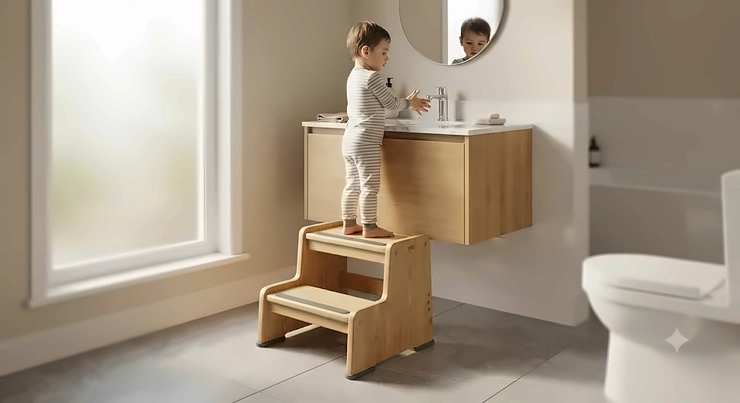
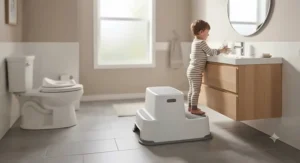
Picture it. It’s 7:40 a.m., you’re running late, and a very small person stands in front of a very tall sink with their arms raised like a conductor waiting for the orchestra. A two-step stool for bathroom sink and toilet is one of the least glamorous purchases you’ll make this year. It may also be one of the most useful. Two levels, one lightweight platform, and suddenly your toddler can reach the tap, the soap, the toilet seat and a little independence.
Why does this matter beyond the morning rush? Hand hygiene is one of the simplest ways to cut down the colds and stomach bugs that circulate through Canadian daycares every winter. The Canadian Paediatric Society’s guidance on handwashing for parents and children describes it as the best way to stop germs spreading and recommends about 15 to 20 seconds of scrubbing under running water. A child who can’t reach the tap can’t do any of that. The stool is what makes the habit physically possible.
This guide compares seven real models, including dual-height step stools, a nesting pair, a wooden option and a convertible design. It also covers how to choose, what Canadian recalls teach us, and what these stools cost over time. A note on method: everything here comes from published specs and aggregated review themes. I haven’t hands-on tested any of these products, and where reviews couldn’t be verified, I say so.
Quick Comparison: 7 Step Stools for Sink and Toilet at a Glance
Here’s the short version before we go deep. Prices are approximate Canadian-dollar ranges from the time of research and will move around, so check current pricing on amazon.ca before you buy.
| Model | Steps and Size | Capacity | Price Range (CAD) | Best For |
|---|---|---|---|---|
| Playtex 2-Tier Step Stool | Compact, 21 cm (8.25 in) high | 68 kg (150 lb) | C$20–C$30 | Tight budgets, second bathrooms |
| Forbena Toddler Step Stool | Two steps, 25 cm (10 in) high | 91 kg (200 lb) | C$25–C$40 | Toilet training plus sink use |
| Secure Home Wider Dual Height 2 Step Stool | Steps of about 13 cm and 27 cm (5 in and 10.5 in) | 180 kg (396 lb) | C$25–C$40 | Mixed ages, wider stance |
| Dreambaby Toddler & Me 2-Step Stool | About 27 cm (10.5 in) high | 136 kg (300 lb) | C$40–C$60 | Taller kids, shared family use |
| Skip Hop Double-Up Step Stool | Nesting pair, stackable | 113 kg (250 lb) | C$35–C$50 | Small powder rooms |
| WOOD CITY Toddler Step Stool | Two-level wooden design | 91 kg (200 lb) | C$30–C$45 | Warm decor, a heavier feel |
| AIYAPLAY Toddler Step Stool (3-to-2 Step) | Converts between 3 and 2 steps | Not verified | C$40–C$60 | Growing kids, adjustable height |
Looking at the table, the Playtex 2-Tier Step Stool is the cheapest way in, but its lower rise suits smaller toddlers best. The Dreambaby Toddler & Me 2-Step Stool costs more, yet its extra height and 136 kg (300 lb) rating make it the strongest fit if the stool will be shared with taller siblings. If your washroom is tiny, the nesting Skip Hop Double-Up Step Stool is the space-saver.
💬 Just one click — help others make better buying decisions too!😊
Top 7 Two-Step Bathroom Stools: Expert Analysis
Each pick below gets the same treatment: what the specs mean in practice, who it suits, and what buyers consistently report. Think of it as reading the spec sheet with a sceptical friend.
1. Playtex 2-Tier Step Stool — lightest-touch pick for tight budgets
The pitch is simplicity: a squat plastic platform with notched sides that a toddler can carry without a co-pilot.
At 32 × 32 cm (12.5 × 12.5 in) and 21 cm (8.25 in) high, it’s the lowest stool in this round-up. That height is its honest limit. It suits a two- to four-year-old at a typical vanity and a standard toilet, but a tall toddler at a high counter may still be reaching. The textured top and skid-resistant feet matter more than they sound, because bathroom floors and small wet socks are a bad combination. The 68 kg (150 lb) rating covers a child comfortably but isn’t built for sharing with adults.
Based on the specs, this is the stool for a first bathroom, a grandparent’s guest washroom, or a family that just wants the job done. Reviewers on a retail listing (roughly 300 reviews on Walmart’s page, not Amazon) describe it as light, easy to wipe down and steady on floors. One parent compared it favourably to a wooden step that was loud and easy to stub toes on. Confirm the amazon.ca listing matches this model before buying.
Pros:
- ✅ Light enough for kids to carry
- ✅ Skid-resistant top and feet
- ✅ Wipes clean in seconds
Cons:
- ❌ Lower rise than most rivals
- ❌ Not intended for adult weight
Expect around C$20–C$30. For a no-frills stool, that’s strong value.
2. Forbena Toddler Step Stool — snap-together simplicity with a taller stance
Forbena leans into practicality, with a two-step body that sits a little taller than the entry-level plastic options.
The listing specs give 38 × 33 × 25 cm (15 × 13 × 10 in), a weight of about 1.3 kg (2.8 lb) and a 91 kg (200 lb) capacity. The extra height compared with the Playtex means a toddler at a standard vanity can reach the tap without stretching. Light weight lets small kids move it themselves, but it also means adults should keep an eye on it near a slippery floor. It’s a plastic design with non-slip feet and an easy-clean surface.
For a family doing toilet training and sink access with a single stool, it’s a sensible middle path. Reviewers consistently mention that it snaps together easily, stays put on tile and holds up to daily use. Some buyers purchased two, one per bathroom. The most repeated wish is that the steps were slightly wider, so it suits narrow feet better than big, boot-clad ones.
Pros:
- ✅ Quick, tool-free assembly
- ✅ Good height for sink and toilet
- ✅ Stable on tile per reviewers
Cons:
- ❌ Steps feel narrow to some buyers
- ❌ Not foldable for storage
Budget around C$25–C$40. A solid all-rounder for the price.
3. Secure Home Wider Dual Height 2 Step Stool — widest stance, lightest body
Wider is the whole point here. The name isn’t marketing fluff; the design is built around a broader platform.
It measures about 37 × 33 × 24 cm (14.5 × 13 × 9.4 in), and it’s a featherweight at roughly 0.95 kg (2.1 lb). One published roundup describes a first step of about 13 cm (5 in) and a second of about 27 cm (10.5 in), which is what makes it a dual-height design: a younger toddler starts on the low step, and an older one graduates to the high one. The 180 kg (396 lb) rating is unusually high for plastic, though the practical takeaway is that it won’t flex under a determined climber.
Analytically, this is a strong fit for a household with two children of different ages. Reviewers highlight the added height, the grippy rubber panels and how easily toddlers carry it around. Listing details conflict on assembly (some say none, others say some), so check the description on the exact listing you choose.
Pros:
- ✅ Two distinct step heights
- ✅ Very high stated weight rating
- ✅ Easy for kids to carry
Cons:
- ❌ Assembly details vary by listing
- ❌ Very light, so needs grippy floors
Expect about C$25–C$40. Great value for mixed-age families.
4. Dreambaby Toddler & Me 2-Step Stool — tallest and sturdiest of the mainstream picks
The “Me” in the name is deliberate: this stool is designed to work for parents too.
Dreambaby lists it at about 27 cm (10.5 in) high and 39 cm (15.4 in) wide, with a 136 kg (300 lb) capacity, handles and an anti-slip surface with a grippy bottom rim. That width gives kids a real platform rather than a perch, and the extra height helps at higher vanities. The trade-off is bulk. It takes up more floor than the Playtex, so measure your washroom.
On paper, this is the pick if the stool will live in a shared bathroom or serve as a step for an adult reaching a high shelf. On a Babylist listing (some reviews collected through a promotion, so read with that in mind), it averages 4.9 out of 5 from about 50 reviews. Parents mention that it’s taller than other stools they’d tried, wipes clean and doesn’t budge on the floor.
Pros:
- ✅ Taller and wider than most rivals
- ✅ Very high weight rating
- ✅ Grippy top and bottom rim
Cons:
- ❌ Takes more floor space
- ❌ Pricier than plastic basics
Budget C$40–C$60. Worth it if you want one stool to last.
5. Skip Hop Double-Up Step Stool — nesting design for tiny powder rooms
Two stools that nest inside each other. It’s the most clever bit of stool engineering here, and it’s relevant to anyone whose washroom is closet-sized.
The set is listed at about 34 × 38 × 21 cm (13.4 × 15.1 × 8.4 in) with a 113 kg (250 lb) rating. Use the pieces stacked for a taller, stepped climb, or separately for two users. Handles sit in the centre of the stool, which one editorial roundup notes may make it harder for toddlers to move alone. Its taller configuration also suits shorter toddlers or higher counters.
Here’s the takeaway: this is the strongest choice for multi-use bathroom furniture in a small home. Reviewers use it as a step, a snack-time seat and a perch. Listing data captured at the time of research showed roughly 4.6 out of 5 across a few thousand ratings, a large sample. A downside noted by users is that it’s less “grab and go” for little hands.
Pros:
- ✅ Nests to save floor space
- ✅ Two configurations in one purchase
- ✅ Large body of positive ratings
Cons:
- ❌ Centre handles hard for toddlers
- ❌ Stacked version feels less compact
Plan on C$35–C$50. Best for small spaces.
6. WOOD CITY Toddler Step Stool — wooden feel with a two-level build
If plastic isn’t your aesthetic, this is the wooden alternative in the group, and a good example of dual-height step stools done in natural material.
The listing describes solid wood construction, two step levels for ages roughly one to three, a 91 kg (200 lb) capacity and ten non-slip pads: four on the base, six across the stepping surfaces. That pad count is worth noticing, because wood alone can be slick when wet. The real-world upside is weight; a wooden stool tends to stay put where a featherweight plastic one skates.
The honest caveat is review verification. The listing I found showed about 4.1 out of 5 from a small sample on a third-party seller page, so treat it as a limited signal and read amazon.ca reviews directly. Wood also asks for a little more care in a damp room: wipe it dry and check the pads periodically.
Pros:
- ✅ Sturdy, less likely to slide
- ✅ Ten non-slip pads included
- ✅ Blends into home decor
Cons:
- ❌ Needs drying after splashes
- ❌ Limited verified review data
Expect about C$30–C$45. A good value for a warmer look.
7. AIYAPLAY Toddler Step Stool (3-to-2 Step) — converts as your child grows
This is the adjustable option, and adjustability is exactly what parents of fast-growing kids tend to want.
The listing describes a design that converts from three steps to two, aimed at ages roughly two to five, with a trapezoid base and non-slip surface. The 3-step mode is for reaching a counter or sink; the 2-step mode is meant for sitting during toilet training. That makes stool height adjustability the headline feature. It’s a heavier, more structured build than the flat stools above, so it takes up more room.
I couldn’t verify reviews or a capacity figure for this model, so treat it with more caution than the others and read amazon.ca feedback carefully. Given Canadian recalls of some toddler step stools from other lines (covered in the safety section), always check spacing between bars and confirm the specific model isn’t recalled.
Pros:
- ✅ Converts between 3 and 2 steps
- ✅ Grows with your child
- ✅ Wide, structured base
Cons:
- ❌ Bulkier than flat stools
- ❌ Limited verified review data
Budget around C$40–C$60. Pay for adjustability only if you’ll use it.
What Is a Two-Step Stool for Bathroom Sink and Toilet?
A two-step stool for bathroom sink and toilet is a compact, low platform with two stepping levels, typically about 13 to 27 cm (5 to 10.5 in) high, that helps toddlers reach a vanity tap and sit on the toilet with their feet supported. Non-slip treads and grippy feet keep it stable on wet bathroom floors.
That definition hides a small design choice with real consequences. Dual-height step stools give you two rises: a low step for younger or shorter kids and a high step for older ones or higher vanities. Because two-step bathroom stools are low and wide, they’re generally more stable than tall learning towers. And because they’re light, toddlers can often shift them without help, which quietly builds independence.
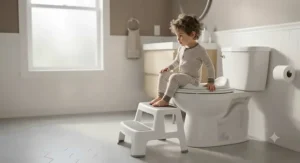
The toilet side matters as much as the sink. A child who sits with dangling feet has to strain, while a stool under the feet lets knees rest at or slightly above hip height. The result is more comfort and, for many families, a smoother transition through potty training.
How to Choose a Two-Step Stool for Bathroom Sink and Toilet
Choosing well comes down to six checks. Do them in order and you’ll avoid most regrets.
- Measure your vanity and toilet. Standard vanities run roughly 80 to 90 cm (32 to 36 in) tall. Compare that with your child’s reach; a toddler should be able to wash under running water without lifting their elbows awkwardly high.
- Match the height to the child. Younger toddlers do best on a lower step, while four- and five-year-olds need the taller one. If your child is between sizes, choose a stool with two heights.
- Check the footprint against your washroom. A wide stool is more stable but needs floor space. In a tight space, a nesting or foldable design earns its keep.
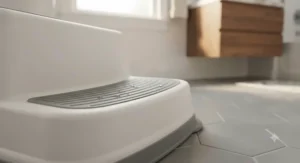
- Prioritize grip. Look for a textured top and skid-resistant feet on the base. In a bathroom, this matters more than a cute colour.
- Read the weight rating sensibly. Higher ratings suggest sturdier construction, but they don’t guarantee stability. Check that the base is wider than the top.
- Search for recalls before you buy. Health Canada publishes recalls, such as the StepUp Sidekick Learning Tower recall, where a tray and step could come loose. A two-minute search of the model name is cheap insurance.
Stool Height Adjustability: When It Matters and When It Doesn’t
Stool height adjustability sounds like an obvious win. In practice it depends on how fast your child grows and how many places you’ll use the stool.
There are three ways to get flexibility. The first is a fixed dual-height design, like the Secure Home Wider Dual Height 2 Step Stool, where the two levels are built in. The second is a nesting system, like the Skip Hop Double-Up Step Stool, where you choose one piece or two. The third is a true convertible, like the AIYAPLAY Toddler Step Stool (3-to-2 Step), which changes configuration.
Here’s my read. If you have one child aged two to three and a standard vanity, a fixed two-step stool is likely enough, because the height you need today is close to the height you’ll need in a year. Adjustability earns its cost when siblings share the stool, when the stool moves between the sink and a kitchen counter, or when you expect your child to use it until age five or six. The trade-off is more moving parts, which means more to inspect for wear. Whenever a design converts, check that locks click firmly and nothing wobbles before the child steps on.
Two-Step Stools vs Learning Towers vs Adult Step Stools
Should you buy something taller? It depends on what you want the stool to do. This table compares the main alternatives.
| Type | Footprint | Portability | Best For | Watch Out For |
|---|---|---|---|---|
| Two-step stool | Small | High | Sink, toilet, quick tasks | Not for counters |
| Learning tower | Large | Low | Kitchen helping, counter height | Bulk, entrapment gaps |
| Adult folding stool | Medium | Medium | Reaching high shelves | Not made for toddlers |
| Potty-training ladder seat | Medium | Low | Toilet-only use | No sink use |
A two-step stool wins for bathrooms because it’s low, stable and carried in one hand. Learning towers are excellent in kitchens, but their tall, enclosed design is overkill for a washroom and is where some entrapment recalls have arisen. If toilet training is your only goal, a ladder seat works, but a stool that also serves the sink gives you more for less.
Handwashing Habits for Toddlers: Building the Routine Around the Stool
A stool doesn’t create a habit. A routine does. But the stool removes the excuse, and that’s half the battle.
Start with consistency. Put the stool in the same place, at the same sink, every day. Then build a fixed order: step up, water on, soap, scrub, rinse, dry. The Canadian Paediatric Society suggests about 15 to 20 seconds of scrubbing, roughly a “Happy Birthday” song, and the Government of Canada’s Hand-Washing Heroes video is a short, kid-friendly way to model the steps.
Anchor washing to moments toddlers understand: after using the toilet, before meals, after coming in from outside. Public health guidance for child care also recommends washing after diapering or toileting. For handwashing habits for toddlers, the stool becomes a cue. Stool out, hands washed.
A few practical extras help. Use a soap dispenser a child can press. Keep towels within reach. If you use hand sanitizer for out-of-home moments, keep the bottle out of your child’s reach, since swallowed sanitizer can be harmful. And always supervise; a stool is a step up, not a babysitter.
Setup, Placement and Maintenance: Your First 30 Days
Most stool problems happen in the first month, when everyone is still learning. A little planning helps.
Week one: place and practice. Put the stool on a dry, flat spot in front of the sink, not in the doorway where feet will trip on it. Let your child practise climbing up and down while you stand close. Teach one rule from day one: one child on the stool at a time.
Week two: check grip and stability. Wiggle the stool. It should sit without rocking. If it slides on tile, add a bath mat with a rubber backing beneath it or check that the anti-slip pads are fully seated.
Weeks three and four: build the habit. Add the handwashing routine and, if toilet training, place the stool for foot support.
Ongoing maintenance:
- Wipe plastic with mild soap and water weekly.
- Dry wooden stools after splashes to protect the finish.
- Every month, inspect feet and non-slip pads for peeling or missing pieces.
- Check locks or hinges on folding or convertible designs before each growth spurt.
A common mistake in the first 30 days is leaving a stool where it blocks a drain-side path. Move it out of the walkway when it isn’t in use.
✨ Ready to Pick Your Stool!
🔍 Take your bathroom routine to the next level with these carefully compared options. Click on any highlighted product to check current pricing and availability. A well-chosen stool gives your family a safer, calmer and more independent washroom!
Real-World Scenarios: Which Stool Fits Which Household
Specs are abstract, so here are three household profiles with a suggested match. These are reasoning examples, not testimonials.
Scenario 1: The condo powder room. A family of three in a 55 m² (about 590 sq ft) condo with a two-year-old and a washroom the size of a phone booth. Budget around C$40, used several times daily. The Skip Hop Double-Up Step Stool suits this best, because it nests when not in use and stacks when needed.
Scenario 2: The shared family bathroom. Two kids, aged three and six, and a single sink. Budget up to C$60, used constantly. The Dreambaby Toddler & Me 2-Step Stool offers the height for the older child and the sturdiness for both, with a rating high enough that a parent can use it too.
Scenario 3: The grandparents’ guest bathroom. A stool that appears for weekend visits and gets stored otherwise. Budget under C$30, used twice a month. The Playtex 2-Tier Step Stool is plenty: it’s inexpensive, light and easy to store.
Notice how the decision follows floor space, number of children and frequency of use, not brand. That’s the pattern to copy in your own home.
Multi-Use Bathroom Furniture: Features That Actually Matter (And Those That Don’t)
A good stool becomes multi-use bathroom furniture almost by accident. It’s a step at the sink, a foot rest at the toilet, a seat for shoes, a stool for reading books by the bath. Not every feature helps, though.
Features that matter:
- A wide, textured top. It gives real grip and space for both feet.
- Skid-resistant feet. The floor-facing pads keep the stool from sliding.
- Handles. They help with carrying, though position matters. Centre handles are less toddler-friendly than side notches.
- A wipe-clean finish. In a washroom, this is non-negotiable.
Features that matter less:
- Cute themes. A dinosaur is charming, but stability is what counts.
- Sky-high weight ratings. A 180 kg (396 lb) rating is reassuring but doesn’t make a stool safer for a toddler. Base width and grip do.
- Extra accessories. Bonus gifts and add-ons are pleasant, not essential.
Think about where else the stool might live. A stool that can migrate from the washroom to the bedroom or kitchen extends its usefulness, but that adds a reason to check it for wear often.
Safety and Canadian Regulations: What Parents Should Know
There’s no seal that makes a toddler stool “Health Canada approved.” Instead, products must comply with the Canada Consumer Product Safety Act, which prohibits selling dangerous products, and Health Canada issues recalls when problems surface. That means parents do part of the vetting.
Recent history is a useful checklist of what goes wrong. Aosom Canada’s Qaba Toddler Kitchen Helper 2 Step Stool was recalled because of an entrapment hazard caused by spacing between the back bars; a child’s head became stuck, and thousands were sold in Canada. That’s a different product from the AIYAPLAY listed here, but it shows why bar spacing matters. Other recalls involved a bamboo step stool whose platform could crack, and Cosco kitchen steppers, where a rear safety bar could detach.
Practical steps:
- Search the exact model name and “recall” before buying.
- Avoid designs with gaps a child’s head or limbs could fit through.
- Keep the stool on dry, flat floors.
- Let only one child use it at a time.
- Supervise, always.
Long-Term Cost and Value: What You’ll Really Spend
A C$25 stool that lasts three years and a C$55 stool that lasts six cost about the same per year. What matters is how long you’ll use it and how well it holds up.
| Model | Price Range (CAD) | Likely Useful Life | Value Verdict |
|---|---|---|---|
| Playtex 2-Tier Step Stool | C$20–C$30 | 2–3 years | Best entry value |
| Forbena Toddler Step Stool | C$25–C$40 | 3–4 years | Solid all-rounder |
| Secure Home Wider Dual Height 2 Step Stool | C$25–C$40 | 3–5 years | Great for siblings |
| Dreambaby Toddler & Me 2-Step Stool | C$40–C$60 | 4–6 years | Long-term durable |
| Skip Hop Double-Up Step Stool | C$35–C$50 | 3–5 years | Small-space winner |
| WOOD CITY Toddler Step Stool | C$30–C$45 | 3–5 years | Warm, low-cost wood |
| AIYAPLAY Toddler Step Stool (3-to-2 Step) | C$40–C$60 | 3–5 years | Only if adjustability used |
Useful life figures are my estimates based on height and construction, not manufacturer claims. Read against the ranges, the Dreambaby Toddler & Me 2-Step Stool looks the priciest but potentially has the lowest cost per year for a long-use family. Meanwhile, the Playtex 2-Tier Step Stool and Secure Home Wider Dual Height 2 Step Stool offer the lowest cost of entry. A second stool for another bathroom is often better value than a premium option you’ll carry around.
FAQ
❓ What height should a step stool be for a toddler at the bathroom sink?
❓ Can a two-step bathroom stool hold an adult?
❓ Are wooden or plastic step stools better in a washroom?
❓ Does my toddler need a stool for the toilet as well as the sink?
❓ How often should I check a toddler step stool for wear or recalls?
Conclusion
Here’s the honest wrap-up. The best two-step stool for bathroom sink and toilet isn’t the one with the biggest weight rating or the cutest print. It’s the one that fits your washroom, your child’s height and your budget, and doesn’t slide when the floor gets wet.
For a tight budget, the Playtex 2-Tier Step Stool is the simple entry point. For mixed ages, the Secure Home Wider Dual Height 2 Step Stool and Forbena Toddler Step Stool offer versatile heights. If you want the sturdiest, tallest mainstream option, the Dreambaby Toddler & Me 2-Step Stool is my top analytical pick, while the Skip Hop Double-Up Step Stool wins for small spaces. The WOOD CITY Toddler Step Stool suits a warmer aesthetic, and the AIYAPLAY Toddler Step Stool (3-to-2 Step) makes sense if stool height adjustability will actually be used.
Whatever you choose, do three things: check for recalls, watch for gaps a small body could get stuck in, and build the handwashing routine around the stool from day one. Small platform, big payoff.
Recommended for You
- 7 Best Step Stool For Potty Training Picks In 2026
- Step Stools Under $25 CAD: 7 Brilliant Toddler Picks For 2026
- 7 Best Training Pants For Girls In Canada 2026
Disclaimer: This article contains affiliate links. As an Amazon Associate, I earn from qualifying purchases. If you purchase products through these links, we may earn a small commission at no additional cost to you.
✨ Found this helpful? Share it with your friends! 💬🤗
