
In This Article
A potty seat for toilet training is a child-sized ring that sits on top of a regular toilet seat, shrinking the opening so a toddler can sit without slipping in. Many add splash guards, padding, or handles for balance, helping kids move from diapers to the family toilet without a separate floor potty.
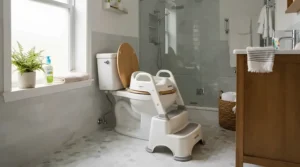
That’s the textbook version. The real-life version involves a three-year-old eyeing a porcelain bowl the way you’d eye a cliff edge. This is why the choice of potty seat for toilet training matters far more than its modest price tag suggests. A wobbly seat teaches fear. A snug, comfortable one teaches independence.
Toilet training, also called potty training or toilet learning, has a surprisingly long history of shifting advice. Wikipedia’s overview of toilet training notes that modern approaches lean on behavioural and cognitive psychology rather than the old stern-schedule methods. The practical upshot is simple: your child’s comfort and sense of safety come first, and equipment should support that.
This guide compares seven real, widely sold options for Canadian families, from a bargain padded ring to a floor potty with a removable topper. Along the way, I’ll translate every spec into what it means on a Tuesday morning at 7:40 a.m., when everyone is late. You’ll find advice on toilet seat fit compatibility, padded potty seats, secure potty seats for toddlers, toilet training seat inserts, handles for balance, and potty training transition tips.
A quick note on method: I haven’t personally used these products, and I won’t pretend otherwise. What follows is analysis of real specs and aggregated review sentiment from published sources.
Quick Comparison: Potty Seat for Toilet Training Options at a Glance
| Product | Type | Standout | Best For | Price Range (CAD) |
|---|---|---|---|---|
| BabyBjörn Toilet Training Seat | Hard insert ring | Adjustable dial fit | Multi-toilet households | Around C$45-C$65 |
| Upseat Soft-Sit Potty Training Seat | Foam insert with backrest | Soft, made in Canada | Nervous or sensitive sitters | C$35-C$50 |
| Mommy’s Helper Contoured Cushie Step Up | Padded insert with step | Handles plus built-in stool | Kids who can’t reach the bowl | C$40-C$60 |
| Mommy’s Helper Contoured Cushie Tushie | Padded insert | Lift handle and wall hook | Tight budgets | Under C$25 |
| Munchkin Arm & Hammer Multi-Stage 3-in-1 Potty Seat | Floor potty, insert, stool | Grows with your child | Gradual floor-to-toilet progression | C$30-C$50 |
| Munchkin Sturdy Potty Seat | Hard insert | Built-in handles | Budget grip and stability | Under C$25 |
| Summer by Ingenuity My Size Potty Pro | Floor potty with topper | Looks like a real toilet | Kids who want the “grown-up” look | Roughly C$40-C$65 |
Prices are estimates at the time of research and shift often, so check current price before buying. Looking at the table, the Munchkin Sturdy Potty Seat and the Mommy’s Helper Contoured Cushie Tushie win on cost, while the BabyBjörn Toilet Training Seat wins on adaptability. If your child needs a stool to climb up, the Mommy’s Helper Contoured Cushie Step Up removes a purchase from your list. Meanwhile, the Munchkin Arm & Hammer Multi-Stage 3-in-1 Potty Seat and the Summer by Ingenuity My Size Potty Pro suit families who want a floor-level starting point.
💬 Just one click — help others make better buying decisions too!😊
Top 7 Potty Seat for Toilet Training Picks: Expert Analysis
1. BabyBjörn Toilet Training Seat — adjustable dial locks onto most bowls
The headline feature is the fit mechanism: a dial underneath lets you tune the seat to your bowl once, after which it rests in place every time. Nobody loves fiddling with hardware mid-emergency, so that matters.
The seat measures about 29 × 36 × 9 cm and weighs roughly 400 g. That’s light enough for a toddler to lift on and off alone, a small detail with outsized psychological payoff, since independence is half the game. Rubber edging grips the rim, and a built-in handle on the back lets you hang it on a hook instead of leaving it lurking on the floor. The opening is wide enough for a parent to help with wiping, yet narrow enough to stop a small bottom slipping through.
Based on the spec comparison, this is the pick for families who move between toilets: home, grandparents’, the cottage. The hard polypropylene-and-elastomer build wipes clean easily, though it isn’t padded, so very small or sensitive bottoms may prefer softer designs.
Aggregated review sentiment is strongly positive on stability, fit, and easy cleaning, and a parenting-site tester panel also named it a top seat pick. Common caveats in user reviews are that the splash guard is modest, so some boys still need to sit further back, and that the adjustment grip can loosen over time and need a re-tighten.
Pros:
- ✅ Dial adjusts to fit most toilet bowls
- ✅ Light enough for toddlers to place themselves
- ✅ Wipe-clean build with hang-up handle
Cons:
- ❌ Hard surface with no padding
- ❌ Adjustment grip may need re-tightening
Expect roughly C$45-C$65 at the time of research. It costs more than basic rings, but the adaptable fit earns that premium in multi-toilet households.
2. Upseat Soft-Sit Potty Training Seat — soft foam with a built-in backrest
The standout is comfort: a soft, squishy polyurethane foam seat, manufactured in Canada, in place of hard plastic. That’s a genuine point of difference in a category dominated by moulded plastic.
It’s a one-piece design with a supportive backrest, built-in splash guard, and anti-slip base, and it’s marketed as BPA- and phthalate-free. The backrest is the sleeper feature. Most toilet-mounted trainers leave kids perched upright with nothing behind them, which is nerve-racking for a child who leans back or needs a few minutes for a bowel movement. A backrest turns “perching” into “sitting.”
On paper, this suits nervous sitters, kids who dislike cold plastic, and parents who want padded potty seats without a complicated assembly. Foam generally calls for wipe-downs rather than soaking, so budget a little extra attention at cleaning time.
Here’s the honest caveat on reviews: I couldn’t verify a meaningful pool of independent customer reviews for this specific model at the time of research. Treat the comfort and fit claims as manufacturer claims until you’ve read current Amazon.ca ratings. Also check the return policy, since at least one Canadian retailer lists it as final sale, and hygiene items are often non-returnable.
Pros:
- ✅ Soft foam seat with supportive backrest
- ✅ Built-in splash guard and anti-slip base
- ✅ Made in Canada
Cons:
- ❌ Few independent reviews to verify claims
- ❌ Foam needs gentle wipe-down cleaning
Plan on around C$35-C$50. It’s a fair value if comfort is your main obstacle.
3. Mommy’s Helper Contoured Cushie Step Up — padded seat with handles and built-in stool
The standout is that it solves two problems at once: reaching the toilet and staying balanced once there.
This padded, foldable seat features moulded non-slip handles, extra-wide non-slip floor pads, and a contoured shape with a built-in deflector. It assembles without tools and folds flat for storage. Listings describe it as fitting standard and most elongated seats on toilets roughly 41-47 cm (16-18.5 in) high, but not square bowls. Weight capacity is listed as roughly 18-23 kg depending on the retailer, so verify on the listing you buy from.
Here’s what the spec sheet means in practice. A toddler who can’t reach the bowl otherwise needs a separate stool, and an unattached stool is one more thing to slide. Here the handles for balance and the steps are one unit, so the climb-up routine becomes automatic. That makes it a smart choice for secure potty seats for toddlers who are still short and wiggly.
Reviewers describe it as the best seat they’ve tried, and appreciate that it comes on and off easily. Recurring complaints are that kids can yank on the handles and make the legs move, and that the cushioning is less contoured than the photos suggest.
Pros:
- ✅ Handles and steps in a single unit
- ✅ Thick padding with non-slip floor pads
- ✅ Folds flat for storage
Cons:
- ❌ Larger footprint around the toilet
- ❌ Lower weight limit than some rivals
Expect around C$40-C$60. For short kids, it’s good value.
4. Mommy’s Helper Contoured Cushie Tushie — budget padded seat with lift handle and wall hook
The standout is padding at a bargain price, plus a wall hook that keeps the seat off the bathroom floor.
The seat is about 28 × 28 cm (11 × 11 in) and roughly 3 cm (1¼ in) thick, with an opening of about 17 × 15 cm. It’s fully wrapped in a wipeable covering, has a built-in urine deflector, and fits standard round seats and most elongated ones. A glow-in-the-dark duck print adds charm.
Now the distinction that trips people up: the handle on this seat is a “sanitary lifting handle,” meant for removing it from the toilet, not a grip for your toddler. If handles for balance are on your must-have list, this isn’t your seat. What you get instead is a soft, warm perch that costs less than a takeout dinner.
I couldn’t find a verified customer-review pool for this model, so rely on the specs and check Amazon.ca for current feedback. As with other toileting products, one retailer states it doesn’t accept returns for hygiene reasons, so measure first.
Pros:
- ✅ Thick padding at a very low price
- ✅ Wall hook keeps it off the floor
- ✅ Fits standard and most elongated seats
Cons:
- ❌ Lift handle isn’t a grip for the child
- ❌ No verified review pool found
Around C$25 or less puts this squarely in budget territory. Cheap, comfortable, and a bit basic.
5. Munchkin Arm & Hammer Multi-Stage 3-in-1 Potty Seat — potty chair, insert, and step stool in one
The standout is stage-by-stage versatility. It starts as a sit-down floor potty with splash guard and side grips, then the top lifts off to become one of the more practical toilet training seat inserts, and finally the base serves as a step stool.
The design includes a slot for a baking-soda deodorizing disc. Its trainer arms hug the inside of the toilet seat. Important compatibility notes: one retailer listing says it works with standard seats but not properly with elongated ones, and the manufacturer’s care guidance warns against using the insert on a cushioned adult toilet seat.
My read is that it suits families who like the gentler floor-level introduction recommended for first attempts. One parenting-site panel of testers and parents picked it as the overall best potty. Reviewers like the easy cleaning and how it grows with the child, while complaining that the side handles look like carry handles but lifting by them pops the lid and insert apart, and the deodorizer produces little scent.
Pros:
- ✅ Three uses from a single purchase
- ✅ Easy-rinse removable basin
- ✅ Side grips and splash guard built in
Cons:
- ❌ Poor fit on elongated bowls
- ❌ Handles tempt you to carry it, which fails
Expect about C$30-C$50. It’s strong value if you want to skip buying a separate potty.
6. Munchkin Sturdy Potty Seat — contoured insert with built-in handles at a bargain
The standout: grip handles on both sides, at a price that barely registers.
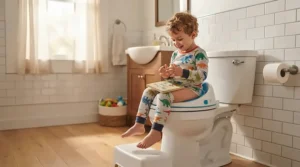
It’s a BPA-free, contoured plastic seat with non-skid edges and built-in handles. The sensible way to think about handles for balance is that they give your child something to hold while they plant their feet, relax, and trust the seat. A toddler who isn’t gripping the rim is a toddler who isn’t tense, which tends to help bowel movements, too.
This is a straightforward pick for budget-conscious parents who want a stable, uncomplicated seat. Its biggest asymmetry is fit. Reviewers praise the secure hold, easy cleaning, and value, and say the handles give extra security. However, a couple note it may not fit all toilet shapes, and one flatly says it isn’t suited to round seats. Measure your bowl before ordering.
Note that a hook for hanging is sold separately, so factor in a few extra dollars if you want one.
Pros:
- ✅ Built-in handles for stability
- ✅ BPA-free contoured design with non-skid edges
- ✅ Very low cost compared to alternatives
Cons:
- ❌ Fit complaints on some bowl shapes
- ❌ Hook isn’t included
Plan on under C$25. It’s excellent value if your toilet shape matches.
7. Summer by Ingenuity My Size Potty Pro — realistic floor potty with a removable topper
The standout is psychological: it looks and feels like a real toilet.
It’s a floor potty designed to resemble an adult toilet, with a removable topper (a transition ring) that fits onto the family toilet later. There’s even a storage compartment in the tank for books and wipes. In practice, this suits kids who respond to “just like Mommy and Daddy’s” and who need floor-level confidence before the big leap.
The topper is the connection to toilet training seat inserts. Think of the floor potty as the training wheels and the topper as the moment you take them off. The trade-off is that you pay for a large item and store it, and you’re likely to use the topper only after a stretch of floor-potty use.
On a Canadian retailer’s page, reviewers praise the realistic look and the removable topper, though one parent said their child still preferred the floor potty to the topper for now. Some listed reviews were collected as part of a promotion, so weigh them accordingly.
Pros:
- ✅ Realistic toilet look builds enthusiasm
- ✅ Removable topper for the adult toilet
- ✅ Tank storage for books and wipes
Cons:
- ❌ Bulky to store in small bathrooms
- ❌ Children may stay loyal to the floor potty
Expect roughly C$40-C$65 at the time of research. Check current price, since variations in colour and retailer are common.
Top 7 Specs Compared
| Product | Padding | Grip Features | Fit Note | Best For |
|---|---|---|---|---|
| BabyBjörn Toilet Training Seat | None (hard) | Rim-grip, no side handles | Adjusts via dial | Travel and multi-toilet homes |
| Upseat Soft-Sit Potty Training Seat | Full foam | Backrest | Anti-slip base | Comfort-first kids |
| Mommy’s Helper Contoured Cushie Step Up | Thick padding | Moulded handles plus steps | Not for square bowls | Short toddlers |
| Mommy’s Helper Contoured Cushie Tushie | 3 cm padding | Lift handle only | Round and most elongated | Budget padding |
| Munchkin Arm & Hammer Multi-Stage 3-in-1 Potty Seat | None (hard) | Side grips | Standard seats, not elongated | Floor-to-toilet path |
| Munchkin Sturdy Potty Seat | None (hard) | Built-in handles | Shape-dependent fit | Budget stability |
| Summer by Ingenuity My Size Potty Pro | None (hard) | Floor-potty design | Topper fits adult toilet | “Real toilet” fans |
The pattern here is clear: padding and handles rarely arrive together, and only the Mommy’s Helper Contoured Cushie Step Up pairs both. If you want grip without spending much, the Munchkin Sturdy Potty Seat is the cheapest route. Comfort-first families should compare the Upseat Soft-Sit Potty Training Seat against the Mommy’s Helper Contoured Cushie Tushie, then decide whether Canadian manufacturing or cost matters more.
Potty Training Transition Tips: A Practical Usage Guide
Buying the seat is the easy part. Using it well is where most families stumble, and none of this appears on a retailer’s product page.
Before day one:
- Do the wiggle test. Place the seat on the toilet and push it side to side. If it shifts, readjust or choose another model before your child ever sits on it.
- Find a home for it. Hang it on a hook or set it somewhere reachable, so the seat becomes part of your child’s routine rather than a hurdle.
- Add foot support. The Canadian Paediatric Society’s toilet learning guide points out that children feel steadier on a potty chair than on a bare toilet, and recommends a toilet seat adapter plus a footstool if you skip the potty. Dangling feet make everything harder, especially bowel movements.
The first week:
- Start with sitting practice fully clothed, then bottoms off, for a minute or two after meals.
- Keep sessions short and relaxed. Stay home for the first few days, and never force it.
- Praise the attempt, not just the result.
Ongoing maintenance:
- Wipe the seat after each use and do a deeper clean daily with mild soap.
- Re-check fit weekly, particularly for adjustable-dial or friction designs.
- Dry foam and padded surfaces fully before storing.
Common first-30-day mistakes:
- Switching seats mid-training because of a single accident
- Asking a child to use an unstable seat “just for now”
- Skipping the stool
These potty training transition tips are boring on purpose. Consistency beats cleverness every time.
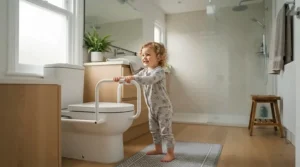
Real-World Scenarios: Matching a Potty Seat for Toilet Training to Your Home
Specs mean nothing without a bathroom to put them in. Here are three profiles, with reasoning.
Scenario 1: The two-bathroom house with frequent grandparent visits. Budget: up to C$65. Frequency: daily at home, weekly elsewhere. The BabyBjörn Toilet Training Seat is the logical match because the dial re-adjusts to a different toilet quickly, and the hang-up handle makes it easy to carry in a tote bag. Its hard surface is easy to wipe down before and after visits.
Scenario 2: The condo with one bathroom and zero storage. Budget: under C$50. Frequency: constant, since everyone shares the toilet. A fold-flat design such as the Mommy’s Helper Contoured Cushie Step Up removes the separate stool from the equation, and its handles help a short toddler climb and steady themselves. If space is still tight, the Mommy’s Helper Contoured Cushie Tushie at under C$25 has a wall hook and a thin profile.
Scenario 3: The cottage family and road-trip regulars. Budget: under C$40. Frequency: weekends and holidays. Here, the lightweight Munchkin Sturdy Potty Seat earns its place: handles for stability, cheap enough to leave at the cottage, and simple to clean. The Upseat Soft-Sit Potty Training Seat is the upgrade if a nervous child needs padding and a backrest to feel secure in an unfamiliar bathroom.
Notice how the best choice shifted with the home, not the product ranking. That’s the point of matching equipment to your life instead of chasing one universal winner.
Problem → Solution Guide: Fixing Common Potty Seat Headaches
Toilet learning has predictable bumps. The City of Toronto’s toilet training guidance reminds parents that accidents are normal for a year or more after starting, so setbacks aren’t failures. Here are the usual culprits and what to try.
Problem 1: “My child is afraid of falling in.”
Solution: Choose a narrower opening and a model with a firm fit. The BabyBjörn Toilet Training Seat keeps its grip, and the Munchkin Sturdy Potty Seat gives something to hold. Let your child press on the seat first to prove it doesn’t move.
Problem 2: “The seat is too cold or hard.”
Solution: A foam or padded design like the Upseat Soft-Sit Potty Training Seat or Mommy’s Helper Contoured Cushie Tushie takes the chill out. A quick warm-water rinse on a hard seat also helps.
Problem 3: “We have splash disasters.”
Solution: Check splash guard height before buying, and teach boys to sit well back. Reviewers of several models flag that guards help but don’t make aiming irrelevant.
Problem 4: “Everything’s fine until a bowel movement.”
Solution: Add a stool for foot support. The CPS guide notes that poor foot support can make passing a stool harder. If pain persists, consult your child’s doctor.
Problem 5: “My child refuses to use the toilet insert.”
Solution: Go back a step. A floor potty like the Munchkin Arm & Hammer Multi-Stage 3-in-1 Potty Seat or the Summer by Ingenuity My Size Potty Pro gives a gentler restart without feeling like failure.
How to Choose a Potty Seat for Toilet Training
Follow these six steps and you’ll avoid most buyer’s remorse.
- Measure your toilet first. Measure from the bolt holes to the front of the bowl. About 42 cm (16.5 in) usually means round, and about 47 cm (18.5 in) means elongated. Fit comes before everything else.
- Check your seat type. Soft-close, cushioned, or oddly shaped adult seats can cause problems. Munchkin’s care guidance, for instance, warns against using its insert on a cushioned adult seat.
- Decide on padding. Padded potty seats reward sensitive kids but need more careful cleaning. Hard plastic wipes clean fast.
- Look for grip. Handles for balance help most toddlers, but make sure they’re grips and not just lift handles.
- Think about height. If your child can’t climb up alone, a built-in step or separate stool is mandatory.
- Plan for storage and travel. A hook, fold-flat design, or light weight makes daily life smoother.
A final tip: ask whether your child is actually ready. The CPS guide describes readiness signs such as showing interest in the potty and sitting steadily. A great seat can’t fix a child who isn’t there yet.
Toilet Seat Fit Compatibility: Round, Elongated, and the Odd Ones Out
Here’s the unglamorous truth: toilet seat fit compatibility decides whether a seat feels secure or sketchy, and most product pages bury this detail.
Standard bowls fall into two shapes. Plumbing guides put round seats at about 42 cm (16.5 in) and elongated at about 47 cm (18.5 in), measured from the bolt holes. A third type, the compact-elongated bowl, has an oval shape but a near-round length, so measure carefully rather than assuming.
Why this matters for kids: shorter bowls can feel easier to reach and sit on without scooting forward, which is one reason many parents find potty seats work well on round toilets. Elongated bowls give more room but leave a bigger gap if the insert is built for round.
Real examples show how varied fit claims are:
- The Munchkin Arm & Hammer Multi-Stage 3-in-1 Potty Seat is described by one retailer as suited to standard seats but not properly elongated ones.
- The Mommy’s Helper Contoured Cushie Tushie is listed as fitting standard round and most elongated seats.
- The Mommy’s Helper Contoured Cushie Step Up is described as unsuitable for square toilets.
- The BabyBjörn Toilet Training Seat relies on its dial to adapt to different bowls.
Before buying, measure the bowl, note the shape, and check for tank clearance, since a closely mounted tank can interfere with larger seats. When in doubt, favour an adjustable design.
Padded Potty Seats vs Hard Plastic: Which Is Better?
Neither wins outright. Each solves a different problem.
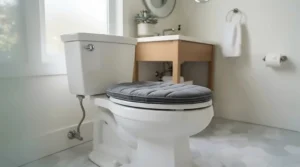
Padded potty seats such as the Upseat Soft-Sit Potty Training Seat, the Mommy’s Helper Contoured Cushie Tushie, and the Mommy’s Helper Contoured Cushie Step Up are warmer and softer. They win with kids who object to cold plastic, who sit for a long time, or who are physically small. They also give kids a gentler first impression of the big toilet.
The cost is cleaning. Foam and vinyl-wrapped padding need prompt wiping, thorough drying, and replacement if they crack or absorb odours. Over a long training period, wear matters more than it does with moulded plastic.
Hard plastic such as the BabyBjörn Toilet Training Seat and the Munchkin Sturdy Potty Seat is easy to wipe or rinse and tends to last through siblings. Its downside is comfort, and some children simply refuse it.
My read on the evidence: if your child shows any resistance to sitting, try padding first. If you have two or three kids coming up behind this one, hard plastic likely lasts longer. And if you want both, the Mommy’s Helper Contoured Cushie Step Up adds padding and handles in one piece. Whatever you choose, secure potty seats for toddlers depend on fit and grip more than softness, so don’t trade stability for comfort.
Secure Potty Seats for Toddlers: Do Handles for Balance Actually Matter?
Short answer: often, yes, but not always.
Handles for balance give small hands an anchor. A toddler who grips something plants their feet, steadies their trunk, and stops tensing every muscle. That’s especially useful for bowel movements, where relaxation is half the battle. Models such as the Munchkin Sturdy Potty Seat and the Mommy’s Helper Contoured Cushie Step Up have real grips, and the Munchkin Arm & Hammer Multi-Stage 3-in-1 Potty Seat offers side grips on its floor-potty form.
But there are caveats. A handle that’s too high or too far forward won’t suit small arms. Handles also make a seat bulkier, which is awkward in tiny bathrooms. And a lift handle, as on the Mommy’s Helper Contoured Cushie Tushie, helps parents, not toddlers.
Other features worth weighing:
- Splash guards: useful, especially for boys, but height varies.
- Anti-slip bases and rubber edging: matter more than handles in many cases, since a sliding seat undermines everything.
- Hanging hooks: underrated, since a seat that’s easy to store is a seat that’s actually used.
- Deodorizer discs and licensed characters: nice extras that reviewers rate as modest at best.
Your priority order should be fit, then stability, then comfort, then extras.
Toilet Training Seat Inserts vs Floor Potties vs Built-In Seats
Which route suits your child? Here’s how the three main approaches compare.
| Option | Pros | Cons | Best For |
|---|---|---|---|
| Toilet training seat inserts (e.g., BabyBjörn Toilet Training Seat, Munchkin Sturdy Potty Seat) | Direct path to the family toilet; no emptying; compact | Fit-dependent; some kids feel unsteady | Confident toddlers and busy parents |
| Floor potties (e.g., Summer by Ingenuity My Size Potty Pro) | Feet on the ground; very stable; portable | Must be emptied and cleaned; bulky | First attempts and anxious children |
| Hybrids (e.g., Munchkin Arm & Hammer Multi-Stage 3-in-1 Potty Seat) | Grows with your child; two uses in one | Fit limits on elongated bowls; more parts | Families wanting flexibility |
The table makes the trade-off obvious: floor potties feel safest, while inserts are tidier long-term. Hybrids try to give you both, though the Munchkin Arm & Hammer Multi-Stage 3-in-1 Potty Seat has its elongated-bowl limitation. Since the Canadian Paediatric Society’s guidance describes a potty chair as steadier for many children while also endorsing a seat adapter plus stool, neither path is wrong. Choose based on your child’s confidence and your cleaning tolerance.
Common Mistakes When Buying a Potty Seat for Toilet Training
Most regrets come from the same handful of errors.
Mistake 1: Skipping measurements. A beautiful seat that wobbles is worse than a plain one that fits. Always check bowl shape.
Mistake 2: Assuming handles mean grips. Check whether handles are for your child or for lifting.
Mistake 3: Buying before your child is ready. HealthLink BC explains that children must be both physically and emotionally ready, and that household stress can delay readiness. Equipment can’t rush development.
Mistake 4: Ignoring return policies. Hygiene products often can’t be returned, and at least one retailer’s page for a padded seat says so plainly. Know the rules before you buy.
Mistake 5: Forgetting foot support. Even the best seat leaves dangling feet unsupported. Budget for a stool or choose a design with built-in steps.
Mistake 6: Overbuying. You rarely need the fanciest model. A well-fitting C$25 seat beats a poorly fitting C$65 one.
If you remember only one thing: fit and stability come first, extras last.
Long-Term Cost & Maintenance
A potty seat for toilet training has a short working life, so the real question is cost per month of use and whether it survives to a second child.
| Tier | Product | Price Range (CAD) | Value Verdict | Best For |
|---|---|---|---|---|
| Budget | Munchkin Sturdy Potty Seat | Under C$25 | Strong value if it fits | Simple grip on a budget |
| Budget | Mommy’s Helper Contoured Cushie Tushie | Under C$25 | Good comfort for the cost | Padding on a budget |
| Mid-range | Munchkin Arm & Hammer Multi-Stage 3-in-1 Potty Seat | C$30-C$50 | Replaces two purchases | Floor-to-toilet progression |
| Mid-range | Mommy’s Helper Contoured Cushie Step Up | C$40-C$60 | Saves buying a stool | Short toddlers |
| Mid-range | Summer by Ingenuity My Size Potty Pro | Roughly C$40-C$65 | Best for hesitant kids | “Real toilet” appeal |
| Premium | Upseat Soft-Sit Potty Training Seat | C$35-C$50 | Comfort plus Canadian made | Nervous sitters |
| Premium | BabyBjörn Toilet Training Seat | Around C$45-C$65 | Durable and adaptable | Multi-child, multi-toilet homes |
Prices are ranges and may vary; check current price before purchasing. The cheapest options win on pure cost per month, but the BabyBjörn Toilet Training Seat spreads its price across siblings thanks to a hard, wipe-clean build. Meanwhile, the Mommy’s Helper Contoured Cushie Step Up earns back its price if you’d otherwise buy a stool.
For upkeep, wipe daily, deep-clean weekly, and re-check fit often. Replace padded seats at the first sign of cracking or lingering odour. Hard seats last longer, but replace any that crack, since sharp edges or weak points are a safety concern.
Frequently Asked Questions
❓ Are padded potty seats easier to keep clean than plastic ones?
❓ What's the best potty seat for toilet training on an elongated toilet in Canada?
❓ Do I need a step stool with a potty seat for toilet training?
❓ How much should I spend on a potty seat for toilet training?
❓ Can toilet training seat inserts be used on a soft-close or cushioned toilet seat?
Conclusion
Choosing a potty seat for toilet training comes down to three honest questions: does it fit your toilet, does your child feel secure on it, and will you actually keep it clean? Everything else is garnish.
If I had to sketch the shortlist from the research: the BabyBjörn Toilet Training Seat for adaptable fit, the Mommy’s Helper Contoured Cushie Step Up for kids who need steps and handles for balance, the Upseat Soft-Sit Potty Training Seat for comfort-first families (with the caveat that independent reviews are thin), and the Munchkin Sturdy Potty Seat for the tightest budgets. Families who want a gentler start should look at the Munchkin Arm & Hammer Multi-Stage 3-in-1 Potty Seat or the Summer by Ingenuity My Size Potty Pro. The Mommy’s Helper Contoured Cushie Tushie rounds things out as a low-cost padded option.
Remember that equipment supports the process, but patience drives it. Follow your child’s cues, keep sessions calm, and treat accidents as information, not defeat. And if your child still isn’t using the toilet by age four, the Canadian Paediatric Society suggests talking with your doctor.
✨ Ready to make toilet training a little easier?
🚽 Tap any highlighted product name above to check current pricing and availability. The right seat can turn a daunting milestone into a confident step your child is proud of. Happy training!
Recommended for You
- 3-in-1 Potty Chairs For Small Bathrooms: 7 Best Picks 2026
- Potty Chairs For Toddlers: 7 Best Picks For Canadian Families (2026)
- Two-Step Stool For Bathroom Sink And Toilet: 7 Best Picks 2026
Disclaimer: This article contains affiliate links. As an Amazon Associate, I earn from qualifying purchases. If you purchase products through these links, we may earn a small commission at no additional cost to you.
✨ Found this helpful? Share it with your friends! 💬🤗
