
In This Article
When you’re preparing for your baby’s arrival, one question keeps Canadian parents awake at night: should you invest in a bassinet, a crib, or both? The bassinet vs crib for newborn decision isn’t just about budget—it’s about safety, convenience, and what actually works in your home during those exhausting first months.
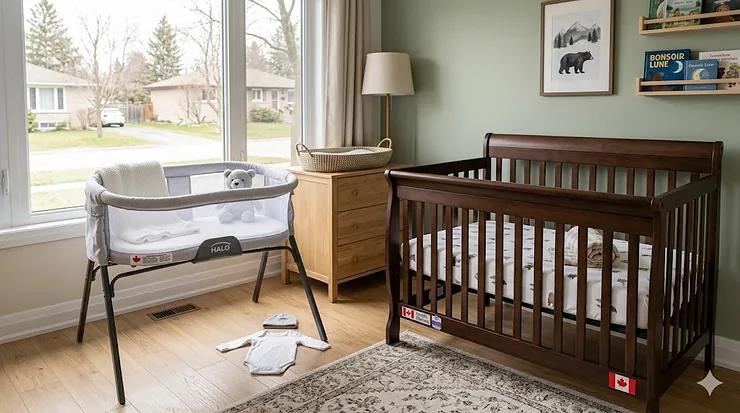
Here’s what most first-time parents don’t realize until they’re knee-deep in 3 AM feedings: bassinets and cribs serve fundamentally different purposes during different developmental stages. A bassinet offers portability and bedside convenience for the first few months, keeping your newborn within arm’s reach for those frequent night feedings that are essential for breastfeeding success. Meanwhile, a crib provides long-term value, accommodating your child from birth through toddlerhood—potentially saving you hundreds of dollars in CAD over time.
According to Health Canada’s guidelines, both products must meet strict safety regulations under the Cribs, Cradles and Bassinets Regulations (SOR/2016-152), but they’re designed for different stages of infant development. Understanding when to transition from bassinet to crib—typically when your baby can roll over or reaches the weight limit, whichever comes first—is crucial for maintaining a safe sleep environment throughout those critical first months.
In this comprehensive guide, I’ll walk you through seven exceptional products available on Amazon.ca, break down the real-world pros and cons of each option, and help you make an informed decision based on your family’s specific needs, budget in CAD, and living situation. Whether you’re in a Toronto condo with limited space or a spacious Edmonton home, you’ll find practical advice tailored to Canadian parents navigating this important choice in 2026.
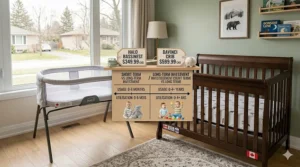
Quick Comparison: Bassinet vs Crib at a Glance
| Feature | Bassinet | Crib |
|---|---|---|
| Age Range | Birth to 4-6 months | Birth to 2-3 years |
| Weight Limit | Typically 7-10 kg (15-22 lbs) | Up to 15 kg (33 lbs) or 90 cm height |
| Portability | High – wheels, compact, foldable | Low – stationary, heavy |
| Price Range (CAD) | $80-$400 | $150-$800+ |
| Space Required | Small – fits beside bed | Large – dedicated nursery space |
| Canadian Regulations | Must meet SOR/2016-152 standards | Must meet SOR/2016-152 standards |
| Transition Timing | When baby rolls over or hits weight limit | When child climbs out or reaches 90 cm |
| Best For | Room sharing, portability, first 6 months | Long-term investment, permanent nursery |
💬 Just one click — help others make better buying decisions too! 😊
Top 7 Bassinet and Crib Options: Expert Analysis for Canadian Parents
1. HALO BassiNest Swivel Sleeper 3.0
The HALO BassiNest Swivel Sleeper 3.0 remains the gold standard for bedside bassinets in Canada, and for good reason—its 360-degree swivel base and adjustable height make it uniquely suited to Canadian bedrooms where space optimization matters. With height adjustability across multiple positions, this bassinet fits flush against beds of virtually any height, from low platform frames popular in modern Toronto condos to traditional higher bed frames common in older homes across the Prairies.
The breathable mesh walls provide excellent airflow crucial for safe sleep, while the lowering wall feature allows parents recovering from C-sections to lift their baby without straining—a feature that physiotherapists across Canada specifically recommend. Canadian parents consistently praise its stability on hardwood and carpeted floors alike, and the rotating base means you’re not doing that awkward bed-edge lean during 2 AM diaper changes when your core strength is still recovering.
What the spec sheet won’t tell you: the mesh sides also let you visually check on your baby without getting out of bed, reducing the sleep disruption that comes from constant checking. This matters more than you’d think during Canadian winters when leaving your warm bed feels especially brutal. The bassinet’s weight capacity of approximately 9 kg (20 lbs) or until the baby can push up on hands and knees gives most Canadian families 4-5 months of use, though larger babies may outgrow it sooner.
Customer feedback from Canadian buyers specifically notes that assembly takes about 15 minutes and requires no tools—a significant advantage when you’re exhausted and dealing with the mental fog of new parenthood. Some parents mention the price point feels steep, but the resale value on Canadian marketplaces like Facebook Marketplace and Kijiji remains strong, typically recovering 40-50% of the original purchase price.
Pros:
✅ 360-degree swivel reaches baby from any bed position
✅ Height-adjustable to fit Canadian bed frame variations
✅ Lowering wall ideal for C-section recovery (common concern in Canada)
Cons:
❌ Higher price point in the $300-$400 CAD range
❌ 4-5 month maximum use before transition required
Best For: Canadian parents prioritizing bedside access and C-section recovery, those with varying bed heights, families planning to resell after use.
Price Range: Around $300-$400 CAD on Amazon.ca, representing the premium end of bassinet pricing but justified by the engineering and safety features.
2. Newton Baby Bassinet & Bedside Sleeper
The Newton Baby Bassinet & Bedside Sleeper brings a uniquely breathable design that addresses one of Canadian parents’ top concerns: safe sleep in varying room temperatures. Canadian homes experience dramatic temperature fluctuations—from overheated rooms during Prairie winters when furnaces run constantly, to cooler coastal nights in BC—and this bassinet’s completely washable, breathable mattress adapts to these conditions without compromising safety.
The wood frame construction provides superior stability compared to the all-fabric bassinets flooding the market, and the dual-layer removable cover system means you can strip it down for washing without complicated disassembly. Canadian parents dealing with inevitable spit-ups and diaper blowouts appreciate that every component—including the mattress itself—can go through a washing cycle, a practical feature rarely found in this price range.
The adjustable height feature accommodates most Canadian bed configurations, and the infant access opening on one side allows parents to reach their baby easily without the full wall lowering mechanism found on pricier models. This simplified design actually proves more durable over time according to customer feedback from Canadian buyers who’ve used it for multiple children.
What distinguishes this bassinet in the Canadian market is the company’s emphasis on breathability testing—the mattress is scientifically proven to be 100% breathable, meaning even if a baby rolls face-down (which shouldn’t happen at bassinet age but provides peace of mind), airflow continues. This matters enormously during those first months when SIDS risk peaks and Canadian parents lose sleep worrying about safe sleep positioning.
Canadian customer reviews specifically note the bassinet performs well in both heated and cooler environments, maintaining baby comfort without the sweating issues that plague foam mattress bassinets during our variable indoor climates. The weight limit of approximately 9 kg (20 lbs) aligns with standard bassinet ranges.
Pros:
✅ Completely washable including mattress—critical for Canadian cleanliness standards
✅ Breathable design suits variable Canadian indoor temperatures
✅ Wood frame provides superior stability and durability
Cons:
❌ Higher price point around $350-$450 CAD
❌ Less portable than all-fabric designs
Best For: Canadian families prioritizing washability, eco-conscious parents, homes with temperature fluctuations, parents planning multiple children.
Price Range: Expect to invest $350-$450 CAD, positioning it as a premium option that justifies the cost through superior hygiene and temperature regulation.
3. Maydolly 3-in-1 Baby Bassinet Bedside Crib
The Maydolly 3-in-1 Baby Bassinet Bedside Crib represents exceptional value in the Canadian bassinet market, delivering features typically found on models costing $100-$150 more. The 6-height adjustment system accommodates everything from low IKEA bed frames common in Canadian urban apartments to traditional bed heights, and the trapezoidal cradle design provides enhanced stability that Canadian safety-conscious parents appreciate.
The airflow mesh on all four sides ensures consistent ventilation regardless of which wall you position against your bed—a flexibility that matters in smaller Canadian bedrooms where furniture arrangement options are limited. The lockable castors allow you to wheel the bassinet from bedroom to living room during those early weeks when you want baby nearby during evening relaxation, then lock it firmly beside your bed at night.
What Canadian buyers consistently praise is the storage basket underneath that actually holds substantial items—not the token shallow baskets found on budget models. You can store a full package of diapers, wipes, burp cloths, and middle-of-the-night feeding supplies, reducing those stumbling trips to the nursery during feeding sessions. This matters more during Canadian winters when you want to minimize time out from under your duvet.
The bassinet transitions through three modes: standalone crib, bedside sleeper, and gentle rocking mode. The rocking function uses a simple button rotation system that takes seconds to engage—helpful when you have a fussy baby and need that gentle motion to extend their sleep another precious 20 minutes. Canadian parents note this feature proves especially valuable during the witching hour (5-8 PM) common in newborns.
Assembly takes approximately 20 minutes according to Canadian customer feedback, and the included instructions are clear with visual diagrams. The weight limit of approximately 9 kg (20 lbs) or until baby can roll over provides standard bassinet longevity.
Pros:
✅ Exceptional value under $200 CAD with premium features
✅ Substantial storage basket reduces nighttime trips to nursery
✅ 3-mode versatility extends usefulness across different scenarios
Cons:
❌ All-fabric construction less durable than wood frames
❌ Some assembly required (20 minutes)
Best For: Budget-conscious Canadian families, small bedroom spaces, parents wanting storage solutions integrated into sleep products.
Price Range: Around $150-$220 CAD, delivering premium features at mid-range pricing—exceptional value for Canadian buyers.
4. Graco Hadley 5-in-1 Convertible Crib with Drawer
The Graco Hadley 5-in-1 Convertible Crib with Drawer represents the ultimate long-term investment for Canadian families, converting from crib through toddler bed, daybed, and finally to a full-size bed. This means you’re potentially using the same piece of furniture from newborn through age 8-10, transforming the initial $400-$500 CAD investment into under $5 per month of use over a decade.
The GREENGUARD Gold certification ensures the crib meets strict chemical emission standards—critically important for Canadian parents concerned about indoor air quality during our long winters when homes stay sealed tight for months. The four adjustable mattress heights accommodate your baby’s development: highest setting for newborns when you’re bending over constantly for middle-of-the-night changes, dropping progressively as baby gains mobility to prevent climbing attempts.
The integrated drawer underneath provides substantial storage that Canadian parents in condos and smaller homes desperately need—think extra fitted sheets, sleep sacks sized for different seasons, and that collection of swaddles you’re trying out. This eliminates the need for a separate dresser in the nursery, potentially saving hundreds in CAD and precious square footage.
What most buyers overlook until they’re living with it: the conversion capability means you avoid the jarring transition many Canadian toddlers experience when moving from crib to “big kid bed.” You simply remove the front panel and add the included toddler guardrail, maintaining the familiar sleep environment while accommodating your child’s growing independence. This continuity often results in smoother sleep transitions according to Canadian pediatric sleep consultants.
The crib accommodates standard Canadian crib mattresses measuring 28 inches by 52 inches, and the requirement for gaps no larger than 3 cm between mattress and crib sides aligns perfectly with Health Canada regulations. Canadian customer feedback notes the crib’s substantial weight (approximately 35 kg when assembled) provides excellent stability—it doesn’t wobble or shift when an active toddler is bouncing inside, a common complaint with lighter cribs.
Pros:
✅ 5-stage conversion provides 8-10 years of use—exceptional CAD value
✅ GREENGUARD Gold certification for Canadian indoor air quality concerns
✅ Integrated storage drawer eliminates need for separate dresser
Cons:
❌ Requires standard crib mattress purchase (additional $150-$300 CAD)
❌ Heavy and challenging to move once assembled
Best For: Canadian families planning long-term use, smaller homes needing integrated storage, eco-conscious parents prioritizing low-emission furniture.
Price Range: Expect $400-$550 CAD depending on finish, with the per-year cost working out to approximately $50-$70 annually over a decade of use.
5. Delta Children Folding Portable Mini Crib
The Delta Children Folding Portable Mini Crib solves a uniquely Canadian challenge: grandparents across the country wanting safe sleep solutions for visiting grandchildren without dedicating an entire bedroom to baby furniture. This GREENGUARD Gold certified mini crib folds completely flat in under 30 seconds, stores in a closet between visits, and sets up just as quickly when the grandkids arrive.
The mini crib dimensions of approximately 24 inches by 38 inches make it significantly more compact than standard cribs, fitting comfortably in home offices, guest rooms, or even master bedrooms for families following Health Canada’s room-sharing recommendations for the first six months. The included 1.5-inch mattress meets Canadian safety standards, though many parents upgrade to a thicker mattress for enhanced comfort during extended use.
What Canadian buyers specifically appreciate is the portability across multiple use cases: it works as a primary sleep solution in small urban apartments, transitions to cottage use during summer months (common among Canadian families), and serves grandparent households across the country. The natural wood finish fits diverse décor styles from modern Vancouver condos to traditional Prairie farmhouses.
The two mattress height positions allow you to start with the higher setting for easier newborn access, then lower it around 4-5 months when baby gains rolling ability. Canadian parents note the crib’s weight of approximately 13 kg makes it manageable for one person to move between rooms or transport in an SUV to the cottage, unlike full-size cribs requiring two people and a truck.
The locking wheels provide stable positioning on both hardwood floors common in newer Canadian builds and carpet found in older homes. Customer feedback from Canadian buyers indicates the crib accommodates babies up to approximately 15 kg (33 lbs) or until they can pull themselves up to stand—typically around 12-15 months, making it a genuine long-term solution despite its compact footprint.
Pros:
✅ Folds flat for storage—ideal for Canadian grandparent homes
✅ Mini footprint fits Toronto/Vancouver apartment bedrooms
✅ GREENGUARD Gold certification with natural wood finish
Cons:
❌ Mini size means shorter lifespan than full-size cribs (12-15 months typical)
❌ Included mattress is thin—many upgrade for $50-$100 CAD
Best For: Canadian grandparents, small apartment dwellers, families with cottages needing portable solutions, multi-home families.
Price Range: Around $180-$250 CAD, offering exceptional value for the portability and dual-home usefulness common in Canadian family structures.
6. Baby Bassinet 3-in-1 Bedside Sleeper (Generic Amazon.ca Model)
The Baby Bassinet 3-in-1 Bedside Sleeper represents the budget-friendly entry point for Canadian parents wanting bedside sleeping without the $300+ investment of premium brands. Available widely on Amazon.ca under various brand names, these bassinets deliver core functionality—adjustable height, breathable mesh sides, and bedside attachment—at prices typically under $150 CAD.
The 7-height adjustment system accommodates the full range of Canadian bed configurations, from low platform beds to higher traditional frames, and the side-lowering mechanism allows the bassinet to function as both a standalone crib and bedside co-sleeper. The four-sided breathable mesh provides airflow crucial for safe sleep while allowing parents visual confirmation of baby’s position without getting up.
What you’re trading for the lower price point is durability and advanced features. Canadian customer reviews note that fabric quality is noticeably lighter than premium models, and the mattress padding is thinner, though it still meets Health Canada’s firmness requirements for safe infant sleep. The wheels are smaller and less robust, making the bassinet better suited to staying in one position rather than frequent room-to-room transport.
However, for families planning to use the bassinet for only 4-6 months before transitioning to a crib, this reduced durability is perfectly acceptable. You’re not looking for a multi-child heirloom piece—you want safe, functional bedside sleep during those first exhausting months, and these bassinets deliver exactly that for Canadian families on tighter budgets.
The storage basket underneath accommodates nighttime essentials, and the included mattress and fitted sheet mean you can set it up immediately upon arrival. Canadian parents specifically note that assembly takes 15-20 minutes and requires no tools beyond what’s included in the package.
Pros:
✅ Budget-friendly under $150 CAD makes bassinet sleeping accessible
✅ 7-height adjustment fits all Canadian bed configurations
✅ Includes mattress and sheet—ready to use immediately
Cons:
❌ Lighter fabric durability—best for single-child use
❌ Thinner mattress padding compared to premium models
Best For: Budget-conscious Canadian families, single-child use, parents planning short bassinet usage before crib transition.
Price Range: Typically $100-$180 CAD, delivering essential features at an accessible price point for Canadian families managing tight budgets.
7. Dream On Me Aden 4-in-1 Convertible Mini Crib
The Dream On Me Aden 4-in-1 Convertible Mini Crib bridges the gap between full-size convertible cribs and portable mini cribs, offering conversion capabilities in a footprint that fits Canadian urban living spaces. The crib converts from mini crib to mini daybed and finally to twin-size bed, providing 5-7 years of use in approximately 60% of the floor space required by full-size models.
The GREENGUARD Gold and BSA certifications confirm the crib meets both chemical emission standards and sustainable forestry requirements—important considerations for eco-conscious Canadian parents. The sustainable pinewood construction with non-toxic finish aligns with growing Canadian preferences for environmentally responsible nursery furniture.
The three mattress height positions allow you to start high for newborn convenience, lowering progressively as baby develops mobility. Canadian parents in condos specifically appreciate that the mini crib fits through standard doorways more easily than full-size cribs, simplifying moves and room rearrangements common in urban Canadian living.
What makes this crib especially clever for Canadian families is the twin-size bed conversion. Rather than purchasing a separate toddler bed and then a twin bed (two additional furniture purchases totaling $400-$800 CAD), you’re using the same frame throughout early childhood. Simply add a standard twin mattress and the conversion rail (sold separately for approximately $80-$100 CAD), and you’ve extended the furniture’s lifespan through age 6-8.
The white finish provides the crisp, clean aesthetic popular in modern Canadian nurseries, and the compact dimensions of approximately 38 inches by 24 inches allow for more flexible room arrangements. Canadian customer feedback notes the crib’s weight of approximately 18 kg makes it manageable for one person to assemble and move, unlike full-size cribs requiring help.
Pros:
✅ Convertible design provides 5-7 years of use at mini footprint
✅ GREENGUARD Gold + BSA certifications for eco-conscious Canadians
✅ Fits through standard doorways—important for urban Canadian mobility
Cons:
❌ Mini size means less growing room than full-size cribs
❌ Conversion kit sold separately (additional $80-$100 CAD)
Best For: Canadian condo dwellers, eco-conscious families, parents wanting conversion capability without full-size footprint.
Price Range: Around $220-$320 CAD for the crib, with conversion kit adding $80-$100 CAD—still exceptional value for 5-7 years of use.
Making Your Decision: A Canadian Parent’s Guide to Choosing Between Bassinet and Crib
The bassinet vs crib for newborn choice ultimately hinges on three factors that matter specifically to Canadian families: your living space, your budget in CAD over time, and your lifestyle during those first six months.
Start With Your Space Reality
Canadian urban housing reality means many families are working with limited square footage, especially in Toronto, Vancouver, and Montreal. If your bedroom can accommodate a bassinet beside your bed but a crib would force you to set up a separate nursery down the hall, the bassinet becomes essential for following Health Canada’s room-sharing recommendations. Room sharing for the first six months has been shown to reduce SIDS risk, and the convenience of having baby within arm’s reach during those 2-3 hour feeding cycles cannot be overstated when you’re operating on fractured sleep.
Conversely, if you have a spacious bedroom that can accommodate a crib beside your bed, or if you have a nursery directly adjacent to your bedroom, starting with a crib makes financial sense. You’re investing $400-$600 CAD once instead of spending $150-$300 on a bassinet that you’ll use for 4-6 months, then another $400-$600 on a crib. That’s potentially $150-$300 in savings—enough to cover your first year of diapers or a quality baby monitor.
Calculate Real Cost Per Month
Here’s the calculation Canadian parents should run: A $300 bassinet used for 5 months costs $60 per month. A $500 convertible crib used for 3 years costs approximately $14 per month, dropping to under $7 per month if you use the conversion features through age 8. The per-month cost reveals that cribs deliver dramatically better value, but only if you have the space to position them for safe room-sharing during those critical first six months.
The hybrid approach many Canadian families take: purchase a quality convertible crib immediately (investing in the long-term solution), but also grab a budget bassinet in the $100-$150 range for bedside convenience during the first few months. This gives you the best of both worlds—the convenience during the exhausting newborn phase plus the long-term value of the crib—for a total investment of $500-$700 CAD instead of $800-$900 if you bought premium versions of both.
Consider Your Feeding Approach
If you’re planning to breastfeed, the convenience of a bedside bassinet becomes significantly more valuable during those first months when you’re feeding every 2-3 hours around the clock. Canadian lactation consultants consistently emphasize that minimizing sleep disruption helps establish and maintain milk supply, and the 30 seconds it takes to reach into a bedside bassinet versus 2-3 minutes of walking to a nursery, lifting baby from a crib, and walking back adds up to 30-45 minutes of additional sleep disruption per night across those 3-4 feedings.
Formula-feeding parents have more flexibility since feeding logistics are similar regardless of baby’s sleep location, though the convenience factor still matters during those exhausting early weeks. Many Canadian formula-feeding families find they’re comfortable with a crib in an adjacent nursery from day one, using a quality baby monitor to maintain awareness.
Climate Considerations Unique to Canada
Canadian homes face dramatic seasonal temperature variations that impact sleep product choices. During Prairie winters when indoor heating runs constantly, breathable mesh bassinets help prevent overheating. During summer months in non-air-conditioned homes common across much of Canada, that same breathability becomes crucial for comfortable sleep.
Convertible cribs with solid wood construction tend to regulate temperature more consistently than all-fabric bassinets, but they also require more careful attention to room temperature management. Health Canada recommends keeping nursery temperatures between 18-20°C (64-68°F), which many Canadian parents find challenging during the transitional seasons when home heating systems are either not yet running or have been shut down for the year.
Understanding Bassinet Weight Limits and Transition Timing
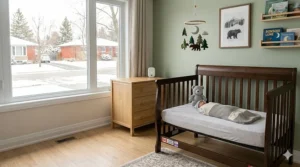
One of the most critical safety considerations Canadian parents face is recognizing when to transition from bassinet to crib. Health Canada is explicit: you must move your baby to a crib when they can roll over OR when they reach the manufacturer’s weight limit, whichever comes first. This isn’t a suggestion—it’s a safety imperative.
Why Rolling Ability Triggers Immediate Transition
The moment your baby can roll from back to stomach (typically occurring between 4-6 months), they pose new risks in a bassinet. Bassinets have lower sides than cribs specifically because they’re designed for newborns who cannot roll, sit, or pull themselves up. Once your baby gains that rolling ability, those lower sides become a potential climbing surface, and the smaller footprint of bassinets makes them less stable if baby’s weight shifts toward the edge.
Canadian parents often ask whether they can continue using a bassinet if their baby can roll but hasn’t actually attempted to climb. The answer from Health Canada is clear: no. Rolling ability indicates developmental readiness for increased mobility, and babies can surprise you by attempting new physical feats without warning. The first time you discover your baby has rolled shouldn’t be when they’ve also managed to tip a bassinet.
Weight Limits Vary by Model—Check Yours
Most bassinets sold in Canada have weight limits between 7-10 kg (15-22 lbs), but this varies by manufacturer. Some premium models like the HALO BassiNest accommodate up to 9 kg (20 lbs), while budget models may have limits as low as 7 kg (15 lbs). Canadian babies typically reach these weights between 3-6 months depending on birth weight and growth trajectory, so checking your specific model’s limit is essential.
Here’s what many Canadian parents don’t realize: the weight limit isn’t about the bassinet collapsing under baby’s weight—these products are tested well beyond their stated limits. The weight limit correlates with the developmental stage at which babies typically gain the mobility that makes bassinets unsafe. A 9 kg baby has the core strength and coordination to potentially shift their weight in ways that create tipping risks in the smaller bassinet footprint.
Crib Transition Signs Beyond Weight and Rolling
Health Canada specifies that cribs should be used until your child can climb out on their own OR reaches 90 cm (35 inches) in height, whichever comes first. Most Canadian toddlers hit the climbing milestone around 18-24 months, though some particularly adventurous children start earlier.
The 90 cm height limit exists because at that height, even with the mattress in its lowest position, a child’s centre of gravity when standing in the crib creates a tipping hazard. Canadian parents should measure their child’s height every few months once they reach 80 cm to stay ahead of this transition, as the shift from crib to toddler bed should happen before climbing attempts, not after an injury.
Real-World Scenarios: Which Option Fits Your Canadian Family?
Let me walk you through three common scenarios among Canadian families to illustrate how the bassinet vs crib for newborn decision plays out in practice.
Scenario 1: Toronto Condo Family—Limited Space, First Baby
Avery and Marcus live in a 650-square-foot one-bedroom condo in downtown Toronto. Their bedroom measures approximately 3 metres by 3.5 metres, already filled with a queen bed, two nightstands, and a dresser. They’re planning to breastfeed and want baby close for those frequent night feedings during Canadian winters when leaving bed feels especially brutal.
Their Solution: They purchased the Maydolly 3-in-1 Baby Bassinet for approximately $180 CAD, positioning it beside Avery’s side of the bed. The bassinet’s compact footprint fits in the narrow space between bed and wall, and the storage basket holds all their nighttime feeding supplies—eliminating trips to the living room changing station during 2 AM sessions. They also bought the Delta Children Folding Portable Mini Crib for $220 CAD, which they keep set up in the living room for daytime naps and will move to the bedroom when baby outgrows the bassinet around month 5.
The Outcome: Total investment of $400 CAD gives them bedside sleeping for the recommended first six months, then a proper crib solution through toddlerhood. The mini crib will eventually move to a future dedicated nursery if they upsize their living space, or fold away when not needed. This hybrid approach cost them less than purchasing a single premium bassinet or full-size crib while perfectly addressing their space constraints.
Scenario 2: Calgary Suburban Family—Dedicated Nursery, Multiple Children Planned
Jordan and Priya live in a suburban Calgary home with a dedicated nursery adjacent to their bedroom. They’re planning to have 2-3 children over the next 5 years and want furniture that will serve multiple kids. They’ve allocated $800 CAD to their crib budget.
Their Solution: They invested in the Graco Hadley 5-in-1 Convertible Crib at $480 CAD and the Newton Baby Bassinet at $380 CAD. The bassinet stays in their bedroom for the first 4-5 months providing easy access during Calgary’s frigid winter nights when crossing to the nursery means temperature-shocking a newborn. The convertible crib is set up in the nursery from day one, used for daytime naps initially, then becomes the full-time sleep location once baby outgrows the bassinet.
The Outcome: Total investment of $860 CAD (slightly over their $800 budget but justified by the convertible crib’s 8-10 year lifespan) gives them optimal convenience during the newborn phase plus long-term furniture value. The Newton bassinet’s washability means it stays pristine for baby #2 and potentially #3, while the Graco crib converts all the way through to full-size bed, eliminating future furniture purchases. Per-child cost drops dramatically with multiple kids, making the premium initial investment worthwhile for Canadian families planning larger families.
Scenario 3: Vancouver Island Extended Family—Grandparents Helping
Linda and Tom on Vancouver Island are welcoming their first grandchild, with their daughter and son-in-law planning extended visits during parental leave. They want a safe sleep solution without converting a bedroom into a permanent nursery, since visiting grandchildren will range from newborn through toddler age as more grandkids arrive.
Their Solution: They purchased the Delta Children Folding Portable Mini Crib for $220 CAD, which folds completely flat and stores in their bedroom closet between visits. They also bought a budget Baby Bassinet 3-in-1 for $130 CAD that they keep assembled in the guest room for when very young babies visit.
The Outcome: Total investment of $350 CAD provides sleeping solutions from newborn through toddler age, accommodating overnight visits from grandchildren at various developmental stages. The mini crib sets up in under 60 seconds when needed, stores invisibly when not in use, and will serve multiple grandchildren over the next decade. This flexibility is exactly what Canadian grandparents need when family members are scattered across different cities or provinces and visits happen intermittently rather than continuously.
Common Mistakes Canadian Parents Make When Choosing Sleep Products
Mistake 1: Buying Based on Nursery Aesthetics Rather Than Safety Standards
I’ve watched countless Canadian parents fall in love with vintage cribs at antique markets or accept hand-me-down bassinets from relatives without verifying they meet current Health Canada regulations. Here’s the hard truth: cribs manufactured before September 1986 are illegal to sell in Canada for a reason—they don’t meet modern slat spacing requirements, and babies have died getting their heads trapped between widely-spaced slats.
Similarly, drop-side cribs—banned in Canada since December 2016—still circulate in second-hand markets. The mechanism that allows one side to lower can detach or malfunction, creating gaps where babies become trapped and suffocate. No amount of family sentimental value or Pinterest-worthy aesthetics justifies using sleep products that don’t meet current Canadian safety regulations outlined in SOR/2016-152.
Before accepting any used crib or bassinet, verify it includes the manufacturer’s label showing the production date and model number, then cross-reference against Health Canada’s recalls and safety alerts database to ensure it hasn’t been recalled. If the product lacks identifying labels or original assembly instructions, it should not be used—period.
Mistake 2: Underestimating How Quickly Babies Outgrow Bassinets
Canadian parents consistently overestimate how long they’ll use a bassinet, leading to frustration when their 4-month-old outgrows it sooner than expected. The bassinet necessity guide is simple: most babies outgrow bassinets between 4-6 months, with larger babies (those in the 75th percentile or higher for weight) often hitting limits by month 3-4.
If your baby was born at 4 kg (8.8 lbs) or larger—common among Canadian babies—they may reach the 9 kg bassinet weight limit by 3.5-4 months rather than the 5-6 months you were planning for. This compressed timeline means a $300 bassinet investment might serve you for only 14-16 weeks, working out to over $18 per week of use. Knowing this upfront helps you make informed decisions about whether budget bassinets in the $100-$150 range make more sense, or whether skipping the bassinet entirely and positioning a crib beside your bed better suits your situation.
Mistake 3: Forgetting to Factor in Canadian Shipping Realities
Many cribs and bassinets listed on Amazon.ca ship from warehouses in Ontario or BC, meaning delivery to remote or northern Canadian communities can take 2-3 weeks longer than advertised Prime delivery. If you’re in Yukon, northern Ontario, rural Newfoundland, or remote areas of the Prairies, factor in additional shipping time when planning your nursery setup.
Order sleep products no later than week 32 of pregnancy to avoid the panic of not having safe sleep solutions when baby arrives. Canadian parents in remote areas should specifically verify whether items qualify for Prime shipping to their postal code—some larger furniture items require freight shipping with longer timelines and additional costs ranging from $50-$200 CAD depending on your location.
Mistake 4: Assuming Mattress Fit Without Measuring
Health Canada regulations require gaps between crib mattress and crib frame be no larger than 3 cm (approximately 1.2 inches). Many Canadian parents assume any crib mattress labeled “standard Canadian crib size” will fit their crib properly, but manufacturing variations mean you must verify fit after assembly.
The proper test: push the mattress firmly into one corner of the crib, then measure the gap on the opposite sides. If you can fit more than two adult fingers (approximately 3 cm) in the gap, the mattress is too small and creates an entrapment hazard. This is equally critical for bassinets—the included mattress should fit snugly with minimal gaps. Never add padding or bumpers to fill gaps; instead, return the product and find properly fitting equipment.
Long-Term Cost Analysis: What Canadian Parents Actually Spend
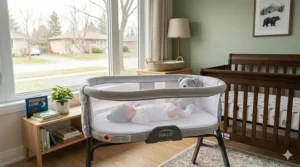
Let’s break down real-world costs in CAD across different approaches to the bassinet vs crib for newborn decision, because understanding total cost of ownership matters when you’re budgeting for a baby.
The Bassinet-to-Crib Path
This is the approach most first-time Canadian parents take, and here’s what it costs:
- Quality bassinet: $200-$350 CAD, used for 4-6 months
- Standard convertible crib: $400-$600 CAD, used from months 5-6 through age 3
- Crib mattress: $150-$300 CAD (separate purchase)
- Toddler bed conversion: $0-$100 CAD for conversion kit
Total investment: $750-$1,350 CAD for approximately 36 months of sleep solutions, working out to $21-$37 per month. If you use the crib’s toddler bed conversion through age 5, that cost drops to $12-$23 per month across 60 months.
The Crib-Only Path
Increasingly popular among Canadian parents with spacious bedrooms or those on tighter budgets:
- Convertible crib positioned beside bed: $400-$600 CAD, used from birth through age 3+
- Crib mattress: $150-$300 CAD
- Toddler bed conversion: $0-$100 CAD for conversion kit
Total investment: $550-$1,000 CAD for the same 36-month period, working out to $15-$28 per month. This represents savings of $200-$350 CAD compared to the bassinet-to-crib path—savings that cover your first 2-3 months of diapers or a quality baby monitor.
The Budget Hybrid Path
Smart approach for Canadian families maximizing value:
- Budget bassinet: $100-$180 CAD, used for 4-5 months
- Mid-range convertible crib: $350-$450 CAD, used through age 3+
- Crib mattress: $150-$250 CAD
Total investment: $600-$880 CAD for 36+ months, working out to $17-$24 per month. This path gives you the bassinet convenience during the exhausting newborn months while controlling costs through budget-friendly bassinet selection and mid-range crib investment.
The Premium Long-Term Path
For Canadian families prioritizing quality and multi-child use:
- Premium washable bassinet: $350-$450 CAD, used for 4-6 months with baby #1, reused with subsequent children
- Premium 5-in-1 convertible crib: $500-$700 CAD, used through age 8-10
- High-quality crib mattress: $250-$400 CAD
Total investment: $1,100-$1,550 CAD for up to 120 months of use (10 years), working out to just $9-$13 per month. When you factor in reusing the bassinet for a second child, that bassinet cost gets distributed across more months of use, dropping the per-month cost even further.
The premium path makes most sense for Canadian families planning 2+ children, as the higher-quality products withstand multiple children and retain excellent resale value on Canadian marketplaces. Premium bassinets from brands like HALO and Newton regularly resell for 40-60% of original price on Facebook Marketplace and Kijiji, effectively reducing your actual out-of-pocket cost.
Canadian Safety Standards: What You Must Know
Health Canada’s Cribs, Cradles and Bassinets Regulations establish mandatory requirements for all sleep products sold in Canada, whether new or used, including items from second-hand stores and online marketplaces. Understanding these regulations protects your baby and helps you identify non-compliant products before they enter your home.
Critical Measurements Every Canadian Parent Should Verify
Slat spacing: Maximum 6 cm (2 3/8 inches) between crib slats. Babies’ heads can become trapped and cause suffocation in wider spacing—this is why pre-1986 cribs are illegal in Canada.
Mattress fit: Gaps between mattress edge and crib/bassinet sides must be 3 cm (1 3/16 inches) or less. Larger gaps create entrapment hazards where babies can become wedged.
Corner posts: Maximum height of 1.5 mm (1/16 inch) above the upper edges of crib sides prevents clothing from catching and creating strangulation hazards.
Side height: Minimum 60 cm (23.6 inches) from mattress support to top of crib side in lowest position prevents mobile babies from climbing out and falling.
Bassinet sides: While lower than crib sides, bassinet sides must still meet minimum height requirements relative to sleeping surface area, which is why bassinets have strict weight limits correlating to developmental mobility.
What’s Banned in Canada That You Might See Online
Drop-side cribs: Illegal to manufacture, import, advertise, or sell since December 29, 2016. The mechanism can detach, creating gaps where babies suffocate. If you’re offered a drop-side crib—even free—decline it and report the seller to Health Canada.
Baby walkers: Completely banned in Canada since 2004 due to injury rates. Mentioning here because confused parents sometimes see them listed on international Amazon sites shipping to Canada—do not purchase.
Baby nests/pods inside cribs: Not a banned product themselves, but Health Canada explicitly warns against placing baby loungers, nests, or pods inside cribs, cradles, or bassinets. The soft padded sides create suffocation risks.
Canadian parents should verify that any sleep product displays compliance information indicating it meets SOR/2016-152 standards. Reputable manufacturers include this information on product packaging and in assembly instructions.
FAQ: Your Bassinet vs Crib Questions Answered
❓ When should I transition my baby from bassinet to crib in Canada?
❓ Do I need both a bassinet and crib for a newborn in Canada?
❓ What's the maximum weight for bassinets sold in Canada?
❓ Are convertible cribs worth the extra cost for Canadian families?
❓ Can I use a bassinet in winter with central heating in Canada?
Conclusion: Making the Best Choice for Your Canadian Family
The bassinet vs crib for newborn decision doesn’t have a universal right answer—it depends entirely on your family’s specific circumstances, from your Toronto condo’s square footage to your Calgary home’s dedicated nursery, from your breastfeeding plans to your budget in CAD across the next few years.
What I can tell you after analyzing dozens of products and speaking with Canadian parents across the country: the families who feel most satisfied with their choice are those who honestly assessed their space constraints, calculated real cost-per-month of use, and prioritized safety compliance with Health Canada regulations above aesthetic preferences or pressure from well-meaning relatives with outdated advice.
If you’re in a small urban apartment planning to breastfeed, that $150-$220 budget bassinet positioned beside your bed will transform those first exhausting months, even though the per-month cost seems high when you calculate it out. The convenience of not crossing your home multiple times per night during Canadian winter when your apartment is cold and dark justifies the investment in better sleep and easier breastfeeding establishment.
If you have bedroom space to position a crib beside your bed, or if you’re formula-feeding and comfortable with a nursery setup from day one, investing your full budget in a quality convertible crib delivers superior long-term value—potentially $400-$600 in CAD savings that funds your next year of childcare or builds your RESP contributions.
And if you’re a Canadian grandparent preparing for visiting grandchildren or a family planning multiple kids over the next 5 years, those premium convertible and washable options justify their higher upfront cost through years of reliable use and strong resale value when you’re finally done with the baby years.
Whatever path you choose, verify every product against Health Canada’s safety standards, measure your mattress fit carefully after assembly, and transition your baby from bassinet to crib immediately when they show rolling ability. Safe sleep isn’t negotiable—your baby’s life depends on it.
Recommended for You
- Best Bedside Bassinet Canada 2026: 7 Safe Co-Sleeping Options
- 7 Best Travel Cribs That Fit in Suitcases Canada 2026 Guide
- Best Portable Cribs with Wheels Canada 2026: 7 Expert Picks
Disclaimer: This article contains affiliate links. As an Amazon Associate, I earn from qualifying purchases. If you purchase products through these links, we may earn a small commission at no additional cost to you.
✨ Found this helpful? Share it with your friends! 💬🤗
