
In This Article
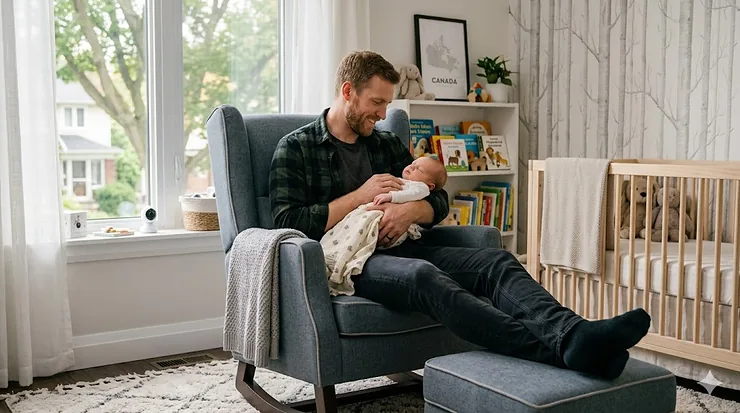
If you’re over 175 cm (5’10”), you’ve probably experienced that awkward moment—sinking into a nursery glider only to find your knees jutting up, your head unsupported, and your lower back screaming for relief after just 10 minutes. Most nursery gliders are designed for average-height users, with seat depths around 50 cm (20 inches) and backrests that top out at 61-63 cm (24-25 inches). For tall parents in Canada, where those 3 a.m. feeding sessions already challenge you during harsh winter months, an ill-fitting glider transforms exhaustion into genuine discomfort.
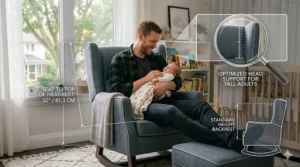
The physics behind this problem are straightforward: when your seat height sits below your knees, your pelvis tilts backward, flattening your spine’s natural curve and forcing your lower back to compensate. Add a baby who needs feeding every three hours, and you’re setting yourself up for chronic back pain. What most Canadian buyers overlook is that a nursery glider for tall parents needs three critical measurements: seat depth of at least 53-56 cm (21-22 inches) to support your full thigh length, backrest height of 66-76 cm (26-30 inches) for proper head and neck support, and seat-to-floor height around 53 cm (21 inches) that keeps your feet flat without knee strain. These aren’t luxury features—they’re ergonomic necessities, especially during Canadian winters when you might be wearing thicker loungewear and need extra room to move comfortably.
Quick Comparison: Top Nursery Gliders for Tall Canadian Parents
| Model | Seat Depth | Back Height | Weight Capacity | Recline Type | Price Range (CAD) | Best For |
|---|---|---|---|---|---|---|
| Babyletto Kiwi Electronic | 56 cm | 104 cm total | 136 kg | Power | $900-$1,200 | Tech-savvy parents wanting USB charging |
| Nurture& Glider Plus | 55 cm | 107 cm total | 159 kg | Power with adjustable lumbar | $1,400-$1,700 | Premium comfort seekers |
| DaVinci Piper | 54 cm | 102 cm total | 136 kg | Manual pop-up | $700-$950 | Mid-range quality choice |
| Delta Children Epic | 53 cm | 99 cm total | 136 kg | Stationary | $550-$750 | Budget-conscious tall families |
| Babyletto Kiwi Plus | 53 cm | 104 cm total | 136 kg | Power with adjustable headrest | $1,100-$1,400 | Parents wanting customized support |
| Delta Children Nest | 54 cm | 101 cm total | 136 kg | Manual dual-position | $600-$850 | Compact nurseries needing versatility |
| Babyletto Kiwi Deluxe | 53 cm | 104 cm total | 136 kg | Power with heat/massage | $1,300-$1,600 | Ultimate relaxation enthusiasts |
Looking at these specifications, the Babyletto Kiwi Electronic delivers exceptional value in the $900-$1,200 CAD range with its 56 cm seat depth—that extra 3 cm makes a noticeable difference for parents over 183 cm (6 feet). Budget-conscious shoppers should note that the Delta Children Epic sacrifices power reclining but maintains the crucial 53 cm seat depth, a smart trade-off that saves $350-450 CAD. Canadian buyers often underestimate how winter layering affects comfort—when you’re wearing fleece pyjamas during those February night feedings, that additional seat width on models like the Nurture& Glider Plus (55 cm depth) prevents the cramped feeling common in narrower chairs.
💬 Just one click—help others make better buying decisions too! 😊
Top 7 Nursery Glider for Tall Parents: Expert Analysis
1. Babyletto Kiwi Electronic Recliner & Swivel Glider
The Babyletto Kiwi Electronic stands out as the most tall-friendly mainstream option available on Amazon.ca, and for compelling reasons beyond its marketing. With a seat depth of 56 cm (22 inches) and total height of 104 cm (41 inches), this glider accommodates parents up to 193 cm (6’4″) without the head-hanging-over-the-back problem that plagues shorter models. The power recline system operates whisper-quiet—critical when you’ve finally got your baby drowsy at 2 a.m. and don’t want squeaking mechanisms to undo 30 minutes of rocking. What differentiates this model from competitors is its seat-to-backrest height of 67 cm (26.5 inches), which means your shoulders and neck get full support even when you’re sitting upright during those daytime feeding sessions.
For tall Canadian parents, three features matter most: the 270-degree swivel lets you reach a side table without standing (saving your back when you’re sleep-deprived), the built-in USB port keeps your phone charged for those 4 a.m. Google searches about infant sleep patterns, and the performance eco-weave fabric repels the inevitable spit-up accidents. Customer feedback from Canadian buyers specifically mentions that the seat width of 55 cm (21.75 inches) accommodates broader frames comfortably—particularly relevant if you’re layered up during Manitoba winters. The electronic control panel sits on the armrest, easily accessible even when holding a baby, unlike some competitors that place controls awkwardly under the seat.
Pros:
✅ 56 cm seat depth supports full thigh length for tall users
✅ 270-degree swivel plus power recline requires zero manual effort
✅ GREENGUARD Gold Certified for Canadian indoor air quality standards
Cons:
❌ At 56 kg (123 lbs), it’s heavy to move between rooms
❌ USB charging limited to small devices (phones only, not tablets)
The Babyletto Kiwi Electronic typically ranges from $900-$1,200 CAD on Amazon.ca, positioning it as a mid-to-premium investment. For parents planning to use this chair beyond the nursery years—and at this quality level, you absolutely should—the per-year cost becomes quite reasonable. Note that some Canadian retailers offer extended warranties; always verify these when purchasing.
2. Nurture& The Glider Plus – Premium Power Recliner
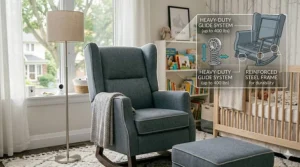
The Nurture& Glider Plus represents the premium tier of nursery seating, and its 107 cm (42.1-inch) total height immediately signals its tall-parent orientation. This model doesn’t just accommodate height—it’s engineered around it. The adjustable power headrest moves up an additional 10 cm beyond standard position, meaning parents over 188 cm (6’2″) finally get proper cervical support. Combine this with the adjustable lumbar support (rare in nursery gliders at any price point), and you’ve got a chair that actively prevents the lower back strain that accumulates over months of night feedings.
Canadian buyers should pay attention to the 159 kg (350-pound) weight capacity—the highest in this category and particularly relevant for broader-framed individuals or those who might occasionally sit with a partner during bonding time. The seat depth of 55 cm (21.7 inches) falls into the sweet spot for heights between 178-198 cm (5’10”-6’6″). What justifies the premium pricing is the build quality: the frame uses reinforced hardwood rather than the particleboard common in budget models, and the metal gliding mechanism is commercial-grade. You’ll feel this difference during year three when cheaper gliders start developing wobbles and squeaks.
From a Canadian perspective, this glider’s performance fabric withstands the wear patterns of humid summer months and dry winter heating without cracking or fading. The built-in USB ports (both Type-A and Type-C) accommodate current smartphone standards—a forward-thinking detail given how quickly charging technology evolves. Customer reviews from Ontario and BC buyers consistently mention the “zero gravity” feel of the full recline position, which reduces spinal pressure during those marathon feeding sessions.
Pros:
✅ Adjustable headrest and lumbar support customize to your exact height
✅ 159 kg weight capacity highest in category
✅ Commercial-grade mechanisms last through multiple children
Cons:
❌ Premium pricing around $1,400-$1,700 CAD
❌ 107 cm height requires 2.4 metre+ ceiling clearance
This investment makes sense for tall parents planning multiple children or those with existing back issues. The cost-per-use calculation favours quality here—you’ll use this chair 500+ hours during the first year alone, making the premium over budget options roughly $1.50 CAD per hour of superior comfort.
3. DaVinci Piper Recliner & Swivel Glider
The DaVinci Piper hits the middle ground between budget-friendly and feature-rich, making it a pragmatic choice for Canadian families watching their nursery budget. With a 54 cm (21.3-inch) seat depth, it accommodates parents up to 188 cm (6’2″) without the thigh-cutting sensation shorter seats create. The manual pop-up leg rest operates via a simple lever mechanism—not as convenient as power controls but dramatically more reliable over years of use. You won’t find yourself calling repair services three years down the road because an electric motor failed, a common issue with lower-quality power recliners.
What Canadian buyers appreciate is the GREENGUARD Gold certification, indicating it meets Health Canada’s stringent standards for chemical emissions. Given that your baby will spend hundreds of hours breathing near this upholstery, this certification carries real health value. The 360-degree swivel operates on sealed ball bearings rather than the plastic bushings found in cheaper models—this means smoother, quieter operation even after years of use. The metal base design also simplifies cleaning underneath, relevant when dealing with dropped bottles and snack crumbs during toddler years.
The Piper’s 102 cm (40-inch) total height with a 67 cm (26.5-inch) back height provides adequate neck support for most tall parents, though those over 193 cm (6’4″) might find their heads slightly above the cushioning. Canadian customer feedback specifically notes that the heathered polyester fabric holds up well to pet hair removal—a practical consideration for multi-pet households common across Canadian suburbs. The FSC-certified wood frame indicates sustainable forestry practices, aligning with Canadian environmental values.
Pros:
✅ Manual mechanism more reliable than cheap electric systems
✅ 360-degree swivel on sealed bearings stays smooth for years
✅ GREENGUARD Gold meets Health Canada emission standards
Cons:
❌ Manual recline requires two hands (awkward while holding baby)
❌ Seat width at 51 cm narrower than premium options
Typically available in the $700-$950 CAD range on Amazon.ca, the Piper represents solid mid-tier value. It won’t wow you with cutting-edge features, but it delivers reliable comfort through multiple children without mechanical failures. For tall parents on moderate budgets, this is where practicality intersects with adequate ergonomics.
4. Delta Children Epic Glider
The Delta Children Epic proves that budget-conscious doesn’t mean back-pain-inducing, though it requires understanding exactly what you’re getting (and not getting) for $550-$750 CAD. The 53 cm (21-inch) seat depth sits at the minimum threshold for tall-parent comfort—adequate for parents up to 183 cm (6 feet), but those taller will notice their knees extending past the seat edge. This chair’s genius lies in what it prioritizes: a sturdy wooden frame with pocketed coil seat support that won’t sag after two years of daily use, while skipping the electric mechanisms that add cost and potential failure points.
The 360-degree swivel and glide function operate on all-steel mechanisms—Delta Children’s testing involves 100,000 rocking cycles, which translates to roughly five years of normal use. For Canadian families facing tight budgets during that expensive first year of parenthood, this durability matters more than power recline. The 99 cm (39-inch) total height means parents over 188 cm (6’2″) will lack head support, but the supportive backrest design helps compensate by maintaining proper lumbar curvature. The linen-inspired fabric integrates easily into living rooms post-nursery, extending this chair’s useful life beyond infant years.
What Canadian buyers need to understand is this chair’s limitation during those marathon feeding nights. Without recline capability, you can’t adjust position to relieve pressure points during hour-long sessions. However, pairing it with a separate ottoman (often available for $150-200 CAD) creates a comfortable setup for about $900 total—still hundreds less than premium recliners. The seat cushion thickness of 14 cm (5.5 inches) provides adequate padding, though you’ll notice compression after year three with heavy daily use.
Pros:
✅ Pocketed coil seat support resists sagging better than foam
✅ Steel gliding mechanism tested to 100,000 cycles
✅ Budget-friendly at $550-$750 CAD without sacrificing frame quality
Cons:
❌ No recline function limits position options during long sessions
❌ 53 cm seat depth minimum for tall comfort, not generous
The Epic makes sense for tall parents who prioritize long-term durability over convenience features and plan to supplement with an ottoman. It’s an honest budget option that doesn’t pretend to compete with premium models but delivers what it promises without cutting corners on structural integrity.
5. Babyletto Kiwi Plus with Adjustable Power Headrest
The Babyletto Kiwi Plus takes the successful Kiwi Electronic formula and addresses its one limitation for very tall parents: the headrest now adjusts upward via power controls, accommodating heights up to 198 cm (6’6″). This seemingly small addition transforms comfort for parents in that height range who’ve spent years with their heads hanging over chair backs. The headrest adjustment range spans about 13 cm (5 inches), controlled via the same armrest panel that manages recline and glide functions.
With a 53 cm (21-inch) seat depth, this model matches the Kiwi Electronic’s dimensions but adds that crucial headrest flexibility. For Canadian buyers, this matters during those 2 a.m. winter feeding sessions when you’re bundled in a robe and need every centimetre of support. The 104 cm (41-inch) total height when the headrest is fully extended means you’re getting proper cervical support even when sitting fully upright—critical during the first six months when many parents nurse or bottle-feed in more upright positions recommended by Health Canada’s safe sleep guidelines.
The performance eco-weave fabric contains at least 30% recycled yarn (relevant for environmentally-conscious Canadian families) while maintaining water-repellent properties. This isn’t just marketing—when that 3 a.m. bottle leaks or spit-up happens mid-burp, you’ll appreciate fabric that wipes clean rather than staining permanently. The CertiPUR-US certified foam means no concerning chemicals off-gassing in your baby’s room, important given Canadian winters keep windows closed for months. The 270-degree swivel allows full room visibility without standing, particularly useful in smaller Canadian condo nurseries where furniture placement limits movement.
Pros:
✅ Adjustable power headrest extends support range to 198 cm heights
✅ 30% recycled yarn content reduces environmental impact
✅ Water-repellent fabric handles inevitable spills without staining
Cons:
❌ At $1,100-$1,400 CAD, premium pricing vs. standard Kiwi
❌ Added complexity of power headrest increases potential repair needs
This model fits the narrow window of very tall Canadian parents (over 188 cm/6’2″) who find standard high-back chairs inadequate. If you’re under that height, the regular Kiwi Electronic saves $200-300 CAD without sacrificing comfort. But for those in that upper height bracket, the adjustable headrest isn’t a luxury—it’s the difference between sustainable use and chronic neck strain.
6. Delta Children Nest Nursery Swivel Recliner
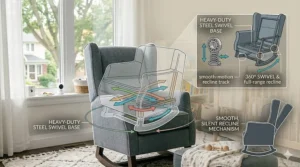
The Delta Children Nest occupies an interesting position: compact enough for tight Canadian condo nurseries yet engineered with enough seat depth (54 cm/21.3 inches) to accommodate tall parents. The dual-position manual recline system offers two distinct positions—footrest extended with upright back, or fully reclined with both back and footrest deployed. This simplicity proves advantageous during sleep-deprived operation; you can’t accidentally hit the wrong button because there are only two clear positions accessible via a single lever.
The 101 cm (39.8-inch) total height with 67 cm (26.4-inch) back height covers the tall-parent comfort range up to about 188 cm (6’2″). Beyond that height, you’ll experience the familiar head-over-backrest situation, though the well-designed lumbar support helps compensate. The chenille yarn upholstery creates what Delta describes as “blanket-like softness”—less marketing hyperbole than accurate description. During those winter feeding sessions common across Canadian climates, this soft-touch fabric feels noticeably warmer than slick performance fabrics, though it does require more careful cleaning.
Canadian buyers appreciate the metallic chrome base aesthetic, which reads more like contemporary furniture than “nursery gear,” easing the transition when you eventually move this chair to your living room or bedroom. The whisper-quiet 360-degree swivel operates on precision bearings rather than plastic bushings, maintaining smooth operation through years of use. At 54 cm seat depth, this accommodates the critical thigh-length support for heights up to 188 cm without that uncomfortable edge-of-seat feeling. The seat cushion uses no-sag steel sinuous springs rather than pure foam, resisting compression over time.
Pros:
✅ Compact 76 cm width fits smaller Canadian condo nurseries
✅ Dual-position manual system eliminates button-confusion mistakes
✅ Chenille fabric provides warmth during Canadian winter feedings
Cons:
❌ Chenille requires more careful spot-cleaning than performance fabrics
❌ Manual recline needs two free hands (challenging while holding baby)
In the $600-$850 CAD range, the Nest delivers practical tall-parent features without premium pricing. It makes particular sense for urban Canadian families in apartments where space comes at a premium but comfort can’t be sacrificed. The contemporary styling also photographs well—relevant given how many first-year baby photos happen in the nursery.
7. Babyletto Kiwi Deluxe with Heat & Massage
The Babyletto Kiwi Deluxe represents the pinnacle of nursery glider luxury, and Canadian buyers should understand exactly what the $1,300-$1,600 CAD investment delivers beyond the standard Kiwi Electronic. The heat and massage functions aren’t gimmicks—they’re targeted relief tools. The heating element warms the lower lumbar region to about 40°C (104°F), increasing blood flow and reducing the muscle tension that accumulates during long feeding sessions. The massage function offers five patterns ranging from gentle pulse to deeper kneading motions, controlled via the remote stored in the side pocket.
With 53 cm (21-inch) seat depth and 104 cm (41-inch) total height matching the standard Kiwi, this model maintains the tall-parent accommodation that defines the Kiwi line. What differentiates it is the comprehensive recovery support—after spending 45 minutes nursing at 3 a.m., activating the lumbar heat and gentle massage helps your muscles release tension before you return to bed. Canadian parents dealing with the physical demands of winter (shovelling driveways, carrying babies in bulky snowsuits, repeatedly bending to put on tiny boots) particularly value this recovery-oriented functionality.
The power recline operates via the included remote control, which Canadian buyers note is easier to operate one-handed than armrest buttons—a surprisingly important detail when you’re holding a sleeping baby and desperately need to adjust position. The 270-degree swivel glide operates whisper-quiet, crucial during those delicate moments when your baby’s finally drowsy. The GREENGUARD Gold certification means this chair meets Health Canada’s strictest emission standards despite the additional electrical components for heat and massage—no small engineering feat.
Pros:
✅ Lumbar heat function reduces muscle tension during marathon sessions
✅ Five massage patterns target specific discomfort zones
✅ Remote control operation easier one-handed than button panels
Cons:
❌ Heat/massage motors add weight (55 kg/122 lbs) and future repair complexity
❌ Premium pricing difficult to justify if you won’t use heat/massage regularly
This model makes sense for tall Canadian parents with existing back issues or those planning multiple children close in age. If you’ll spend 800+ hours annually in this chair over several years, the recovery features justify the premium. However, if you’re seeking basic tall-parent accommodation without the therapeutic add-ons, the standard Kiwi Electronic saves $400-500 CAD while delivering the core ergonomics.
Setting Up Your Glider for Maximum Comfort: Canadian Climate Considerations
Position matters as much as the glider itself, particularly in Canadian homes where seasonal extremes affect nursery conditions. Place your glider at least 90 cm (3 feet) from windows to avoid winter drafts—cold air sinking from windows creates floor-level currents that make those 4 a.m. feeding sessions unnecessarily chilly. During Alberta or Manitoba winters where temperatures drop below -30°C, this placement distance becomes even more critical. If your nursery has baseboard heating, position the glider where heat can circulate around it rather than being blocked by the chair’s bulk.
For proper lumbar support during use, your feet should rest flat on the floor with knees at 90 degrees when the glider is in upright position. If you’re on the taller end (over 188 cm/6’2″), you might need a thin cushion behind your lower back to maintain spine curvature—this isn’t admitting the glider doesn’t fit; it’s optimizing ergonomics for your specific proportions. Canadian parents should secure the glider’s swivel base with the included floor protectors to prevent hardwood scratches, particularly relevant given our indoor-heavy winters mean more time spent rocking.
Consider lighting placement: position a dimmable lamp within arm’s reach at shoulder height. During those dark January mornings when sunrise doesn’t come until 8 a.m., you’ll need to check diapers and prepare bottles without flooding the room with brightness that wakes your baby fully. Store feeding supplies in a side table or hanging organizer attached to the glider arm—reaching for items shouldn’t require standing, which interrupts the soothing rhythm you’ve established. Lastly, if you’re using the glider in a basement nursery (common in Canadian split-level homes), add a dehumidifier during humid summer months to prevent fabric mildew, and consider a small space heater during winter since basements run cooler.
Real-World Scenario: Matching Gliders to Canadian Family Profiles
The Toronto Condo Family (Budget: $900 CAD): Living in a 65 square metre two-bedroom condo in Liberty Village, space comes at a premium. The Delta Children Nest ($600-$850 CAD) fits their 2.1-metre nursery wall while providing 54 cm seat depth for their 183 cm (6-foot) dad. The compact 76 cm width leaves room for a side table, and the contemporary chrome base transitions to their living room post-infancy. They supplement with a $120 ottoman for extended feeding comfort. Total investment: $820 CAD, leaving budget for proper blackout curtains essential for Toronto’s bright summer mornings.
The Vancouver Island Family (Budget: $1,200 CAD): Living in a rainforest climate where moisture is constant, they prioritize fabric durability. The Babyletto Kiwi Electronic ($900-$1,200 CAD) with performance eco-weave fabric resists moisture better than chenille alternatives. The 56 cm seat depth accommodates mom’s 178 cm (5’10”) height and dad’s 191 cm (6’3″) frame equally well. The power recline means neither parent struggles with manual levers during middle-of-night sessions. The USB charging port keeps devices powered during coastal power outages common during winter storms.
The Calgary Multi-Child Family (Budget: $1,600 CAD): Planning three children in five years, they need maximum durability and therapeutic support. The Nurture& Glider Plus ($1,400-$1,700 CAD) provides adjustable lumbar support that both 175 cm (5’9″) mom and 193 cm (6’4″) dad customize to their needs. The 159 kg weight capacity means it confidently handles dad sitting with toddler sibling during baby feeding times. The commercial-grade mechanisms will survive years of intensive use, making the per-child cost reasonable. The reinforced frame justifies the premium during Calgary’s temperature swings from -30°C to +30°C that stress lesser-quality furniture joints.
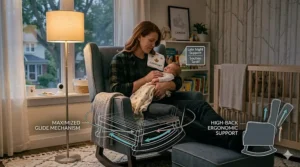
How to Choose a Nursery Glider for Tall Parents in Canada
First, measure your actual seated proportions before trusting manufacturer size claims. Sit against a wall with your back flat and knees at 90 degrees—measure from your sitting surface to the top of your head (this determines minimum backrest height) and from the back of your bottom to the back of your knees (this determines minimum seat depth). For parents over 178 cm (5’10”), target minimum 53 cm (21-inch) seat depth; over 188 cm (6’2″), seek 55+ cm depth. Your backrest should extend at least to your shoulder blades for basic support or fully to your head for optimal comfort.
Second, test weight distribution in recline position if possible. Many gliders feel comfortable upright but create pressure points when reclined because weight shifts to different contact areas. Canadian buyers should visit stores like West Coast Kids or Snuggle Bugz where demo units allow full testing. If buying online from Amazon.ca, verify the return policy covers “comfort issues”—some sellers only accept returns for defects, leaving you stuck with an uncomfortable chair. Check that recline angles support feeding positions recommended by Health Canada; some cheap recliners tilt too far back for safe infant feeding.
Third, prioritize glide mechanism quality over extra features. A smooth, silent glide that lasts five years beats power massage functions that fail after 18 months. Examine whether the glide operates on sealed ball bearings (preferred) or plastic bushings (cheaper, wears faster). Canadian climate extremes stress mechanisms—dry winter air contracts metals while humid summers expand them. Quality sealed systems handle these cycles; cheap mechanisms develop squeaks and wobbles. Test swivel smoothness; it should rotate effortlessly with one hand while holding a baby in the other. If demonstration isn’t possible, prioritize brands with CSA-approved testing standards indicating Canadian safety compliance.
Fourth, calculate total cost including accessories. A $600 glider needing a $200 ottoman for leg support plus a $100 lumbar pillow for back support costs $900—potentially more than a complete premium model with built-in features. Consider fabric care costs too; chenille requiring professional cleaning three times annually adds $180-240 per year versus performance fabrics you wipe clean. Factor in delivery costs for Amazon.ca—oversized furniture often incurs $150-300 shipping to remote areas outside major cities. Finally, verify warranty coverage specifically addresses Canadian use; some U.S. warranties become void when products cross the border.
Fifth, assess post-nursery functionality to maximize value. Will this chair work in your living room or bedroom after baby outgrows midnight feedings? Traditional “nursery style” gliders with pastel fabrics photograph beautifully but feel out of place in adult spaces. Contemporary designs in neutral heather or charcoal tones transition seamlessly. Consider whether the glider’s scale fits multiple rooms—an oversized model perfect for a spacious Oakville nursery might overwhelm a downtown Montreal bedroom. Check if fabric is replaceable; spending $150 on new upholstery after three years beats buying an entirely new chair.
Common Mistakes When Buying a Nursery Glider for Tall Parents
The most expensive mistake is prioritizing aesthetics over ergonomics. That gorgeous velvet glider in sage green might photograph beautifully for Instagram, but if its 50 cm seat depth cuts off blood flow to your legs after 20 minutes, you’ll dread every feeding session. Canadian parents particularly fall into this trap when designing Pinterest-worthy nurseries, forgetting that function must precede form. Beauty means nothing at 3 a.m. when your lower back is screaming and your knees won’t straighten properly after an hour of nursing. Choose the glider that fits your body first, then select from colours available in that ergonomic model.
Another critical error is testing gliders while wearing street clothes instead of sleepwear. When you visit retailers like West Coast Kids during daytime shopping trips, you’re wearing fitted jeans and structured clothing. But you’ll actually use this glider wearing loose pyjamas or nursing robes, often with a burp cloth draped over your shoulder. These changes significantly affect how the seat depth and width feel. What fits perfectly in jeans becomes too snug in fleece pyjamas. Canadian winters demand warmer, bulkier sleepwear than many other climates—that narrow 51 cm seat width causes problems in December that weren’t apparent during August shopping.
Many tall parents underestimate the importance of armrest height. If armrests sit too low (below your natural elbow position), you’ll hunch forward to use them for baby support, creating shoulder and neck tension. Ideal armrest height places your forearms parallel to the floor when your shoulders are relaxed. This becomes crucial during feeding sessions when armrests bear your baby’s weight for extended periods. Too-high armrests force you to shrug your shoulders upward; too-low means you can’t comfortably rest your arms. Most Canadian retailers don’t clearly list armrest-to-seat measurements—bring a tape measure and check before purchasing.
A surprisingly common mistake is ignoring glide track length. Some budget gliders offer only 10-15 cm of forward-backward travel, barely qualifying as “gliding.” For effective soothing motion, you need at least 20-25 cm of travel distance. This matters more for taller parents because your center of mass sits further from the glider’s pivot point—shorter glide tracks mean you work harder to achieve the same rocking motion. Test whether the glide feels smooth throughout its full range; cheaper mechanisms often bind at the end points, creating jarring stops that wake drowsy babies.
Finally, failing to account for Canadian winter static electricity causes unnecessary frustration. Dry heated indoor air during -20°C winter months creates static buildup between certain fabric types and fleece pyjamas. Every time you stand up after feeding, you experience an unpleasant shock. Performance polyester fabrics particularly amplify this problem. When shopping, rub your sleeve against the upholstery sample vigorously—if you feel static, multiply that sensation by 50 during February in Ottawa. Fabric treatments and humidifiers help but can’t completely eliminate the issue with static-prone materials. Opting for cotton-blend or natural-fibre upholstery sidesteps this winter headache entirely.
Long-Term Value: Cost Analysis for Canadian Families
Understanding true cost means calculating beyond the initial price tag. A $550 CAD glider used 800 hours annually for five years delivers 4,000 total hours of use, equating to $0.14 per hour. A $1,400 premium glider over the same period costs $0.35 per hour—a $0.21 difference. If that premium model includes power recline preventing back strain worth one physiotherapy session ($85-120 per visit in Canadian cities), the investment pays for itself after preventing a single injury. For parents with existing back issues, upgrading from manual to power recline might prevent chronic problems that cost thousands in ongoing treatment.
Consider maintenance and repair economics too. Budget gliders saving $500 upfront often require $150 repair services around year three when swivel mechanisms wear out. Mid-tier models with sealed bearing systems typically run maintenance-free through multiple children. Premium gliders sometimes include extended warranties covering parts and labour—verify whether these warranties honour Canadian addresses, as some manufacturers void coverage for international purchases even within North America. The peace of mind knowing your $1,500 glider includes five-year coverage adds value beyond the physical chair.
Resale value factors into total cost surprisingly significantly. Well-maintained premium brands like Babyletto and Nurture& retain 40-50% of purchase price on Canadian marketplaces like Facebook Marketplace and Kijiji after three years of use. A $1,200 Babyletto Kiwi Electronic reselling for $500-600 means net cost around $600-700 over its nursery lifespan. Budget brands typically resell for 10-20% of original price due to wear and dated styling. That $600 Delta glider might fetch $80-120 used, meaning net cost remains $480-520. The premium model’s better retention narrows the actual cost difference substantially.
Energy consumption matters for power recliners, though impact is minimal. Electric mechanisms draw roughly 30 watts during operation, costing approximately $0.003 per hour at average Canadian electricity rates (13 cents/kWh). Over 800 annual hours, that’s $2.40 yearly—negligible in total cost analysis. However, power models usually require accessible outlets, potentially limiting placement options in older homes where nursery outlets are scarce. Factor in electrician costs ($150-300) if you need to add an outlet specifically for the glider.
Finally, opportunity cost of comfort deserves consideration. If an uncomfortable glider causes you to dread feeding sessions, leading to shortened breastfeeding duration or reduced bonding time, the emotional and health costs far exceed any monetary savings. Canadian parents typically spend 600-800 hours in nursery gliders during baby’s first year. That’s equivalent to 15-20 full work weeks. Investing in genuine comfort during this intensive period isn’t luxury—it’s prioritizing your physical and mental health during one of life’s most demanding phases.
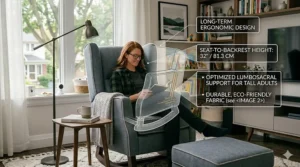
Nursery Glider Maintenance for Canadian Climates
Winter care (November-March) demands attention to indoor humidity levels. When temperatures drop below -10°C, most Canadian homes run at 20-30% humidity—well below the 40-50% ideal for fabric and wood. Dry air causes wood frames to contract, potentially loosening joints and creating squeaks. Place a humidifier in or near the nursery, targeting 40-45% humidity. This prevents frame stress while avoiding the excess moisture that promotes mould growth. Check glider joints monthly during winter; tighten any loose bolts using the Allen key included with most models (store it taped inside a frame tube for easy access).
For upholstery maintenance during Canadian winters, vacuum weekly using the upholstery attachment to remove dust and hair that accumulates faster in closed, heated environments. Performance fabrics handle spot-cleaning with mild soap and water; chenille requires more delicate treatment with fabric-specific cleaners. Address spills immediately—once milk or formula dries into fabric during dry winter conditions, it becomes significantly harder to remove and may require professional cleaning. Keep a bottle of enzyme-based stain remover specifically for organic spills in your nursery closet.
Summer maintenance (June-August) focuses on different challenges. Humid summer air affects mechanisms differently than winter dryness—metal parts can develop surface rust if exposed to moisture. If your nursery lacks air conditioning and humidity exceeds 60%, consider a small dehumidifier during particularly muggy weeks. This is especially relevant in humid regions like Southern Ontario, the Maritimes, and coastal BC. Wipe down metal glide tracks monthly with a dry cloth to remove moisture before rust forms. For models with power mechanisms, ensure no moisture reaches electrical components; keep windows closed during rainstorms if your glider sits near them.
Year-round care includes lubricating the glide mechanism every 6-8 months. Use silicone spray lubricant (available at Canadian Tire for $8-12) rather than oil-based products that attract dust and gum up over time. Spray the glide tracks while rocking the chair back and forth to distribute lubricant evenly. Avoid over-lubricating—three 1-second bursts per track suffice. For swivel mechanisms, apply one burst to the central pivot point annually. Power recliners require checking wire connections every six months to ensure nothing has loosened from repeated motion—look for exposed wires or frayed insulation.
Fabric protection pays dividends long-term. Apply scotchguard or similar fabric protector every 12-16 months, even on “stain-resistant” performance fabrics. These factory treatments wear off gradually with cleaning and use. Reapplying costs $15-20 for a can covering one glider but prevents hundreds in professional cleaning or premature replacement. Test protector on a hidden area first to ensure it doesn’t darken or alter fabric appearance. For leather or faux-leather models (less common for nursery gliders but occasionally used), condition every 4-6 months using leather-specific products to prevent cracking during temperature extremes.
Nursery Glider Safety Compliance in Canada
Health Canada regulates nursery furniture under the Canada Consumer Product Safety Act (CCPSA), though interestingly, gliders and rocking chairs face less prescriptive regulation than cribs or playards. The CCPSA’s general “duty to report” means manufacturers must ensure products don’t pose danger to human health or safety, but no specific Canadian standard equivalent to crib regulations (SOR/2016-152) governs glider construction. This places greater responsibility on parents to verify safety independently rather than relying solely on “meets Canadian standards” claims that may reference voluntary rather than mandatory compliance.
Look for GREENGUARD Gold Certification on any glider you’re considering—this third-party certification verifies the product has been tested for over 10,000 chemicals and VOCs, meeting strict emission standards. Given Canadian winters keep windows closed for months, low-emission furniture significantly impacts indoor air quality. Products with this certification contribute to healthier breathing environments, particularly relevant for infants whose respiratory systems are still developing. The Babyletto Kiwi line, DaVinci Piper, and several Delta Children models carry GREENGUARD Gold certification, indicating they’ve passed rigorous chemical emission testing aligned with Health Canada’s indoor air quality guidelines.
CertiPUR-US certification verifies foam cushioning meets specific safety standards—no PBDE flame retardants, no heavy metals, no formaldehyde, no phthalates regulated by the Consumer Product Safety Commission. While CertiPUR-US is an American certification, Health Canada recognizes it as indicating safe foam manufacturing practices. Canadian fire safety regulations (governed provincially rather than federally, adding complexity) generally align with California TB117-2013 standards that many quality gliders meet. Verify that any glider you’re considering explicitly states flame retardant-free foam, as some manufacturers still use chemical treatments despite safer alternatives being available.
For structural safety, check weight capacity ratings honestly. A glider rated for 136 kg (300 lbs) means total weight including user and baby—for a 95 kg parent holding a 5 kg infant, you’re at 100 kg, well within limits. However, these ratings assume even weight distribution. If you frequently lean heavily to one side or use the glider in ways manufacturers didn’t intend (letting toddler siblings jump on it, which absolutely happens), you exceed safe stress parameters. Canadian tort law places liability on manufacturers for design defects but on users for misuse—maintain gliders according to instructions to preserve warranty coverage and ensure safety.
Tip-over prevention deserves attention particularly for tall parents whose weight sits higher from the floor, creating greater leverage during rocking motions. Most quality gliders include wide, weighted bases preventing tip-overs under normal use, but test this during in-store trials. Sit in the glider and rock vigorously forward and back—if you feel the chair approaching its balance point, choose a different model. Some gliders include “stay-put” brake mechanisms locking the swivel when not in use; engage these features if you have pets or toddlers who might interact with the glider while it’s unoccupied. Anchor floor protectors properly—they’re not just for preventing scratches but also stabilizing the glider against sliding on hardwood or tile floors common in Canadian homes.
Comparing Nursery Gliders to Alternative Seating
Traditional Rocking Chairs offer nostalgic appeal and simpler mechanics but fall short for tall parents. The curved rockers create fixed arcs—if you’re taller, your center of mass sits higher, making the rocking motion feel tippier and less controlled. Most rockers also lack the seat depth gliders provide; 48-50 cm depths are standard, cutting off circulation for heights over 178 cm (5’10”). The visual motion of a rocking chair can be stimulating rather than soothing for some babies who respond better to gliders’ horizontal back-and-forth movement. Rockers also wear floors more than gliders—curved runners create pressure points that dent softwood floors and scratch hardwood finishes, relevant for Canadian homes where flooring represents significant investment.
Recliners without glide function (standard living room recliners) provide excellent lumbar support and often feature better cushioning than nursery-specific gliders. However, they lack the gentle motion component that helps soothe babies to sleep. The reclining motion on standard recliners is also typically louder—mechanical sounds wake drowsy babies at inopportune moments. Most importantly, standard recliners occupy substantially more space than nursery gliders (90-100 cm width vs. 70-80 cm), problematic in smaller Canadian urban nurseries. They can work well as secondary seating in larger homes where partners want a comfortable spot while the primary caregiver uses the glider.
Stationary Armchairs with Ottomans cost less than gliders but eliminate the motion benefit entirely. For some babies, this isn’t disadvantageous—not all infants respond positively to rocking motions. If your baby falls asleep equally well with or without motion, a high-quality stationary chair with proper ergonomics costs $300-500 CAD, saving substantial money. The challenge is you won’t know your baby’s preferences until they’re here. Buying a stationary chair first, then discovering your baby needs motion to settle, means either suffering through or buying a glider anyway. Most Canadian parents find the glider’s versatility (use it with or without motion as needed) worth the premium.
Poufs and Floor Seating represent the budget extreme—$50-100 for cushioned floor seating. For very tall parents, floor seating actually provides advantages: unlimited “seat depth” since your legs extend freely, and your height becomes less relevant to comfort. The significant downsides include difficulty standing from floor level while holding a baby (particularly after C-sections or if you develop knee issues), lack of back support leading to poor posture, and greater cold exposure since floor-level temperatures run 3-5°C cooler than waist-height during Canadian winters. Floor seating works as occasional supplementary nursing spots but shouldn’t be primary seating for months of daily use.
The evidence supports gliders as optimal nursery seating for tall Canadian parents when budget allows. They specifically address the combination of challenges tall parents face: need for extended seat depth, requirement for higher back support, benefit of gentle soothing motion, and ability to use comfortably through hours of daily sessions. Alternative seating options either sacrifice critical comfort elements or fail to provide the motion component valuable for infant care.
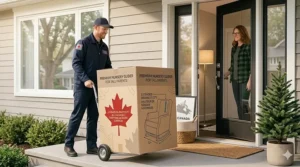
❓ FAQ: Nursery Gliders for Tall Parents in Canada
❓ Can I use a nursery glider if I'm over 193 cm (6'4') tall?
❓ Are nursery gliders available on Amazon.ca shipped assembled?
❓ How much weight can nursery gliders safely support?
❓ Do nursery gliders work on carpet or only hardwood floors?
❓ Can I use my nursery glider outside on a covered patio during summer?
Conclusion: Finding Your Perfect Nursery Glider in Canada
Choosing a nursery glider for tall parents in Canada means balancing ergonomic necessities against budget realities while accounting for our unique climate demands. If you’re over 183 cm (6 feet), refusing to compromise on seat depth isn’t being picky—it’s preventing chronic pain during months of intensive use. The difference between a 50 cm and 55 cm seat depth might sound marginal, but it determines whether you can sit comfortably for hour-long feeding sessions or spend those months with aching thighs and numb feet.
For budget-conscious Canadian families, the Delta Children Epic ($550-$750 CAD) delivers essential tall-parent accommodation without premium features—solid value if you’re willing to supplement with an ottoman. Mid-tier shoppers should focus on the DaVinci Piper ($700-$950 CAD) for reliable manual operation and GREENGUARD Gold certification meeting Health Canada standards. Premium buyers get genuine value from the Babyletto Kiwi Electronic ($900-$1,200 CAD) with its 56 cm seat depth and power controls that eliminate awkward manual manipulation while holding a baby. Very tall parents above 188 cm (6’2″) specifically benefit from the Babyletto Kiwi Plus ($1,100-$1,400 CAD) and its adjustable power headrest.
The Canadian marketplace offers these quality options through Amazon.ca with reasonable shipping to most urban areas, though remote northern communities may face longer delivery times and higher costs. Always verify current pricing, as Canadian dollar fluctuations affect Amazon.ca costs more volatilely than Amazon.com. Check for seasonal sales around Black Friday and Boxing Day when nursery furniture often sees 15-25% discounts. Remember that your glider will serve as command central during the most physically demanding months of early parenthood—it’s where you’ll spend hundreds of hours bonding with your baby, and investing in genuine comfort pays dividends in reduced pain and increased patience during those challenging middle-of-the-night moments.
Canadian parents deserve nursery furniture that accommodates our actual bodies rather than forcing us into ergonomic compromises. The seven gliders reviewed here specifically address the challenges tall parents face, providing the seat depth, back height, and supportive design that standard models neglect. Choose based on your specific height, budget, and feature priorities—but don’t settle for a glider that leaves you uncomfortable. Your back, neck, and shoulders will thank you through countless feeding sessions, and your baby will benefit from a parent who isn’t distracted by physical discomfort during those precious bonding moments.
Recommended for You
- 7 Best Affordable Nursery Gliders Under $400 Canada 2026
- Glider vs Rocking Chair for Nursery: 7 Top Picks Canada 2026
- 7 Best Nursery Gliders That Canadian Parents Love 2026
Disclaimer: This article contains affiliate links. As an Amazon Associate, I earn from qualifying purchases. If you purchase products through these links, we may earn a small commission at no additional cost to you.
✨ Found this helpful? Share it with your friends! 💬🤗
