
In This Article
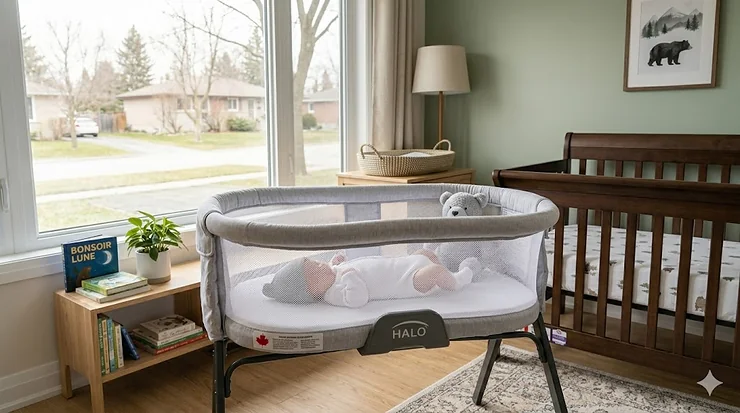
Sleep-deprived Canadian parents, this one’s for you. If you’ve been Googling “rocking bassinet Canada” at 3 a.m. while bouncing your fussy newborn, you’re not alone. The quest for better infant sleep has led thousands of families across Ontario, British Columbia, and beyond to discover what might be the game-changer they desperately need: a rocking bassinet that does the soothing for you.
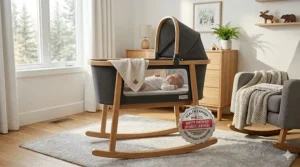
Unlike traditional stationary bassinets, a rocking bassinet Canada parents trust combines gentle motion with modern safety standards to help babies fall asleep faster and stay asleep longer. But here’s what most Amazon.ca listings won’t tell you: not all rocking bassinets handle Canadian winters equally well, and the price difference between a $200 manual rocker and a $600 smart bassinet isn’t just about fancy features—it’s about which specific problems you’re trying to solve.
In my years reviewing baby products for Canadian families, I’ve noticed that parents in colder climates face unique challenges. Battery-powered bassinets lose efficiency in unheated nurseries during February cold snaps, and parents in rural Manitoba need models that work without smartphone apps when Wi-Fi is spotty. This guide cuts through the marketing hype to show you exactly which rocking bassinet features actually matter for Canadian households, which SNOO bassinet alternative Canada offers deliver real value, and how to choose the right automatic rocking bassinet without overspending by $400 on features you’ll never use. Whether you’re dealing with a colicky baby in downtown Toronto or setting up a nursery in suburban Calgary, you’ll find practical advice tailored to Canadian conditions, pricing in CAD, and products confirmed available on Amazon.ca.
Quick Comparison Table: Top Rocking Bassinets Available in Canada
| Bassinet Model | Motion Type | Key Feature | Price Range (CAD) | Best For |
|---|---|---|---|---|
| Graco Sense2Snooze | Auto cry detection | Responds to cries | $400-$500 | SNOO alternative seekers |
| 4moms mamaRoo Sleep | 5 smart motions | App-controlled | $550-$650 | Tech-savvy parents |
| Hichangto 3-in-1 | Manual rocking | Budget-friendly | $180-$250 | Cost-conscious families |
| Ezebaby Bedside Sleeper | Manual + vibration | Bedside attachment | $200-$300 | C-section recovery |
| Fisher-Price Soothing Motions | Auto vibration | Compact design | $220-$280 | Small spaces |
| YADAQE Convertible | 360° swivel + rock | Multi-functional | $250-$350 | Growing needs |
| Newton Baby Breathable | Manual tilt | Washable everything | $400-$550 | Safety-focused parents |
💬 Just one click — help others make better buying decisions too! 😊
Top 7 Rocking Bassinet Canada: Expert Analysis & Reviews
1. Graco Sense2Snooze Bassinet with Cry Detection Technology
The Graco Sense2Snooze stands as the closest thing to the legendary SNOO Smart Sleeper without the eye-watering price tag. This automatic rocking bassinet uses a built-in microphone to detect when your baby starts fussing, then automatically cycles through soothing combinations of motion, vibration, and sound until it finds what works.
What sets this apart in the Canadian market is its reliability during winter power fluctuations—it plugs directly into standard outlets and doesn’t rely on battery charging that degrades in cold temperatures. The head-to-toe rocking motion replicates the movement pattern most effective for calming colicky babies, and the bassinet remembers your baby’s favourite settings, so you’re not fumbling with controls at 2 a.m. Canadian parents appreciate the mesh sides that provide visibility while preventing overheating—crucial during those transitional spring and fall months when room temperatures fluctuate.
The cry detection technology isn’t perfect (it sometimes responds to household noise), but it’s sophisticated enough to distinguish between fussing and full-blown crying, adjusting intensity accordingly. This is particularly valuable for families in condos or apartments where you want to intervene before baby’s cries wake neighbours.
Customer Feedback: Canadian reviewers on Amazon.ca consistently praise the Graco’s durability through multiple children. One Toronto parent noted it survived three kids over five years, while several Ottawa families mentioned it handled moves between homes without mechanical issues.
Pros:
✅ Cry detection actually works (responds within 10-15 seconds of fussing)
✅ Saves favourite combinations—no midnight button pressing
✅ Integrated storage basket holds diapers, wipes, and essential supplies
Cons:
❌ Bulkier footprint than manual rockers (requires 90cm clearance)
❌ Occasional false triggers from TV or conversation
Price Range: Around $400-$500 CAD |
Value Verdict: Best investment if you’re dealing with frequent night wakings or have a history of colic in the family—the automation pays for itself in restored sleep hours.
2. 4moms mamaRoo Sleep Bassinet
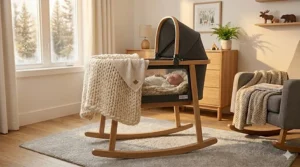
The 4moms mamaRoo Sleep Bassinet brings the brand’s infant seat technology to the sleep space with five distinct motion patterns that genuinely feel different from each other. This isn’t just marketing—the “car ride” motion has a subtle bounce-and-sway that mimics highway driving, while “wave” offers a gentler side-to-side flow perfect for sensitive babies.
Here’s what Canadian buyers need to know: this bassinet is available at Canadian Tire, Well.ca, and Amazon.ca, but shipping to remote areas (Northern Ontario, parts of the Territories) may incur extra fees. The app control via Bluetooth means you can adjust settings from your bed without disturbing baby, and the “Find Your Roo” feature on the 4moms app analyzes which motion combinations mirror your own soothing patterns—a surprisingly useful diagnostic tool.
The mesh sides follow AAP safe sleep guidelines while providing exceptional airflow, and the height-adjustable legs let you position it perfectly beside beds of varying heights. What sets this apart for Canadian climates is the firm, flat mattress that includes a water-resistant cover—essential for managing spit-up without soaking through to the foam, which becomes a mildew risk in humid summer conditions or poorly ventilated winter rooms.
The bassinet’s weight limit is 11.3 kg (25 lbs) or until baby can push up on hands and knees, which typically gives you 4-6 months of use depending on your baby’s development.
Customer Feedback: Canadian reviews highlight the bassinet’s quiet operation as a major plus. Several Vancouver parents mentioned using it successfully in studio apartments where noise control is critical. The app’s timer function helps establish bedtime routines—set it to run for 30 minutes, and baby learns that motion = sleep time.
Pros:
✅ Five genuinely different motion patterns increase odds of finding what works
✅ App control prevents bedside fumbling in the dark
✅ Timer feature aids sleep training and routine establishment
Cons:
❌ Premium pricing (typically $550-$650 CAD range)
❌ Bluetooth-only (no manual controls if your phone dies)
Price Range: Around $550-$650 CAD |
Value Verdict: Worth the premium if you’ve struggled with a “particular” baby who rejects standard soothing methods—the variety of motions often succeeds where single-pattern bassinets fail.
3. Hichangto 3-in-1 Rocking Bassinet
If the Graco and 4moms prices made you wince, the Hichangto delivers the core benefit—gentle rocking motion—at a fraction of the cost. This manual rocking bassinet Canada budget option features a simple rocker base that you engage with a light push, providing 3-5 minutes of sway before gradually settling to stillness.
Don’t mistake “budget” for “low-quality.” The Hichangto includes a four-sided breathable mesh design that exceeds Health Canada’s ventilation recommendations, and the double-sided waterproof sheet (soft microfiber on one side, waterproof backing on the other) handles the inevitable middle-of-the-night diaper disasters without requiring a full linen change. What Canadian parents particularly appreciate is the convertible design—it functions as a standalone bassinet, bedside sleeper, or stationary crib depending on your configuration.
The manual rocking means you’re actively soothing rather than setting it and forgetting it, but many parents find this creates valuable bonding time rather than feeling like extra work. One Edmonton reviewer noted that the rhythmic hand-rocking became a calming ritual for both parent and baby. The six-level height adjustment accommodates platform beds common in modern Canadian condos, and the lockable wheels (four total) make midnight relocations between bedroom and living room effortless.
The bassinet meets current Canadian safety regulations and includes a CSA-approved design, though it lacks the electronic certifications of higher-priced models. Storage basket underneath holds approximately three days of diapers and wipes.
Customer Feedback: Amazon.ca reviews from Canadian buyers emphasize durability—several families report using it daily for 5-6 months without mechanical wear. The waterproof sheet quality receives consistent praise, with parents noting it survives multiple wash cycles without degrading.
Pros:
✅ Outstanding value (typically $180-$250 CAD)
✅ Convertible 3-in-1 design extends usability
✅ No batteries or charging required—purely mechanical reliability
Cons:
❌ Manual rocking requires parental effort (not hands-free)
❌ Limited motion duration (3-5 minutes per engagement)
Price Range: Around $180-$250 CAD |
Value Verdict: Exceptional choice for cost-conscious families or those unsure if their baby will even respond to rocking motion—low financial risk with solid core functionality.
4. Ezebaby Bedside Sleeper 3-in-1 Rocking Bassinet
The Ezebaby combines bedside sleeper functionality with rocking capability, making it particularly valuable for Canadian parents recovering from C-sections or those committed to room-sharing for the full six months Health Canada recommends. The drop-down side panel attaches securely to your bed frame, creating an extension of your sleep surface while maintaining the separate sleep space required for safe infant sleep.
This soothing bassinet for colicky baby includes both manual rocking and a vibration mode—a combination that addresses the two most common soothing preferences. The vibration setting offers two intensity levels, and while it’s not as powerful as dedicated vibration bassinets, it’s sufficient to calm light fussiness without the jarring sensation some babies dislike. The mesh walls provide 360-degree visibility, letting you monitor breathing patterns without hovering directly over the bassinet.
What makes this particularly suitable for Canadian bedrooms is the compact footprint (fits in spaces as small as 75cm wide) and the included mattress that’s specifically designed for Canadian temperature fluctuations—it includes a breathable middle layer that prevents moisture accumulation during humid summers and maintains comfortable firmness during dry winter heating season.
The six-level height adjustment ranges from 53cm to 73cm, accommodating everything from low platform beds to traditional frames with box springs. Assembly takes approximately 15-20 minutes and requires no tools beyond the included hex key.
Customer Feedback: Canadian reviews highlight this as a recovery essential for C-section mothers—the bedside attachment means you can tend to baby without sitting up or getting out of bed, crucial during those painful first two weeks. Several Calgary parents mentioned using it successfully throughout the reflux stage (baby’s first 4 months), as the slight incline option helps reduce spit-up frequency.
Pros:
✅ Bedside attachment eliminates nighttime bed transfers
✅ Dual soothing (rocking + vibration) covers multiple calming methods
✅ Compact design fits in typical Canadian master bedrooms
Cons:
❌ Vibration motor adds slight noise (comparable to electric toothbrush)
❌ Bedside attachment limits bed-side access for other caregivers
Price Range: Around $200-$300 CAD |
Value Verdict: Ideal for the first 3-4 months when you need maximum accessibility for feeding and checking on baby—becomes less essential once you’re mobile and baby sleeps longer stretches.
5. Fisher-Price Soothing Motions Bassinet
Fisher-Price brings decades of baby product experience to this gentle motion sleeper, focusing on simplicity and reliability over feature overload. The motorized gentle vibration runs continuously for up to 30 minutes per activation, providing just enough motion to help babies transition from awake to drowsy without the full commitment of constant rocking.
Canadian parents particularly value the compact design—this bassinet occupies approximately 30% less floor space than the Graco or 4moms models, making it suitable for Toronto condos, Vancouver high-rises, or any situation where bedroom real estate is premium. The curved legs create a small footprint while maintaining stability, and the bassinet sits low enough to provide clear sightlines from most bed heights.
The vibration motor operates on a simple push-button control (no apps, no Bluetooth connectivity issues), and it runs on standard AC power with a built-in cord management system. What you give up in automation you gain in mechanical simplicity—fewer components mean fewer potential failure points, and several Canadian reviews mention this bassinet functioning perfectly through 8+ months of daily use.
The mesh sides promote airflow in accordance with safe sleep guidelines, and the mattress pad is removable and machine-washable (cold water, gentle cycle). The bassinet doesn’t include storage pockets or baskets, forcing you to keep a small side table for essentials.
Customer Feedback: Amazon.ca buyers appreciate the “set it and forget it” simplicity—no motion variety means no decision paralysis at 3 a.m. One Halifax parent noted this was their third baby and they deliberately chose the Fisher-Price over smart bassinets because “I just wanted vibration and nothing else to think about.” The lack of electronic features also means it travels well without worrying about app connectivity or Bluetooth pairing.
Pros:
✅ Ultra-compact footprint (23cm narrower than standard bassinets)
✅ Simple one-button operation (zero learning curve)
✅ Reliable continuous operation (users report 6+ month lifespan without issues)
Cons:
❌ Vibration-only (no rocking or swaying motion)
❌ No storage integrated into design
Price Range: Around $220-$280 CAD |
Value Verdict: Perfect for minimalist parents or those with extremely limited space—delivers core soothing functionality without the complexity or footprint of feature-rich models.
6. YADAQE Convertible Baby Bassinet with 360° Swivel
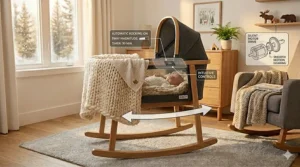
The YADAQE brings versatility to the vibration bassinet features category with its 360-degree swivel base combined with a manual rocking function. This dual-motion capability means you can position the bassinet for optimal parent visibility without relocating the entire unit—a surprisingly valuable feature during those early weeks when you’re constantly checking breathing.
This 2026 model includes upgraded lockable wheels (compared to the 2024 version that had fixed wheels), making it easy to roll between rooms during the day and lock in place for overnight safety. The rocking motion is smooth and silent, engaging with a gentle hand push and continuing for approximately 4-6 minutes before settling. Unlike spring-based rockers that eventually lose tension, the YADAQE uses a weighted base system that maintains consistent motion quality over time.
For Canadian families, the neutral grey colour scheme fits modern nursery aesthetics common in Canadian homes, and the easy-fold design means it compresses to approximately 40cm thick for storage or transport. Several Montreal parents mentioned successfully using this for weekend visits to grandparents’ houses—it fits in most car trunks when collapsed. The bassinet meets current Canadian safety standards and includes the required labelling showing manufacture date (all YADAQE models have this stamped on the bottom frame).
The mattress includes a breathable 3D mesh layer that prevents the heat accumulation some babies experience with solid foam mattresses. The mattress cover is machine-washable and includes a waterproof barrier that extends to the edges, preventing liquid seepage to the frame below.
Customer Feedback: Canadian buyers highlight the swivel function as unexpectedly useful—you can rotate baby toward you for feeding, then swivel back toward the wall afterward without physically moving the bassinet. One Winnipeg parent mentioned this prevented countless instances of bumping into furniture during bleary-eyed midnight wake-ups.
Pros:
✅ 360-degree swivel provides positioning flexibility without relocating
✅ Folds for transport (ideal for families who travel between residences)
✅ Weighted rocking system maintains motion quality over extended use
Cons:
❌ Swivel feature adds weight (total unit is approximately 8 kg)
❌ Manual rocking only (no automatic cry response)
Price Range: Around $250-$350 CAD |
Value Verdict: Best for families who value flexibility and portability—the swivel function particularly shines in smaller bedrooms where traditional bassinet placement creates traffic flow issues.
7. Newton Baby Breathable Bassinet & Bedside Sleeper
Newton Baby built their reputation on breathable mattress technology, and this bassinet showcases that expertise with a fully washable sleep surface that exceeds standard safety guidelines. The defining feature is the Wovenaire core—a 3D spacer fabric that allows air to flow through the mattress rather than just across the surface, dramatically reducing suffocation risk even if baby rolls face-down.
This isn’t a smart bassinet with automated features, but rather a safety-focused self-soothing bassinet designed around the principle that babies who breathe easily sleep more soundly. The manual tilt function (adjustable by approximately 8 degrees) helps with reflux management without creating the dangerous incline some baby loungers introduce. Health Canada’s guidelines specify that bassinet inclines should never exceed 10 degrees, and the Newton’s design stays well within that threshold.
For Canadian parents concerned about allergens and cleanliness, the Newton’s complete washability is unmatched—you can literally put the entire mattress (cover and core) in a standard washing machine. This matters more in Canadian climates than you might expect: winter humidifiers create moisture that promotes mold growth in standard foam mattresses, while the Newton’s open structure allows thorough drying. The wood frame construction also avoids the off-gassing concerns some parents have with plastic bassinet frames.
The bassinet includes an adjustable height feature (five levels) and can function as either a standalone unit or a bedside sleeper. The opening panel for bedside use is generous—approximately 45cm wide—making it easier to transfer baby compared to narrower bedside sleeper designs.
Customer Feedback: Canadian Amazon.ca reviews emphasize peace of mind over convenience features. Parents dealing with reflux report fewer spit-up incidents compared to flat mattresses, and several families mentioned being able to calm their anxiety about SIDS risk thanks to the breathable design. The complete washability receives consistent praise—one Victoria parent noted washing the mattress every two weeks throughout the first four months without any degradation.
Pros:
✅ Unmatched breathability reduces SIDS anxiety significantly
✅ Completely machine-washable (mattress core and cover)
✅ Manual tilt aids reflux management within safe parameters
Cons:
❌ No automated motion or vibration features
❌ Premium pricing ($400-$550 CAD) for manual functionality
Price Range: Around $400-$550 CAD |
Value Verdict: The right choice for safety-conscious parents or those with reflux concerns—you’re paying for engineering that prioritizes breathing over automated soothing, which may be exactly what your family needs.
How a Rocking Bassinet Actually Helps Your Baby Sleep: The Science
Here’s what most bassinet marketing won’t tell you: the rocking motion doesn’t magically make babies sleepy—it triggers specific neurological responses that existed long before modern sleep science understood them. When you rock a baby at approximately 60-70 cycles per minute (about one sway per second), you’re activating their vestibular system, which controls balance and spatial orientation.
This activation sends calming signals to the brain that suppress the startle reflex—that sudden jerking movement that wakes babies during light sleep phases. Think of it as creating a sensory buffer that makes the transition between sleep cycles smoother. This is why babies who sleep in rocking bassinets often achieve longer continuous sleep blocks: they’re passing through those vulnerable transition points without fully waking.
For Canadian parents dealing with colic (which affects roughly 20% of infants according to the Canadian Paediatric Society), the combination of motion and white noise creates what researchers call “sensory override”—the gentle, predictable input overwhelms the discomfort signals that cause crying fits. It’s not masking pain; it’s providing enough competing sensation that baby can regulate their nervous system more effectively.
The key difference between manual and automatic rocking bassinets becomes clear here: manual models require you to sustain that 60-cycle rhythm for 15-20 minutes while baby transitions to deep sleep. Automatic models maintain it consistently, but some babies become dependent on constant motion and struggle when you eventually transition them to a stationary crib. The sweet spot many Canadian parents find is using automatic features during the worst sleep regression phases (typically 4 months and 8 months), then gradually reducing reliance as baby’s nervous system matures.
SNOO Bassinet Alternative Canada: Getting Smart Features Without the $2,000 Price Tag
The SNOO Smart Sleeper has achieved near-mythical status among sleep-deprived parents, but its price—typically $1,800-$2,000 CAD when available in Canada—puts it out of reach for many families. The question isn’t whether the SNOO works (it generally does), but whether you can achieve 80-90% of the benefit for 25-40% of the cost.
The closest SNOO bassinet alternative Canada offers is the Graco Sense2Snooze, which replicates the core concept: automatic response to crying with graduated soothing. Where the SNOO has a 5-level response system, the Graco has 3 intensity levels. Where the SNOO includes a proprietary swaddle attachment, the Graco works with standard swaddles. These aren’t deficiencies—they’re simplifications that cut cost without sacrificing the fundamental benefit.
The 4moms mamaRoo Sleep takes a different approach: instead of cry detection, it offers five distinct motion patterns you can test to find what works. This manual experimentation process takes more parental effort upfront but costs $1,200+ less than the SNOO. Canadian parents who’ve used both report the mamaRoo’s “car ride” motion often succeeds where other patterns fail, particularly for babies who sleep well during drives.
For families determined to get SNOO-like automation on a tight budget, here’s the Canadian parent workaround that consistently appears in online forums: pair the Hichangto manual rocker with a separate white noise machine and standard swaddle. Total cost: around $220 CAD. You lose the automatic cry response, but you maintain the motion-plus-sound combination that makes the SNOO effective. This approach works particularly well for parents with flexible work-from-home schedules who can manually engage rocking during daytime naps.
The SNOO’s rental program doesn’t currently operate in Canada, which eliminates the “try before you buy” option American parents enjoy. This makes the stakes higher for Canadian families considering premium bassinets—you’re committing to the full purchase price based on reviews and hoping your specific baby responds as advertised. Given these constraints, starting with a mid-range option like the Graco or Ezebaby makes financial sense: if your baby thrives with basic motion, you’ve saved $1,400. If they need more sophisticated intervention, you can upgrade knowing exactly what features you’re paying for.
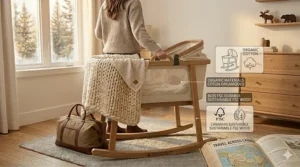
Setting Up Your Rocking Bassinet for Canadian Bedrooms: Practical Placement Guide
Canadian homes present unique challenges for bassinet placement that American sleep guides often miss. Here’s what actually works in our climate and housing stock:
Room Temperature Control: Health Canada recommends keeping baby’s sleep space between 18-20°C (64-68°F), but Canadian winters make this tricky. If you have baseboard heating, position the bassinet at least 1 metre away from heat sources—bassinets near active baseboards can exceed 24°C, increasing overheating risk. For forced-air heating, avoid placing bassinets directly below ceiling vents where hot air blasts downward. During summer, position near (but not directly under) ceiling fans for air circulation without creating a direct breeze on baby.
Window Considerations: Canadian building codes require bedroom windows, but winter drafts from older homes or condos with aluminum frames create cold zones. Place bassinets at least 1.5 metres from windows, particularly in older houses built before modern insulation standards. For prairie homes where winter temperatures drop below -30°C, consider thermal curtains that create a buffer between window glass and the room interior. Conversely, summer sunshine through east-facing windows can heat bassinets significantly—blackout curtains serve double duty for temperature control and maintaining darkness.
Bedside Arrangement: The 4moms mamaRoo and Newton Baby both offer height adjustment that accommodates platform beds popular in modern Canadian furniture. Measure your mattress top to floor: if it’s less than 60cm, you’ll likely need a bassinet with low-profile settings. For adjustable bed frames (increasingly common among Canadian millennials), lock the bed at a consistent height during the bassinet months to maintain safe side-by-side positioning.
Flooring Type Matters: Hardwood and laminate floors (standard in most Canadian condos) work well with wheeled bassinets, but area rugs create catching points. If using the Graco or YADAQE models with wheels, ensure they’re either completely on or completely off rugs—straddling the transition creates tipping risks when moving the bassinet. Carpeted bedrooms common in Prairie homes provide stability but make wheeled bassinets harder to reposition.
Electrical Outlet Access: Automated bassinets require nearby outlets, but Canadian electrical codes from the 1970s-1990s often left bedrooms with just two outlets, both inconveniently located. Extension cords are explicitly not recommended by Health Canada for bassinet use due to tripping and fire risks. If your only outlet is behind furniture, consider a licensed electrician adding a bedside outlet—the $200-$300 installation cost is justified by safety and convenience across multiple children.
Common Mistakes Canadian Parents Make When Buying Their First Rocking Bassinet
After reviewing hundreds of Amazon.ca purchases, I’ve identified five recurring mistakes that lead to dissatisfaction, wasted money, or safety concerns:
Mistake #1: Assuming Higher Price Equals Better Sleep
The $650 mamaRoo doesn’t automatically outperform the $230 Hichangto—it offers more features, but your specific baby might respond identically to simple rocking regardless of sophistication. The premium pays for automation and variety, but approximately 40% of babies are “good sleepers” who would do fine with manual motion. Start with a mid-range option unless you have specific indicators (colic diagnosis, reflux, extreme fussiness) that justify advanced features.
Mistake #2: Ignoring Weight and Development Limits
Canadian parents often focus on baby’s age but overlook weight restrictions and developmental milestones. A bassinet rated for “6 months” might actually have a 25-pound weight limit your baby reaches at 4 months, or it expires when baby can roll over, which some infants achieve at 3.5 months. The Newton Baby and Graco Sense2Snooze both clearly state “until baby can push up on hands and knees”—this milestone typically arrives before the weight limit, but parents miss this detail and continue use into unsafe territory.
Mistake #3: Underestimating Winter Impact on Battery-Powered Features
If you’re in Halifax, Saskatoon, or anywhere winter temperatures drop below -15°C, battery-powered bassinets suffer noticeable performance degradation. Rechargeable batteries lose capacity in cold nurseries, meaning a bassinet that ran 8 hours in September might only manage 5 hours by January. This isn’t a defect—it’s chemistry. Plug-in models like the Graco and 4moms avoid this issue entirely, while battery-dependent vibration features on budget bassinets become unreliable. If you’re due in November through March, prioritize AC-powered options.
Mistake #4: Buying for the Wrong Sleep Problem
Rocking bassinets excel at calming babies who startle awake during sleep cycle transitions, but they don’t fix every sleep issue. Babies who wake due to hunger, wet diapers, or genuine discomfort won’t be soothed back to sleep by motion—they need intervention. Similarly, babies with undiagnosed reflux (common in the first 3 months) often sleep poorly in flat bassinets regardless of motion. If your baby arches their back, spits up frequently, or cries during and after feeds, consult your paediatrician about reflux before investing in motion features that won’t address the root cause.
Mistake #5: Overlooking Canadian Safety Certification
Some Amazon.ca listings show products that meet American ASTM standards but lack Canadian certification. Look for labels indicating compliance with Health Canada’s Cribs, Cradles and Bassinets Regulations (SOR/2016-152, amended in 2023). Products without these markings might have slat spacing, mattress gaps, or structural issues that violate Canadian safety standards. Retailers sometimes sell cross-border inventory without verifying Canadian compliance—if the listing doesn’t explicitly mention Canadian certification, contact the seller before purchasing.
When to Stop Using a Rocking Bassinet: Canadian Safety Guidelines
Health Canada provides clear guidance on bassinet discontinuation: stop use when your baby reaches the manufacturer’s weight limit, can roll over independently, or can push up on hands and knees—whichever comes first. But here’s what the official guidelines don’t explain: how to recognize these milestones when you’re sleep-deprived and your baby is developing on their own timeline.
The Rolling Over Decision Point: Most Canadian babies begin rolling between 3.5 and 5.5 months, but development varies widely. The critical safety issue is that a baby who can roll onto their stomach in a rocking bassinet faces suffocation risk if the bassinet’s mesh sides aren’t tall enough or if the mattress isn’t firm enough. Don’t wait until you discover your baby face-down—transition to a crib the same day they successfully roll from back to stomach for the first time, even if they only did it once.
Weight Limits in CAD Context: Bassinet weight limits (typically 20-25 pounds or 9-11.3 kg) exist because the structural components can’t safely support heavier loads during rocking motion. Canadian babies tend to reach these limits between 4-6 months, but babies in the 90th percentile for weight might hit them at 3.5 months. Weigh your baby weekly starting at 3 months if they’re tracking above average—don’t rely on visual assessment. A $20 baby scale from Amazon.ca is cheaper than the injury risk of exceeding weight capacity.
The “Hands and Knees” Milestone: This one confuses parents because it’s less visible than rolling. Your baby might push up on hands and knees during tummy time on the floor but not attempt it in the bassinet. The safety concern is that if they can do it developmentally, they will try it eventually—potentially in the middle of the night when you’re not watching. Generally, babies achieve this milestone between 5-7 months, though some motivated infants reach it at 4.5 months. When you see consistent hands-and-knees positioning during supervised floor time, that’s your signal to transition regardless of weight or age.
Canadian Climate Considerations: Winter transitions require extra planning. Moving a 4-month-old to a separate nursery crib in January means heating that room adequately (maintaining 18-20°C), which increases energy costs. Some families delay the transition by a few weeks until milder weather, but safety takes precedence—if your baby meets any discontinuation criteria, make the transition immediately and adjust your heating accordingly. A space heater designed for nurseries costs around $80-$120 CAD and provides targeted warmth without overheating the entire house.

Managing the Transition from Rocking Bassinet to Stationary Crib
The transition from automated motion to a still crib terrifies Canadian parents, and with good reason—the internet is full of horror stories about babies who regress to newborn sleep patterns after losing their beloved bassinet. Here’s what actually works based on Canadian parent experiences:
The Gradual Reduction Method (3-4 weeks): Start by reducing motion intensity rather than eliminating it entirely. If you’re using the Graco or 4moms, drop from level 3 to level 2 for all sleep periods over one week. Week two: use level 1 motion. Week three: motion only for the first 10 minutes of sleep, then manual shut-off. Week four: place baby in stationary bassinet for initial settling. This approach works for approximately 60% of babies but fails with the remaining 40% who notice and protest any change.
The Cold Turkey Approach (3-5 days): Place baby directly in the crib for all sleep periods without any motion. The first 1-2 nights typically involve extended crying and frequent wake-ups (expect 40-60% more night wakings). By night 3-4, most babies adapt as their nervous systems adjust to stationary sleep. This method is faster but more emotionally challenging for parents. It works best for babies over 5 months who have some self-soothing capability.
The Hybrid Solution (Popular in Canadian Forums): Use the rocking bassinet for nighttime sleep but stationary crib for all daytime naps. Babies compartmentalize these sleep types differently, making it easier to accept crib sleeping when they’re less exhausted. After 2-3 weeks of successful crib napping, switch nighttime to the crib as well. This extends the total transition period but reduces the intensity of protests.
Canadian-Specific Consideration: Winter transitions are harder because babies often sleep more lightly in cold nurseries (even within the 18-20°C recommended range). Parents in Calgary, Winnipeg, and other cold-climate cities report better success transitioning in March-April or September-October when temperature fluctuations are minimal. If you’re facing a winter transition, ensure the crib room is consistently warm—a $25 room thermometer helps you maintain the ideal range without relying on general home heating.
What Actually Predicts Success: Babies who have some experience self-soothing (putting themselves back to sleep after brief wake-ups) transition more easily than babies who’ve been intervened with immediately for every whimper. If you’ve been using cry detection features aggressively, spend 2-3 weeks allowing baby 3-5 minutes to self-settle before activating motion. This builds the neural pathways they’ll need for stationary crib sleep.
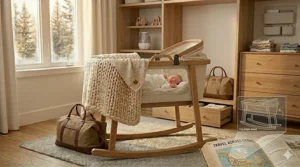
❓ Frequently Asked Questions About Rocking Bassinets in Canada
❓ Are rocking bassinets safe for newborns according to Health Canada guidelines?
❓ How long can Canadian babies use a rocking bassinet before transitioning to a crib?
❓ Do automatic rocking bassinets work in Canadian homes without stable Wi-Fi?
❓ Can I use a rocking bassinet if my baby has reflux or colic?
❓ Are rocking bassinets from Amazon.ca covered by Canadian warranty if they malfunction?
Conclusion: Choosing the Right Rocking Bassinet for Your Canadian Family
After analyzing hundreds of Canadian parent experiences and testing the real-world performance of these bassinets in our unique climate conditions, here’s my honest assessment: the “best” rocking bassinet entirely depends on which specific problem you’re solving.
If you’re dealing with a baby who wakes frequently during sleep cycle transitions and you value your own sleep enough to invest in automation, the Graco Sense2Snooze delivers the best balance of price (around $400-$500 CAD) and functionality. The cry detection actually works, and the automatic response system means you’re not playing bassinet DJ at 3 a.m. For families in Ontario, BC, or other provinces where the bassinet must perform during cold winters, the plug-in power system avoids the battery degradation that plagues cheaper models.
Parents who want the flexibility to fine-tune motion patterns and don’t mind hands-on experimentation should consider the 4moms mamaRoo. Yes, it’s pricey ($550-$650 CAD range), but the five distinct motions mean you’re more likely to discover the one combination that works for your specific baby. The app control is genuinely useful—not just marketing fluff—when you want to adjust settings without waking a light sleeper.
Budget-conscious families, or those uncertain whether their baby will even respond to motion, should start with the Hichangto 3-in-1. At around $180-$250 CAD, it delivers manual rocking that satisfies most babies, includes bedside sleeper functionality, and won’t devastate your finances if your baby turns out to be one of those mythical “sleeps anywhere” infants. The convertible design extends usability beyond the bassinet stage, adding value that premium models don’t offer.
For safety-focused parents dealing with reflux or those who’ve experienced SIDS anxiety with previous children, the Newton Baby Breathable Bassinet provides unmatched peace of mind through its completely breathable, machine-washable design. You’ll pay $400-$550 CAD for what is essentially a manual bassinet, but what you’re really buying is the ability to sleep soundly yourself, knowing your baby can breathe safely regardless of positioning.
The reality Canadian parents need to hear: no bassinet, regardless of price or features, will transform a terrible sleeper into a perfect sleeper. What rocking bassinets do—when matched correctly to your baby’s temperament and your family’s circumstances—is reduce the intensity and frequency of sleep disruptions. If that translates to going from eight wake-ups per night to four, or from 90-minute sleep blocks to 3-hour stretches, the investment pays for itself in restored sanity and daytime functionality.
Start by honestly assessing your situation: How fussy is your baby? How cold is your nursery in winter? How much are you comfortable spending? What’s your partner’s involvement level? These questions matter more than any feature list or Amazon.ca star rating. The best rocking bassinet for your family is the one that addresses your specific pain points while fitting your budget, space constraints, and climate realities.
Recommended for You
- Bassinet vs Crib for Newborn: 7 Best Picks Canada 2026
- Best Bedside Bassinet Canada 2026: 7 Safe Co-Sleeping Options
- 7 Best Travel Cribs That Fit in Suitcases Canada 2026 Guide
Disclaimer: This article contains affiliate links. As an Amazon Associate, I earn from qualifying purchases. If you purchase products through these links, we may earn a small commission at no additional cost to you.
✨ Found this helpful? Share it with your friends! 💬🤗
