
In This Article
Choosing between a glider vs rocking chair for nursery might feel like splitting hairs, but the decision will shape thousands of hours you’ll spend feeding, soothing, and bonding with your little one. I’ve spent the last decade helping Canadian parents navigate nursery furniture decisions, and this choice consistently ranks among the most important—yet most confusing—purchases on the checklist.
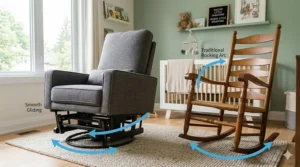
Here’s what most first-time parents don’t realize: the difference between gliding motion benefits and traditional rocker style goes far beyond aesthetics. A glider moves horizontally on a fixed track, creating that smooth vs rocking movement you’ll experience during 3 AM feedings. Traditional rockers pivot on curved legs with a more pronounced arc. Both calm babies effectively, but one might save your hardwood floors while the other fits better in that cramped Toronto condo nursery.
The Canadian market presents unique considerations. Our harsh winters mean you’ll likely spend more time indoors during those crucial first months. Space constraints in urban centres like Vancouver and Montreal favour compact designs. And with pricing on Amazon.ca typically running 15-20% higher than US equivalents due to import duties and exchange rates, making the right choice the first time matters for your budget. According to Health Canada’s consumer product safety regulations, nursery furniture must meet specific safety standards—something savvy Canadian parents should verify before purchasing.
This comprehensive nursery chair comparison will walk you through seven carefully vetted options available to Canadian buyers, real-world performance insights you won’t find in product descriptions, and the practical factors that actually matter when you’re sleep-deprived at 2 AM. We’ll break down which is better glider or rocker for different situations, decode the rocking chair buying guide essentials, and help you understand whether your family needs that smooth gliding motion or if traditional rocking will serve you better.
Quick Comparison: Gliders vs Rockers at a Glance
| Feature | Glider Chairs | Rocking Chairs |
|---|---|---|
| Motion Type | Horizontal, linear gliding on fixed track | Arc-shaped rocking on curved legs |
| Noise Level | Nearly silent operation | Can creak on hardwood floors |
| Floor Protection | Excellent—no contact point movement | Risk of scratching floors over time |
| Space Requirements | Requires 45-60 cm clearance behind | Needs 60-75 cm for full rock |
| Price Range (CAD) | $270-$800+ | $190-$600+ |
| Weight Capacity | Typically 135-180 kg | Usually 115-160 kg |
| Best For Canadian Buyers | Condo dwellers, hardwood floors, long feeding sessions | Larger spaces, budget-conscious, traditional aesthetic |
Looking at this comparison, the glider edges ahead for most urban Canadian families. The silent operation means you won’t wake a sleeping baby when you stand up—crucial in smaller spaces where the nursery might share a wall with your bedroom. That smooth gliding motion also reduces strain on your lower back during marathon cluster-feeding sessions, something that becomes painfully apparent around week three postpartum. However, if you’re working with a tighter budget or have your heart set on a classic wooden rocker that could become a family heirloom, traditional rockers deliver excellent value and that nostalgic aesthetic many Canadian families cherish.
The floor protection factor matters more than most realize. Canadian winters mean tracking in salt, sand, and moisture that can damage hardwood—rockers’ constant friction amplifies this wear, while gliders stay stationary. For families in rental properties or condos with strict flooring damage policies, this distinction could save you hundreds in deposit deductions.
💬 Just one click — help others make better buying decisions too! 😊
Top 7 Nursery Chairs Available on Amazon.ca: Expert Analysis
1. MAMAZING Lullapod Power Nursery Recliner — The Premium All-in-One Champion
The MAMAZING Lullapod represents the current gold standard in nursery seating, and it’s readily available to Canadian buyers through Amazon.ca. This isn’t just a glider—it’s a triple-motor power recliner that combines gliding, swiveling (270°), and full electric recline with what MAMAZING calls “HugAssist” armrests that actually move to support your arms during feeding.
Key Specifications: Triple motor system, 270° swivel capability, dual USB charging ports (USB-A and USB-C), removable washable covers, weight capacity around 160 kg, available in multiple fabric options including performance materials resistant to spills. The chair measures approximately 76 cm wide, making it suitable for most nursery layouts while still providing generous seating space.
Why This Stands Out: What most parents discover after purchase is how the adjustable armrests eliminate that numbness you get in your left arm during long breastfeeding sessions on that side. The triple-motor system means the footrest, backrest, and lumbar support all adjust independently—you’re not locked into preset positions like cheaper recliners. For Canadian buyers dealing with postpartum recovery during winter months when getting outside feels impossible, this chair becomes your sanctuary.
Customer Feedback: Canadian reviewers consistently praise the chair’s performance during Canadian winters, noting it’s comfortable enough for those extended indoor days. The USB ports get mentioned in nearly every review—keeping your phone charged during marathon feeding sessions matters more than you’d think. Some users note the chair runs on the heavier side (around 45 kg), making repositioning challenging without help.
Pros:
✅ Triple-motor customization beats any fixed-position chair
✅ 270° swivel lets you reach the change table without standing
✅ Performance fabric handles inevitable spit-up disasters
Cons:
❌ Premium pricing in the $750-$850 CAD range
❌ Heavy weight makes moving difficult
Value Verdict: If your budget allows, this chair justifies its premium price tag through features that directly address real parenting challenges. Canadian families report using it well beyond the nursery years—it transitions beautifully to a home office or reading nook. At around $800 CAD, you’re paying roughly $2 per day over a conservative three-year use period.
2. CANMOV Swivel Rocker Recliner — Best Manual Glider for Budget-Conscious Canadians
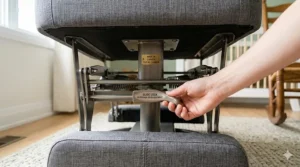
The CANMOV Swivel Rocker hits that sweet spot between functionality and affordability that appeals to Canadian buyers watching exchange rates. This manual recliner combines 360° swivel, smooth gliding, and reclining capability without the premium price tag of power options.
Key Specifications: Manual recline lever, 360° swivel base, smooth glider mechanism, weight capacity approximately 135 kg, available in neutral colours (cream, grey, white) that suit Canadian design aesthetics. Dimensions around 72 cm wide fit comfortably in most nursery spaces.
Expert Perspective: What separates this from similar budget options is the quality of the glider mechanism. Many chairs in this price range ($350-$450 CAD) sacrifice smooth motion for cost savings—the CANMOV maintains consistent glide quality even after months of daily use. The manual recline works reliably, though you’ll need both hands free to operate it (not ideal when holding a sleeping baby). For Canadian buyers in apartments or condos where space comes at a premium, the swivel function compensates for cramped quarters by letting you rotate toward windows, change tables, or cribs without the chair requiring additional clearance.
Customer Feedback: Amazon.ca reviewers frequently mention this chair “punches above its weight class.” The assembly takes about 30 minutes with clear instructions. Some taller users (over 183 cm) report wishing for more legroom, but average-height Canadians find it comfortable. The neutral fabric options coordinate easily with popular Canadian nursery colour schemes.
Pros:
✅ Mid-range pricing around $400 CAD makes premium features accessible
✅ 360° swivel maximizes functionality in small spaces
✅ Reliable glider mechanism that stays smooth over time
Cons:
❌ Manual recline requires two hands
❌ Legroom limited for taller users
Value Verdict: This represents the floor for “buy it right the first time” quality in gliders. Anything significantly cheaper sacrifices durability or comfort you’ll regret six months in. At the $350-$450 CAD range, Canadian families get solid value without the premium power features.
3. Nurture& The Glider Plus Premium Power Recliner — Top Pick for Breastfeeding Support
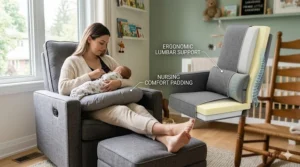
The Nurture& Glider Plus was engineered specifically with nursing mothers in mind, featuring adjustable lumbar support and a headrest that actually makes those 45-minute cluster-feeding sessions manageable. Available on Amazon.ca with Prime shipping to most Canadian addresses.
Key Specifications: Power recline with quiet motor, adjustable lumbar support, adjustable headrest, built-in USB charging, 360° swivel, weight capacity around 150 kg. The chair’s proportions (approximately 75 cm wide) provide generous space without overwhelming smaller nurseries common in Canadian urban housing.
Real-World Analysis: The adjustable lumbar support isn’t just marketing fluff—it addresses the specific lower back strain that develops when you’re feeding in the same position multiple times daily. Canadian physiotherapists who specialize in postpartum recovery often recommend proper lumbar support during feeding to prevent long-term issues. The headrest adjustment matters particularly for taller Canadian users who find standard chair backs hit at awkward heights. This chair accommodates body types from 157 cm to 188 cm comfortably.
Customer Feedback: Nursing mothers on Amazon.ca consistently rate this chair highly for extended feeding sessions. The built-in USB port placement is more practical than competitors’—within easy reach without being in the way. Several Canadian reviewers mention using this through two children without noticeable wear. The ivory colour option shows some staining over time despite spot cleaning, according to long-term users.
Pros:
✅ Adjustable lumbar support prevents postpartum back problems
✅ Headrest customization accommodates various heights
✅ Quiet power motor won’t wake sleeping babies
Cons:
❌ Light-coloured fabrics show wear faster
❌ Premium pricing in the $650-$750 CAD range
Value Verdict: For nursing mothers planning extended breastfeeding (beyond 12 months), the ergonomic features justify the premium pricing. Canadian families dealing with c-section recovery particularly appreciate the gentle power recline that doesn’t require core engagement. Around $700 CAD puts this in the investment category, but it’s an investment in your physical wellbeing.
4. NIOIIKIT Corduroy Upholstered Rocking Chair — Best Traditional Rocker Under $300 CAD
The NIOIIKIT Corduroy Rocking Chair brings classic rocking chair styling into the modern era with practical updates like built-in side pockets and adjustable footrest—all at a price point that won’t shock Canadian buyers already dealing with elevated baby gear costs.
Key Specifications: Traditional curved rocker legs, corduroy upholstery (available in cream, grey, dark green), adjustable footrest, dual side pockets for essentials, weight capacity approximately 135 kg. Compact footprint around 70 cm wide suits smaller Canadian nurseries.
Why Choose a Traditional Rocker: Despite gliders dominating discussions, traditional rockers offer distinct advantages that resonate with certain Canadian families. The more pronounced rocking motion some parents find more effective for colicky babies—that deeper arc mimics the swaying many babies prefer. The lighter weight (around 22 kg versus 35-45 kg for most gliders) means you can easily reposition it, helpful in multi-purpose rooms common in Canadian homes. And there’s something deeply comforting about that nostalgic aesthetic, especially for families incorporating heirloom pieces into their nursery.
Customer Feedback: Amazon.ca reviewers appreciate the quality at this price point (around $280-$320 CAD). The corduroy fabric provides good grip—you won’t slide around during use. Several Canadian buyers mention using furniture pads under the rockers to protect hardwood floors, noting this adds about $15 CAD but prevents damage. The side pockets genuinely hold burp cloths, remote controls, and phones without feeling flimsy.
Pros:
✅ Budget-friendly pricing under $300 CAD
✅ Lightweight design enables easy repositioning
✅ Traditional aesthetic appeals to heritage-minded families
Cons:
❌ Requires floor protection for hardwood
❌ Rocking motion can disturb sleeping babies when you stand
Value Verdict: This hits the sweet spot for Canadian families wanting classic rocker styling without the premium pricing. At under $300 CAD, it delivers solid value if you’re willing to accept a rocker’s limitations regarding floor protection and noise.
5. Skandiquip Nursery Rocking Chair — Canadian-Friendly Safety Features
The Skandiquip Rocking Chair incorporates anti-tip safety design—a feature that matters more in Canadian homes where winter clothing, heavy blankets, and occasional floor clutter create tripping hazards. This chair was clearly designed with real-world parenting chaos in mind.
Key Specifications: Anti-tip safety design, cotton fabric cover (removable for washing), 440-lb (200 kg) weight capacity—significantly higher than most competitors, modern curved rocker design, available in white and beige. Dimensions accommodate larger body types comfortably without taking excessive floor space.
Safety-First Design Philosophy: The anti-tip mechanism prevents the chair from pitching backward if you lean too far while reaching for something—a real risk with traditional rockers that Canadian parents with toddlers particularly appreciate. That 200 kg weight capacity means two parents can safely use the same chair, relevant for families where both parents participate in nighttime routines. The removable cotton cover washes easily, crucial when dealing with Canadian winter germs and inevitable infant messes.
Customer Feedback: Canadian buyers specifically mention the stability factor in reviews. Several users with older children note the anti-tip design provides peace of mind when their toddler climbs onto the chair (not recommended, but it happens). The cotton fabric breathes well—important during summer months in homes without air conditioning, common across much of Canada. Assembly takes roughly 20 minutes with minimal tools required.
Pros:
✅ Anti-tip safety design prevents dangerous backward pitching
✅ Exceptional 200 kg weight capacity accommodates all body types
✅ Removable, washable cotton cover simplifies maintenance
Cons:
❌ Traditional rocker design requires floor protection
❌ Limited colour options may not suit all nursery schemes
Value Verdict: At around $350-$420 CAD on Amazon.ca, this chair justifies its pricing through superior safety features and build quality. Canadian families with multiple children particularly appreciate the durability—this chair survives successive babies without structural issues.
6. GarveeHome Teddy Fleece Rocking Chair — Cozy Comfort for Canadian Winters
The GarveeHome Teddy Fleece model addresses a distinctly Canadian need: warmth during those brutal February nights when you’re feeding a baby at 3 AM and the thermostat is set to 18°C to save on heating bills. The teddy fleece upholstery provides inherent insulation without feeling bulky.
Key Specifications: Plush teddy fleece upholstery, high backrest (approximately 102 cm) for full upper body support, 300-lb (136 kg) weight capacity, gliding rocker mechanism that combines gentle rocking with smooth forward motion, available in cream and brown. Footprint around 71 cm wide fits most nursery layouts.
Canadian Winter Optimization: What makes this chair particularly relevant for Canadian buyers is how the teddy fleece performs when ambient temperatures drop. Unlike smooth leather or performance fabrics that feel cold to the touch, teddy fleece maintains warmth—you won’t recoil when you sit down at 2 AM. The material also provides natural grip, preventing the sliding that occurs with slippery fabrics when you’re wearing flannel pajamas. The high backrest matters more in Canadian climates where you’re likely wearing layers—the extra height accommodates bulky sweaters without compromising support.
Customer Feedback: Amazon.ca reviewers consistently mention the comfort factor. The plush material requires occasional vacuuming to maintain appearance—teddy fleece attracts lint and pet hair more than smooth fabrics. Some users report the fleece pills slightly after 8-10 months of daily use, though this doesn’t affect functionality. Canadian buyers in colder provinces (Alberta, Saskatchewan, Manitoba) particularly appreciate the warmth factor during winter months.
Pros:
✅ Teddy fleece stays warm during cold Canadian nights
✅ High backrest accommodates layered winter clothing
✅ Hybrid gliding-rocking mechanism offers motion variety
Cons:
❌ Teddy fleece requires more frequent cleaning
❌ Material may pill over time with heavy use
Value Verdict: At around $300-$380 CAD, this chair delivers exceptional comfort for Canadian families prioritizing coziness during long winter months. The teddy fleece adds roughly $50 CAD to similar chairs with standard upholstery, but that premium pays dividends during overnight feeds when temperatures drop.
7. Storkcraft Tuscany Glider and Ottoman — Complete Package Value
The Storkcraft Tuscany bundle includes a matching ottoman—something most chairs charge $150-$250 CAD extra for—making this combination excellent value for Canadian buyers looking for complete nursery seating. Available through Amazon.ca with reliable shipping across provinces.
Key Specifications: Glider plus matching ottoman, cleanable upholstered comfort in multiple fabric patterns (taupe swirl, grey, beige), solid wood construction, weight capacity approximately 135 kg, removable lumbar pillow included. The glider measures roughly 69 cm wide; ottoman is 51 cm wide—both compact enough for typical Canadian nursery dimensions.
Bundle Advantage Analysis: Here’s the math that matters for Canadian families: buying a quality glider and ottoman separately typically costs $400-$500 + $150-$250 = $550-$750 CAD total. The Storkcraft bundle runs around $450-$550 CAD on Amazon.ca—savings of $100-$200 CAD compared to piecing together equivalent quality separately. The ottoman isn’t just decorative; it actually locks to glide in sync with the chair, creating that full-body rocking experience many parents prefer for evening soothing sessions.
Customer Feedback: Canadian reviewers frequently mention this bundle’s value proposition. The assembly process takes 45-60 minutes for the complete set but doesn’t require advanced skills. The fabric patterns (particularly the taupe swirl) hide stains better than solid colours—practical for Canadian parents who might go several days between spot cleaning during those overwhelming newborn weeks. Several buyers mention using this set in their living room after the nursery phase, confirming the furniture’s durability and style longevity.
Pros:
✅ Bundle pricing saves $100-$200 CAD versus buying pieces separately
✅ Ottoman locks to glide in sync with chair
✅ Multiple fabric patterns help conceal inevitable stains
Cons:
❌ Longer assembly time for complete set
❌ Standard features without premium upgrades
Value Verdict: For Canadian families budget-conscious but refusing to compromise quality, this bundle hits the target. At around $500 CAD for both pieces, you’re getting solid construction and practical features without paying for bells and whistles you might not need.
Setting Up Your Nursery Chair for Canadian Success: A Practical Guide
Getting maximum value from your glider vs rocking chair for nursery investment requires more than just ordering the right model on Amazon.ca—proper setup and maintenance ensure it performs optimally through thousands of feeding sessions and countless hours of use.
Strategic Placement Considerations
Position your chair within arm’s reach of essential items: change table, crib, nightstand with burp cloths and feeding supplies. Canadian parents in smaller spaces should place gliders near corners to maximize their minimal clearance requirements—that 45-60 cm behind the chair is less than rockers’ 60-75 cm needs. For families in apartments with shared walls, positioning your chair away from common walls prevents disturbing neighbours during late-night sessions.
Consider natural light carefully. Morning sun creates beautiful nursery ambiance but can overheat during feeding sessions. Canadian summers get surprisingly hot, even in northern regions—afternoon sun streaming through west-facing windows makes feeding uncomfortable June through August. Position chairs perpendicular to windows when possible, or invest in proper window treatments (blackout cellular shades run $80-$150 CAD but regulate temperature year-round).
Floor Protection for Canadian Homes
This detail separates experienced Canadian parents from first-timers: floor protection matters significantly more here than in milder climates. Winter tracking brings salt, sand, and moisture that accelerates wear under rocking chairs. Install furniture pads or glides under rocker legs—good quality versions cost $15-$30 CAD at Canadian Tire or Home Hardware. For gliders, use a low-pile area rug (not high-pile—that interferes with gliding mechanisms) underneath to protect hardwood and reduce noise transmission to units below if you’re in a condo.
Hardwood floors expand and contract with Canadian temperature swings—that gorgeous maple flooring installed in August will behave differently come February. Position chairs considering this seasonal movement. Avoid placing heavy furniture against walls during heating season when indoor humidity drops; leave 2-3 cm clearance to prevent scratching as wood contracts.
Winterization and Year-Round Maintenance
Canadian winters demand specific considerations rarely mentioned in standard care guides. Keep lubricant spray (like WD-40) handy for glider mechanisms—low humidity during heating season can cause metal tracks to stiffen or squeak. Apply a thin coat every 4-6 weeks from November through March. For rockers, check curved legs monthly for splits or cracks; dry indoor air can cause wood to check or split, especially around joints.
Fabric care varies by season. Summer humidity promotes mould in poorly ventilated nurseries—run a dehumidifier if moisture becomes visible on windows. Remove and wash fabric covers monthly during summer, every six weeks during dry winter months. Spot clean spills immediately using cold water and mild detergent; hot water sets protein-based stains from breast milk or spit-up. For teddy fleece or corduroy upholstery, vacuum weekly using the upholstery attachment to prevent lint buildup.
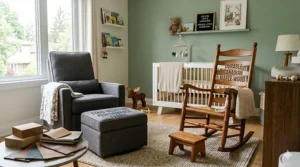
Which Is Better Glider or Rocker: Matching Chair to Your Canadian Family
The glider vs rocking chair for nursery debate doesn’t have a universal answer—the superior choice depends entirely on your specific situation, space constraints, budget, and personal preferences.
When Gliders Win for Canadian Families
Urban condo dwellers: If you’re furnishing a 650-square-foot Toronto condo or a 750-square-foot Vancouver apartment, gliders’ minimal clearance requirements (45-60 cm behind) let you utilize limited nursery space more efficiently. The silent operation matters exponentially more when your nursery shares a wall with your bedroom or a neighbour’s unit.
Hardwood floor owners: Canadian homes increasingly feature beautiful hardwood flooring—protecting that investment matters. Gliders eliminate the constant friction rockers create against floors, preventing scratches that reduce resale value or cost hundreds in damage deposits when you move.
Nighttime feeding priority: Parents handling most feeds overnight benefit from gliders’ smooth, gentle motion that soothes babies without the jarring stops/starts rockers create when you shift weight. That seamless motion continues even as you drowse off—beneficial during those 4 AM feeds when you’re barely conscious yourself.
Long-term ergonomic needs: If you’re planning extended breastfeeding (18+ months), have existing back problems, or are recovering from c-section surgery, gliders’ superior lumbar support and smooth motion reduce strain during marathon feeding sessions. Canadian mothers pursuing PHAC (Public Health Agency of Canada) breastfeeding recommendations of exclusive breastfeeding for six months particularly benefit from proper ergonomic support.
When Traditional Rockers Serve Canadian Families Better
Budget constraints: Quality rockers start around $190-$280 CAD on Amazon.ca—roughly $100-$200 CAD less than comparable gliders. For Canadian families managing tight budgets while equipping a nursery, that differential might cover a quality car seat or several months of diaper expenses.
Heritage aesthetic preference: Families incorporating vintage or heirloom pieces into nursery design often find gliders’ modern appearance clashes with traditional decor. A beautiful wooden rocker complements antique cribs, vintage dressers, and classic Canadian design elements popular in older homes.
More pronounced motion preferred: Some babies respond better to traditional rocking’s deeper arc—that distinct forward-backward motion more closely mimics in-utero sensations. Parents with particularly fussy or colicky babies sometimes find traditional rocking more effective than gliding for inducing sleep.
Easy repositioning needed: Rockers typically weigh 10-15 kg less than gliders (22-27 kg versus 35-45 kg). Canadian families frequently moving furniture—seasonal room swaps common in smaller homes, or regular visits to grandparents who need nursery furniture temporarily—benefit from rockers’ portability.
The Hybrid Compromise
Several models reviewed above (like the GarveeHome Teddy Fleece) combine gliding and rocking mechanisms, offering both motion types. These hybrids typically cost $50-$100 CAD more than single-motion chairs but provide flexibility to experiment and discover which motion your specific baby prefers. Canadian families with multiple children often appreciate this versatility—your first child might prefer gliding while your second responds better to traditional rocking.
Nursery Chair Comparison: Features That Actually Matter in Canada
Beyond the basic glider vs rocking chair distinction, several features dramatically impact long-term satisfaction—yet manufacturers rarely explain their practical implications for Canadian users.
Swivel Function: Urban Essential or Unnecessary Luxury?
360° swivel capability adds $75-$150 CAD to chair pricing. Is it worth it? For Canadian families in spaces under 150 square metres, absolutely. Swivel function lets you rotate toward the crib, change table, or bedroom door without standing—invaluable when you’ve finally gotten a baby to sleep and don’t want to risk waking them. In open-concept layouts increasingly popular in Canadian new builds and condo developments, swivel chairs let you rotate between nursery activities and keeping an eye on older siblings or meal prep in adjacent spaces.
However, families with dedicated nurseries exceeding 12 square metres and chair placement optimized for natural flow patterns might find swivel unnecessary. Analyze your specific layout: if you’ll primarily move between chair and crib only, stationary chairs suffice. If you need to access change table, door, window, and storage from your seated position, invest in swivel.
Recline Function: Manual vs. Power
Power recline adds $200-$350 CAD versus manual recline. The convenience justifies premium pricing in specific circumstances: c-section recovery where engaging core muscles to operate manual recline causes pain; families where both parents use the chair and prefer different recline angles; or households with mobility challenges where operating manual levers proves difficult.
Manual recline serves most Canadian families well, assuming you understand the limitation—you need both hands free to operate it. This means you cannot recline while holding a sleeping baby, something parents discover too late. Power recline lets you adjust position mid-feeding or while holding a baby, but requires electrical outlet access and adds mechanical complexity that can eventually require maintenance.
Ottoman Inclusion: Worth the Extra CAD?
Matching ottomans add $100-$200 CAD when purchased separately. They provide legitimate ergonomic benefit—elevated feet reduce lower leg swelling common postpartum and improve circulation during extended sitting. For Canadian parents taller than 175 cm, ottomans provide essential leg support that standard footrests don’t accommodate.
However, ottomans occupy additional floor space (typically 51 x 51 cm)—problematic in smaller nurseries. Some gliders include integrated footrests that deploy when reclined, eliminating ottoman needs entirely. Evaluate your specific situation: if your nursery can accommodate the footprint and your height exceeds 173 cm, ottomans significantly improve comfort. Shorter users in cramped spaces might skip them without major comfort sacrifice.
Fabric Performance for Canadian Climates
Performance fabric (water and stain-resistant) costs $50-$125 CAD more than standard upholstery but drastically reduces maintenance burden. Canadian parents dealing with spit-up, diaper blowouts, and toddler snacks spilled in the nursery benefit enormously from wipeable surfaces. Standard fabric requires spot cleaning that doesn’t always succeed; performance fabric handles the same spills with a damp cloth.
Leather alternatives look attractive but perform poorly in Canadian temperature extremes—cold to touch during winter (uncomfortable at 2 AM), sticky during summer humidity. Fabric breathes better across seasons. Teddy fleece, while cozy in winter, can feel uncomfortably warm June through August. Consider your home’s climate control: if you maintain consistent temperature year-round, texture matters less. If you set thermostats to 16°C overnight in winter for sleeping, choose warmer fabrics.
Common Mistakes Canadian Parents Make When Buying Nursery Chairs
Mistake 1: Ordering Without Measuring
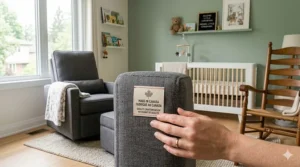
Canadian homes built before 1990 often feature smaller doorways (76 cm standard) and narrower hallways than modern construction. I’ve watched countless parents order perfect chairs that won’t physically fit through their doorway or navigate the turn from hallway into nursery. Measure three dimensions: doorway width, hallway turn radius, and final placement clearance.
Most chairs on Amazon.ca list assembled dimensions in product descriptions—verify these measurements before ordering. Account for delivery method: large chairs often arrive in multiple boxes requiring assembly inside the room, but some ship pre-assembled. Check seller specifications regarding packaging. For apartments with elevators, measure elevator door width and interior depth; some chairs require freight elevator access.
Mistake 2: Ignoring Provincial Shipping Realities
Free shipping on Amazon.ca typically requires $35 minimum purchase, but “free shipping” doesn’t guarantee timeline. Canadian parents in remote or northern communities (anywhere beyond major urban centres) face extended delivery times—sometimes 3-4 weeks for furniture. Order nursery chairs during second trimester, not third, to avoid situations where baby arrives before chair does.
Some Amazon.ca sellers specifically exclude certain provinces or territories from free shipping promotions. Read fine print carefully: furniture items frequently incur surcharges for delivery to Atlantic Canada, Manitoba, Saskatchewan, and all three territories. These fees can add $75-$200 CAD to advertised prices. Budget accordingly and verify actual delivered pricing before committing.
Mistake 3: Overlooking Weight Capacity for Breastfeeding Positions
Standard weight capacity (135 kg) assumes single-person use. However, many Canadian mothers use supportive breastfeeding pillows (Boppy, My Brest Friend) adding 1-2 kg, plus the baby’s growing weight. More significantly, some nursing positions involve the partner providing support or assistance—two adults partially sharing chair weight temporarily. Chairs rated for 135 kg approach limits in these scenarios; 150-200 kg capacity provides comfortable safety margin.
This becomes particularly relevant for Canadian families where both parents participate in nighttime routines. If you envision both adults occasionally using the chair simultaneously—one holding baby while the other provides bottle, burp cloth, or simple emotional support—invest in higher weight capacity models.
Mistake 4: Prioritizing Aesthetics Over Fabric Practicality
Instagram-worthy nurseries feature gorgeous chairs in pristine white or cream fabric. Reality features babies who projectile vomit, diaper leaks that defy physics, and toddler siblings who sneak juice boxes into the nursery. Light-coloured fabric without stain protection becomes a source of stress, not tranquility.
Canadian parents should prioritize dark-ish medium tones (grey, taupe, muted blues/greens) with performance fabric treatment. These colours conceal inevitable stains while maintaining attractive appearance. Save the pristine white aesthetic for homes where you employ full-time help or possess superhuman cleaning motivation. Most Canadian families benefit more from practical choices that reduce daily stress.
Smooth vs Rocking Movement: The Science Behind Soothing
Understanding the biomechanics behind different motion types helps explain why some babies respond better to specific chairs—knowledge that can guide your purchasing decision.
How Gliding Motion Benefits Infant Calming
Gliders create horizontal, linear movement that closely mimics the motion babies experienced in utero when mothers walked. Research from pediatric sleep specialists suggests this horizontal motion engages infants’ vestibular system (inner ear balance mechanisms) more gently than rocking’s vertical arc. The consistent, predictable glide rhythm helps establish the regular sensory input babies find soothing.
For Canadian babies dealing with colic or reflux—conditions that affect 10-25% of infants according to Canadian Paediatric Society data—gliding’s gentle motion proves less disruptive to sensitive digestive systems than traditional rocking. The smooth horizontal plane doesn’t create the slight vertical bouncing inherent in rockers, which can trigger discomfort in babies with reflux issues.
Traditional Rocker Style: When Arc Motion Works Better
Conversely, some babies respond more positively to traditional rocking’s pronounced arc. The deeper, more obvious motion provides stronger vestibular input—beneficial for babies who need more intense sensory stimulation to calm. Occupational therapists working with infants sometimes recommend traditional rockers for babies demonstrating sensory-seeking behaviors (constantly wanting vigorous motion, difficulty settling with gentle movement).
The rocking motion also more closely mimics specific cultural holding and soothing practices common in many Canadian immigrant communities. Families maintaining traditional child-rearing practices from countries where vigorous rocking represents standard infant soothing may find traditional rockers align better with their cultural approach to parenting.
Individual Baby Variation
Here’s the reality that furniture marketing doesn’t acknowledge: babies’ motion preferences vary dramatically. Your friend’s baby might have slept beautifully with gentle gliding while yours screams until you provide more vigorous rocking. This individual variation means the “perfect” chair is the one YOUR specific baby responds to—something you won’t definitively know until after birth.
This unpredictability argues for purchasing mid-range chairs rather than premium options if budget is constrained. A $400 CAD glider that your baby tolerates serves you better than an $800 CAD glider they hate, necessitating additional purchase of a rocker they prefer. Consider Amazon.ca’s return policies (often 30 days for furniture) when making your selection—keep packaging materials until you’ve verified the chair meets your baby’s needs.
Long-Term Value: Will You Use This Chair Beyond Nursery Years?
Canadian parents spending $300-$800 CAD on nursery chairs naturally wonder about long-term value—will this expensive furniture gather dust after a few years, or provide ongoing utility justifying the investment?
Transition to Living Spaces
Quality gliders transition beautifully to living rooms, home offices, or primary bedrooms once nursery days end. Neutral fabric choices (greys, taupes, charcoal) coordinate with evolving decor schemes through your home’s lifespan. Canadian families in open-concept homes can relocate nursery gliders to reading nooks or beside fireplaces, providing comfortable seating for years beyond childcare.
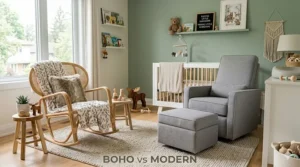
Traditional rockers carry stronger aesthetic identity—that classic silhouette clearly signals “rocking chair” regardless of placement. While this works beautifully in heritage homes embracing traditional Canadian design, it may clash with contemporary or minimalist aesthetics dominating urban Canadian condo design. Consider your home’s overall style when selecting: will this chair integrate into multiple rooms as your needs evolve, or become that piece relegated to basement storage?
Resale Market for Canadian Baby Gear
Facebook Marketplace and Kijiji demonstrate strong demand for quality used nursery furniture across Canadian provinces. Well-maintained gliders from reputable manufacturers retain 50-65% of original value after 2-3 years of use. Performance fabric models command premium pricing; standard fabric shows wear more obviously, reducing resale value.
Traditional wooden rockers actually hold value better than upholstered pieces—solid wood construction survives decades if properly maintained. Canadian buyers seeking vintage or heirloom-quality pieces actively hunt well-maintained rockers, sometimes paying 70-80% of original retail for quality examples. If you’re confident in your ability to maintain furniture and anticipate selling after your family is complete, factor resale value into your purchase decision.
Multi-Child Considerations
Canadian families planning multiple children (average 1.9 children per family according to Statistics Canada) should invest in durable chairs that survive successive babies. Construction quality matters enormously: gliders with metal frames outlast plastic mechanisms; chairs with removable, washable covers maintain appearance better than permanently upholstered options.
Budget accordingly for durability if you’re planning 2-3 children. A $600 CAD chair serving three babies costs $200 per child—justifiable investment. A $300 CAD chair requiring replacement after one child costs the same $300 per child—false economy. For Canadian families certain they want multiple children, prioritize build quality and washable fabrics over cutting-edge features that might prove gimmicky.
❓ FAQ: Your Nursery Chair Questions Answered
❓ Can I use a glider on carpeted floors in Canadian homes?
❓ How much does shipping add to Amazon.ca nursery chair prices?
❓ Do gliders require more maintenance than rocking chairs in Canadian climates?
❓ Can I wash glider or rocker cushions in Canadian washing machines?
❓ Will my nursery chair fit through apartment elevators and doorways?
Conclusion: Making Your Final Decision on Glider vs Rocking Chair for Nursery
After reviewing seven excellent options available on Amazon.ca, analyzing the glider vs rocking chair for nursery debate from multiple angles, and addressing the specific considerations Canadian families face, you’re equipped to make an informed decision that serves your family’s needs for years.
The “best” chair isn’t the one with the most features or highest price tag—it’s the chair that matches your specific situation. Urban Canadian families in condos or apartments under 100 square metres typically benefit most from gliders’ space efficiency and silent operation. The smooth gliding motion benefits most babies most of the time, particularly those with reflux or sensitive digestive systems. Families in larger homes with traditional design aesthetics might find classic rockers better suit their space and style while delivering the pronounced motion some babies prefer.
Consider your budget realistically. That $800 CAD power glider delivers amazing features, but a $400 CAD manual option provides 90% of the functionality for 50% of the cost. Canadian families facing the $10,000-$15,000 total cost of equipping a nursery must allocate funds strategically—sometimes choosing a mid-range chair lets you invest more in a quality car seat, crib mattress, or other safety-critical items.
Don’t underestimate the importance of your partner’s input. If you’re breastfeeding, you’ll log more hours in this chair—but your partner will use it too. Test chairs together if possible, or at minimum discuss priorities: does one of you have existing back problems suggesting specific ergonomic needs? Do height differences mean you need more adjustability than standard chairs provide?
Finally, remember that while this purchase matters, it doesn’t make or break your parenting success. Babies thrived for millennia before ergonomic nursery gliders existed. You’ll manage beautifully regardless of whether you choose a glider or rocker, high-end or budget option. Make the best decision you can with available information and budget, then move forward confidently to more important preparation—like figuring out how to install that car seat properly and getting some sleep before your life changes forever.
For more Canadian parenting resources and nursery setup guidance, explore our other articles covering everything from crib selection to creating safe sleep environments compliant with Health Canada guidelines.
🌟 Recommended for You
- 7 Best Nursery Gliders That Canadian Parents Love 2026
- 7 Smart Nursery Storage Solutions Small Rooms Canada 2026
- Best Hanging Diaper Caddy Canada 2026: 7 Top Picks
Disclaimer: This article contains affiliate links. As an Amazon Associate, I earn from qualifying purchases. If you purchase products through these links, we may earn a small commission at no additional cost to you.
✨ Found this helpful? Share it with your friends! 💬🤗
