
In This Article
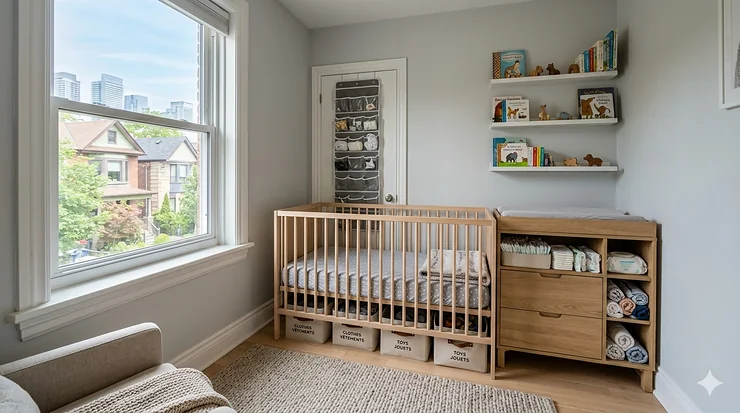
Creating a functional nursery in a compact Canadian condo or older home with smaller bedrooms presents unique challenges that parents across Toronto, Vancouver, and Montreal know all too well. When you’re working with 2.4 to 3 metres (8 to 10 feet) of usable floor space, every storage decision matters significantly more than it would in a spacious suburban nursery.
The reality is that babies require an astonishing amount of gear—diapers, clothing in multiple sizes, blankets, toys, books, and feeding supplies—yet Canadian urban homes rarely offer the luxury of dedicated storage rooms. What makes this particularly challenging for Canadian families is that our seasonal clothing needs are extensive. You’re not just storing summer onesies; you’re managing winter sleepers, spring transition pieces, and bulky snowsuits that occupy precious drawer space.
Smart nursery storage solutions for small rooms aren’t about cramming more items into less space—they’re about strategically selecting furniture and organizational systems that serve multiple purposes while growing with your child. The best approach combines vertical storage to capitalize on wall space, multi-functional furniture that eliminates redundancy, and clever under-crib storage ideas that transform wasted space into valuable real estate. Throughout this guide, I’ll share expert analysis on products available through Amazon.ca, real-world Canadian scenarios, and practical transformation strategies that address the specific challenges of organizing a nursery in limited square footage.
Quick Comparison: Top Storage Solutions at a Glance
| Product Type | Best For | Space Saved | Price Range (CAD) |
|---|---|---|---|
| Floating Wall Shelves | Vertical storage, books | 1-1.5 m² floor space | $40-$80 |
| Cotton Rope Diaper Caddy | Portable essentials | Counter/dresser space | $35-$55 |
| Fabric Storage Cubes (4-pack) | Closet organization | 0.5 m² floor space | $30-$50 |
| 3-Tier Rolling Cart | Mobile changing station | Flexible positioning | $45-$90 |
| Drawer Organizers (8-piece) | Dresser efficiency | 40% more capacity | $25-$40 |
| Natural Wood Book Ledges | Display & storage | 0.8 m² floor space | $50-$85 |
| Hanging Crib Organizer | Immediate access items | Eliminates side table | $25-$45 |
Looking at this comparison, the most versatile investment for Canadian parents dealing with small nurseries is the combination of floating wall shelves and fabric storage cubes. Wall-mounted storage removes clutter from floor level—critical when you’re measuring every square inch—while cube organizers adapt to changing needs as your baby grows. The rolling cart deserves special attention for Canadian homes where nurseries and changing areas might be in separate rooms; mobility becomes essential during those late-night diaper changes in winter when you want to minimize time away from a heated space.
💬 Just one click — help others make better buying decisions too! 😊
Top 7 Nursery Storage Solutions: Expert Analysis
1. Wallniture Utah Floating Wall Shelves (Set of 3, White Pine)
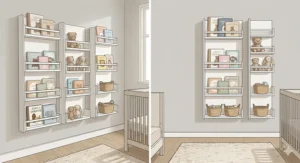
The Wallniture Utah collection transforms unusable vertical space into functional storage without the visual weight of traditional bookcases—a game-changer for small Canadian nurseries where every piece of furniture needs to earn its place. These solid pine shelves come in a set of three varying sizes (ranging from 16 to 24 inches/40 to 60 cm), allowing you to create a customized wall display that holds baby books, small toys, and decorative items while keeping the floor clear for essential furniture.
What sets these apart from cheaper alternatives is the built-in safety rail along the front edge, which prevents items from sliding off when your toddler inevitably bumps into furniture or when you’re reaching for a bedtime story in dim lighting. The white finish integrates seamlessly with most nursery colour schemes, and the included mounting hardware with mini level makes installation straightforward even for first-time parents. Each shelf supports up to 8 kg (18 lbs), which is sufficient for approximately 12-15 board books plus several small items.
For Canadian buyers specifically, these shelves address a common challenge in older homes with limited electrical outlets—you can position them strategically to display a baby monitor or nightlight without needing to snake cords across the room. The modular set design also means you can start with wall-mounted storage in the nursery and later relocate individual shelves to a playroom or bedroom as your child’s needs evolve, maximizing your investment over time.
Pros:
✅ Solid wood construction withstands years of use
✅ Safety rail prevents items from falling during bumps
✅ Set of three creates flexible display options
Cons:
❌ Requires wall stud mounting for maximum weight capacity
❌ White finish may show marks over time in high-traffic areas
Canadian parents consistently praise the clean aesthetic and space-saving design in their reviews. One Toronto mother noted these shelves freed up an entire dresser top in her 2.4 metre (8-foot) wide nursery. Available on Amazon.ca in the $50-$75 CAD range for the three-shelf set, these represent solid value when you calculate the cost per storage unit and factor in their multi-year usability.
2. CHERAINTI Baby Diaper Caddy Organizer (Cotton Rope Basket)
The CHERAINTI Cotton Rope caddy measures 40 cm × 23 cm × 19 cm (15.7″ × 9.1″ × 7.6″), which provides significantly more capacity than most competitors—a detail that matters tremendously when you’re storing Canadian-sized diaper boxes (which tend to be bulkier than American equivalents) alongside wipes, creams, and spare clothing. This isn’t just another storage basket; it’s a mobile command centre that travels from changing table to crib to living room, keeping everything you need within arm’s reach.
What most buyers overlook is the handle locker design, which allows you to hang this caddy on crib rails, dresser edges, or even a stroller handle when you’re out. For Canadian parents managing winter gear alongside baby supplies, this portability becomes invaluable—you can stock it with indoor essentials and simply carry it to whichever room you’re occupying rather than maintaining duplicate supplies in multiple locations. The 100% natural cotton construction means no synthetic odours and zero allergy concerns for sensitive baby skin.
The removable divider is where this caddy’s versatility truly shines. Initially, you’ll use it to separate diapers from wipes and creams. Six months later, when diaper changes become less frequent, remove the divider and repurpose it as a toy basket for the living room or a craft supply holder in your home office. Canadian reviewers particularly appreciate that it maintains its shape even when partially full—unlike cheaper fabric options that collapse into useless pouches—thanks to high-precision stitching and structured sides.
Pros:
✅ Larger capacity accommodates Canadian-sized diaper packages
✅ Handle locker enables hanging on multiple surfaces
✅ Natural cotton is safe for babies with sensitive skin
Cons:
❌ Light colour shows stains more readily than darker options
❌ Not machine washable (spot clean only)
Available in the $35-$50 CAD range on Amazon.ca, this caddy receives consistent 4.5+ star ratings from Canadian buyers. One Vancouver parent mentioned using it for three years across two children, eventually transitioning it to bathroom storage for toiletries—demonstrating the long-term value beyond the infant stage.
3. EZOWare Foldable Storage Cube Bins (Set of 4, Multiple Colours)
The EZOWare fabric cube set delivers 41 litres of storage per bin—that’s approximately 164 litres (43 gallons) total capacity in a package that measures 33 cm × 38 cm × 33 cm (13″ × 15″ × 13″) per cube. For context, that’s enough space to store an entire season of baby clothing in each cube, making them ideal for Canadian parents who need to rotate between summer and winter wardrobes while working with limited closet space.
These bins are specifically designed to fit KALLAX-style cube shelving systems (widely available at IKEA Canada and other Canadian retailers), but they’re equally functional stacked in a closet or lined up under a crib. The non-woven fabric exterior resists moisture and wipes clean easily—essential for Canadian climates where tracking in snow, rain, and mud is inevitable during those early morning daycare drop-offs. The reinforced handles support substantial weight, allowing you to carry a full bin of clothing or toys without the sides collapsing.
What separates quality storage cubes from inferior options is structural integrity, and the EZOWare bins include cardboard reinforcements in the base and sides that maintain the cube shape even when empty. This matters significantly more than most parents realize: if your bins sag when partially full, you lose usable capacity and create visual clutter. These cubes can be folded flat when not in use, which is particularly valuable for Canadian households that might rotate seasonal items to basement or garage storage.
Pros:
✅ 41L capacity per cube stores full seasonal wardrobe
✅ Compatible with widely available KALLAX systems across Canada
✅ Folds flat for storage when rotating seasonal items
Cons:
❌ Lighter items may shift inside due to slightly oversized interior
❌ Handle attachment could be reinforced for heavier loads
Canadian buyers consistently rate these 4+ stars on Amazon.ca, with particular praise for how they maximize vertical storage in closets. Priced in the $30-$45 CAD range for a set of four, they deliver approximately $8-$11 per cube—strong value considering they’ll transition from nursery to playroom to teenager’s room over 10+ years.
4. TOOLF 3-Tier Rolling Cart (Metal Frame with Lockable Wheels)
The TOOLF Rolling Cart measures 40 cm × 30 cm × 80 cm high (15.7″ × 11.8″ × 31.5″), creating three tiers of storage that can be repositioned throughout your home as needs change—a flexibility that Canadian parents working with small, awkwardly shaped spaces absolutely need. Unlike fixed furniture, this cart slides between rooms, serving as a changing station in the nursery during infancy, then transitioning to an art supply organizer in the playroom or even kitchen storage for snacks and bottles.
The metal frame construction supports up to 15 kg (33 lbs) per tier, which comfortably accommodates stacks of diapers, wipes containers, clothing, and baby care products on the top two levels, with bulkier items like diaper boxes or extra bedding on the bottom. The lockable wheels are the critical detail here—they prevent the cart from rolling away during use, but unlock for easy repositioning. For Canadian homes with laminate or hardwood floors (common in condos and newer builds), the smooth-rolling wheels won’t scratch surfaces like some furniture can.
What makes this particularly valuable for small-space nurseries is that it eliminates the need for a dedicated changing table. Position it beside your crib or dresser, stock the top tier with immediate-access supplies, and you’ve created a functional changing station without dedicating 0.9 m² (10 square feet) to a purpose-built table you’ll only use for 18-24 months. When your child outgrows diapering, this cart has already proven its versatility in hundreds of Canadian households—reviewers report using it for everything from bathroom organization to craft supplies to kids’ homework stations.
Pros:
✅ Mobile design adapts to changing room layouts
✅ Lockable wheels provide stability during use
✅ Metal construction withstands years of heavy use
Cons:
❌ Open design means items are visible (not ideal for clutter-prone families)
❌ Assembly required (approximately 15-20 minutes)
Available on Amazon.ca in the $45-$85 CAD range depending on finish and features, this represents one of the smartest investments for multi-year value. Canadian reviews consistently mention using these carts for 5+ years across different rooms and purposes.
5. mDesign Soft Fabric Drawer Organizers (Set of 8, Polka Dot Pattern)
The mDesign drawer organizer set includes eight pieces in two sizes—six smaller compartments measuring 20 cm × 10 cm (8″ × 4″) and two larger ones at 30 cm × 10 cm (12″ × 4″)—designed specifically to transform a standard dresser into an efficient baby clothing storage system. For Canadian parents who’ve invested in a quality dresser that will grow with their child (rather than buying a purpose-specific changing table), these organizers are non-negotiable for maximizing drawer capacity.
What most people don’t realize about organizing baby clothes is that tiny garments create chaos in standard-sized drawers. Socks disappear, onesies get buried, and you end up rummaging through an entire drawer for a matching outfit at 3 AM. These fabric compartments solve that by creating dedicated zones: one section for socks, another for bibs, a third for hair accessories, and so on. The reinforced sides maintain their shape even with lightweight items, and the polka dot pattern adds visual appeal while disguising minor stains or wear.
The real value proposition here is that these organizers increase your usable drawer space by approximately 40% through better vertical stacking and organization. In practical terms, you can fit newborn through 12-month clothing in a single dresser instead of needing additional storage furniture. For Canadian families in condos or smaller homes where adding another piece of furniture simply isn’t possible, this efficiency gain is transformative. The breathable fabric allows airflow around clothing, preventing the musty smell that can develop in closed drawers during humid summer months.
Pros:
✅ Eight-piece set creates comprehensive dresser organization
✅ Increases usable drawer capacity by approximately 40%
✅ Breathable fabric prevents moisture buildup and odours
Cons:
❌ Lighter fabric may shift slightly when opening drawers quickly
❌ Pattern may not appeal to minimalist aesthetic preferences
Canadian buyers rate these organizers 4.5+ stars on Amazon.ca, frequently mentioning how they simplified morning routines by making every item immediately visible and accessible. Priced around $25-$38 CAD for the eight-piece set, they’re one of the most cost-effective storage upgrades you can make—working out to roughly $3-$5 per organizer compartment.
6. Maxpeuvon Natural Wood Nursery Book Shelves (Set of 3 with Beaded Bar)
The Maxpeuvon floating shelves measure 40 cm × 10 cm × 15 cm (15.8″ × 3.94″ × 5.9″) each and feature a protective wood beaded bar across the front that prevents books and toys from sliding off—a design detail that becomes increasingly important as your child transitions from infant to mobile toddler. These shelves are constructed from 100% premium pine wood rather than engineered composites, which means they can genuinely support the manufacturer’s claimed 10 kg (22 lbs) capacity per shelf without sagging over time.
What makes these particularly well-suited for Canadian nurseries is their natural wood finish, which complements both modern minimalist aesthetics popular in urban condos and traditional farmhouse styles common in suburban and rural homes. The beaded bar detail adds texture and visual interest while serving a functional safety purpose—important in a country where seismic activity (BC) or settling foundations (prairies) can cause minor vibrations that might dislodge items from standard shelves.
The installation hardware includes wall anchors suitable for drywall and plaster—both common in Canadian residential construction—plus a template for precise spacing if you’re mounting all three shelves. Each shelf can hold approximately 15-20 board books when arranged spine-out, or 8-10 picture books when displayed face-forward for visual appeal. The depth is intentionally designed to accommodate standard children’s book dimensions (typically 20-25 cm tall) without books tipping forward, and the 10 cm depth prevents items from being pushed too far back where they’re difficult to reach.
Pros:
✅ Solid pine construction supports full 10 kg weight capacity
✅ Beaded safety bar prevents items from falling
✅ Natural wood finish complements diverse décor styles
Cons:
❌ Requires three separate wall installations (more time investment)
❌ Natural wood may show fingerprints and marks over time
Available on Amazon.ca in the $50-$80 CAD range for the three-shelf set, these represent a premium option compared to basic floating shelves. Canadian reviews frequently mention the quality construction and note these shelves transition beautifully from nursery to kids’ room to teen space, making them a legitimate 15+ year investment.
7. Baby Hanging Diaper Organizer (Grey Oxford Cloth with Multiple Compartments)
The Hanging Diaper Organizer measures 48 cm × 40 cm (19″ × 16″) with seven compartments of varying sizes, designed to hang on crib rails, changing tables, or wall hooks via reinforced metal grommets. This addresses one of the most common pain points in small Canadian nurseries: keeping frequently used items immediately accessible without dedicating valuable dresser or counter space to them.
The 600D polyester Oxford cloth construction is both durable and easy to clean—simply wipe with a damp cloth—which matters significantly when you’re dealing with diaper cream spills, leaked bottles, and general baby mess. What separates this organizer from cheaper alternatives is the inclusion of two strong PE boards that maintain the structure’s shape even when heavily loaded. Many budget hanging organizers sag into useless pouches after a few weeks of use, but the PE board reinforcement keeps these compartments rigid and accessible.
For Canadian parents, the versatility of attachment options is particularly valuable. You can use the C-clip hooks for standard crib rails, adjustable buckle straps for thicker modern crib bars common in Canada, or simply hang it on wall-mounted hooks using the metal-reinforced grommets. This adaptability means the organizer travels with you—hang it in the nursery overnight, move it to the living room during daytime, or even attach it to a car seat headrest for long trips across Canadian provinces during summer vacation.
Pros:
✅ Seven compartments accommodate diverse supplies
✅ Multiple attachment options work with various furniture types
✅ PE board reinforcement maintains structure under weight
Cons:
❌ Grey colour may show dust and lint accumulation
❌ Not suitable for very heavy items like large wipes containers
Canadian buyers on Amazon.ca consistently rate these 4+ stars, with particular appreciation for how they eliminate the need for a separate side table in already cramped nurseries. Priced in the $25-$42 CAD range, this is one of the most affordable storage solutions that delivers immediate, tangible organizational improvement.
Practical Usage Guide: Setting Up Your Small Nursery Storage System
Installing and optimizing storage in a compact nursery requires a systematic approach rather than randomly purchasing organizational products. Start by measuring your available wall space, closet dimensions, and under-crib clearance before buying anything. Most Canadian cribs maintain 30-35 cm (12-14 inches) of clearance beneath the mattress platform—perfect for low-profile storage bins that can hold out-of-season clothing, extra bedding, or bulk diaper supplies.
Mount floating shelves 120-140 cm (48-55 inches) from the floor, positioning them high enough that a standing toddler can’t reach breakable items but low enough that you can access books and toys without a step stool. Use a stud finder to locate wall framing—particularly important in older Canadian homes where drywall thickness varies—and always anchor shelving to studs rather than relying solely on drywall anchors for safety.
Canadian climate considerations for storage: Our dramatic seasonal temperature swings create unique storage challenges. Wooden shelves installed in winter may expand slightly during humid summers, while metal carts can feel cold to touch during frigid Canadian winters. Position wooden furniture away from heating vents and radiators to prevent warping, and consider adding felt pads to metal cart wheels to reduce noise on hardwood floors common in Canadian homes. During winter, store cotton rope baskets away from exterior walls where condensation can develop, and rotate stored clothing seasonally to prevent musty odours during humid periods.
For ongoing maintenance, audit your nursery storage quarterly as your baby’s needs evolve rapidly. Items used daily should be positioned at waist height for easy access, while occasional-use supplies can be stored higher or lower. Create designated zones: diapering supplies in one area, clothing in another, feeding items in a third. This spatial organization reduces search time during sleep-deprived midnight changes and helps other caregivers (grandparents, babysitters) quickly locate necessary items.
Real-World Scenario: Three Canadian Families, Three Solutions
Scenario A: Toronto Condo Family (600 sq ft, 2.4m × 2.7m Nursery)
Emma and James live in a downtown Toronto condo with a nursery that barely accommodates a crib and dresser. They implemented a vertical storage strategy using three sets of floating wall shelves above the dresser, hanging diaper organizers on both the crib rail and closet door, and fabric storage cubes in their closet. By eliminating a traditional changing table and instead using their dresser top with drawer organizers, they freed up 0.8 m² (9 square feet) of floor space—enough room for a comfortable feeding chair. Total investment: approximately $280 CAD. Their key insight: “Every piece of furniture needs to serve at least two purposes, or it doesn’t belong in our space.”
Scenario B: Vancouver Craftsman Home Family (900 sq ft, 3m × 3m Nursery)
Sarah is a single mother in a 1920s Vancouver craftsman with a small nursery that has limited outlet access and quirky wall angles from original architecture. She prioritized mobile storage—a three-tier rolling cart for diapering supplies that moves between rooms, plus foldable storage cubes that stack in the closet during off-seasons. The rolling cart proved invaluable during BC’s frequent power outages, allowing her to bring all necessary supplies to whichever room had the best natural light. Total investment: approximately $185 CAD. Her advice: “Flexibility matters more than perfection when you’re dealing with older Canadian homes that have unique layouts.”
Scenario C: Calgary Suburban Family (1,400 sq ft, 3.6m × 3.6m Nursery)
The Patels in suburban Calgary have more square footage but faced a different challenge: their nursery shares a wall with the master bedroom, making nighttime noise control critical. They chose soft fabric storage solutions—cotton rope baskets for toys, fabric drawer organizers, and hanging organizers instead of rigid plastic containers that clatter. Natural wood floating shelves added storage without creating echo in the larger space. Total investment: approximately $310 CAD. Their learning: “Sound-dampening storage materials improve sleep quality for everyone in the house—worth the extra investment in quieter organizational solutions.”
Common Mistakes When Buying Nursery Storage for Small Rooms
The biggest error Canadian parents make is purchasing dedicated baby furniture that becomes obsolete within 18-24 months. Specialty changing tables, single-purpose diaper stacking systems, and infant-specific storage units represent poor value when you’re working with limited space and budget. According to Wikipedia’s overview of nursery furniture, the modern concept of dedicated infant rooms emerged in the early 20th century, but historical approaches favoured adaptable furniture—wisdom worth revisiting for today’s space-conscious families. Instead, invest in quality pieces that adapt as your child grows: a solid dresser works from infancy through teenage years, while floating shelves transition seamlessly from baby books to school supplies to teenage décor.
Many parents over-purchase storage solutions before their baby arrives, buying every organizational product that appears in Pinterest nursery photos. This creates clutter rather than solving it—you end up with a small room filled with empty storage containers waiting for phantom supplies. Start with essential storage (one set of drawer organizers, one mobile caddy, one wall-mounted option) and add targeted solutions as you identify actual needs through daily use.
A specifically Canadian mistake is ignoring our seasonal storage requirements when planning nursery organization. Parents in milder climates can get away with a single dresser of clothing, but Canadian babies need summer wardrobes, winter layers, and transitional pieces—easily tripling storage needs. Factor in space for bulky snowsuits, heavy sleep sacks, and seasonal bedding when calculating required storage capacity, or plan for basement/garage rotation systems if bedroom space is truly limited.
Overlooking weight capacity is dangerous. That adorable decorative shelf might look perfect in Instagram photos, but if it can’t safely support actual baby supplies, it’s useless and potentially hazardous. Always verify weight limits, especially for wall-mounted options, and consider what happens as items shift or your toddler tries to climb furniture. Canadian building codes are generally robust, but older homes may have drywall that requires different anchoring systems than newer construction—factor this into installation planning.
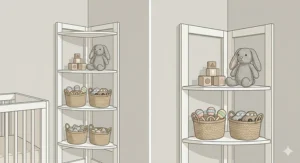
Choosing Multi-Functional Furniture for Maximum Efficiency
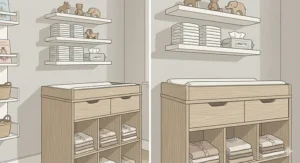
Multi-functional furniture eliminates redundancy by combining two or more purposes in a single footprint. A dresser topped with a secure changing pad replaces both a chest of drawers and a changing table, immediately saving 0.6-0.9 m² (6-10 square feet) in a small nursery. Look for dressers with smooth-sliding drawers (you’ll be opening them one-handed while holding a baby), rounded corners for safety, and sufficient depth (at least 45 cm/18 inches) to accommodate folded baby clothes.
Cribs with built-in storage drawers beneath the mattress platform combine sleeping space with hidden storage, though Canadian parents should verify drawer clearance against your specific crib model—some designs reduce under-crib storage capacity. Storage ottomans serve as seating, footrests, and hidden storage for blankets or toys, while bookshelves with built-in toy bins (popular in IKEA Canada stores) merge display and organizational functions.
When selecting multi-functional pieces for Canadian homes, consider our seasonal rotation needs. Furniture with adjustable or removable components adapts better to changing requirements: drawer organizers that can be reconfigured, shelving systems with movable brackets, and storage cubes that collapse when not in use. This flexibility is particularly valuable in smaller urban Canadian homes where every room serves multiple purposes throughout the year.
Resist the temptation to buy furniture sized for your baby’s current age. A quality 6-drawer dresser suitable for adult clothing will accommodate baby clothes for 15+ years, while a specialty baby armoire becomes obsolete by age three. Calculate the cost-per-year of usability: a $500 dresser used for 15 years costs $33 annually, while a $200 baby-specific storage unit used for 2 years costs $100 annually—the more expensive option delivers better value.
Vertical Storage: Utilizing Canadian Wall Space Effectively
Canadian building codes generally allow wall-mounted furniture in most residential applications, but you must anchor to wall studs (typically spaced 40 cm/16 inches apart in modern construction, though older homes vary) or use appropriate drywall anchors rated for your specific wall type. The Canadian Standards Association (CSA) develops safety standards for consumer products including furniture, and while many standards are voluntary, adherence demonstrates products have been independently tested for safety. Before mounting anything, locate studs using an electronic stud finder—essential in older Canadian homes where walls may contain unexpected blocking, insulation, or hidden pipes.
Floating shelves should be installed 30-40 cm (12-16 inches) apart vertically to accommodate picture books displayed face-forward, or 20-25 cm (8-10 inches) apart for spine-out book storage and small toys. In typical 2.4 metre (8-foot) ceiling height Canadian rooms, you can usually fit 4-5 levels of shelving before reaching awkward access height, creating substantial storage capacity without consuming floor space.
Wall-mounted storage works particularly well in Canadian nurseries with radiator or baseboard heating along exterior walls—rather than leaving that wall space empty due to heat sources, mount floating shelves 15-20 cm (6-8 inches) above the heat source to create usable storage that doesn’t interfere with heating efficiency. Just ensure stored items won’t be damaged by gentle heat exposure (avoid storing medications or electronics directly above radiators).
The key advantage of vertical storage in small Canadian spaces is that it scales with your child’s development. Initially, you’ll stock bottom shelves with items you need to reach while holding a baby, gradually transitioning higher shelves to child-accessible toy storage as they grow. By age 3-4, your child can independently access books and toys from waist-height shelves, promoting independence while keeping floor space clear for play.
Under-Crib Storage Ideas That Actually Work in Canada
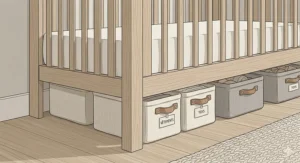
The space beneath a crib represents approximately 0.6-0.8 m² (6-8 square feet) of storage potential in most Canadian nurseries—equivalent to adding a small chest of drawers without occupying additional floor space. Most cribs maintain 30-35 cm (12-14 inches) of clearance from floor to mattress platform, sufficient for low-profile storage bins specifically designed for this application.
Choose bins with wheels or smooth-sliding bases to enable easy access without scratching floors—particularly important for the hardwood and engineered wood flooring common in Canadian condos and newer homes. Clear or mesh-topped bins allow you to identify contents without pulling them fully out, while solid-colored options maintain a cleaner visual aesthetic if your crib skirt doesn’t fully conceal under-crib storage.
Ideal under-crib storage contents: Out-of-season clothing is perfect for this location—store your baby’s summer wardrobe beneath the crib during Canadian winters, then swap when seasons change. Bulk diaper boxes, extra bedding, and infrequently used items like the infant bathtub after your baby outgrows it all work well. Avoid storing items you need daily, as bending to retrieve bins from floor level becomes tedious during exhausted late-night care sessions.
Measure your specific crib’s clearance before purchasing under-crib bins, as dimensions vary between manufacturers. Canadian safety standards require specific crib slat spacing and mattress support positioning, which can affect available under-crib space. Some convertible cribs (that transition from crib to toddler bed to full bed) adjust mattress height, potentially reducing under-crib storage as you lower the mattress for older infants—factor this into your storage planning.
Long-Term Value: Storage That Grows With Your Canadian Child
The most economical nursery storage approach is selecting pieces that transition through childhood stages rather than requiring replacement every few years. Floating wall shelves that display board books during infancy become homework supply storage by age six and decorative display space for collectibles by the teenage years. Quality wooden shelving will literally last decades if properly maintained—a worthwhile investment considering Canadian furniture prices often run 15-20% higher than American equivalents due to import costs and exchange rates.
Fabric storage cubes compatible with standard cube shelving systems offer unparalleled longevity. During infancy, they store diapers and blankets. At age 2-3, they transition to toy storage. By elementary school, they’re organizing art supplies, books, and school materials. Teenage years find them holding sports equipment, craft projects, or gaming accessories. A $40 CAD set of four cubes delivering 15 years of service works out to less than $3 annually—exceptional value for any household budget.
Rolling carts exemplify multi-stage usefulness in Canadian homes where room purposes shift as children grow. The nursery changing station cart becomes a toddler snack station, then an elementary craft supply organizer, and eventually a teenager’s makeup or gaming accessory storage. The mobility remains valuable throughout all these stages, particularly in Canadian homes with basements where kids’ activity spaces often migrate as they age.
Consider total cost of ownership when evaluating storage options. A $25 hanging organizer used for 18 months then discarded costs more per month than a $75 quality dresser organizer set used for 10 years. Canadian parents should calculate cost-per-year-of-use and prioritize durability, as replacing worn-out storage repeatedly becomes expensive. Additionally, quality pieces maintain resale value—Facebook Marketplace and Kijiji in Canadian cities see active secondary markets for well-maintained children’s furniture, potentially recovering 30-50% of initial investment.
Safety Considerations for Small-Space Nursery Storage
Health Canada emphasizes that nursery furniture must be secured to walls using anti-tip straps or anchoring systems, particularly critical in small spaces where furniture is closer to cribs and potential climbing opportunities. According to Canada.ca’s nursery safety guidelines, tip-over accidents cause serious injuries annually—particularly in provinces like BC where seismic activity creates additional furniture stability concerns.
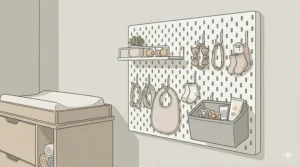
Wall-mounted storage requires proper installation in wall studs or appropriate drywall anchors rated for your specific wall type. Many older Canadian homes feature plaster walls rather than drywall, which requires different anchoring techniques and hardware. If you’re uncertain about your wall construction, consult the building plans (often available through municipal archives for older homes) or hire a professional installer. The $50-$100 installation cost is negligible compared to potential injury from improperly secured furniture.
Avoid storing heavy items on high shelves, regardless of weight capacity ratings. Even properly installed shelves can fail if overloaded, and higher storage positions increase fall injury severity. Store heavy items like bulk diaper boxes in floor-level bins or bottom dresser drawers, reserving upper shelves for lighter items like books, small toys, and decorative elements. This weight distribution also increases furniture stability.
Canadian parents should regularly inspect storage hardware—checking that wall anchors remain secure, drawer guides haven’t loosened, and no sharp edges have developed on metal or wooden pieces. Our dramatic temperature fluctuations (particularly in prairie provinces with -30°C winters and +30°C summers) can cause wood expansion and contraction that loosens hardware over time. Schedule quarterly safety checks as standard maintenance, tightening any loose components immediately.
FAQ: Your Nursery Storage Questions Answered
❓ How much storage do I really need for a baby in a small Canadian nursery?
❓ Can I safely mount floating shelves in an older Canadian home with plaster walls?
❓ What's the best under-crib storage solution for hardwood floors common in Canadian condos?
❓ How do I organize nursery storage for two kids sharing a small room?
❓ Should I buy storage furniture or use what I already have for the nursery?
Conclusion: Creating Your Perfect Small-Space Nursery
Organizing a nursery in a compact Canadian home isn’t about cramming maximum items into minimum space—it’s about thoughtfully selecting versatile, multi-functional storage that adapts as your child develops. The seven products analyzed in this guide represent different storage categories (vertical, portable, hidden, organizational), allowing you to build a customized system matching your specific room dimensions, budget, and aesthetic preferences.
Remember that the most effective small-space nurseries prioritize accessibility and flexibility over completeness. You don’t need every storage product marketed to new parents; you need the specific solutions that address your unique challenges. Start with essentials (drawer organizers, one portable caddy, one wall-mounted option), assess what works after 2-3 weeks of actual use, then add targeted solutions for identified pain points.
Canadian parents benefit from thinking seasonally—rotate clothing, bedding, and even toys as your baby grows and seasons change. This reduces visual clutter while ensuring your active storage always contains currently relevant items. The basement, garage, or even upper closet shelves can hold out-of-season items, freeing your nursery’s premium real estate for daily necessities. With strategic planning and the right storage solutions available through Amazon.ca, even a 2.4 metre (8-foot) nursery can feel organized, functional, and peaceful—exactly what sleep-deprived new parents need.
Recommended for You
- Best Hanging Diaper Caddy Canada 2026: 7 Top Picks
- Best Toy Storage Bins Canada 2026: 7 Smart Solutions
- 17 Nursery Closet Organization Ideas That Work | Canada 2026
Disclaimer: This article contains affiliate links. As an Amazon Associate, I earn from qualifying purchases. If you purchase products through these links, we may earn a small commission at no additional cost to you.
✨ Found this helpful? Share it with your friends! 💬🤗
