
In This Article
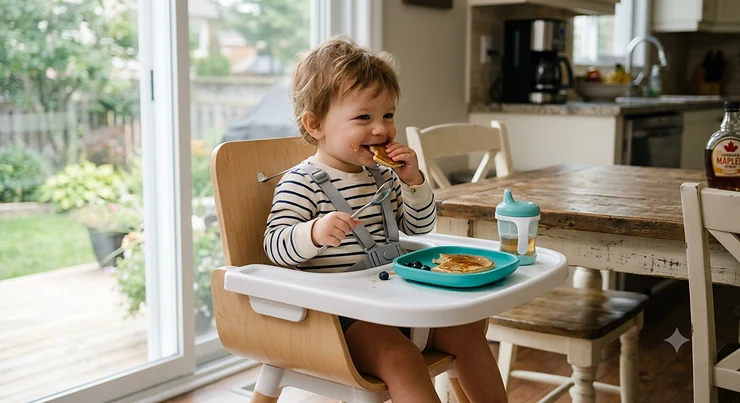
Somewhere between “I can’t believe how much drool is involved in eating a single pea” and “why is there yogurt on the ceiling,” every Canadian parent has the same thought: I need the best high chair, and I need it yesterday. A high chair is defined as a raised seat with a tray, designed to let an infant or toddler sit at meal height safely and semi-independently while eating. It sounds simple. It is not simple, because the market has exploded into a confusing pile of foam-covered, harness-strapped, wheel-equipped contraptions that all claim to be “easy clean” and “grows with baby.”
Here’s what actually matters, based on real specs, real Health Canada guidance, and real aggregated reviews rather than marketing copy: stability, restraint quality, cleanability, and how well the chair adapts as your kid grows from purée-flinging infant to spaghetti-negotiating toddler. This guide breaks down seven real, currently available high chairs — spanning ultra-budget to genuine splurge — with the honest trade-offs nobody puts on the box. We’ll also dig into when to start using one, what a safety harness should actually do, what “JPMA certified” means for a Canadian buyer, and how to keep the whole operation under $200 if that’s your ceiling. No fluff, no fabricated five-star anecdotes — just the analysis you’d want from a friend who’s spent way too many hours reading spec sheets so you don’t have to.
Quick Comparison Table
| High Chair | Best For | Price Range (CAD) | Ease of Cleaning | Grows With Child |
|---|---|---|---|---|
| IKEA Antilop | Tightest budget | Under C$30 | High (wipeable plastic) | To ~3 years |
| Ingenuity Full Course SmartClean | Budget with features | Under C$200 | High (foam seals seams) | Birth to 5 years |
| Graco Table2Table LX | Multi-stage families | C$150-C$200 range | Moderate | Infant to youth stool |
| Maxi-Cosi Minla | Newborn-ready mid-range | C$300-C$400 range | Moderate-High | Birth to 6 years |
| Stokke Tripp Trapp | Long-term wood investment | C$350-C$450 range | Moderate (wood, not dishwasher-safe) | Infant to adult |
| Cybex Lemo 2 | Safety-focused families | C$300-C$400 range | High | To 209 lbs (~95 kg) |
| 4moms High Chair | Easiest cleanup, tech-forward | C$400-C$450 range | Highest (one-wipe silicone) | Infant to toddler |
A quick scan of the table tells you most of what you need before diving deeper: if your priority is pure cleanability, the silicone-seated 4moms and the sealed-foam Ingenuity pull ahead, while the Stokke and Graco trade a bit of wipe-down convenience for sheer longevity. Budget shoppers shouldn’t dismiss the IKEA Antilop just because it looks bare-bones — its simplicity is precisely why it survives toddler warfare so well. Notice, too, that “grows with child” spans wildly different definitions, from a chair that becomes a booster to one that becomes furniture your kid uses in university; that distinction matters more than most buying guides admit, and we’ll unpack it product by product below.
Just one click — help other Canadian parents make better mealtime decisions too! 😊
Top 7 High Chairs: Expert Analysis
1. IKEA Antilop — cheapest chair that still passes the shake test
The Antilop has achieved near-cult status among Canadian parents for one reason: it costs less than a large pizza and still holds up. Expanding on that standout feature, the whole design philosophy here is “remove everything that isn’t load-bearing,” and somehow it works.
The frame is tubular steel, the seat is a single molded plastic shell, and the tray pops off in one motion for rinsing under a tap — no crevices, no fabric, no cushion to fish crumbs out of. In practice, that minimalism means a 90-second cleanup after even the messiest bowl of oatmeal, which is more than some C$400 chairs can claim. There’s no recline and no height adjustment, so it’s genuinely built for babies who can already sit up unassisted, generally from around 6 months onward.
Based on the spec comparison against every other chair on this list, the Antilop is the only one explicitly designed to be disposable-cheap without feeling disposable-flimsy; the steel legs don’t wobble the way cheap plastic-legged competitors do. It’s the obvious pick for second households, grandparents’ houses, tight condos, or parents who’d rather not marry themselves to a C$400 decision before knowing if their baby will even tolerate sitting still.
Reviewers consistently report that the tray is watertight enough to double as a small basin, and that the lack of padding is a non-issue once a slipcover or the optional cushion insert is added. A recurring complaint in aggregated feedback is that the straight-backed seat isn’t the comfiest for long meals, and that the tray’s suction can be strong enough to be tricky for tired parents to release one-handed.
Pros:
- ✅ Genuinely under C$30, no accessories required
- ✅ Steel frame resists tipping better than similarly priced plastic chairs
- ✅ Tray removes and rinses in seconds, no fabric to wash
Cons:
- ❌ No recline, so not ideal before baby sits unassisted
- ❌ Minimal padding makes long meals less comfortable
At well under C$200 — usually well under C$30 — the Antilop’s value proposition is almost unfair to compare against the rest of this list. If budget is your primary filter, start here and only upgrade if a specific gap (recline, portability, aesthetics) actually matters to your household.
2. Ingenuity Full Course SmartClean 6-in-1 High Chair — best budget pick with real growth stages
Ingenuity built its reputation on stretching a single product across years of use, and the Full Course SmartClean leans hard into that with six configurable modes from infant recliner to youth stool. That “SmartClean” branding isn’t just marketing fluff — the EVA foam seat is sealed at the seams specifically to stop liquid from seeping into crevices the way older foam-and-fabric high chairs notoriously did.
Key specs that matter in practice: a five-point safety harness for the infant and toddler stages, two dishwasher-safe trays (a deep one for messy independent eating, a shallow one for snacks), and multiple height and recline positions that let the chair track a baby from roughly 4-6 months (with the recline and insert) through age five. That’s a genuinely wide age range for one seat, which changes the cost-per-use math significantly compared to chairs that top out at toddlerhood.
Who should care: budget-conscious families who still want the bells and whistles — recline, multiple trays, dishwasher-safe parts — without paying premium-brand prices. What most buyers overlook about this model is that the sealed-foam approach genuinely does outperform stitched fabric cushions on stain resistance, which matters a lot once puréed carrots enter the picture.
Aggregated review sentiment is largely positive on ease of assembly and the dishwasher-safe trays, with a recurring theme that the recline mechanism can feel slightly less premium than pricier competitors, occasionally requiring two hands to adjust.
Pros:
- ✅ Six growth stages from infant recliner to youth stool
- ✅ Sealed foam seat resists staining better than stitched cushions
- ✅ Two dishwasher-safe trays included
Cons:
- ❌ Recline adjustment can feel less smooth than premium brands
- ❌ Bulkier footprint than minimalist budget options
Typically found in the C$150-C$200 range, the Full Course SmartClean is arguably the best value pick on this entire list for parents who want features without stretching past the under-$200 threshold.
3. Graco Table2Table LX 6-in-1 Highchair — best for families who hate buying furniture twice
Graco’s Table2Table LX earns its name honestly: it converts from a full high chair into a genuine table-and-chair set your toddler can use well past the high-chair years, which sidesteps the awkward “now what do we do with this” phase most chairs eventually hit.
The chair includes six configurable modes, a two-position recline for the infant stage, and a tray with multiple height settings so it can be pulled up to a standard dining table height as your child grows into a booster-then-chair role. On paper, this means one purchase covers a stretch that would otherwise require a high chair, then a separate booster, then a kid’s table set — three purchases collapsed into one frame.
This is the pick for parents who value furniture continuity over minimalism; if your kitchen doubles as a toy-storage battlefield already, having fewer discrete baby products to store is a real, if underrated, win. Reviewers consistently note the sturdiness of the frame and the genuine usefulness of the final “big kid table” stage, while a recurring critique is that the fabric-covered seat pad, while removable, isn’t quite as fast to clean as sealed-foam competitors like the Ingenuity above.
Pros:
- ✅ Converts into an actual kid-sized table and chair set
- ✅ Six modes cover infant through big-kid stages
- ✅ Sturdy frame rated well for stability in testing
Cons:
- ❌ Fabric seat pad cleans slower than sealed-foam alternatives
- ❌ Larger overall footprint once in table mode
Priced in the C$150-C$200 range at the time of research, the Table2Table LX earns its spot by extending genuine usefulness years beyond a typical high chair’s shelf life — a strong argument for households short on storage space and patience for repeat purchases.
4. Maxi-Cosi Minla 6-in-1 High Chair — best from-birth option in the mid-range tier
The Minla’s headline feature is right there in the name for anyone who reads specs closely: it’s designed to be usable from birth, with a reclining newborn insert, rather than requiring an add-on bassinet accessory the way many competitors do.
Specs worth translating into real life: the compact fold mechanism means it can be stored upright against a wall — genuinely useful in condo kitchens where floor space is currency — and the detachable kitchen booster seat mode lets the same product travel from nursery high chair to grandma’s dining table without buying a second product. The multiple recline positions matter more than they sound; a newborn genuinely needs near-flat support, and chairs that only recline to 30 degrees aren’t appropriate for that stage regardless of what the box implies.
Based on the spec comparison, the Minla sits in an interesting niche: it’s more design-forward and compact than the Ingenuity or Graco, but less expensive than the Stokke or Cybex, making it the pick for parents who want European styling and from-birth usability without premium-tier pricing. Aggregated feedback highlights the compact fold as a standout for small kitchens, with some reviewers noting the fabric cushion, while easy to wipe, requires occasional machine washing for deeper stains.
Pros:
- ✅ Usable from birth with reclining newborn insert
- ✅ Compact fold suits smaller Canadian kitchens
- ✅ Detachable booster mode adds portability
Cons:
- ❌ Cushion needs occasional machine washing, not just wiping
- ❌ Priced above the true budget tier
Expect a C$300-C$400 range for the Minla, positioning it squarely as a mid-range option for parents who want the from-birth convenience without jumping to premium pricing.
5. 4moms High Chair — easiest high chair to clean, hands down
If “easiest high chair to clean” is the phrase that brought you here, this is the product that phrase was practically invented for. The 4moms High Chair replaces fabric and foam entirely with a one-piece silicone seat that wipes clean in a single pass — no seams, no stitching, no fabric to soak in a sink.
That silicone construction isn’t just a gimmick; it means there’s genuinely nowhere for purée to hide, which is the single biggest complaint aggregated across competitor reviews for fabric-cushioned chairs. The tray detaches with a magnetic-assist mechanism, and the frame includes a five-point harness alongside anti-tip rear legs. Reviewers consistently note that the cleanup time compared to their previous high chair dropped dramatically — often cited as the deciding factor in why they’d recommend it to other parents.
What the spec sheet won’t tell you, but reviewers note, is that the sleek all-plastic-and-silicone look also means it shows fingerprints and general kitchen grime on the frame itself, which some households find they need to wipe down more often than a fabric-free chair would suggest. This is the pick for parents who have decided, reasonably, that they will do almost anything to reduce daily cleanup time, even if it means paying a premium.
Pros:
- ✅ One-piece silicone seat wipes clean instantly
- ✅ No fabric or foam seams for food to hide in
- ✅ Anti-tip rear legs add stability
Cons:
- ❌ Premium price point compared to fabric-seat competitors
- ❌ Glossy frame shows fingerprints between cleanings
At a C$400-C$450 range, the 4moms High Chair costs meaningfully more than the fabric-seat options above, but for households where cleanup time is the single biggest daily frustration, the value math genuinely works out.
6. Stokke Tripp Trapp — best long-term wood investment that outlives the high-chair years entirely
The Tripp Trapp isn’t technically a “high chair” in the traditional sense — it’s a height-adjustable wooden chair with an optional infant/baby set that converts it into a high chair, then quietly becomes a regular dining chair for the rest of your child’s life, and arguably into adulthood.
The frame is solid beech wood rated for adult weight, and the seat and footplate both adjust independently along the frame’s rails, meaning the chair genuinely tracks a growing child’s proportions rather than offering a fixed number of “stages.” That adjustability is the entire point: on paper, one Tripp Trapp frame plus the baby set accessory replaces a high chair, a toddler chair, and eventually a regular dining chair, which changes the long-term cost-per-use calculation dramatically once you factor in a decade of use rather than two years.
Based on the spec comparison, this is the pick for parents thinking in decades rather than months — design-conscious households, families planning multiple children who’ll each use the same frame, or anyone who’d rather buy furniture once. Reviewers consistently praise the build quality and how naturally it blends into a dining room rather than looking like “baby gear,” while a recurring theme in aggregated feedback is that the wood surface requires a damp cloth rather than a dishwasher-safe tray dunk, and the up-front cost feels steep until you do the years-of-use math.
Pros:
- ✅ Solid wood frame rated for adult use, lasts into adulthood
- ✅ Independently adjustable seat and footplate track growth
- ✅ Blends into dining room décor rather than looking like baby gear
Cons:
- ❌ Wood surfaces need wiping, not dishwasher convenience
- ❌ Baby set accessory is sold separately, adding to total cost
The frame plus baby set typically lands in the C$350-C$450 range, which sounds steep next to the Antilop until you remember this chair is designed to still be in use when your toddler is a teenager doing homework at the dinner table.
7. Cybex Lemo 2 Convertible High Chair — safest high chair for babies who are already climbers
For parents specifically searching for the safest high chair for babies, the Lemo 2’s standout feature is refreshingly literal: anti-tip rear wheels that lock the chair in place and resist the kind of tipping that happens when an older sibling leans on the tray or a toddler rocks back mid-tantrum.
The three-in-one set converts from a compact newborn chair to a full high chair to a big-kid chair rated for up to 209 lbs (about 95 kg) — an unusually high weight ceiling that reflects a frame genuinely engineered for long-term structural integrity rather than just infant use. One-hand height and depth adjustment means the tray can be positioned precisely against the child’s torso, closing the entrapment gap that Health Canada specifically flags as a hazard category in high chair safety assessments (more on that below). The five-point harness anchors to the frame rather than just the seat pad, a small detail that matters more than it sounds once a determined toddler starts testing the limits of the restraint.
This is the pick for households with a climber, a mover, or simply parents who lose sleep over stability specs. Aggregated review sentiment consistently highlights the anti-tip mechanism and adjustable tray depth as standout safety features, while some reviewers note the compact fold, while functional, isn’t quite as slim as dedicated portable high chairs.
Pros:
- ✅ Anti-tip rear wheels address a documented tipping hazard
- ✅ Rated for use up to 209 lbs, unusually high ceiling
- ✅ Harness anchors to frame, not just seat pad
Cons:
- ❌ Fold isn’t as compact as travel-focused chairs
- ❌ Premium pricing relative to basic convertible models
Expect a C$300-C$400 range for the Lemo 2, which is a reasonable premium to pay if stability and long-term weight capacity are non-negotiable for your family.
Practical Usage Guide: Setup, Maintenance, and Avoiding Rookie Mistakes
Getting a new high chair out of the box is the easy part; getting the first 30 days right is where most of the avoidable frustration happens. Start by setting the seat to its lowest usable height before your baby’s first meal — a common rookie mistake is leaving it at the tallest setting “for now,” which makes lifting a squirming infant in and out unnecessarily awkward. Check the harness fit weekly for the first few months; babies grow fast, and a five-point harness that fit snugly in week one can be loose by week six.
For maintenance, wipe hard surfaces after every meal but do a deeper clean — removing the tray, seat pad, and harness straps for a proper wash — about once a week, more often if purées are involved. Fabric and foam seats should be checked for trapped moisture in the seams, since mould can develop in cushions that look clean on the surface but stay damp underneath. One optimization trick that doesn’t make it onto any Amazon listing: place a silicone splat mat under the chair from day one, not after the first ceiling-height yogurt incident — it saves significant floor cleanup time and protects hardwood or laminate from acidic food staining.
Real-World Scenarios: Which High Chair Fits Your Family
If you’re a first-time parent in a Toronto or Vancouver condo with limited kitchen square footage, the Maxi-Cosi Minla’s compact fold or the IKEA Antilop’s minimal footprint solve the storage problem directly — both can tuck against a wall or in a closet between meals. If you’re a family of four planning more children and thinking in decade-long timelines, the Stokke Tripp Trapp’s adjustability and adult-rated frame mean the investment compounds across kids and years rather than resetting with each purchase.
If your household includes a toddler who’s already pulled a chair over once, the Cybex Lemo 2’s anti-tip wheels and high weight rating directly address that specific anxiety rather than leaving you to hope for the best. And if daily cleanup time is genuinely the thing making mealtime stressful — more than budget, more than aesthetics — the 4moms High Chair’s silicone seat solves that one problem more thoroughly than any other chair on this list, even accounting for its higher price tag.
Problem → Solution: Fixing the Most Common High Chair Headaches
Problem: Food gets trapped in seat crevices and starts to smell. Solution: prioritize sealed-foam or silicone seats like the Ingenuity SmartClean or 4moms rather than stitched fabric cushions, which trap moisture in the stitching itself.
Problem: The chair tips or rocks when a toddler leans on the tray. Solution: check for anti-tip rear legs or wheels, as featured on the Cybex Lemo 2, and always verify the base width relative to the seat height before buying.
Problem: The harness feels loose within weeks of purchase. Solution: choose a harness that anchors to the frame rather than just the seat pad, and re-check the fit every one to two weeks during rapid growth phases.
Problem: The high chair becomes useless once baby outgrows the infant stage. Solution: prioritize multi-stage chairs like the Graco Table2Table LX or Ingenuity Full Course, or invest once in a Stokke Tripp Trapp that tracks growth for years rather than months.
Problem: Cleaning takes longer than the meal itself. Solution: a one-piece silicone or sealed-foam seat, paired with a floor splat mat, cuts cleanup time dramatically compared to fabric-and-crevice designs.
How to Choose the Best High Chair
What is the best high chair? The best high chair is the one that combines a stable, tip-resistant frame, a secure five-point harness anchored to the frame, and a seat surface that’s genuinely fast to clean — matched to your specific budget, kitchen space, and how long you want the chair to remain useful as your child grows.
- Check the harness anchor point. A harness bolted to the frame outperforms one stitched only to the seat pad, especially once toddlers start testing limits.
- Confirm the stability base. Wider bases and anti-tip features, like those on the Cybex Lemo 2, matter more once a sibling or curious toddler starts leaning on the tray.
- Match the seat material to your patience level. Sealed foam or silicone (Ingenuity, 4moms) cleans faster than stitched fabric; decide how much daily cleanup time you’re willing to spend.
- Think in years, not months. Multi-stage chairs like the Graco Table2Table LX or a Stokke Tripp Trapp change the cost-per-use math dramatically compared to infant-only chairs.
- Measure your kitchen before your cart. Compact-fold options like the Maxi-Cosi Minla matter enormously in smaller Canadian kitchens and condos.
- Verify safety compliance. Look for conformity with ASTM F404 or equivalent standards, discussed in detail below.
- Set your real budget, not your aspirational one. Under C$200 buys genuine functionality (Antilop, Ingenuity); premium tiers buy longevity and convenience, not necessarily more safety.
When to Start Using a High Chair for Your Baby
Most Canadian health authorities point to roughly six months as the natural starting line, but the real trigger is developmental readiness rather than the calendar. According to guidance summarized on the Government of Canada’s infant nutrition page, solid foods should begin around six months alongside continued breastfeeding or formula, which lines up with when most babies can sit upright with support and hold their head steady — the two physical prerequisites for safe high-chair use.
Readiness signs to watch for, rather than a fixed date: your baby can sit with minimal support, has lost the tongue-thrust reflex that pushes food back out, and shows genuine interest in food during family meals. A chair with a deep recline, like the Ingenuity Full Course or Maxi-Cosi Minla, can accommodate a slightly younger baby who isn’t fully sitting yet, but a flat, unreclined chair like the IKEA Antilop genuinely should wait until independent sitting is established — using it too early risks poor postural support and, per Health Canada’s hazard assessments, an increased fall risk.
Safest High Chair for Babies: Health Canada Rules and What Certifications Actually Mean
Safety isn’t a marketing adjective in this category — it’s regulated. Under the Canada Consumer Product Safety Act, high chairs sold in Canada must not pose an “unreasonable hazard,” and Health Canada has specifically assessed high chairs for structural integrity, stability, and entrapment risks, tracking real incident data from 2011 through 2022 involving children under three.
Here’s what most buyers overlook: compliance in Canada is typically demonstrated against standards like ASTM F404, EN 14988, AS 4684, or ISO 9221, and Health Canada actively tests imported products against these criteria, with recent compliance verification projects resulting in real recalls when chairs fail. In practice, this means a chair labelled and sold through a mainstream Canadian retailer or Amazon.ca has generally cleared a baseline bar — but “baseline” and “best” aren’t the same thing. Features like the Cybex Lemo 2’s anti-tip wheels and frame-anchored harness go meaningfully beyond the legal minimum, directly targeting the fall and entrapment hazard categories Health Canada explicitly names as the leading risks in this product category.
Easiest High Chair to Clean: What Actually Makes a Difference
The single biggest variable in cleaning ease isn’t brand reputation — it’s seat construction. Sealed foam (Ingenuity Full Course) and one-piece silicone (4moms) both eliminate the stitched seams where stitched fabric cushions trap moisture and food particles, which is the recurring complaint across aggregated reviews of fabric-seat competitors. Reviewers consistently note that switching from a fabric-cushioned chair to a sealed or silicone one is the single change that most reduces daily cleanup frustration — more than tray size, more than dishwasher-safe parts.
A secondary factor: tray shape. Deep, single-piece trays without ridges (like the Antilop’s) rinse faster than trays with decorative grooves or dual-tray systems, even when the latter are technically dishwasher-safe, simply because dishwasher cycles take longer than a sink rinse. If cleaning speed genuinely drives your decision, prioritize seat material first and tray simplicity second — everything else is secondary.
Best High Chair Under $200: Where Budget Buyers Should Actually Focus
Under C$200, the honest trade-off isn’t safety — every chair on this list meets Canadian regulatory baselines — it’s features and longevity. The IKEA Antilop, at well under C$30, sacrifices recline and multi-stage growth for pure affordability, making it ideal as a first chair or a secondary chair for grandparents’ homes. The Ingenuity Full Course SmartClean, typically in the C$150-C$200 range, sacrifices a bit of premium polish for genuinely comprehensive features — six stages, dual trays, sealed foam — that punch well above its price tier.
What most buyers overlook at this price point: cost-per-month-of-use often favours the more expensive-looking Ingenuity over the cheaper Antilop, because it remains useful for years rather than roughly one. If your baby is your first and last, or you’re testing the waters before investing more, start at the bottom of this range; if you’re planning multiple children or want years of service from one purchase, the Ingenuity’s extra features justify themselves quickly.
✨ Don’t Miss These Exclusive Deals!
🔍 Take your search for the best high chair to the next level with these carefully researched picks. Click on any highlighted product to check current pricing and availability on Amazon.ca. The right chair makes mealtime cleanup — and your sanity — a whole lot easier. 🍽️
High Chair Safety Harness: Why the 5-Point Design Wins
A high chair safety harness isn’t optional gear — it’s the single feature standing between a wriggling toddler and a fall, and Health Canada’s own hazard assessments specifically name insufficient restraint systems as a contributor to reported high-chair injuries. A five-point harness, which secures over both shoulders, both hips, and between the legs (the crotch strap), outperforms a simple lap belt because it prevents a toddler from sliding down and out underneath the tray — a maneuver that determined toddlers attempt more often than parents expect.
The detail that separates good harnesses from great ones: anchor point. A harness stitched only into the seat pad, as seen on some budget fabric-seat chairs, can pull loose under sustained pressure over time. A harness bolted directly to the frame, like the Cybex Lemo 2’s, distributes force into the structural steel or aluminum rather than the fabric — a meaningful difference reviewers rarely mention but safety engineers absolutely design around. Always use the harness every single time, regardless of how briefly your child will be in the chair; Health Canada’s consumer guidance is explicit that inconsistent harness use is a recurring factor in reported incidents.
JPMA Certified High Chair: What That Label Means for Canadian Shoppers
JPMA — the Juvenile Products Manufacturers Association, now operating under the renamed Baby Safety Alliance — is a US-based certification body, not a Canadian regulatory requirement. If you spot a “JPMA certified” sticker on a high chair sold on Amazon.ca, it signals that the product has passed independent testing against ASTM F404, the same core US standard that overlaps significantly with the criteria Health Canada references when assessing high chairs sold in Canada.
Here’s the honest nuance most buying guides skip: JPMA/Baby Safety Alliance certification is a genuinely useful signal of third-party verification, but its absence doesn’t automatically mean a Canadian-sold chair is unsafe, since Health Canada enforces its own compliance regime under the CCPSA independently of US certification programs. For cross-border shoppers or anyone comparing US and Canadian retail listings, treat a JPMA/Baby Safety Alliance mark as a bonus reassurance layered on top of — not a replacement for — checking that the product meets applicable Canadian standards and hasn’t appeared in Health Canada’s recall database.
High Chairs vs. Booster Seats: Which Wins for Which Stage
A dedicated high chair and a portable booster seat solve genuinely different problems, and conflating them leads to buyer’s remorse either way. A full high chair — anything from the Antilop to the Tripp Trapp — offers a stable, often adjustable, standalone seating position ideal for daily use at home, typically from around six months through age three or later. A booster seat straps onto an existing dining chair, sacrificing some stability and adjustability in exchange for a fraction of the footprint and, usually, a fraction of the price.
On paper, this means households with a dedicated kitchen space and a baby who’s home for most meals are best served by a full high chair, while families who eat out often, travel frequently, or live somewhere very compact might get more real-world value from a quality booster paired with a simpler at-home chair like the Antilop. The comparison isn’t about which is “better” in the abstract — it’s about matching the product to how many meals actually happen where.
Long-Term Cost and Maintenance: Total Cost of Ownership
Sticker price tells an incomplete story. The Antilop’s under-C$30 price tag looks unbeatable until you factor in a likely replacement once a toddler outgrows its non-adjustable seat around age three, while the Stokke Tripp Trapp’s C$350-C$450 range looks steep until you spread that cost across a decade of use, potentially multiple children, and zero replacement purchases. Cost-per-year, not cost-per-purchase, is the metric that actually predicts value here.
Maintenance costs matter too, though they’re rarely discussed. Fabric-seat chairs may need replacement cushion covers after a couple of years of heavy staining — an added cost that sealed-foam or silicone chairs like the Ingenuity or 4moms simply don’t incur. Wood chairs like the Tripp Trapp have essentially zero consumable maintenance costs beyond the occasional wipe-down, but the upfront investment in the frame plus baby set accessory is the trade-off. When budgeting, add roughly 10-15% to any fabric-seat chair’s sticker price over a three-year horizon to account for replacement parts and deeper cleaning products.
Common Mistakes When Buying a High Chair
The most frequent mistake is buying based on aesthetics alone — a beautifully styled chair that clashes with your actual kitchen size or cleaning habits becomes a regretted purchase fast. A close second: assuming all “5-point harness” listings are equal, when anchor quality varies significantly between frame-mounted and pad-stitched designs, as discussed above. Parents also commonly underestimate how long they’ll actually want to keep using a chair, buying an infant-only model and needing a second purchase within a year when a multi-stage option would have cost roughly the same upfront.
Another recurring pitfall: ignoring the fold and storage footprint until move-in day, then discovering the chair doesn’t fit through a narrow condo hallway or can’t tuck against a wall between meals. Finally, some buyers skip checking Health Canada’s recall database before purchasing a second-hand or older-model chair — a five-minute check that catches products no longer meeting current safety criteria.
Frequently Asked Questions
❓ When should I start using a high chair for my baby?
❓ What is the safest high chair for babies?
❓ What is the easiest high chair to clean?
❓ Is a JPMA certified high chair required in Canada?
❓ What's the best high chair under $200?
Conclusion
There’s no single “best high chair” that wins for every kitchen, every budget, and every stage of toddlerhood — and any article that claims otherwise is selling you something rather than helping you. What the research does show clearly is this: seat material predicts cleaning ease, harness anchor point predicts real-world safety margin, and how many growth stages a chair covers predicts whether you’re buying once or three times. Whether that points you toward the no-frills Antilop, the do-it-all Ingenuity, or the decade-spanning Stokke Tripp Trapp depends entirely on which of those variables matters most in your actual daily life — not on which chair photographs best.
Start with your non-negotiables — safety compliance and harness quality shouldn’t be negotiable for anyone — then layer in budget, cleaning tolerance, and how long you want this purchase to last. Get those three right, and mealtime stops being a battle and starts being, occasionally, almost peaceful.
✨ Ready to find your family’s perfect fit? Check current pricing and availability on Amazon.ca for any of the seven picks above before your cart empties itself. 🛍️
Recommended for You
- Nipple Cream for Breastfeeding: 7 Top Picks for 2026
- Breast Milk Storage Bags: 7 Safe Picks for Canadian Parents (2026)
- Best Nursing Pillow Canada 2026: 7 Top Picks for New Moms
Disclaimer: This article contains affiliate links. As an Amazon Associate, I earn from qualifying purchases. If you purchase products through these links, we may earn a small commission at no additional cost to you.
✨ Found this helpful? Share it with your friends! 💬🤗
