

In This Article
It’s 2 a.m. Your baby just finished feeding, and instead of drifting off into that peaceful newborn sleep you’ve been dreaming about, they’re arching their back, pulling up their knees, and screaming at a volume that seems physically impossible for someone that small. Sound familiar? You’re not alone — and you’re probably in the right place.

The best anti-colic bottles are specially designed to reduce the amount of air your baby swallows during feeding. In simple terms, they use built-in vent systems — internal tubes, vented bases, or collar vents — to allow air to bypass the milk entirely, so your baby gets a smooth, bubble-free feed instead of a gulp-and-gasp experience. According to the Canadian Paediatric Society, colic typically peaks around 6 to 8 weeks of age, and while there are many theories about its cause, excessive air swallowing during bottle feeding is one of the most widely cited triggers.
The clinical evidence behind anti-colic bottles is genuinely encouraging: a 2023 study published in the Journal of Pediatric Gastroenterology and Nutrition found that babies using anti-colic bottles showed a significant reduction in crying time and regurgitation episodes compared to those using standard bottles. That said, they’re not a guaranteed silver bullet — every baby is different, and finding the right bottle sometimes takes a bit of trial and error.
In this guide, I’ve researched and evaluated 7 of the best anti-colic bottles available on Amazon.ca, covering the full spectrum from budget-friendly starter packs to premium glass options worth every cent. Whether you’re a first-time parent in Halifax trying to survive those early newborn weeks, or a seasoned parent in Vancouver adding a new baby to a busy household, this breakdown will help you cut through the noise and find what actually works.
All prices are listed in Canadian dollars (CAD), and all products have been verified for availability on Amazon.ca.
Quick Comparison: Best Anti-Colic Bottles at a Glance
| Product | Best For | Vent System | Price Range (CAD) | Ease of Cleaning |
|---|---|---|---|---|
| Dr. Brown’s Natural Flow Options+ Narrow | Overall/Reflux | Internal tube vent | $20–$45 | Moderate (multi-part) |
| MAM Easy Start Anti-Colic | Easy cleaning/Travel | Vented base | $20–$40 | Excellent (self-sterilising) |
| Philips Avent Anti-Colic with AirFree Vent | Upright feeding | AirFree angled vent | $25–$50 | Easy |
| Tommee Tippee Closer to Nature | Breastfed babies | Anti-colic valve | $20–$40 | Easy |
| Comotomo Baby Bottle | Combo feeders | Dual anti-colic vents | $25–$50 | Easy (wide neck) |
| Lansinoh NaturalWave | Breast-to-bottle | NaturalWave nipple | $20–$40 | Easy |
| Dr. Brown’s Options+ Wide-Neck Glass | Eco/Premium | Internal tube vent | $35–$65 | Moderate |
Looking at this table, a few clear patterns emerge. Dr. Brown’s dominates for babies with reflux and gas thanks to its internal vent system, while MAM and Philips Avent edge ahead on ease of cleaning — a feature that matters enormously when you’re washing bottles six or more times a day. Budget-conscious Canadian parents in the $20–$35 CAD range should look at Tommee Tippee and Lansinoh, while combo-feeders will find Comotomo’s soft silicone body uniquely comfortable for babies switching between breast and bottle.
💬 Just one click — help others make better buying decisions too! 😊
✨ Don’t Miss These Exclusive Deals!
🔍 Take your newborn feeding to the next level with these carefully selected products. Click on any highlighted item to check current pricing and availability on Amazon.ca. These bottles will help you create more comfortable, gas-free feeds your baby — and your sleep schedule — will thank you for!
Top 7 Best Anti-Colic Bottles in Canada: Expert Analysis
1. Dr. Brown’s Natural Flow Anti-Colic Options+ Narrow Baby Bottle
If there’s one bottle that Canadian parents keep recommending in parenting groups from Calgary to Moncton, it’s this one — and the reputation is well earned. Dr. Brown’s internal vent system is genuinely unique: a two-piece straw-like tube channels air from the nipple collar all the way to the back of the bottle, meaning air never touches the milk your baby drinks. Zero air bubbles in the liquid translates directly to fewer air swallows, less gas, and calmer nights.
The 8 oz / 250 mL version with a Level 1 slow flow nipple is ideal from birth, and the beauty of the “Options+” design is that the vent system can be removed as your baby grows and self-regulates their feeding — no need to buy an entirely different bottle style at 4 months. The breast-shaped nipple encourages a proper latch, which is especially helpful if you’re navigating the back-and-forth of combo feeding.
Where most buyers are caught off guard is the cleaning process. The vent system has multiple small parts — the tube, the reservoir insert, and a tiny vent brush — and if any part isn’t properly cleaned, the effectiveness drops. For parents in colder climates like Winnipeg or Ottawa who are already sleep-deprived, this daily commitment to careful washing is worth weighing. That said, all parts are top-rack dishwasher safe and compatible with most sterilisers sold at Canadian retailers.
Canadian reviewers consistently highlight that the 4-pack 8 oz format is excellent value, landing in the $20–$30 CAD range depending on whether it’s on Prime.
✅ Clinically tested vent system — the gold standard for anti-colic bottles
✅ Removable vent as baby grows (Options+ design)
✅ BPA-free; compatible with most Canadian sterilisers
❌ Multiple parts make cleaning more involved than competitors
❌ Can be prone to occasional leaking if vent not seated properly
Price range: $20–$45 CAD depending on pack size. Check current price on Amazon.ca.

2. MAM Easy Start Anti-Colic Baby Bottle
MAM’s approach to anti-colic feeding flips the usual design on its head — literally. Instead of venting from the top or sides, the MAM Easy Start uses a perforated silicone disc in the base of the bottle that lets air flow in from the bottom as your baby drinks. The result is a smooth, uninterrupted milk supply without air channeling through the liquid itself.
The 5 oz (0+ months) and 9 oz (2+ months) versions are both available on Amazon.ca, and the standout quality here is MAM’s SkinSoft silicone nipple — it’s designed to mimic the feel and flexibility of skin, which makes it one of the better choices for breastfed babies who are sometimes reluctant to accept artificial nipples. The nipple flow rates span from slow to fast, so you’re covered as your baby develops.
What I find genuinely impressive — and what most Canadian parents only discover after buying — is the self-sterilising feature. Simply unscrew the base, add a small amount of water, and microwave for three minutes. Done. For parents in small Toronto condos or rural Saskatchewan homes without the counter space for a bulky steriliser, this is a real practical advantage, and it potentially saves you $30–$50 CAD on a separate unit.
The vented base design does mean you can’t tilt the bottle at steep angles or shake it vigorously without some leakage risk, but at standard feeding positions it performs reliably.
✅ Self-sterilising base — no separate steriliser needed
✅ SkinSoft nipple mimics skin feel for better acceptance
✅ Easy to clean with semi-wide neck design
❌ Vented base can leak if tilted too steeply
❌ No option to remove vent as baby grows
Price range: $20–$40 CAD. Prime-eligible on Amazon.ca. Check current pricing.
3. Philips Avent Anti-Colic Baby Bottle with AirFree Vent
Philips Avent has been a trusted name in Canadian nurseries for well over a decade, and the Anti-Colic with AirFree Vent design represents their most thoughtful iteration yet. The AirFree vent is integrated into the nipple collar and works on an angle — the bottle is designed to be held tilted or nearly horizontal, which means the nipple stays full of milk rather than air even at the end of a feed. This is especially useful for babies with reflux, as the upright or semi-upright feeding position naturally reduces regurgitation.
The venting system here has a clear advantage over Dr. Brown’s in one respect: no extra parts to clean. The vent is built into the collar, so you’re managing just three components — bottle, nipple, and collar — versus five or six with the Dr. Brown’s internal tube. For parents who despise fiddly cleaning at midnight, that simplicity is worth a meaningful amount.
The twin-valve anti-colic system is genuinely effective at preventing nipple collapse, which addresses one of the less-discussed causes of baby gas — the hard sucking your baby does when the nipple collapses and a vacuum forms inside the bottle. Available in plastic and glass versions on Amazon.ca, with the glass option being particularly popular among eco-conscious Canadian parents who prefer to minimize plastic contact with heated milk.
✅ No extra parts — simpler to clean than tube-vent bottles
✅ Upright feeding design helps reduce reflux
✅ Available in BPA-free plastic and glass on Amazon.ca
❌ Requires consistent tilted feeding position to work optimally
❌ Some Canadian reviewers note the AirFree collar can be tricky to align
Price range: $25–$50 CAD depending on pack size and glass vs. plastic. Check current price on Amazon.ca.
4. Tommee Tippee Closer to Nature Anti-Colic Baby Bottle
If the goal is an easy transition from breast to bottle — perhaps for parents in the return-to-work crunch around 12 weeks — the Tommee Tippee Closer to Nature is hard to beat on pure user-friendliness. The wide, breast-shaped silicone nipple is specifically designed to encourage the same natural jaw and tongue movement babies use during breastfeeding, which reduces nipple confusion and makes the switch less of a battle.
The anti-colic valve is built directly into the nipple, keeping part count low and cleaning simple. The 9 oz / 260 mL format is ideal for babies who have moved past the newborn stage, and the Woodland Friends print available on Amazon.ca — while a small detail — is genuinely charming for a nursery that isn’t purely utilitarian.
Here’s the honest caveat: the Tommee Tippee anti-colic valve is good, but it’s not quite as aggressive at removing air from the milk as Dr. Brown’s internal tube system. For babies with mild gas or occasional fussiness, it performs admirably. For babies with severe colic or diagnosed reflux, the more engineered systems of Dr. Brown’s or Philips Avent AirFree may produce better results. Think of this bottle as an excellent “first try” for moderately gassy babies, or as the bottle you reach for when you need ease of use above maximum anti-colic performance.
✅ Wide breast-shaped nipple supports breast-to-bottle transition
✅ Simple design — easy to clean and assemble
✅ Budget-friendly price range for Canadian families
❌ Anti-colic performance is modest compared to tube-vent systems
❌ Slightly stiffer nipple feel than Comotomo or MAM
Price range: $20–$40 CAD. Frequently available in 3-packs on Amazon.ca. Check current pricing.
5. Comotomo Baby Bottle
The Comotomo is unlike any other bottle on this list, and that difference starts with the material: the entire body is made from soft, squeezable medical-grade silicone rather than hard plastic or glass. Pick it up and it genuinely feels like a breast — something that matters deeply when you have a baby who has strong opinions about anything that isn’t the real thing.
The dual anti-colic vents sit on either side of the nipple base and allow air to enter smoothly as the baby drinks, maintaining a steady milk flow without a vacuum effect. What the Comotomo does exceptionally well is reduce feeding anxiety in babies who are resistant to bottles — the pliable body, wide neck, and ultra-soft nipple create the least confrontational bottle-feeding experience available on Amazon.ca.
The wide-neck design also makes cleaning genuinely painless: a standard bottle brush fits easily, and the lack of narrow tubes or internal parts means you’re never wondering whether something is truly clean in there. For Canadian parents who are particular about hygiene — especially those managing daycare bottles where time is limited — this matters more than the spec sheet suggests.
One note for Canadian buyers: the Comotomo runs on the pricier end of the spectrum at the per-bottle level. However, the near-universal baby acceptance rate means you’re far less likely to buy it and have it rejected, which is actually the best value argument of all.
✅ Soft silicone body — closest feel to breastfeeding
✅ Wide neck makes cleaning simple with no internal parts
✅ Dual anti-colic vents reduce vacuum feeding effect
❌ Soft base can tip over when set down
❌ Price per bottle is higher than plastic alternatives
Price range: $25–$50 CAD. Available in 5 oz and 9 oz on Amazon.ca. Check current pricing.
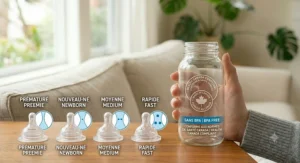
6. Lansinoh NaturalWave Anti-Colic Baby Bottle
Lansinoh is a brand more Canadian parents are discovering, and the NaturalWave bottle earns its place on this list specifically because of how thoughtfully it handles the breast-to-bottle transition. The NaturalWave nipple is engineered to encourage the same wave-like tongue movement that babies use at the breast — a detail that sounds technical but makes a real difference for exclusively breastfed babies who need a bottle for the occasional expressed milk feed.
The 5 oz / 150 mL version with slow flow nipple is an excellent newborn starter, and a notable practical advantage is that these bottles are compatible with Lansinoh’s breast pump collection — you can pump directly into the bottle and move it to the fridge or freezer without any transfer. For Canadian parents who are expressing milk regularly, eliminating that extra step reduces both hassle and the micro-waste of every transfer.
The anti-colic valve in the NaturalWave is a collar-based system similar to Tommee Tippee’s — effective for moderate air reduction without the complexity of a multi-part internal tube. Canadian reviewers have been particularly positive about how readily breastfed babies accept this bottle after being introduced to it, which is often the hardest part of the whole process.
✅ NaturalWave nipple supports natural tongue motion for breastfed babies
✅ Compatible with Lansinoh breast pumps — pump directly into bottle
✅ Honest budget-to-mid price range for Canadian families
❌ Anti-colic performance is moderate — not ideal for severe gas
❌ Less widely known than Dr. Brown’s or MAM, so harder to find replacement nipples locally
Price range: $20–$40 CAD. Available in multipacks on Amazon.ca. Check current pricing.
7. Dr. Brown’s Natural Flow Options+ Wide-Neck Glass Baby Bottle
If you’ve already decided you want to minimise plastic exposure for your baby and you’re willing to invest a bit more, the Dr. Brown’s glass version delivers the same gold-standard internal vent system as the original in a borosilicate glass body. Borosilicate glass is the same material used in quality kitchen cookware — it’s heat-resistant, thermal-shock resistant, and can safely go from the fridge to a warm water bath without stressing the material.
The wide-neck design is a practical upgrade over the narrow neck for parents who find funnelling formula powder into a narrow opening an exercise in frustration (which is most of us, at 3 a.m., in poor lighting). The wide-neck nipple is also slightly easier for breastfed babies to latch onto than the narrow format.
Yes, glass is heavier than plastic — approximately 20–30% more so — and that matters when a baby starts wanting to hold their own bottle. But for the first three to four months when you’re doing all the holding, the advantages of glass — chemical neutrality, odour resistance, and zero risk of plastic degradation over hundreds of dishwasher cycles — outweigh the weight difference. For eco-conscious Canadian families committed to reducing single-use plastics in the nursery, this is the premium choice that holds its value over multiple children.
✅ Borosilicate glass — no plastic leaching risk; extremely durable
✅ Same clinically proven internal vent system as plastic Options+
✅ Wide-neck design is easier to fill and clean
❌ Heavier than plastic — less ideal once baby self-feeds
❌ Premium price range — the highest on this list
Price range: $35–$65 CAD depending on pack size. Check current price on Amazon.ca.
Do Anti-Colic Bottles Really Work? The Honest Science
This is probably the question you actually Googled to get here — and you deserve a straight answer rather than marketing-speak.
The short answer: yes, for many babies, they work meaningfully. The longer answer: they work best for a specific type of problem.
When your baby feeds from a regular bottle, a vacuum builds inside as the milk level drops. To keep drinking, your baby has to suck harder, which frequently breaks the seal between their lips and the nipple. When that seal breaks, air rushes in — and your baby swallows it. That swallowed air becomes gas, which becomes discomfort, which becomes crying. Anti-colic vent systems interrupt this cycle by equalising the pressure inside the bottle continuously, so the nipple never collapses and your baby never needs to suck against a vacuum. Less air in means, for many babies, less gas out.
What the evidence actually shows is nuanced, though. A Cochrane Review has noted that existing clinical studies don’t provide uniformly strong evidence that anti-colic bottles reduce colic across all infants. The reason is that colic itself has multiple possible causes — not all of them related to air swallowing. According to the Canadian Paediatric Society, there is not strong scientific evidence that colic is caused exclusively by gas or food sensitivities; it may be related to an immature nervous system or simply normal developmental crying patterns. Meanwhile, HealthLink BC notes that colic typically peaks at 6 to 8 weeks and resolves on its own between 8 and 14 weeks regardless of intervention.
So the practical takeaway is this: if your baby’s fussiness is primarily linked to swallowing air during feeds — you’ll often see them squirming, pulling off the bottle mid-feed, or seeming uncomfortable specifically during and right after eating — an anti-colic bottle is absolutely worth trying. If the crying is more random and not obviously feed-related, a bottle alone may not solve it, and a conversation with your paediatrician or your provincial health line (811 in most Canadian provinces) is a smart next step.
The bottles with the strongest evidence base are those with internal tube vent systems (Dr. Brown’s Options+) and angled AirFree vents (Philips Avent), both of which have been the subject of independent clinical evaluations.
How to Choose the Best Anti-Colic Bottles in Canada: A 6-Step Framework
Step 1: Identify Your Baby’s Primary Problem
Is it gas, spit-up, reflux, or nipple confusion from switching between breast and bottle? Each issue points toward different bottle features. Gas → internal vent system (Dr. Brown’s). Spit-up/reflux → upright feeding design (Philips AirFree). Nipple refusal → soft silicone body (Comotomo, MAM).
Step 2: Consider Your Cleaning Capacity Honestly
This is the step most first-time parents skip, and it matters enormously. A bottle with five small parts may be clinically superior, but if you know you’ll skimp on cleaning it at midnight, a simpler two-part bottle that you actually clean properly will serve your baby better. Be realistic.
Step 3: Match the Nipple Flow Rate to Your Baby’s Age
The anti-colic vent system only works as intended when paired with the correct nipple flow. A fast-flow nipple on a newborn overwhelms them into gulping — swallowing air regardless of the vent. Stick with Level 1 / Slow Flow for 0–3 months, then follow your baby’s cues.
Step 4: Account for Canadian Winter Realities
If you’ll be warming bottles from a cold car, a cold diaper bag, or a frigid garage refrigerator during a Canadian winter, borosilicate glass (Dr. Brown’s glass, Philips Avent glass) handles thermal cycling better than standard plastic, which can micro-stress over repeated cold-to-warm transitions.
Step 5: Check Amazon.ca Prime Eligibility
Most of the bottles on this list are Prime-eligible, meaning free two-day shipping across most of Canada for Prime members. For parents in more remote areas of British Columbia, northern Ontario, or the Prairie provinces, Prime shipping is often the practical difference between receiving a bottle in two days or two weeks.
Step 6: Buy One Before a Multipack
Resist the temptation to stock up on a 6-pack of any bottle before you know your baby will accept it. Start with a 2-pack, test it for three to four days, then commit. The most expensive bottle is the one your baby refuses — and at $40–$60+ CAD per multipack, trial and error with full sets adds up quickly.
Real-World Canadian Parent Scenarios: Which Bottle Fits Your Life?
The New Parent in a Toronto Condo
You have limited counter space, a small dish rack, and exactly zero desire to store a $45 CAD sterilising unit. The MAM Easy Start is your bottle: self-sterilising in the microwave in three minutes, semi-wide neck for easy hand washing, and an effective vented base that reduces gas without demanding a six-part cleaning ritual. The SkinSoft nipple also works well for babies who are occasionally breastfed when you’re home.
The Exclusively Pumping Parent in Suburban Calgary
Your whole feeding routine revolves around the pump. You need a bottle that accepts pumped milk directly and reduces the number of transfers. The Lansinoh NaturalWave is a natural fit — it’s compatible with Lansinoh’s own breast pump range, and the NaturalWave nipple’s design means your baby gets a feeding motion closest to the breast even when you’re not there. At a mid-range price in CAD, it’s also easy to build a full set without stretching the budget.
The Family Managing Severe Reflux in Halifax
Your paediatrician has flagged reflux as a concern, and every feed ends with a spit-up episode that requires a full outfit change. This is exactly the scenario for the Philips Avent Anti-Colic with AirFree Vent — the bottle is designed specifically to be held at an upright or tilted angle, keeping the nipple full of milk and reducing the amount of air that enters. Paired with a paced feeding technique (pausing every few sucks to let the baby control the pace), this combination is one of the most effective non-medical interventions for mild-to-moderate reflux.
The Parent of Twins in Vancouver Focused on Efficiency
When you’re managing two newborns simultaneously, cleaning time is currency. The Comotomo makes an excellent choice: wide-neck bottles that a standard brush cleans in seconds, soft silicone bodies that babies almost universally accept, and no internal parts to lose or forget in the bottom of the bottle bag. Yes, the per-bottle cost is higher, but when you’re washing 12+ bottles per day, the time saved on cleaning is genuinely worth the CAD investment.

Dr. Brown’s vs. MAM Anti-Colic Bottles: A Deep Comparison
This is one of the most searched comparisons in Canadian parenting forums — and for good reason. These are the two most distinctive anti-colic designs on the market, and they take fundamentally different engineering approaches.
The vent system philosophy is where they diverge most sharply. Dr. Brown’s routes air from the nipple collar down through an internal tube to the back of the bottle, completely separating air from milk. The result is a truly bubble-free feed — clinical studies have confirmed this system reduces colic, spit-up, and burping. MAM draws air through perforations in the base as milk is consumed, which is less aggressive but also simpler and less prone to the leakage issues that Dr. Brown’s can occasionally present when the vent isn’t seated correctly.
Cleaning is where MAM wins decisively. The self-sterilising base is a genuine quality-of-life advantage, particularly for Canadian parents who travel (the self-sterilise feature works in any microwave, including hotel microwaves), while Dr. Brown’s requires a dedicated vent brush and careful tube washing that takes significantly longer per bottle.
Nipple design is a closer call. Dr. Brown’s elongated nipple is closer in shape to a natural breast nipple; MAM’s SkinSoft nipple mimics the feel of skin more accurately than it replicates the shape. Babies with strong latch preferences sometimes favour one over the other unpredictably.
Cost of ownership over 12 months: Both are broadly comparable in total CAD spend. Dr. Brown’s replacement vent inserts add roughly $5–$10 CAD over six months of regular use. MAM’s slightly higher per-bottle price is offset by savings on a separate steriliser ($15–$30 CAD).
Bottom line: Choose Dr. Brown’s if your baby has significant gas or reflux and you want the strongest anti-colic performance available. Choose MAM if you prioritise ease of cleaning, travel convenience, or you’re a combo-feeder who needs a nipple that’s as breast-like as possible in tactile feel.
| Feature | Dr. Brown’s Options+ | MAM Easy Start |
|---|---|---|
| Vent type | Internal tube (top-vent) | Perforated base (bottom-vent) |
| Cleaning | Multi-part — moderate effort | Self-sterilising — easiest on list |
| Leakage risk | Low-moderate (if vent misaligned) | Low (at normal feeding angles) |
| Nipple shape | Elongated, breast-like | Wide, soft SkinSoft silicone |
| Best for | Severe gas, reflux | Ease of use, travel |
| Price range (CAD) | $20–$45 | $20–$40 |
This comparison highlights that neither bottle is objectively superior — the right choice depends entirely on your baby’s specific needs and your practical daily constraints. For severe gas and reflux, Dr. Brown’s vent engineering is hard to beat. For parents prioritising simplicity, MAM’s design removes nearly all friction from the bottle-feeding routine.
Common Mistakes Canadian Parents Make When Buying Anti-Colic Bottles
Buying a full set before testing one bottle. It bears repeating: spend $15–$20 CAD on a single bottle or two-pack before committing to a six-pack. Baby bottle acceptance is sometimes completely irrational, and the “best-reviewed” bottle might be rejected in favour of something else entirely.
Ignoring nipple flow rate. A slow-flow nipple on a hungry, fast-sucking 4-month-old will cause frustration and gulping — creating the very problem you’re trying to prevent. Check the manufacturer’s recommended flow rate by age and upgrade when your baby starts showing signs of feeding frustration (pulling off frequently, chewing the nipple, taking very long to finish a feed).
Assuming the bottle does all the work. Anti-colic bottles work best when paired with paced bottle feeding — holding the bottle horizontal rather than tilted steeply, taking regular pauses, and keeping feeding sessions calm and unhurried. The bottle is one half of the equation.
Skipping cleaning parts in a multi-component bottle. The internal tube in Dr. Brown’s bottles is the most important part to clean thoroughly. Any milk residue left in the tube can harbour bacteria and also diminish the vent’s effectiveness. Use the dedicated vent brush Dr. Brown’s includes in the box.
Not checking Health Canada guidance first. If your baby’s crying seems severe, unresponsive to feeding adjustments, or accompanied by vomiting, poor weight gain, or blood in stool, the right first step is calling 811 (HealthLink BC) or your provincial health line — not purchasing a new bottle. Anti-colic bottles address air swallowing; they cannot address underlying medical conditions.
Ignoring the bilingual labelling requirement. Under Canadian federal law, baby products must carry bilingual (English and French) packaging and instructions. All of the bottles on this list comply with this requirement on Amazon.ca, but if you’re purchasing from a cross-border US seller, verify that the packaging version shipped to Canada meets this standard.
Long-Term Value & Maintenance: What Anti-Colic Bottles Actually Cost in Canada
It’s easy to look at a per-bottle price and make a decision, but the real cost of bottle feeding in Canada runs deeper than the sticker. Here’s how the economics actually break down over a full first year.
Replacement nipples are the ongoing expense every parent forgets to factor in. Most manufacturers recommend replacing silicone nipples every 2–3 months, or sooner if you notice thinning, stickiness, or any cracks. At $8–$15 CAD per 2-pack replacement set, budget roughly $40–$60 CAD annually per nipple size — not negligible when you’re also managing formula costs, which can run $150–$250 CAD per month in Canada.
Replacement vents (Dr. Brown’s specific): The internal vent tube and reservoir should be replaced every 2–3 months as well. At approximately $5–$10 CAD per set of vent replacements, this adds a modest but real ongoing cost that tube-vent bottle users should account for.
Steriliser savings with MAM: If you would otherwise buy a dedicated steriliser (commonly $30–$60 CAD at Canadian retailers), the MAM’s self-sterilising feature effectively pays for the slight per-bottle premium within the first month.
Glass vs. plastic over multiple children: If you plan to have more than one child, the Dr. Brown’s glass bottle is a worthwhile investment. Borosilicate glass doesn’t degrade over washing cycles the way plastic can, and there’s no risk of micro-scratches harbouring bacteria after years of use. The higher upfront cost ($35–$65 CAD per 2–3 pack) is spread across two or more children, making the per-use cost genuinely competitive.
The “rejection tax”: The single biggest waste of money in bottle feeding is buying an 8-pack of bottles your baby won’t use. Starting with 2-packs of 2–3 different brands costs more per bottle but saves you significantly if you end up with a picky feeder.

FAQ: Best Anti-Colic Bottles in Canada
❓ Do anti-colic bottles really work for gassy babies in Canada?
❓ Are Dr. Brown's or MAM anti-colic bottles better for newborns?
❓ What is the best anti-colic bottle for breastfed babies in Canada?
❓ Are anti-colic bottles covered under any Canadian health plans or benefits?
❓ How long does shipping take for baby bottles to northern or remote areas of Canada?
Conclusion: Finding the Best Anti-Colic Bottles for Your Baby in Canada
There’s no single “best” bottle for every baby — but there is a best bottle for your baby, and this guide has given you the framework to find it.
For parents navigating severe gas or reflux, the Dr. Brown’s Natural Flow Options+ remains the gold standard. Its internal vent system has the strongest clinical track record of any bottle on this list, and the Options+ design means it grows with your baby without requiring a complete switch.
For parents who need simplicity above all — whether you’re in a small urban apartment or managing multiple kids — the MAM Easy Start delivers impressive anti-colic performance with a cleaning routine that won’t feel like a second job.
For combo-feeders or parents whose breastfed baby is resistant to bottles, Comotomo is worth every cent of its slightly higher price tag. The soft silicone body changes the entire dynamic of bottle introduction.
Remember: anti-colic bottles work best as part of a broader feeding approach. Paced feeding, appropriate nipple flow rate, regular burping, and prompt attention to any signs of medical concern (poor weight gain, projectile vomiting, blood in stool) are all equally important. If your baby’s crying doesn’t improve, reach out to your paediatrician or contact HealthLink BC at 811 — Canada’s health advice line available in all provinces.
All seven bottles reviewed here are available on Amazon.ca with Prime-eligible shipping across most of Canada. Click any highlighted product name to check current pricing and availability.
✨ Don’t Miss These Exclusive Deals!
🔍 Ready to give your baby a more comfortable feed? Click on any highlighted product above to check current pricing and availability on Amazon.ca. Prime members get fast, free shipping across most of Canada — making it easier than ever to try a new bottle before committing to a full set. Your baby (and your sleep schedule) will thank you! 🇨🇦
Recommended for You
- 7 Best Baby Bottles Canada 2026: BPA-Free & Anti-Colic Picks
- Best Nursery Furniture Set Under $1000 Canada 2026 (Top 7 Picks)
- Best Modern Nursery Furniture in Canada 2026: 7 Top Picks
Disclaimer: This article contains affiliate links. As an Amazon Associate, I earn from qualifying purchases. If you purchase products through these links, we may earn a small commission at no additional cost to you.
✨ Found this helpful? Share it with your friends! 💬🤗
